

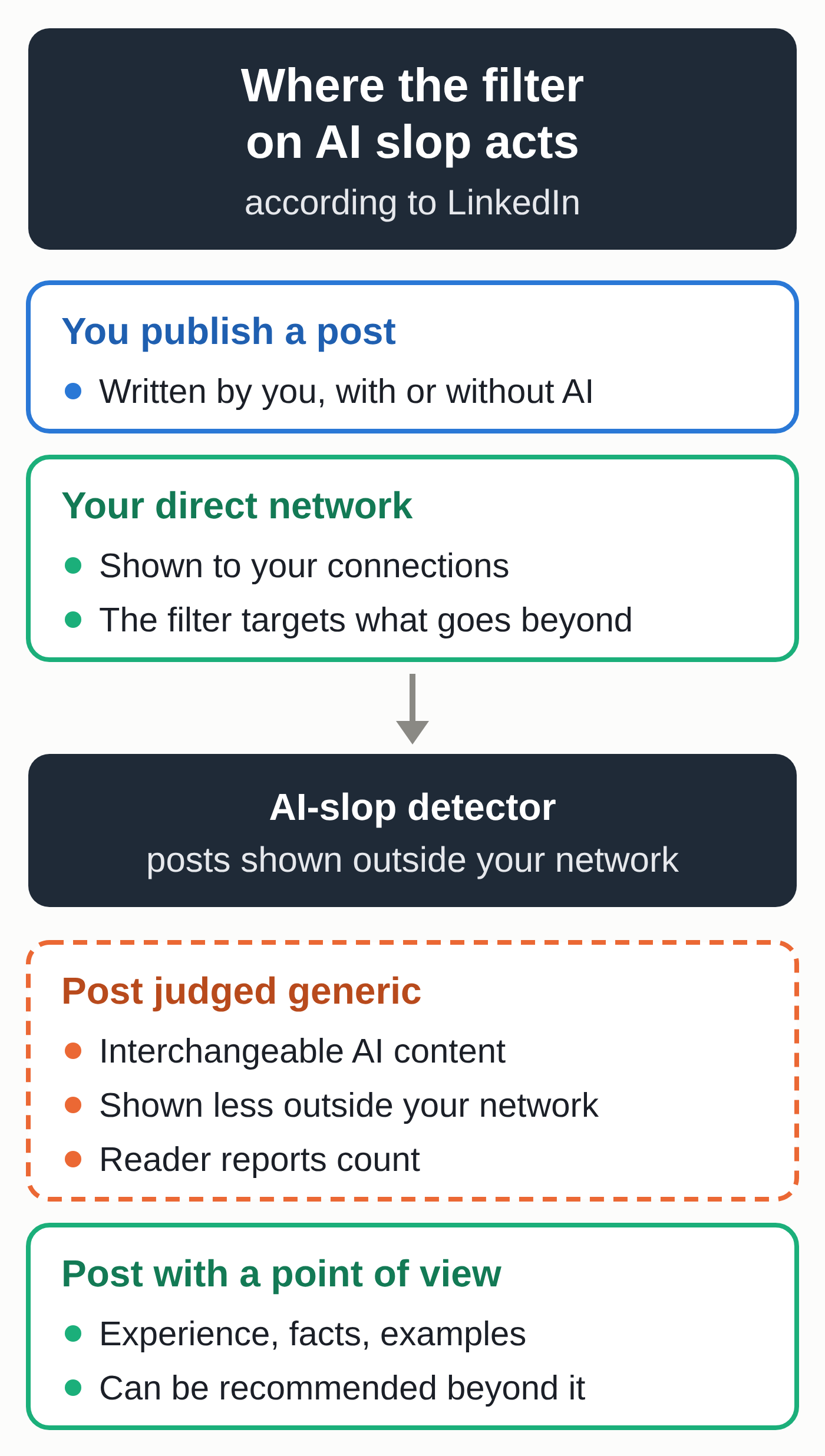
On October 8, 2026, LinkedIn said its “AI slop” detector now checks every post that is distributed beyond the author’s immediate network. AI slop is the common term for generic, repetitive AI-generated content with no point of view of its own. According to LinkedIn, a post like that is less likely to be widely distributed outside that network. If you draft your posts with ChatGPT or Claude and they read like everyone else’s, your reach with people who don’t know you yet is on the line.
What LinkedIn announced on October 8
Tim Jurka, LinkedIn’s vice president of engineering according to Social Media Today, published an article on the platform that day. He wrote that LinkedIn had recently expanded its classifiers to cover all posts distributed beyond the author’s immediate network. He put their precision at 94% for detecting AI slop, on a network of 1.4 billion members.
The system has two parts. Large language models spot new kinds of generic content and generate examples. Those examples train smaller, faster models that can review a large volume of posts.
The other part is a set of agents, each guided by a “policy” that defines its evaluation criteria. Jurka’s examples include whether a post is promotional, celebrates an achievement, or is timely, though he doesn’t say these criteria count against a post. When an agent hits a complicated case, it can send it to human reviewers, whose feedback helps refine those policies.
How we got here
On May 20, 2026, Laura Lorenzetti, executive editor of LinkedIn’s editorial team, laid out the definition: low-effort AI-generated content that may look polished but has no real perspective or substance. She said a post that appears to be AI-generated and lacks a clear point of view is less likely to be widely distributed beyond the author’s network. LinkedIn’s initial testing correctly identified generic content 94% of the time. Comments were in scope too, whether they were posted at scale with automation tools or simply restated the original post.
On July 30, Hari Srinivasan, LinkedIn’s chief product officer according to TechCrunch, said in a post that LinkedIn was gradually rolling out a “Seems like AI slop” button. The button sits in the three-dot menu on every post and comment. The same post announced that LinkedIn was removing its “Enhance your post” AI writing tool and replacing it with a proofreader that checks your text without changing your voice.
On August 19, Srinivasan said more than a million people had used the button since it launched two weeks earlier. He added that when a post gets enough community feedback, its author may see a message in the post’s analytics. No single report decides how a post is distributed, he wrote. By his account, members were seeing 40% fewer views of content LinkedIn classifies as AI slop than a few weeks earlier.
What this means for a freelancer or a small business
Your direct connections are only part of your audience on LinkedIn. A prospect, a recruiter, or a partner who doesn’t know you yet finds your posts when LinkedIn recommends them. That kind of distribution now goes through the filter.
LinkedIn accepts AI as a writing aid. The rule it laid out in May comes down to one line: your posts and comments need to represent your own voice and perspective, the same principle that underpins the foundations of a personal brand. As we read it, the target is interchangeable text, the kind a competitor could have posted word for word.
In our view, three habits common at small businesses are now risky: posting generic tips written in a minute, several times a week; reusing the same post template for every announcement; and handing your comments to a tool that writes and posts them for you. LinkedIn’s User Agreement already prohibits that last one: it bans using bots or other unauthorized automated methods to comment on posts.
Six things to do now
- Open the analytics for your recent posts. If LinkedIn tells you that readers see your content as AI-written, treat it as feedback on how you write: Srinivasan says that is what the message is meant to be.
- Compare impressions on your recent posts with those on posts about similar topics that you published before late July. LinkedIn started rolling out its new classifiers in late July. It gives no exact date for the expansion announced in October, saying only that it is recent. A sharp drop on posts written almost entirely by AI is a signal worth taking seriously.
- Start from your own material before you open ChatGPT or Claude. Write down the fact that makes the post useful: a number from your business, a question a customer asked, a mistake you fixed, a date. The tool can then structure and proofread it.
- Read the post out loud and cut anything that could have come from anyone. Blog du Modérateur, a French tech publication, describes a “slick” style of punchy hooks, line breaks, and a moral at the end that took hold on LinkedIn even before ChatGPT arrived. The more repetitive a style is, the more easily language models reproduce it, the same article notes.
- Write your comments yourself. A comment that repeats the post without adding anything is one of the targets LinkedIn named back in May.
- Post less often if that is what it takes to say something solid. In our view, one post a week with an example from your own business beats three generic ones, for your reputation and for distribution.
Limits and open questions
The 94% figure announced in October is a precision rate measured by LinkedIn itself. Taken at face value, it means about 6 of every 100 posts classified as AI slop would not actually be slop. The 40% figure also comes from LinkedIn, and Srinivasan says he hesitates to share numbers because everyone has a different network and feed.
LinkedIn does not say how much AI slop gets past the filter, and none of the LinkedIn posts cited here describes an appeal process for an author whose post is misclassified. Its announcements refer to “all posts” without saying whether company pages are treated the same way as personal profiles.
In our view, a formal style, AI-assisted translation, or simple proofreading can also make a text sound like AI, to a reader as well as to a detector. Srinivasan himself writes that he is increasingly careful not to “sound like AI.”
The scale of the problem is hard to measure from the outside. A study published in July by Pangram, a startup that develops a detector for AI-written text, found that nearly 41% of long-form posts on LinkedIn were fully AI-generated, Blog du Modérateur reports. The posts were collected from volunteer users of Pangram’s Chrome extension.
What to watch next
Jurka says LinkedIn will add more ways to report AI slop. The other thing to watch is the analytics message rolled out in August: when a post gets enough community feedback, that message is how you will learn how readers see it.
Other platforms are moving the same way. On October 1, the YouTube team announced on its help forum that it is adjusting Shorts recommendations to reduce the reach of videos re-uploaded from other creators without adding anything of their own. YouTube’s spam policies target reposted content that lacks a personal contribution, such as original commentary, educational value, or unique editing. For Google Search, we’ve covered what exposes a site to penalties for fake authors and unreviewed AI content.
In our view, a social media presence built on your expertise and your conversations with your community holds up better against these filters than a calendar full of generic posts. If you’d like to build one with us, see our organic marketing services.