
By December, Barclays expects to have cut about 5,000 full-time jobs, roughly one for every 20 people it employs. About 1,000 of those roles went in the first half of 2026. The other 4,000 are due to go before the end of the year, subject to consultation with staff.
The British bank put the number on page 10 of its third-quarter results presentation on October 22, 2026, next to a line that reads “Organisational simplification and technology change efficiency driven by AI.” Of the cuts from actions taken in the second half, about six in ten fall in support functions, “including developers.” Pre-tax profit for the quarter rose 12% from a year earlier to £2.3 billion ($3.1 billion), CNBC reported.
Barclays’ plan is the largest of the four AI-linked job cuts announced in October 2026 on a list Reuters keeps. It came 16 days after Norway’s DNB said AI agents already bring efficiency gains to its customer checks and its coding.
Page 10 of the results deck
Barclays calls its restructuring “structural cost actions.” The slide lists what they are meant to deliver: about 5,000 fewer full-time employees and, in 2027, gross efficiency savings of more than £1.1 billion and a cost-to-income ratio in the “high-40s%” for Barclays UK, the retail bank. A footnote describes the job figure as the “expected reduction in full-time employees” from actions taken in 2026, “subject to collective and individual consultation as required.”
The actions cost money up front. Barclays spent £307 million on them in the first nine months of 2026 and expects about £300 million more by December. That brings the total above £600 million, roughly double its earlier estimate, Banking Dive reported.
The group employed about 93,000 people at the end of 2025, according to PA Media. Most of the cost cutting is in the UK retail bank, with a smaller share in the investment bank.
Simplification first, AI second
Management did not pin all of it on AI. “The changes that we’re making in the third and fourth quarters of this year are sizable,” chief financial officer Anna Cross told analysts. “They relate both to the simplification of the organization and to some of the impacts that we’re starting to see from AI.”
Chief executive C.S. Venkatakrishnan traced the cuts to years of technology spending, which he described as “modernising our platforms and harmonising our systems and having simpler and better processes.” That work, he said, “is driving the bulk of the efficiency gains that you’ve seen so far.” According to PA, AI has made some work processes more efficient, so the bank can employ fewer people in roles such as developers. “AI is the icing on the cake, not the cake,” Venkatakrishnan said, a line he has used before.
In May, Standard Chartered’s chief executive Bill Winters spoke of replacing “lower-value human capital” with investment, then apologized in a memo the next day. Venkatakrishnan took a different line with Bloomberg at the time: “a job is much more than a collection of tasks.”
Coding and customer checks at DNB
On October 6, DNB announced it would cut about 400 full-time equivalents in its Technology & Services unit. In its notice to the Oslo stock exchange, the bank said it has adopted agentic AI in several parts of its operations and that “this technology replaces tasks that were previously handled manually.”
DNB named the areas where it is already seeing that AI agents can bring “substantial efficiency gains”: checks on customer data, the Know Your Customer process that banks run on their clients, and “technology development and coding.” Chief executive Kjerstin Braathen described the move as “adapting our organisation to a new reality.” The reduction is due to be completed in the fourth quarter.
Seven banks on Reuters’ list
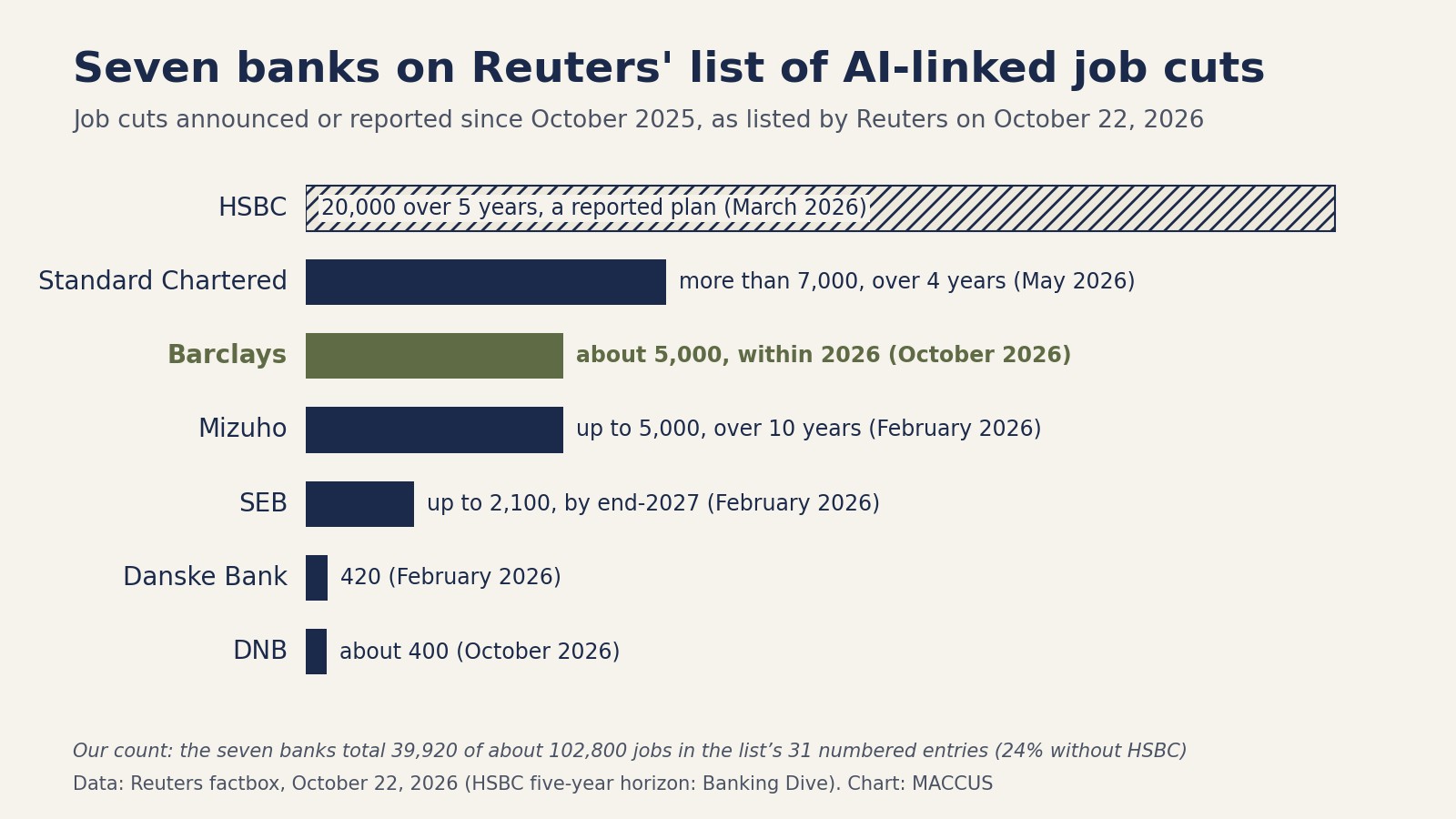
The day Barclays reported, Reuters updated a factbox of AI-linked layoffs announced or reported since October 2025. It has 31 entries that give a number of jobs, and seven of them are banks: HSBC, Standard Chartered, Barclays, Mizuho, SEB, Danske Bank and DNB. The chart at the top of this page shows their figures.
Reuters does not publish a total. By our count, the 31 numbered entries add up to about 102,800 jobs and the seven banks to 39,920, close to four in ten. Reuters and Banking Dive both list HSBC’s 20,000 as a plan the bank was reported in March to be weighing. Without it, banks still account for about a quarter of the rest.
The timelines vary widely. Barclays’ cuts fall within 2026, while Mizuho’s run over ten years and Standard Chartered’s over four. The largest entry outside banking is Amazon, with 16,000 corporate jobs in January. The other October entries are the grocery chain Kroger, with about 3,000 corporate jobs, and the credit-scoring company FICO, with about 570.
Where the numbers stop
The 5,000 is an expected figure for the full year. It includes the 1,000 roles cut in the first half and is still subject to consultation. The six-in-ten share covers only actions taken in the second half. Barclays has not said how many of the jobs AI itself made unnecessary, and its chief executive credits older platform work with most of the savings so far.
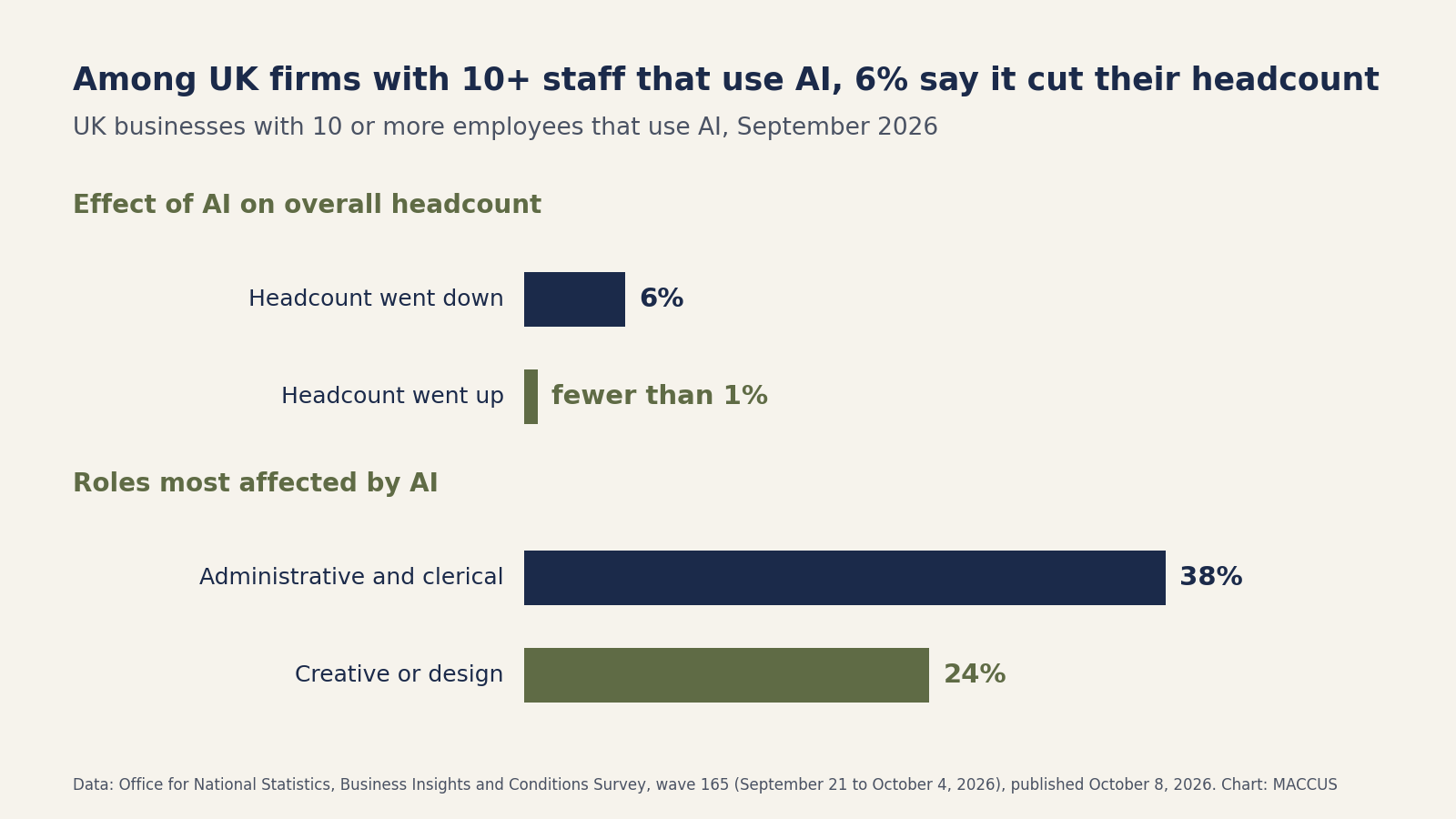
Across the UK economy, AI-linked headcount cuts are still the exception. The Office for National Statistics put the question to businesses in a survey that ran from September 21 to October 4. Among companies with 10 or more employees that use AI, 6% said their headcount had gone down as a result and fewer than 1% said it had gone up. The ONS says those shares “have remained broadly stable over the last year.”
About 30% of all UK businesses now use at least one AI technology, the same survey found. Among AI users with 10 or more employees, 38% named administrative and clerical roles as the most affected, up 9 points since December 2025.
What it means
On October 22, the day of Barclays’ results, Goldman Sachs economist Joseph Briggs wrote in a note reported by Fortune that “automation-related labor disruption is limited when the overall economy is healthy but accelerates during cyclical slowdowns.” Under Goldman’s forecast that AI lifts productivity by 15%, he estimates that up to 9% of workers could be “displaced during the AI transition,” a displacement he describes as temporary, and that AI-related layoffs “should provide a good real-time guide.” Barclays is cutting about 5% of its staff in a quarter when its pre-tax profit rose 12%, with no downturn forcing its hand. That suggests efficiency gains, from AI and from older platform work, are now large enough to shrink a big employer’s headcount in good times.
The jobs most exposed sit in support functions and in software: Barclays and DNB both named coding work, and the ONS puts clerical roles first. Briggs studied 25 occupations that past technology cut back hard, bank tellers among them: on average, employment in those jobs fell 25% in the five years after the decline began, a figure he calls a likely upper bound for AI. Hiring figures and commit counts point the same way: Anthropic’s own data showed juniors falling from 27% to 9% of its technical hires, and one coding tool signed more than ten million public GitHub commits in September. Anthropic’s new public benefit fund, which could make direct distributions to specific groups of people, gives AI’s effect on jobs as its one example.
Briggs notes that only 23% of US establishments have built AI into their regular workflows, and in his view most of the productivity gains are still to come. The next readings will come from Barclays’ consultations through December, from HSBC if it confirms or drops the 20,000 it was reported to be weighing, and from the ONS question, whose 6% has been broadly stable for a year.
Sources
- Q3 2026 Results Presentation, Barclays, October 22, 2026
- Barclays to slash 5,000 jobs in AI efficiency push, CNBC, October 22, 2026
- Barclays to cut 5,000 employees this year, Banking Dive, October 22, 2026
- Barclays to cut 5,000 jobs this year as AI makes work more efficient, PA Media (Yahoo News UK), October 22, 2026
- DNB is making organisational changes in Technology & Services, DNB Bank ASA (Oslo Børs NewsWeb), October 6, 2026
- Factbox-Companies cutting jobs as investments shift toward AI, Reuters (via Euronext), October 22, 2026
- Business insights and impact on the UK economy: 8 October 2026, Office for National Statistics, October 8, 2026
- AI could displace one in 11 workers, Goldman says, but the layoffs are likely waiting for a recession, Fortune, October 22, 2026
Header image: chart by MACCUS, data from the Reuters factbox of October 22, 2026 and Banking Dive