
Torsten Slok, a partner and chief economist at US asset manager Apollo Global Management, says artificial intelligence has not paid off financially for American companies outside the tech sector. He made the case in the October 24, 2026, edition of The Daily Spark, his daily note, under the title “No Signs of AI Payoff Outside the Tech Sector.” The note opens: “Despite massive investments and widespread hype around artificial intelligence, the technology has delivered zero financial payoff to corporate America outside of tech.”
The note runs four short paragraphs and five charts. TechCrunch and Bloomberg picked it up the next day. On Hacker News, the forum run by startup accelerator Y Combinator, the link posted October 24 had drawn 590 points and 630 comments by early afternoon New York time on October 25.
On October 23, the day before the note, Jason Furman, who chaired the Council of Economic Advisers under Barack Obama, said he would pick AI over 20 staff economists if he ran the council today. Furman was describing what a tool can do; Slok was looking at the books of 493 large companies.
The ‘S&P 493’ versus the seven giants
Slok compares the “Magnificent 7” with what he calls the “S&P 493,” the other 493 companies in the S&P 500 index. By the usual definition, which TechCrunch uses, the seven are Alphabet, Amazon, Apple, Meta, Microsoft, Nvidia and Tesla.
The first chart tracks inflation-adjusted revenue per employee, in late-2019 dollars. For the seven giants, it stands at about $780,000 at the latest data point in 2026, up from about $700,000 in early 2019 and $565,000 at the early-2023 low, with a sharp jump in the last quarter shown. For the S&P 493, the line ends near $525,000, barely above the roughly $495,000 of early 2019. Apollo does not label the values; these figures are read off the chart.
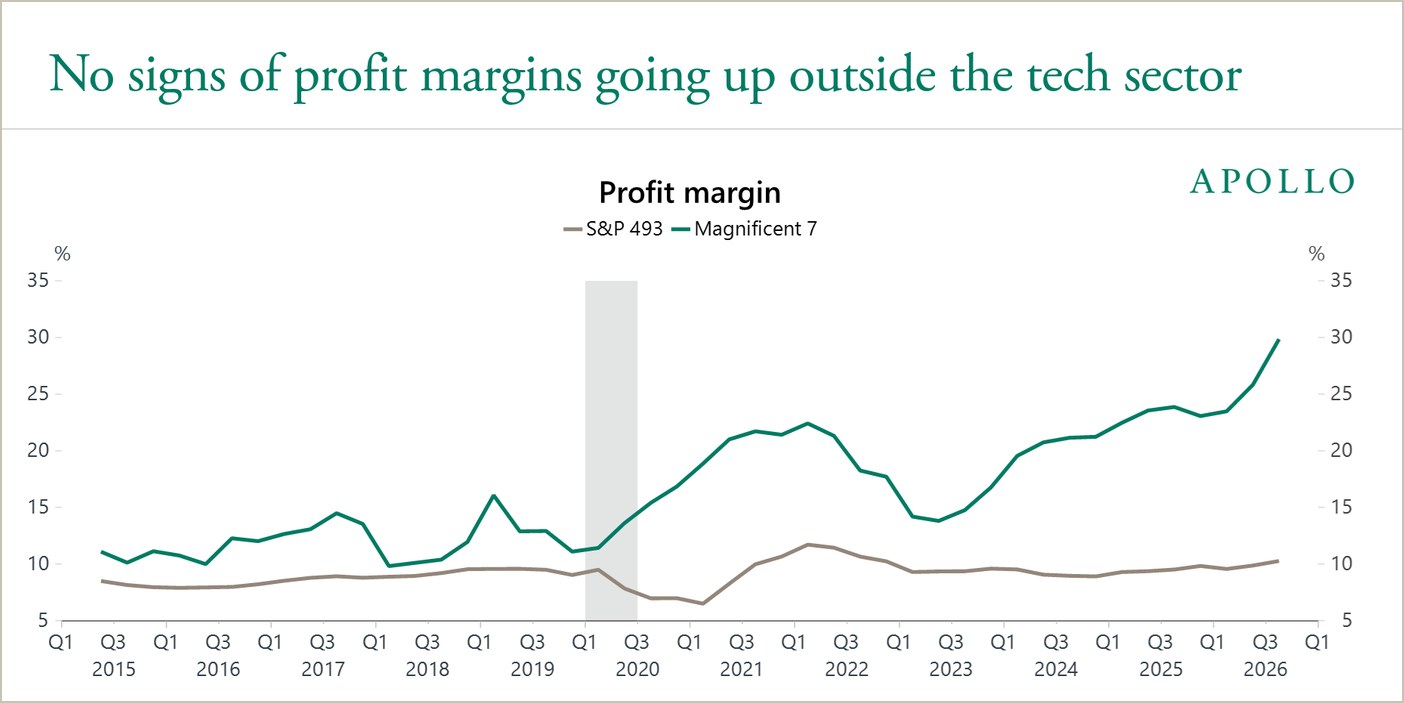
The second chart shows the seven giants’ profit margin approaching 30% at the latest data point, up from about 14% in mid-2023. The S&P 493’s margin has hovered between about 9% and 10% since 2023, below its early-2022 peak of about 11.7%. “Profit margins are rising for the Mag 7 but are flat for the S&P 493,” Slok writes.
No visible productivity boost
The third chart moves beyond large public companies to the US business sector as a whole. It plots annual growth since 1985 in two measures: total factor productivity (TFP), a San Francisco Fed series adjusted for cyclical swings in how intensively labor and capital are used, and output per hour worked, published by the Bureau of Labor Statistics.
TFP growth has fallen to about zero and is slightly negative at the latest data point (about -0.3%). Output per hour is still growing about 2.3% year over year. Neither line has broken out of the range it has held for 40 years, which is why the note says “there are still no signs of AI boosting productivity growth.”
AI spending is concentrated in a few companies
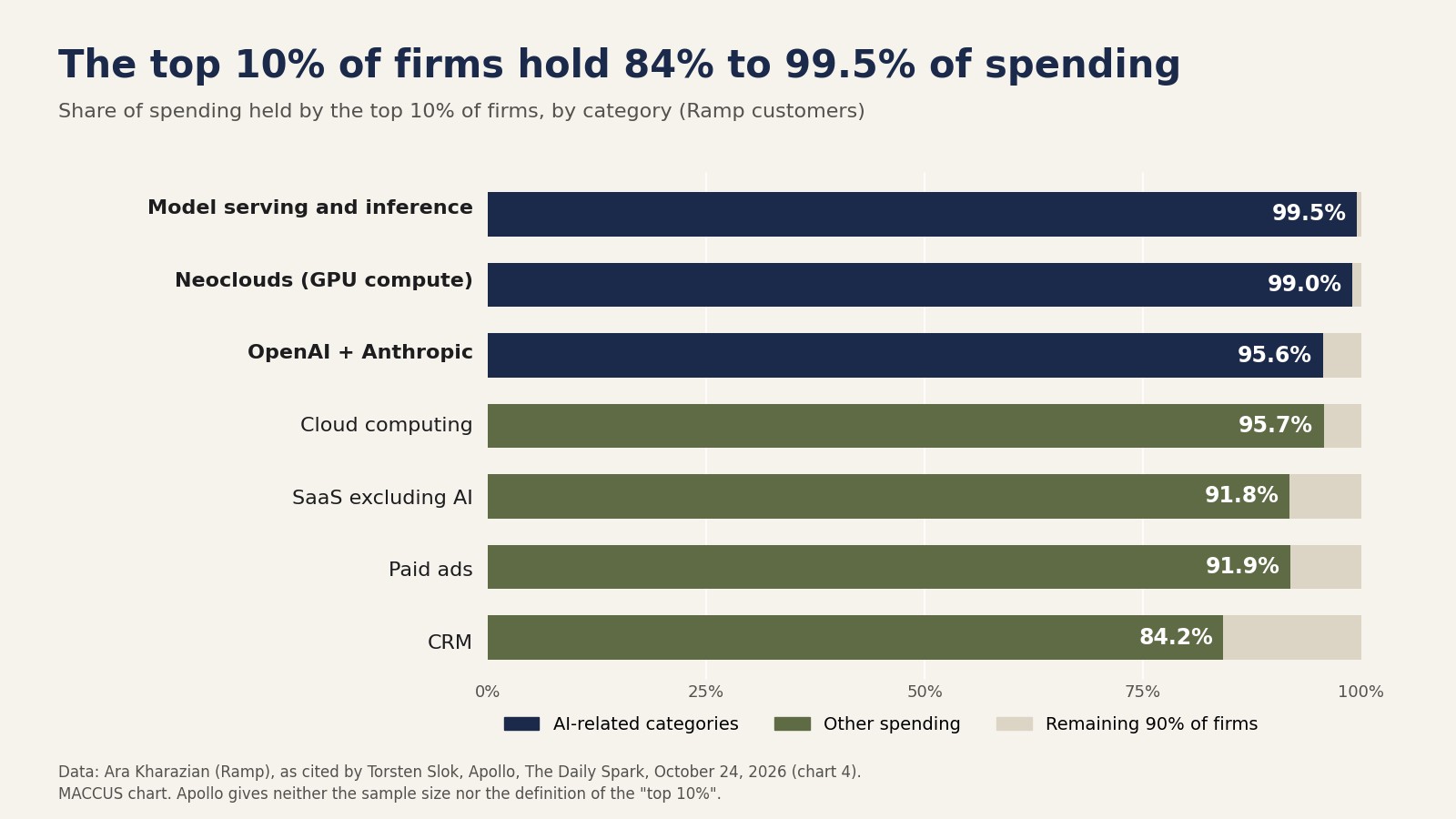
The last two charts use data from Ramp, a US company that sells corporate cards and spend-management software. The fourth cites Ramp economist Ara Kharazian, and the fifth cites the Ramp AI Index. Among Ramp’s customers, the top 10% of firms by spending account for 95.6% of spending on OpenAI and Anthropic and 99.5% of spending on model serving and inference.
The fifth chart, titled “Circularity in AI shows up in token spending too,” profiles those big buyers: among the top 1% of AI spenders, 80.4% are backed by venture capital, compared with 13.1% among median spenders. Ramp’s monthly index shows how wide the gap is. In September 2026, among Ramp customers paying for AI, the top 1% spent a median of $9,567.53 per employee per month on it, versus $15.70 for the median firm in that group.
Slok’s conclusion: “VC-backed companies are spending more and more on tokens, but mainstream corporate America does not need the latest model and is unwilling to pay for it.” As long as agentic AI and token spending stay confined to a small part of the economy, he adds, the macroeconomic effects of AI will be “very limited.”
Concentration shows up on the seller side, too. According to Anthropic’s draft IPO prospectus, as described by The Wall Street Journal, about 20% of the company’s revenue in the first half of 2026 came from two customers.
An argument Slok has made for months
Slok noted on June 8, in “Still Waiting for AI to Trickle Down,” that margins were rising for the seven giants and flat for the S&P 493. On August 9, he wrote that the AI capital spending boom “is so far only showing up in the sellers’ margins, not the buyers’.” The October 24 note repeats the point, sharpens it with the word “zero” and adds charts on productivity and spending.
TechCrunch and Brad DeLong weigh in
TechCrunch, which noted that Apollo once owned it, asked whether companies outside tech are simply lagging behind the tech giants. Slok “sounded skeptical,” the site wrote.
Brad DeLong, an economist and professor emeritus at the University of California, Berkeley, wrote about the note on his blog on October 24. He does not dispute what the charts show. In his view, AI’s biggest effects run through channels that shareholders struggle to capture: user surplus, which he thinks is massive; new businesses entering the market; and incumbent platforms locking in their customers more tightly. That last channel, he writes, helps a few firms rather than the S&P 493.
Where the note stops
Slok’s note is an economist’s commentary built around five charts. It was not peer-reviewed and does not draw on a survey of companies. Apollo’s disclosures say the views expressed “do not necessarily reflect the views and opinions of Apollo.” None of the data covers Europe.
Flat averages do not prove that AI pays nothing. They are consistent with zero gains, and just as consistent with gains that are small, delayed, concentrated in a few companies or offset by other costs. “Zero financial payoff” is Slok’s phrase; the note does not isolate the effect of AI itself.
One sentence in the note goes beyond its charts: “mainstream corporate America is pulling back and starting to view token spending not as a source of growth but as a cost center that weighs on margins.” No chart measures that pullback.
Ramp’s own figures, which cover its customers rather than the S&P 493, point the other way. In September 2026, 55.9% of US businesses on Ramp paid for AI, up 12.1 percentage points from a year earlier; among large businesses, the share was 65.7%, up 0.5 percentage point from August. AI’s share of their spending excluding payroll did slip over the month, from 5.96% to 5.77%.
The fourth chart also shows the top 10% of firms by spending accounting for 91.9% of spending on paid ads and 84.2% on customer relationship management (CRM) software. Some of that concentration likely reflects company size, which the note does not address. Apollo does not give the sample size or its definition of the “top 10%.”
What it means
By writing “zero,” Apollo’s chief economist gives a one-word answer to a question that investors and the companies buying AI keep asking: is it paying off? His charts show a clear split between seven tech giants and the rest of the S&P 500. They do not show why.
Outside tech, and beyond the scope of the note, AI has so far shown up mostly in cost-cutting plans. In the UK, Barclays is cutting 5,000 jobs and cites AI among the reasons; the bank is targeting more than £1.1 billion in gross savings in 2027.
Tokens are getting cheaper. According to Ramp, among customers that track their usage with its tool, the average price of a million OpenAI and Anthropic tokens fell from $0.86 to $0.64 in four weeks, a blended figure that also reflects a shift toward cheaper models. Models such as MiniMax M3.1 Flash, launched October 19 at $0.15 per million input tokens, are pushing prices down.
Slok himself raises the question of whether “mainstream corporate America can turn increasingly cheap intelligence into higher revenue growth and higher profit margins.” “That may be harder than it sounds,” he writes, adding: “AI may be a great calculator, but in business, intelligence is mostly judgment.” In his view, AI does not understand accountability, trust, culture or unwritten rules. That is an opinion his charts do not directly support.
Third-quarter earnings, now being reported, and results for the following quarters will show whether the S&P 493’s margin starts to rise from around 10%. Ramp’s October index should reveal whether adoption keeps climbing or the pullback Slok describes starts to appear in spending.
Sources
- No Signs of AI Payoff Outside the Tech Sector, Torsten Slok, Apollo (The Daily Spark), October 24, 2026
- The Buyers of AI Are Still Waiting for the Payoff, Torsten Slok, Apollo (The Daily Spark), August 9, 2026
- Still Waiting for AI to Trickle Down, Torsten Slok, Apollo (The Daily Spark), June 8, 2026
- Ramp AI Index, Ramp Economics Lab, September 2026 data, accessed October 25, 2026
- AI delivers ‘zero financial payoff’ to most companies, Apollo economist says, Anthony Ha, TechCrunch, October 25, 2026
- Torsten Slok Beats the AI-Bear Drum, Brad DeLong, DeLong’s Grasping Reality, October 24, 2026
- No signs of AI payoff outside the tech sector, Hacker News discussion, October 24, 2026
Header image: MACCUS chart. Data: Ara Kharazian (Ramp), as cited by Apollo, The Daily Spark, October 24, 2026