For every three new gasoline or diesel cars registered in the European Union in September, there were about four new battery-electric cars. The European Automobile Manufacturers’ Association (ACEA), which compiles national registration data, reported on October 22 that 290,117 new battery-electric cars were registered across the 27 EU countries, up 72.9% from September 2025. Gasoline and diesel cars together came to 219,121.
A year earlier the ratio ran the other way: 291,953 gasoline and diesel cars against 167,776 battery-electric ones, or 1.7 for every electric car. Battery-electric cars took 29.9% of the September market, up from 18.9%, while the combined share of gasoline and diesel fell from 32.9% to 22.6%, according to ACEA’s September release.
The comparison has two limits. Hybrids, which also burn gasoline, remain the largest group: counting hybrids and plug-in hybrids, cars with a gasoline or diesel engine still made up about two-thirds of the September market. And over the first nine months of 2026, gasoline and diesel cars combined lead battery-electric cars, with 28.2% of registrations against 22.7%.
A normal-sized month, and a wider gap
September was the second month in a row in which battery-electric cars outnumbered gasoline and diesel cars combined. In August, the EU registered 196,486 battery-electric cars against 179,219 gasoline and diesel cars, according to ACEA’s August figures, published on September 24. But August is a slow month for car sales, with 708,211 registrations in total. September’s market, at 971,048 cars, was 37% larger, and the electric lead grew from about 17,000 cars to about 71,000.
Gasoline registrations fell 23.4% to 168,564 and diesel fell 29.6% to 50,557, while the overall EU market grew 9.3%. In China, by contrast, plug-in cars set a record share in September because sales of gasoline-only cars fell 49% in a market that shrank by 28%.
So far this year, battery-electric cars, with 1,931,465 registrations and 22.7% of the market, have passed gasoline cars alone (21.2%) and rank second behind hybrids (36.3%). ACEA describes a market that held up “despite a challenging macroeconomic environment marked by persistently rising energy prices and geopolitical headwinds,” with demand for electrified cars “supported by buyer support measures and a broader model offering.” ACEA also notes that this year’s figures are provisional and may be revised.
Where the electric cars were bought
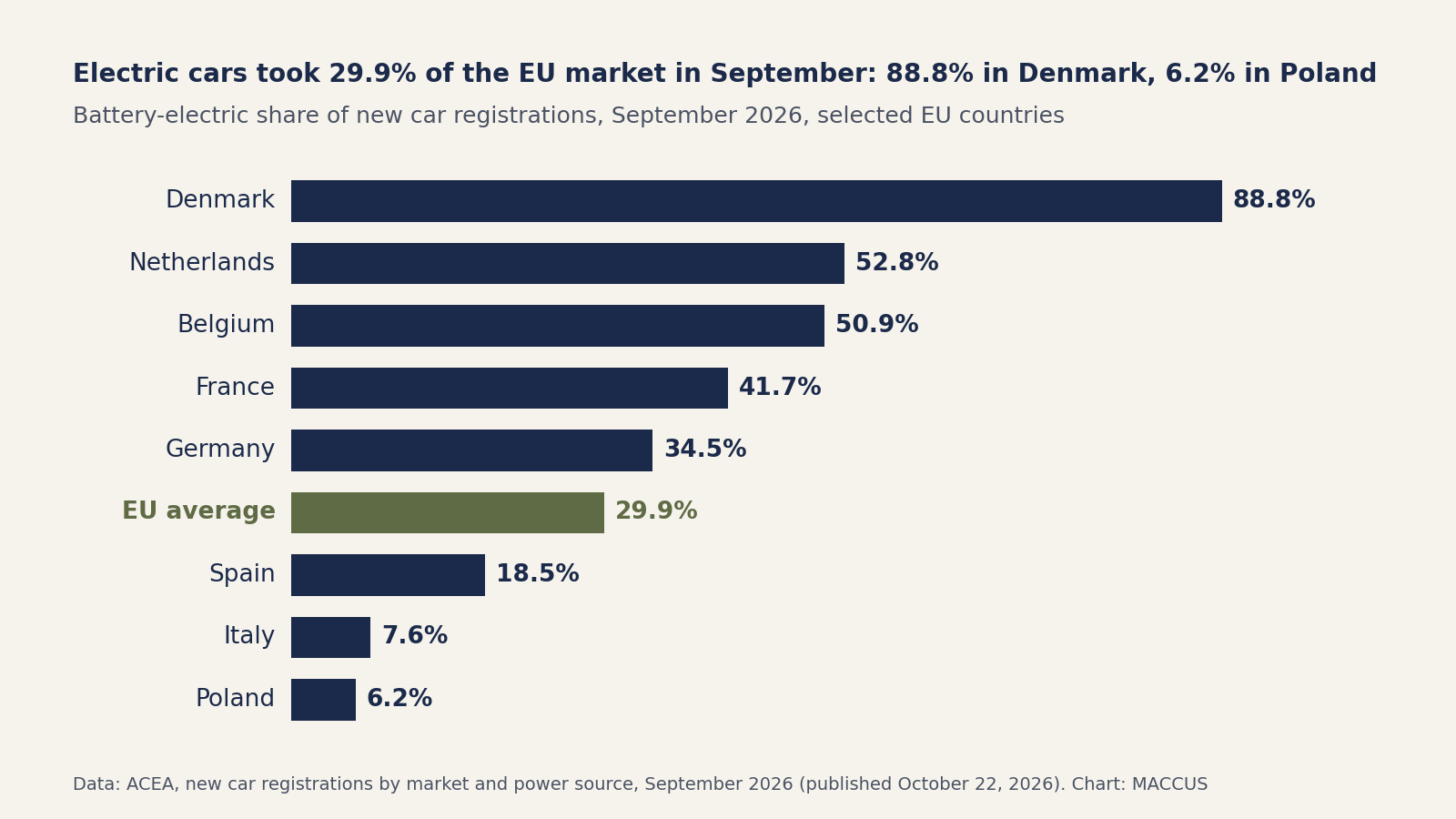
The EU average hides wide gaps between countries. In Denmark, 17,784 of the 20,025 new cars registered were battery-electric, a share of 88.8%. The Netherlands (52.8%) and Belgium (50.9%) passed the halfway mark.
In France, battery-electric registrations more than doubled (up 107.5% to 65,243) and took 41.7% of the market, while gasoline registrations fell 39.1%. In Germany, the EU’s largest market, they rose 94.7% to 88,599, a 34.5% share, and gasoline fell 29.2%.
Together, Germany and France registered 76,908 more battery-electric cars than in September 2025, almost two-thirds of the EU’s increase of 122,341.
Among the other large markets, Spain stood at 18.5% and Italy at 7.6%, with 10,552 battery-electric cars out of 139,166. Hybrids, at 70,188 cars, made up half of Italy’s market. In Poland, battery-electric registrations fell 21.9% from a year earlier to 3,478, or 6.2% of the market, while hybrids took almost half.
Record fuel prices, new subsidies and Chinese brands
ACEA credits buyer support and a wider choice of models. Two other things changed for buyers this year: fuel prices and the growth of Chinese brands. The registration data do not show which of these mattered most.
Fuel prices hit records in September. On September 14, the weighted EU average reached €2.063 a liter for gasoline, about $8.74 a gallon at the October 26 exchange rate, and €2.159 for diesel. Those were the highest readings in a series that began in 2005, Euronews reported, citing European Commission data.
Prices have climbed since the war with Iran broke out at the end of February and disrupted shipments through the Strait of Hormuz. The Commission’s Weekly Oil Bulletin for October 19 still had gasoline at €1.99 a liter and diesel at €2.14.
Governments in the two largest markets are subsidizing buyers. Germany’s grant program gives households under an income ceiling €3,000 toward a battery-electric car registered since January 1, 2026, and up to €6,000 depending on income and the number of children. Its application portal opened on May 19, with €3 billion meant to cover about 800,000 vehicles through 2029, according to the environment ministry. France reopened its “social leasing” program on July 16: lower-income households can lease an electric car for at most €200 a month, and €401 million is set aside for at least 50,000 households, according to the French ecological transition ministry.
Chinese brands are gaining ground. Across the EU, Britain and the EFTA countries, where registrations rose 10.2% to 1.36 million in September, Chery nearly tripled its sales and BYD nearly doubled, Reuters reported. In the EU alone, ACEA’s table shows BYD at 28,309 registrations in September, up 111.4%.
The four Chinese groups in Reuters’ count took 14.6% of the market across the EU, Britain and the EFTA countries, up from 9.6% a year earlier. One of them is Geely, which owns Volvo Cars and whose Zeekr brand builds the vans Waymo is turning into robotaxis.
A two-month streak with conditions attached
The streak came while fuel prices sat near records and new subsidies were paying out in Germany and France. Part of the gain could fade if pump prices fall back. France’s leasing program runs on a fixed budget. Spain, Italy and Poland show that much of the EU has not made the same switch.
Raw counts point the same way. In September the EU registered 652,081 new cars with a gasoline or diesel engine, including 330,693 hybrids and 102,267 plug-in hybrids, against 290,117 battery-electric cars.
What it means
The new-car market is changing much faster than the cars on the road. The EU had 256 million passenger cars in 2024, according to ACEA’s latest fleet report: 49.2% ran on gasoline, 38.4% on diesel and 2.3% on batteries alone, and the average car was 12.7 years old. At this year’s pace of about 2.6 million new battery-electric cars, sales add roughly one percentage point a year to the electric share of the fleet.
Norway shows how long that lag lasts. In September, 18,511 of the 18,733 new cars registered there were battery-electric, ACEA’s figures show, yet battery-electric cars made up only 27.7% of the country’s fleet in 2024. Denmark, at 88.8% of sales in September, had 12.1% of its fleet running on batteries in 2024. Over the next five to twenty years, as the cars bought in 2026 age, more of the switch will happen in the used-car market, at public chargers and on the power grid.
The question for the coming months is whether buyers keep choosing electric cars if fuel prices ease. ACEA’s October figures, due in November, are the next data point.
Sources
- New car registrations: +5.7% in September 2026 year-to-date; battery-electric 22.7% market share, ACEA, October 22, 2026
- New car registrations: +5.3% in August 2026 year-to-date; battery-electric 21.7% market share, ACEA, September 24, 2026
- Vehicles on European roads, January 2026, ACEA, January 2026
- Europe car sales rise 10% in September as EV surge offsets combustion slump, Reuters via TimesLIVE, October 22, 2026
- EU fuel prices hit records as ECB experts see diesel margins peak in October, Euronews, September 19, 2026
- Weekly Oil Bulletin, European Commission, October 22, 2026
- Grant scheme for electric vehicles (EVs), German Federal Environment Ministry (BMUKN), May 20, 2026
- Le dispositif leasing social 2026, French Ministry of Ecological Transition, July 16, 2026
Header image: chart by MACCUS, data from ACEA, EU new car registrations, September 2025, August 2026 and September 2026