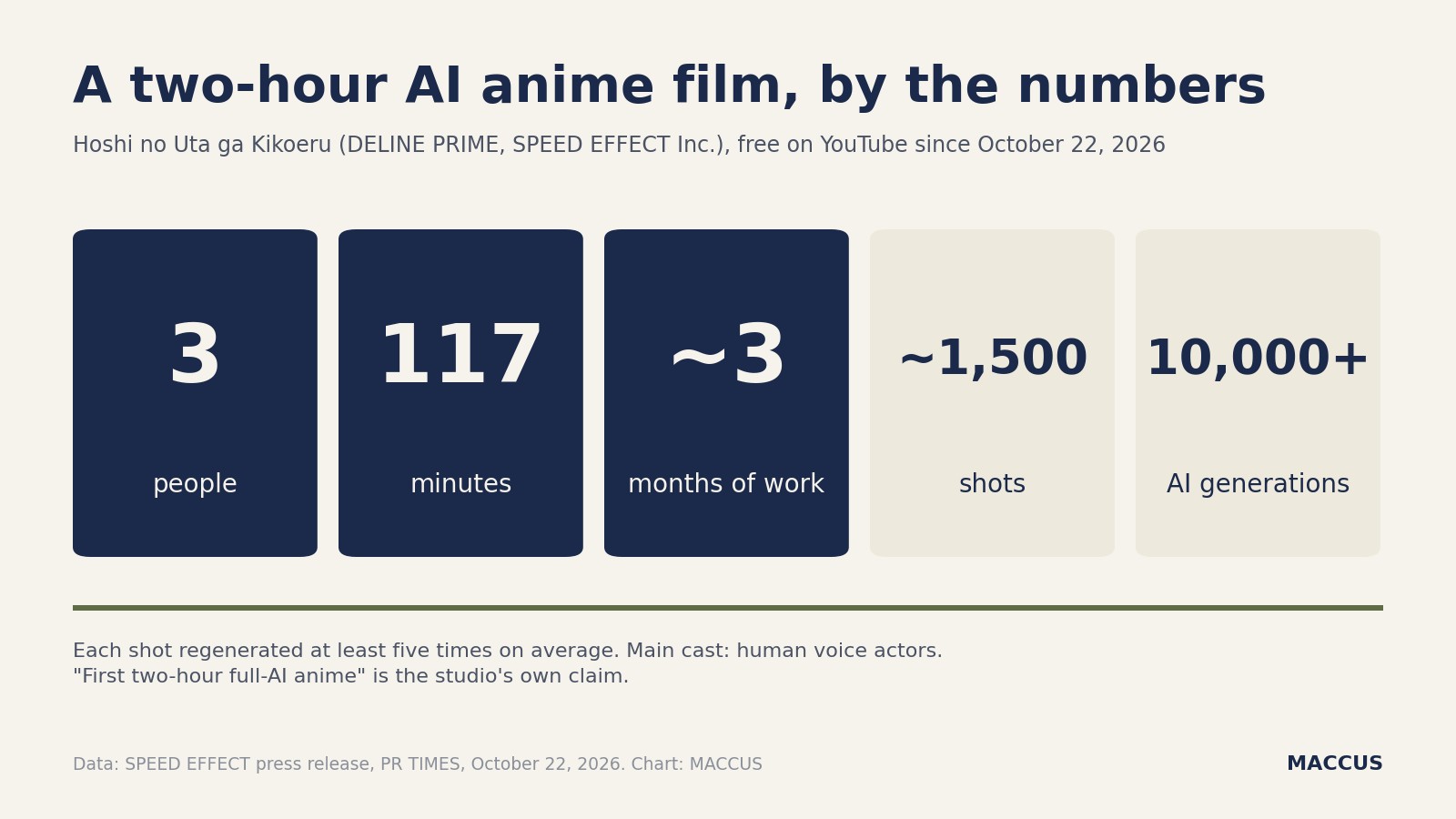

Three people at a Tokyo marketing company have made a 117-minute animated feature with generative AI and put all of it on YouTube for free. Hoshi no Uta ga Kikoeru, a title that translates as “I Can Hear the Song of the Stars,” went up in full on October 22, 2026, Japan’s Anime Day, after about three months of actual production work.
The film comes from DELINE PRIME, a label of SPEED EFFECT Inc., a web marketing and affiliate advertising company in Shibuya. According to the company’s press release on PR TIMES, the team produced about 1,500 shots, regenerated each one at least five times on average, and went through more than 10,000 generation attempts in total. The release bills it as the first two-hour “full generative AI anime” film ever made, a label the company checked only against its own desk research.
The team and its tools
The three are Hirotaka Yuino, the director and the company’s chief executive (his real name is Shohei Imai), plus Shogo Horikawa and Hideto Tsunei, credited with video production and sound effects. Yuino’s own credits run from the original story and script to storyboards, music, backgrounds, character design and editing. In a statement attached to the release, he says he has one year of experience in video production and that this is his first film as a director and screenwriter. He also voices two of the characters.
The moving images were generated mainly with Seedance and MiniMax. Still images came from ChatGPT’s image generator, Nano Banana and Midjourney, and the music from Suno. The release says the team rewrote the background prompts shot by shot and photographed the real Oshitoishi hill in Aso, Kumamoto, where part of the film takes place. The plot, drawn from Yuino’s own experience, follows a social media marketing entrepreneur who can measure his worth only by results.
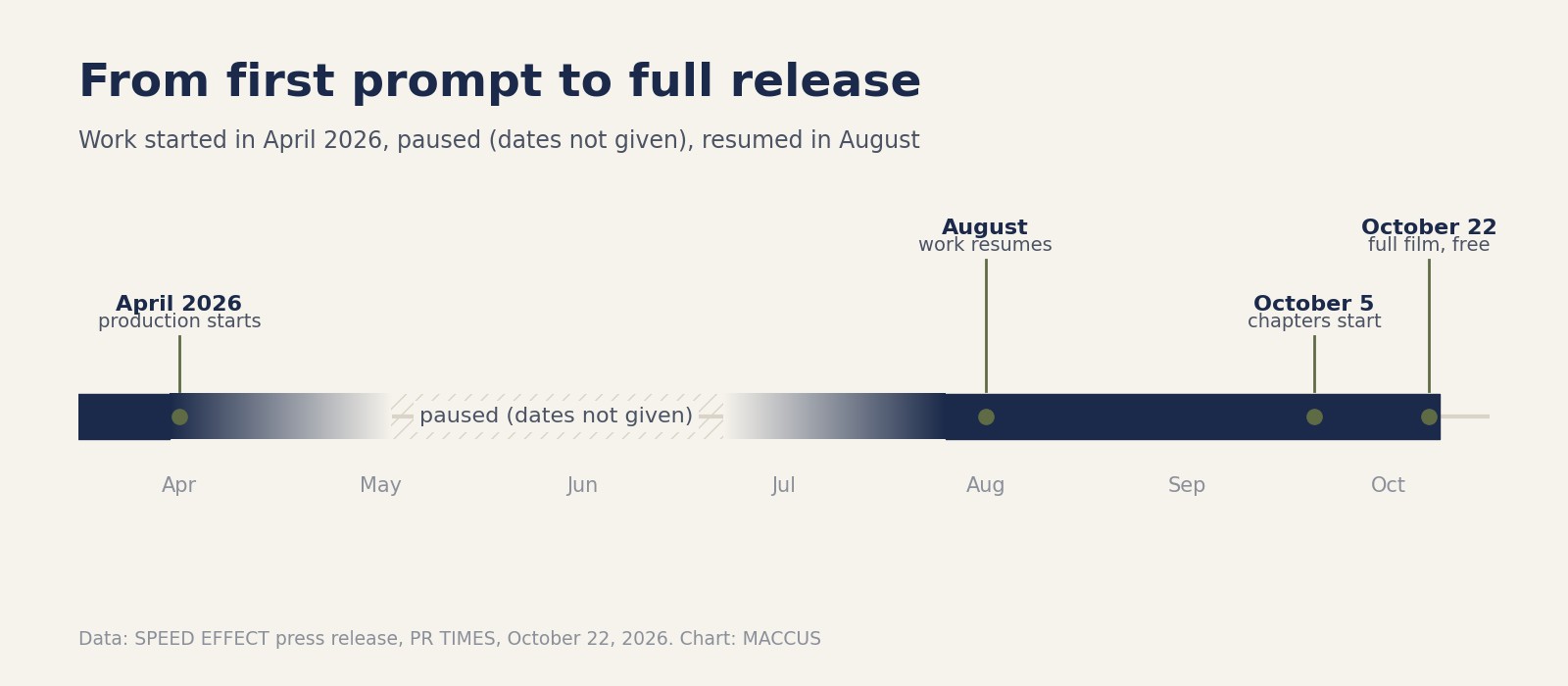
Work started in April 2026, was paused “to concentrate management resources,” in the release’s words, and resumed in August. The release gives no dates for the pause and puts the actual working time at about three months. Three chapters went up one by one from October 5, and the full cut followed on October 22.
The Japanese anime news site Anime! Anime! reported the production figures on release day, and the video trade site PRONEWS led with them on October 26: three people, three months of work, 117 minutes. By the morning of October 27, five days after the full release, the full version had about 11,000 views on YouTube. For comparison, Instagram is testing 90-minute videos, 27 minutes shorter than this film.
Human voices, generated pictures
A footnote in the release limits “full generative AI” to the video production process. Human voice actors play the main roles, and AI voices are used in places, the release says. Yuino says the script, the lyrics and every prompt were typed by hand, and that no existing anime was fed directly into the prompts or reference images. The release also says the scenery was modeled on the look of the films of Makoto Shinkai, the director of Your Name.
Yuino explains why most AI animation has stopped at the length of a short film or a music video: over a long running time, backgrounds and framing fall apart, characters change from shot to shot and emotional continuity breaks. Getting past that wall at feature length is, in his words, probably a first attempt in the industry.
An OpenAI-backed feature, at the other end of the scale
Critterz, another AI feature, is an animated family film backed by OpenAI. Its stated budget is under $30 million, and the team aimed to finish it in about nine months, against the three years a comparable traditional animated film takes, The Next Web reported. Production was announced in September 2025, and AGC Studios launched world sales on May 4 ahead of the Cannes market, Deadline reported. AGC then screened first footage to buyers at the market, according to The Next Web.
Critterz missed the in-festival premiere its producers had targeted for May 2026, The Next Web reported, citing Bloomberg. The Next Web itself tied part of the delay to OpenAI’s shutdown of Sora in March, one of the tools the film had been built on.
What the release does not show
According to a note at the end of the release, the studio’s “first” rests on an in-house desk search in October 2026, which found no earlier feature with every shot generated by AI, a Japanese 2D anime style (photoreal and 3D CG films excluded) and a running time of 100 minutes or more.
SCREENSIDE, a Japanese film site, notes that the release sets out no common standard for what counts as “full generative AI” or which earlier works were considered, and for that reason reports the “first” only as the producer’s own positioning. The Next Web wrote in May that the “first AI feature” title already had “half a dozen contenders.”
The cost comparison also rests on the director’s word: he puts generation costs at about a tenth of what a typical anime film costs, and the release gives no amount. Quality is still to be judged: SCREENSIDE suggests watching whether faces, clothes and movement stay consistent across ages and scenes, and whether the emotional arc holds for 117 minutes.
Yuino’s statement acknowledges the criticism of AI video and of voice actors’ voices being stolen. Public use of AI video still draws pushback, as an Irish council found when it promoted its Christmas with an AI video.
Yuino says the company is not pursuing profit with this film and will keep it free “as a sharing of technical capability.” The film is also a calling card for SPEED EFFECT, which lists AI video production among its businesses.
What it means
The change is the crew size: a production team of three, using commercial AI tools over about three months of work, delivered a 117-minute film. With more than 10,000 attempts for about 1,500 shots, most of the job was directing, picking takes and holding a story together. Fans saw a similar shift when AI sped up video game decompilation, where the human part of the work turned into guidance and review.
Critterz, with a stated budget under $30 million, studio partners and a nine-month target, missed its festival date. Hoshi no Uta ga Kikoeru is already public in full, so any viewer can check the consistency questions SCREENSIDE raised, while the “first” and the cost ratio still rest on the company’s word.
SPEED EFFECT has not published a cost figure, and an amount would make “a tenth of the cost” comparable with budgets like Critterz’s. The team says it wants to take on action scenes, love stories, children’s work and commissioned original anime. The release does not say whether any commission has come in yet.
Sources
- 史上初の2時間尺”フル生成AIアニメ”映画『星の唄が聞こえる』をYouTubeで無料公開, SPEED EFFECT Inc. (DELINE PRIME), PR TIMES, October 22, 2026
- 【AI制作アニメ】『星の唄が聞こえる (全編)』, DELINE PRIME, YouTube, October 22, 2026
- 生成AIを全面活用した長編アニメ映画「星の唄が聞こえる」が完成 「技術力の共有として」YouTubeで無料公開, Anime! Anime!, October 22, 2026
- フル生成AIアニメ映画「星の唄が聞こえる」がYouTubeで無料公開。わずか3名、実働3カ月で117分の長編を制作, PRONEWS, October 26, 2026
- 生成AIアニメ映画『星の唄が聞こえる』無料公開|117分を3人で制作, SCREENSIDE, October 22, 2026
- Sora shutdown leaves Critterz at the Cannes market without its model, The Next Web, May 22, 2026
- AGC Launches Open AI-Produced Animated Family Film ‘Critterz’ For Cannes Market, Deadline, May 4, 2026
Header image: chart by MACCUS, data from SPEED EFFECT’s press release on PR TIMES (October 22, 2026)