On October 28, 2026, Anthropic added a gallery of ready-made legal “artifacts” to Claude for Legal, the offering for legal professionals it launched in May. These artifacts are interactive tools, such as trackers and dashboards, that teams use and share in Claude. The announcement mentions 19 of them. Anthropic built six, including a citation checker; four come from the legal tech company Harvey, the professional services firm PwC and the law firms Goodwin and Foley & Lardner; the other nine focus on access to justice.
In Claude, an artifact is something the assistant builds alongside the conversation (our guide to Claude artifacts and how to share them explains how they work). Anthropic says the most common requests from legal teams since May have been for simpler setup and easier ways to work with colleagues. Each artifact in the gallery opens with an example before a team connects its own data, and each answer links to its source.
Reuters reported on the announcement the same day under the headline “Anthropic unveils additional Claude tools for lawyers.” Law.com and Law360 also covered it.
Six tools built by Anthropic
Anthropic sums up the workflow: a legal professional brings their own documents and sources, Claude does a first pass, and a lawyer applies their judgment to the results. The company says the six in-house tools in the announcement cover the work legal teams raised with it most often.
| Tool (name in the gallery) | What it does, according to Anthropic |
|---|---|
| Cite check | Compares a legal document with its sources and flags quotes that don’t match, wrong page numbers and sources that don’t support the claim. |
| Jurisdiction survey matrix | Compares one legal topic, such as data breach notice rules, across states or countries in a single table linked to the underlying law. |
| Matter board | Turns engagement letters, emails or spreadsheets into one board of open matters, with the owner, the next step and the next deadline. |
| Playbook deviation board | Compares contracts with the company’s standard terms, flags each clause that differs and sends it to the person who approves exceptions. |
| Regulatory horizon scan | Maps upcoming regulations on a timeline, based on the company’s business and where it operates, ranks them by impact and links to the sources. |
| Tabular review | Builds a table from a set of contracts, showing the terms requested, such as severance or non-competes, with a link to the exact language. |
Teams can ask Claude to tailor these tools and use connectors to pull in their playbooks or research sources, with no manual uploads. Anthropic says it has added more than 60 legal connectors since May, including Bloomberg Law, Filevine, Ivo, Legora and Patlytics.
When Claude for Legal launched on May 12, the company announced more than 20 MCP connectors and 12 plugins by role or practice area. Those plugins bundle tools, integrations and skills, a format Anthropic handed to the Linux Foundation on October 22. The May connectors included Legal Data Hunter, which Anthropic says gives access to more than 31 million documents from more than 160 jurisdictions, including consolidated EU law.
Harvey, PwC and two law firms in the gallery
Four artifacts come from partners, and Anthropic says more are coming from the legal tech company Legora and the law firm Orrick. Goodwin offers AI Governance Benchmark, which assesses a company’s approach to AI governance to surface potential gaps. Foley & Lardner built Obligations Checker, which reviews agreements for both parties’ obligations and helps validate expectations before closing and track them after. PwC provides Subpoena Response Tool, which turns a team’s precedents, standard objections and templates into first drafts of subpoena responses.
The fourth, Harvey Intake, changes how legal questions get routed. It gives employees in other departments one place in Claude to send legal questions and requests. Routine questions get an answer drawn from the legal department’s own guidance stored in Harvey; the rest go to a lawyer, whose reply comes back in Claude.
“Business teams are already bringing their questions to Claude. Harvey meets them where they work, giving Legal the ability to set the rules, see what’s being asked, and step in to manage risk,” said Matt Zerweck, head of in-house product at Harvey, in a quote published by Anthropic.
A legal team can also work on an artifact with colleagues in other departments, clients or partners. According to Anthropic, sharing settings protect privacy and support ethical walls between teams. Law.com describes the artifacts as “reusable digital products” that sit alongside the chat window.
Access to justice, American style
Of the nine access-to-justice artifacts, five were built by nonprofit and public interest organizations that Anthropic supported with Claude credits. The announcement describes only those five.
Criminal Charge Reality Check, from Zealous, takes a criminal charge and shows defense teams the sentencing range, public data on how such cases usually end and standard playbooks for release. It covers New York only, Anthropic notes. Rising for Justice built two tools based on D.C. law: one helps attorneys find errors in a landlord’s rent ledger when preparing an eviction case; the other helps them assess whether a criminal record is eligible for sealing.
Immigration Papers Reader, from Mobile Pathways, turns a client’s immigration paperwork into a plain-language first read of key dates and missing documents. Record Clearance, from The Access Project, helps legal aid teams work out whether a record can be cleared under their state’s rules. None of the five mentions French or Belgian law.
Anthropic says this work builds on the Oxford Justice Innovators Programme, a 12-month program run with the Oxford Institute of Technology and Justice and Microsoft, which supports up to 10 innovators working on access to justice. The company is also launching a Legal Ambassadors Program, a community for legal professionals who build with Claude. For now, it is waitlist-only.
A citation checker with no published error rate
The citation checker bears on a problem courts know well. In Mata v. Avianca, attorneys Peter LoDuca and Steven A. Schwartz submitted nonexistent court opinions with fake quotes and citations created by ChatGPT. On June 22, 2023, P. Kevin Castel, a federal judge in New York, imposed a $5,000 penalty on them and their law firm.
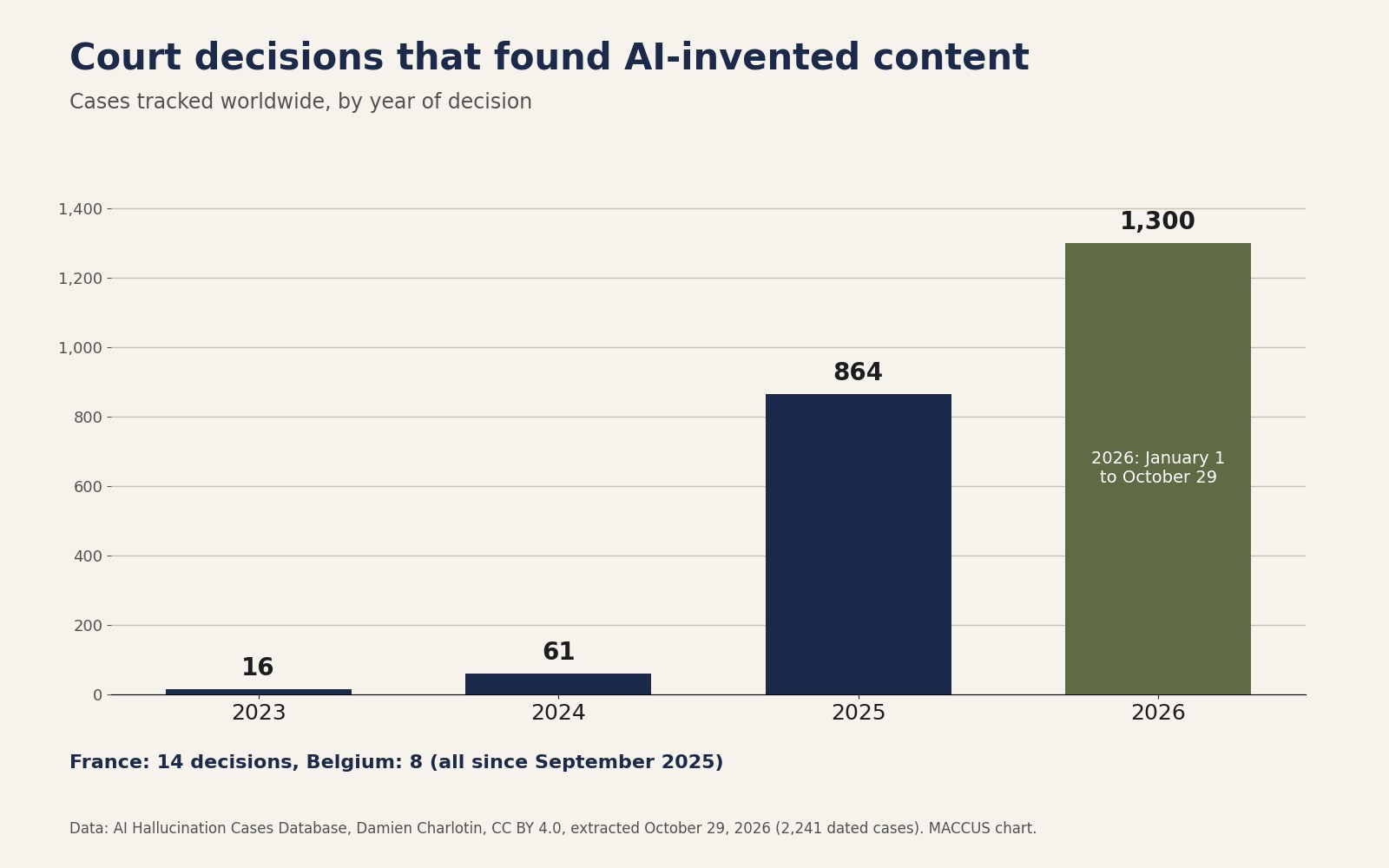
A public database maintained by Damien Charlotin tracks decisions in which a court found, or implied, that a party relied on AI-fabricated content. It counted 2,241 as of October 29, 2026, including 14 in France and eight in Belgium. The 14 French decisions all date from December 2025 or later; eight involve a lawyer, six a self-represented litigant.
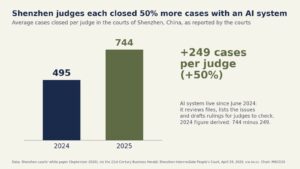
In Great Britain, the presidents of the employment tribunals have noticed signs of AI in many urgent claims. Some courts, meanwhile, use AI for their own work, such as the courts in Shenzhen, where a system drafts judgments that judges then check.
Anthropic describes the tool and walks through an example, but publishes no detection rate and no error rate. The announcement also does not say what the tool flags when a cited decision does not exist in any of the sources it checks, as in Avianca.
The customer testimonials on Anthropic’s page are self-reported. Spellbook says it “wouldn’t be here without Claude” and that close to 500,000 contracts a month move through its tool, a figure the page does not document.
What it means
With this gallery, Claude for Legal moves from technical building blocks (connectors, plugins) to ready-made tools. The clearest change is who asks the questions. Harvey Intake and sharing beyond the legal department could make Claude the front door for legal questions from employees in other departments, while the legal department keeps control of the rules and of any non-routine answers.
For a reader in France or Belgium, three questions remain open. It is unclear which plans include the gallery: the announcement page is filed under Claude Enterprise, names no other plan and no price, and points to Anthropic’s sales team and 13 implementation partners, including Accenture, Deloitte, KPMG and PwC. Nor is it clear whether the tools work for French or Belgian law: those tied to a specific jurisdiction are all American, and only the jurisdiction survey matrix and the regulatory horizon scan are described in terms that cover other countries. And the citation checker comes with no accuracy measure.
Still to watch: the promised artifacts from Legora and Orrick, the list of plans that include the gallery and any figures on the citation checker. In both France and Belgium, some judges are already flagging AI-fabricated content, mostly nonexistent case law or legal texts: Damien Charlotin’s database lists 14 French decisions and eight Belgian ones since September 2025.
Sources
- Introducing artifacts for legal work with Claude, Anthropic, October 28, 2026
- Claude for the legal industry, Anthropic, May 12, 2026
- Claude for Legal, Anthropic, page read October 29, 2026
- Anthropic Releases Claude for Legal Artifacts, a Set of New Interactive Tools for Legal Users, Law.com Legaltech News, October 28, 2026
- Anthropic Expands Claude For Legal With Ease Of Use Tools, Law360 Pulse, October 28, 2026
- Mata v. Avianca, Inc., Opinion and Order on Sanctions, U.S. District Court for the Southern District of New York, June 22, 2023
- AI Hallucination Cases Database, Damien Charlotin, updated October 29, 2026
Header image: MACCUS chart. Data: Anthropic, “Introducing artifacts for legal work with Claude,” October 28, 2026