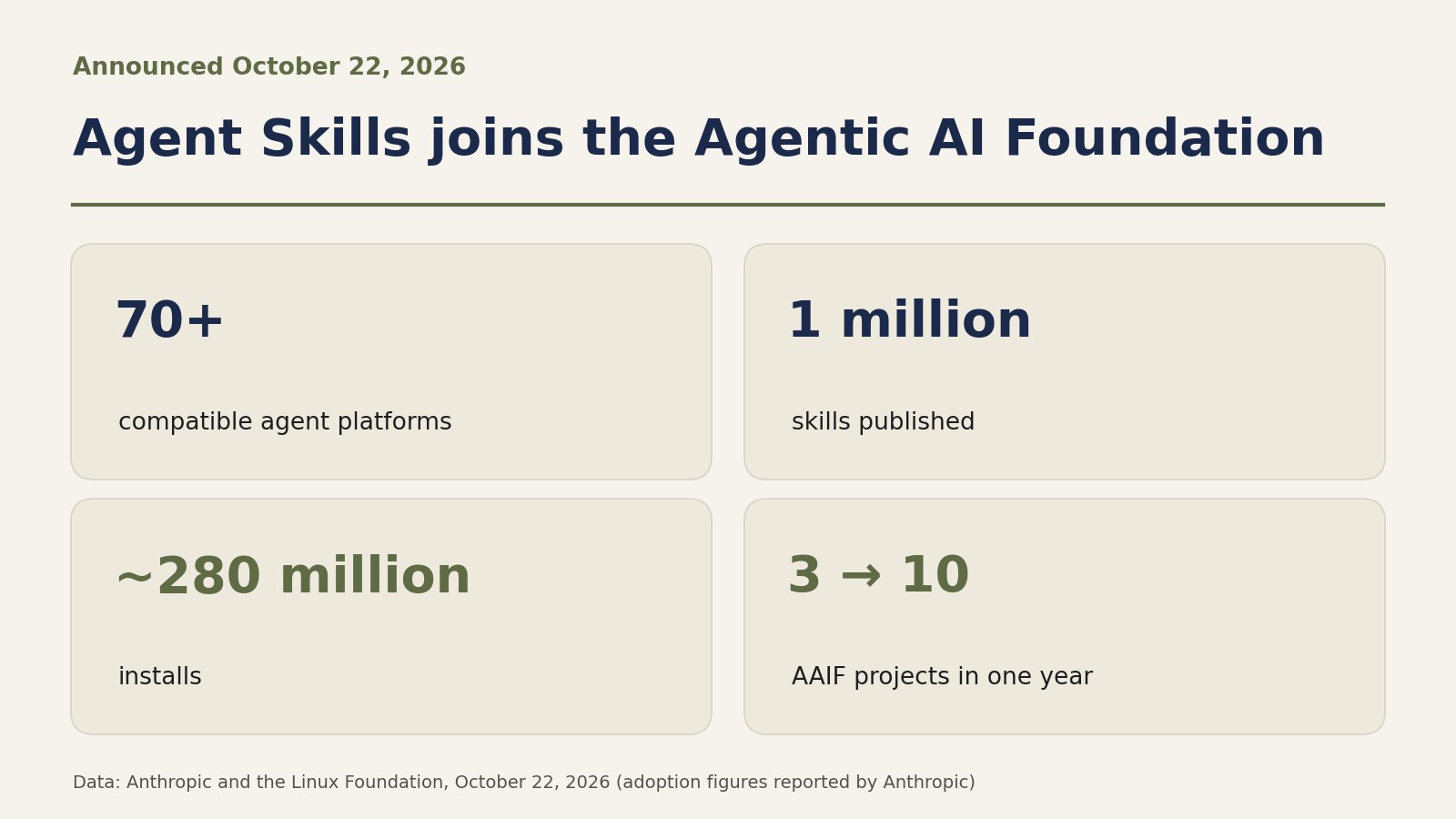

Anthropic said on Thursday, October 22, 2026, that it is donating Agent Skills, the open standard that Claude skills are built on, to the Agentic AI Foundation (AAIF). The foundation sits under the Linux Foundation and was co-founded in December 2025 by Anthropic, Block and OpenAI. It already hosts the Model Context Protocol (MCP), the protocol that connects AI assistants to tools and data.
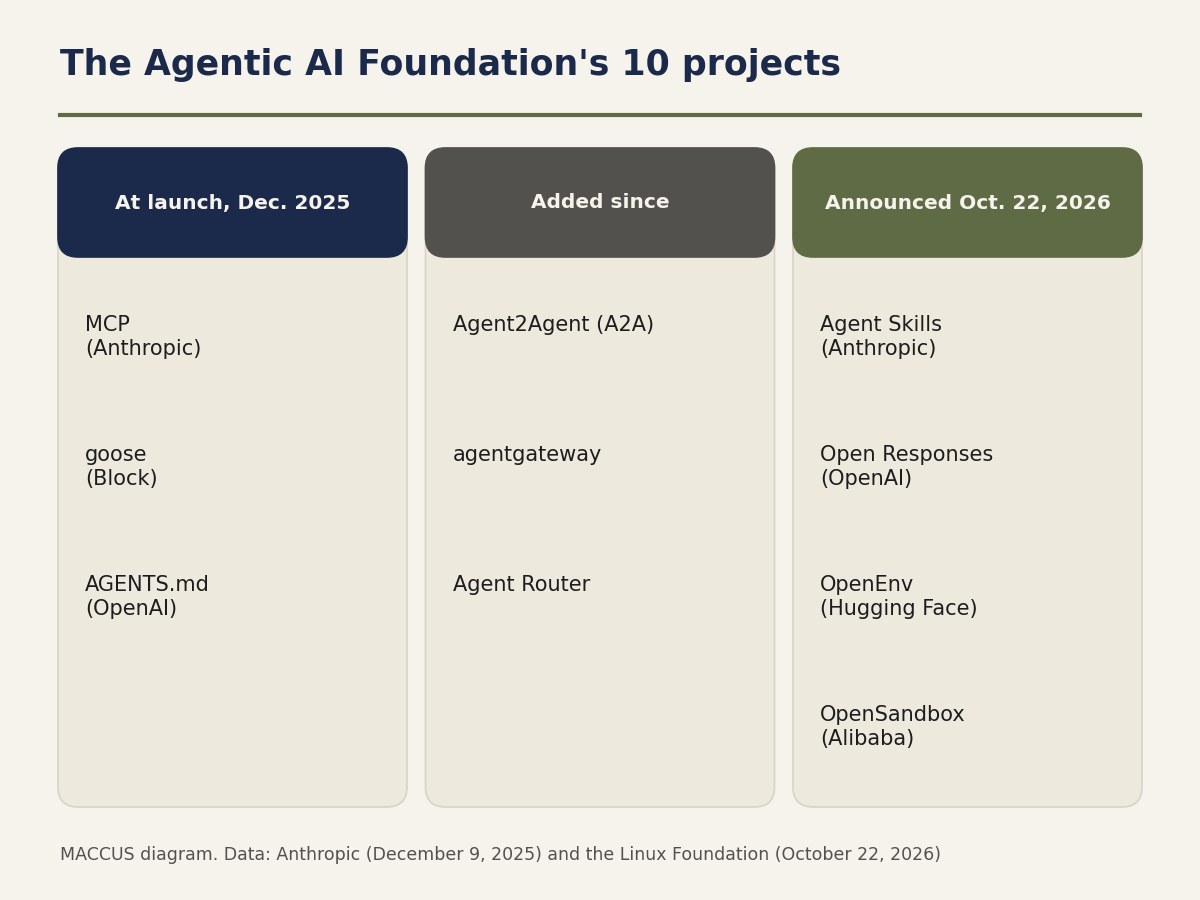
The same day in San Jose, the foundation announced three more projects, contributed by OpenAI (Open Responses), Hugging Face (OpenEnv) and Alibaba (OpenSandbox). That brings the AAIF to 10 projects, up from three at launch. The news came on the first day of AGNTCon + MCPCon North America, held October 22 and 23.
More than 70 platforms, according to Anthropic
A skill is a folder that holds a SKILL.md file and, when needed, scripts and reference documents. The file teaches an agent a specific task or domain. Anthropic says it developed skills while working on Claude Code, its coding agent, which often lacked the procedural knowledge that real business tasks require. Our guide to Claude skills for non-developers covers what goes in a skill and what belongs in a project or a plain .md file instead.
Skills arrived in Claude in October 2025. Within weeks, according to Anthropic, developers had published thousands of them on GitHub and written loaders for Codex, Cursor and OpenCode. On December 18, 2025, the company released the format as an open standard, with its own GitHub organization and domain, agentskills.io.
Anthropic says more than 70 agent platforms have adopted the format since December 2025, including ChatGPT, Cursor, GitHub Copilot and VS Code. It also cites 1 million published skills and nearly 280 million installs. Under the migration process OpenAI has published, a custom GPT’s instructions become a skill when the GPT is migrated to a plugin, a step planned ahead of the retirement of GPTs from ChatGPT on December 11, 2026.
The name, logo, GitHub organization and domain change hands
Anthropic is transferring the Agent Skills name and logo, the GitHub organization and the agentskills.io domain. AAIF membership is not required to use the standard or contribute to it. Engineers from Anthropic, Google, OpenAI and other companies will maintain it as individuals. The two lead maintainers are David Soria Parra, co-creator of MCP at Anthropic, and Mahesh Murag.
The announcement leaves the format itself alone. The specification requires two fields at the top of a SKILL.md file: a name of up to 64 characters and a description of up to 1,024 characters. A compatible agent first reads each skill’s name and description, loads the full instructions when a task calls for them, then runs any bundled scripts if needed. Code in the repository is licensed under Apache 2.0 and the documentation under CC BY 4.0.
“Without the right context, even the most intelligent agents fall short,” David Soria Parra said in the Linux Foundation’s press release. He added that the AAIF “has done important work” giving MCP a neutral home since Anthropic donated it less than a year ago.
Anthropic has proposed starting with a roadmap that covers versioned releases, a formal process for suggesting changes, and security guidance for people who write and install skills. The project’s Discord server collects feedback on proposed changes to the specification.
OpenAI, Hugging Face and Alibaba contribute projects too
Open Responses, contributed by OpenAI, is a specification based on the company’s Responses API. It defines a shared schema so developers can describe a request and its response once, then run it across several model providers with minimal changes. According to The New Stack, AWS (in Bedrock), Databricks, Nvidia, Ollama, OpenRouter, Red Hat and Vercel are already among its supporters. The outlet notes two absences: Anthropic, which keeps its own Messages API, and Google, with its Interactions API.
OpenEnv, contributed by Hugging Face, is a framework for building and sharing reinforcement learning environments, the settings in which agents are trained and evaluated. OpenSandbox, created at Alibaba, provides Docker and Kubernetes sandboxes that run an agent’s code isolated from the rest of the system. “We don’t want its future to be defined by a single company,” said Xiaobin Xu, head of development infrastructure at Alibaba.
The four newcomers join MCP, AGENTS.md (OpenAI), goose (Block), the Agent2Agent (A2A) protocol, Agent Router and agentgateway. “A year ago, AAIF launched with three projects and a bet that agentic AI needed a neutral home to thrive. Today we host 10,” said Manik Surtani, the foundation’s CTO and co-founder.
Security is still a promise
Security guidance remains a roadmap item for now, with no published text. The announcement creates no official skills registry and no pre-publication review. Skills already circulate through third-party catalogs, though.
In a study published on February 5, 2026, security firm Snyk analyzed 3,984 skills listed on ClawHub and skills.sh. It found that 534 of them, or 13.4%, had at least one critical security issue, including malware distribution, prompt injection or exposed secrets. After manual review, Snyk confirmed 76 malicious payloads built to steal credentials, install backdoors or exfiltrate data.
Snyk noted at the time that publishing on ClawHub took only a SKILL.md file and a week-old GitHub account, with no code signing, no security review and no sandbox by default. According to the same report, the attacks targeted users of OpenClaw, Claude Code and Cursor, three tools that read the same format.
The adoption figures come from Anthropic alone. The announcement does not explain how the 280 million installs were counted or give the full list of platforms. A gallery on agentskills.io lists some of the compatible tools.
What it means
The October 22 announcement moves Agent Skills under the AAIF’s governance and keeps the format unchanged. SKILL.md files written for Claude, Copilot or ChatGPT stay valid. The difference lies in who decides what comes next: a foundation co-founded with OpenAI and backed by Google, and maintainers from Anthropic, Google, OpenAI and other companies. MCP took the same path in December 2025, and Anthropic said at the time that the project’s governance model, led by its maintainers, would stay the same.
The move matters most to teams that write a skill once and use it in several assistants. The format no longer depends on one vendor’s business decisions. Each vendor still controls its own products: how Claude, ChatGPT or Copilot load, share and limit skills is not up to the foundation. Claude Duet, the agent Anthropic launched on October 21, picks up the skills already set up in a Claude account.
Tools (MCP), instructions (Agent Skills, AGENTS.md) and isolated execution (OpenSandbox) now sit under the same foundation. Model access remains split: Open Responses starts from OpenAI’s API, and neither Anthropic nor Google is among its supporters, even though Anthropic is an AAIF member.
The timing of the first versioned release and the content of the security guidance are still unknown. The announcement does not address third-party catalogs such as ClawHub or skills.sh either. Whether Anthropic will adopt Open Responses is another open question.
Sources
- Donating Agent Skills to the Agentic AI Foundation, Anthropic, October 22, 2026
- Agentic AI Foundation Announces Four New Projects: Agent Skills, Open Responses, OpenEnv, and OpenSandbox, The Linux Foundation, October 22, 2026
- Specification, Agent Skills, accessed October 23, 2026
- agentskills/agentskills, GitHub, accessed October 23, 2026
- Skills for organizations, partners, the ecosystem, Anthropic, December 18, 2025
- Donating the Model Context Protocol and establishing the Agentic AI Foundation, Anthropic, December 9, 2025
- OpenAI donates Open Responses, its spec for a common LLM API, to the Agentic AI Foundation, The New Stack, October 22, 2026
- Snyk Finds Prompt Injection in 36%, 1467 Malicious Payloads in a ToxicSkills Study of Agent Skills Supply Chain Compromise, Snyk, February 5, 2026
Header image: MACCUS chart, data from Anthropic and the Linux Foundation, October 22, 2026