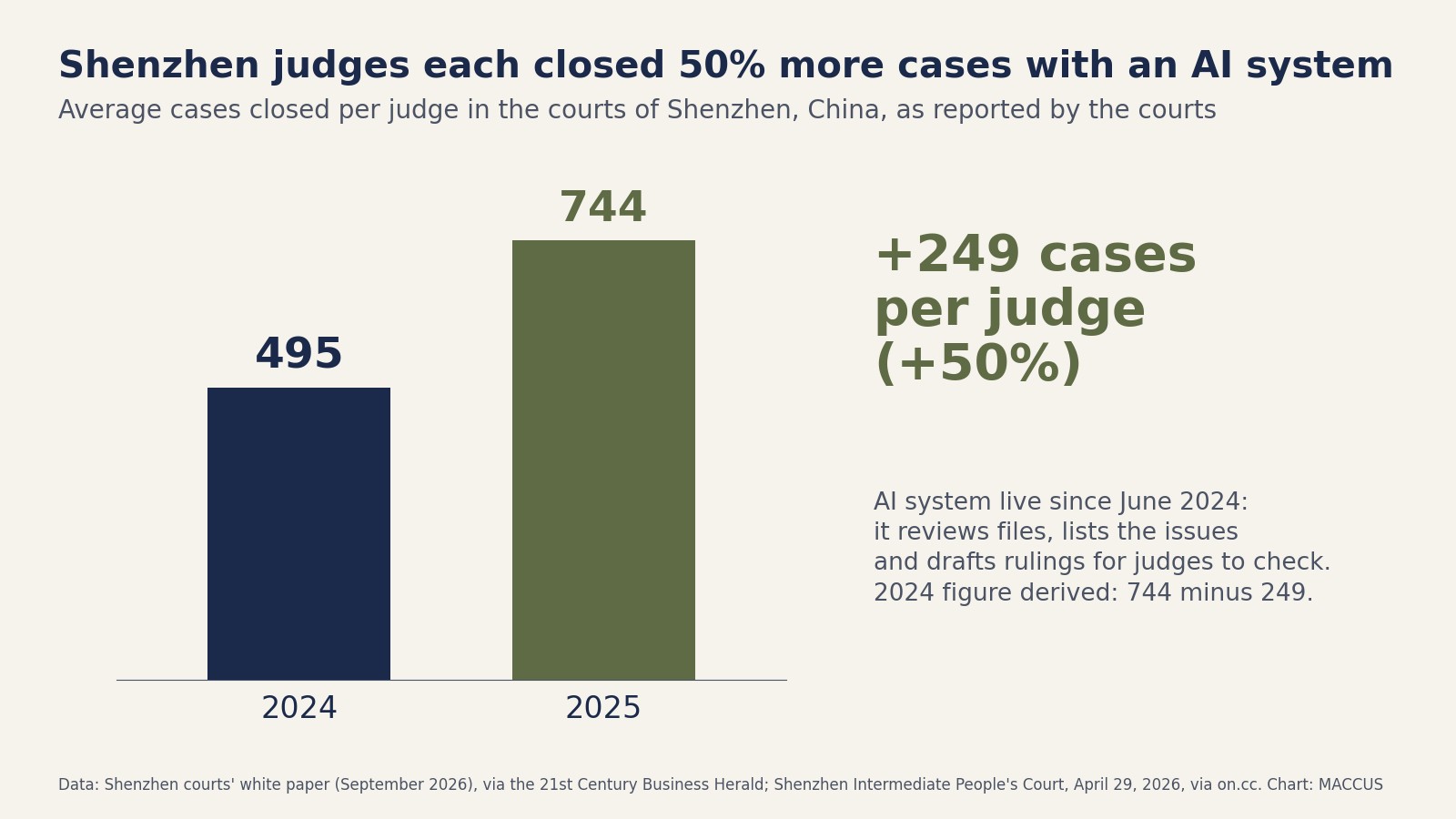

Judges in Shenzhen, a Chinese city of 18 million people, closed an average of 744 cases each in 2025, the city’s courts say. That is 249 more than in 2024, or about 50% more cases per judge. They work with an AI system that reads the case file, lists the issues and drafts the judgment for the judge to check.
Sir Geoffrey Vos, who heads the civil courts of England and Wales, visited the Shenzhen Intermediate People’s Court in September. Impressed by what he saw, he believes courts around the world should consider following its example, WIRED reported on October 28, three days before he retires. By the magazine’s account, he thinks personal injury claims and low-value professional negligence cases could easily be decided by AI. In the interview he set a condition: people could only be asked to accept such decisions if they consent or if a law allows it.
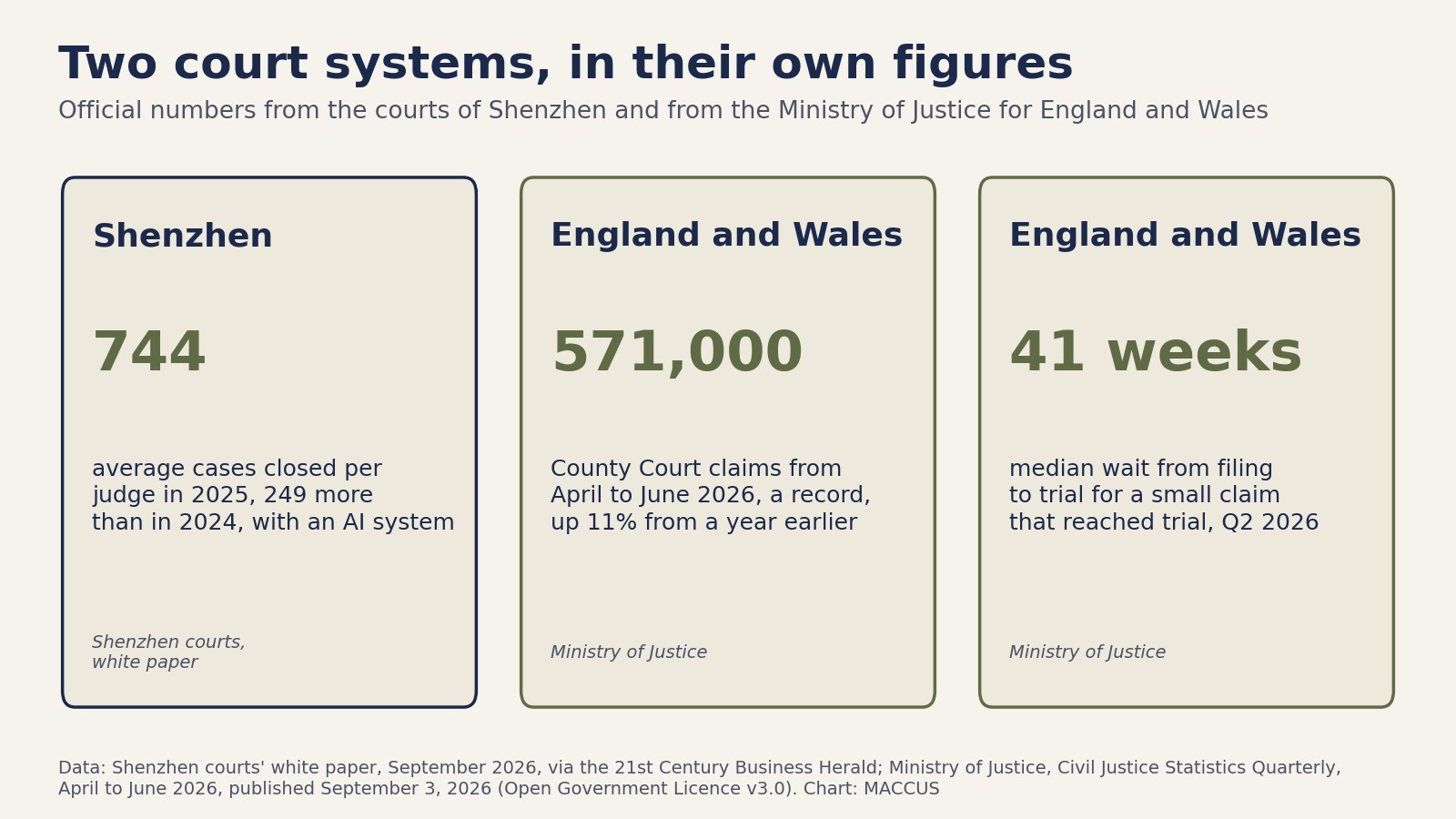
His own courts took in a record 571,000 claims between April and June 2026, according to the Ministry of Justice.
Six cases in the time of one
Shenzhen’s courts switched the system on in June 2024. It now covers civil, administrative and criminal cases and is used to screen new filings, review case files, support hearings, draft documents and search the law. Those details come from a white paper the courts released at the China Rule of Law International Forum, held in Shenzhen on September 22 and 23, as reported by People’s Daily Online.
By August 31, 2026, the system had been used in more than 700,000 cases, the white paper says. It had helped review the files in 609,000 cases, supported 269,000 hearings and helped draft 678,000 documents. The city’s courts closed 773,828 cases in 2025.
The per-judge numbers, 744 cases in 2025 and 249 more than in 2024, come from the 21st Century Business Herald’s account of the white paper. By our count that is a rise of about 50%, the figure the South China Morning Post reported in May. Average monthly closures per judge were 60% higher than before the launch.
Vos described the system in a speech on October 14. It distills the important points from the evidence, lists the issues “that the machine thinks need to be decided” and drafts the reasons and the order. In a second speech that day, he added that the drafting step comes after the judge has decided those issues. “One judge told us that she could, using the system, do 6 cases in the time she had previously taken to do one,” he said.
He called the system “remarkable,” in part because one platform handles every type of civil case, and quoted the white paper: “work that took a full day now takes tens of minutes.”
The court also reports fewer appeals. The white paper puts the drop in the appeal rate at 48% and the drop in judgments overturned or sent back for retrial at 65%, according to the Business Herald, which does not give the period. For 2025 alone, the appeal rate fell 35.1% from a year earlier and the first-instance reversal-or-remand rate fell 33.3%, Hong Kong’s on.cc reported on May 1 in its account of a speech by the court’s vice president, Kuang Xiaohua. Both rates were the best in ten years.
China’s Supreme People’s Court has added the system to its national case-handling platform and will roll it out fully after trials in 23 courts, on.cc reported.
Vos’s conditions
Vos does not use AI to write judgments. He does use Microsoft Copilot every day, he told WIRED, to find documents, work through large files and check things. “I have 11 meetings a day,” he said. Judges in England and Wales work under guidance issued October 31, 2025, which lists summaries and administrative work as possible uses, and legal research and legal analysis as “tasks not recommended.”
He sorts cases by type. Custody and family cases are areas where people expect human judgment, in his view, and so are complex commercial disputes. “What most people desperately want in civil disputes is resolution,” he said. “The question is, where is the line to be drawn?”
“It will only be possible to ask people to accept algorithmic decision-making if they consent to the process in a particular case, or if society decides through legislation,” he told the magazine. His October 14 speech put it more bluntly: “It is obvious that simple small cases can and will be decided by AI if the parties agree.” He pointed to eBay, where 90% of the 60 million small disputes it handles each year are decided “without human intervention.”
He has made the case before. In an April 30 speech in Edinburgh, he said it was “now inevitable that basic economics will dictate that routine judicial decision-making will be informed or directed by machines,” and that the parties’ agreement “will rapidly become automatic.”
A record queue in England and Wales
The County Court in England and Wales received 571,000 claims from April to June 2026, 11% more than a year earlier and the most since the series began, the Ministry of Justice reported on September 3. Small claims that reached trial waited a median of 41 weeks from filing. Personal injury claims, one of the categories Vos says AI could decide, fell 4% to 11,000 in the quarter.
Vos attributes the growth to chatbots. “We see a 10 percent rise in the number of county court cases started every year,” he told WIRED. “That’s because everybody who has a legal problem now puts it into Gemini, ChatGPT, or Claude.” Asked how many of those claims are sound, he answered: “We don’t have the data.”
The ministry points elsewhere. It says the rise was “likely driven by a rise in claims to recover monies in relation to parking on private land.” Money claims under £500 grew 21%, to 245,000. In Britain’s employment tribunals, judges have flagged signs of AI use in a surge of urgent claims.
What the numbers leave out
Every Shenzhen figure comes from the court itself, relayed by official media and on.cc. The figures compare years before and after the launch, so they do not separate the system’s effect from other changes in those courts over the same period.
Vos raised an objection himself. AI “only saves the time of human lawyers and judges if those lawyers and judges actually accept what it says,” he said on October 14. He was “troubled,” he said, by a machine drawing up the list of important facts “when the judge has not read all the facts,” and the boundary between mechanical tasks and decision-making “is more easily said than actually defined.”
Some judges reject the tools outright. At a conference in Seoul in September, a judge from the Philippines called AI “an irresponsible lawyer and a catastrophic judge,” Vos recalled.
Where the line falls, he told WIRED, is “a question for society, politicians, and legislation to resolve.” He also said: “I don’t think you’ll ever do away with human judges.”
What it means
In Shenzhen the machine already drafts the reasoning judges sign, and China’s top court is putting it on a national platform. In England and Wales, the head of civil justice argues in public that people who agree to it could take a machine’s decision on a simple claim. Outside the courts, AI judgment is being measured against professionals too: in a Harvard working paper, three former journal editors preferred AI-written peer reviews to strong human ones in 26 of 30 judgments.
Small claims in England and Wales that go to trial wait a median of 41 weeks from filing, and resolution is what Vos says most people in civil disputes want. The risk he names himself is a judge who signs a machine’s draft without reading the file. Governments are also counting on AI to keep public services running with fewer staff, as in the Dutch plan to cut about 25,000 civil service jobs by 2035.
Vos leaves office on October 31. His successor, Sir Colin Birss, became the judiciary’s lead judge for artificial intelligence in 2023, the judiciary said when it announced his appointment in July. The next markers are the AI project of the Standing International Forum of Commercial Courts, which Vos says will likely produce model rules for the use of AI across its 71 jurisdictions; China’s rollout beyond its 23 trial courts; and whether the ministry’s next quarterly figures show claims still climbing.
Sources
- Should AI Decide Your Court Case? This Judge Says Yes, Joel Khalili, WIRED, October 28, 2026
- Speech by the Master of the Rolls: Legal Geek Conference, Courts and Tribunals Judiciary, October 15, 2026
- Speech by the Master of the Rolls: The future of cross border dispute resolution, Courts and Tribunals Judiciary, October 15, 2026
- Artificial Intelligence (AI) Guidance for Judicial Office Holders, Courts and Tribunals Judiciary, October 31, 2025
- Civil Justice Statistics Quarterly: April to June 2026, Ministry of Justice (UK), September 3, 2026
- 《人工智能司法应用的深圳实践》白皮书发布, People’s Daily Online, September 23, 2026
- 全球首个!深圳AI辅助审判办案超70万件, 21st Century Business Herald (from Nanfang+), September 23, 2026
- 深圳AI輔助判案超60萬宗 法官人均結案率全省第一, on.cc (Hong Kong), May 1, 2026
Header image: chart by MACCUS, data from the Shenzhen courts’ white paper (September 2026, via the 21st Century Business Herald) and the Shenzhen Intermediate People’s Court (April 29, 2026, via on.cc)