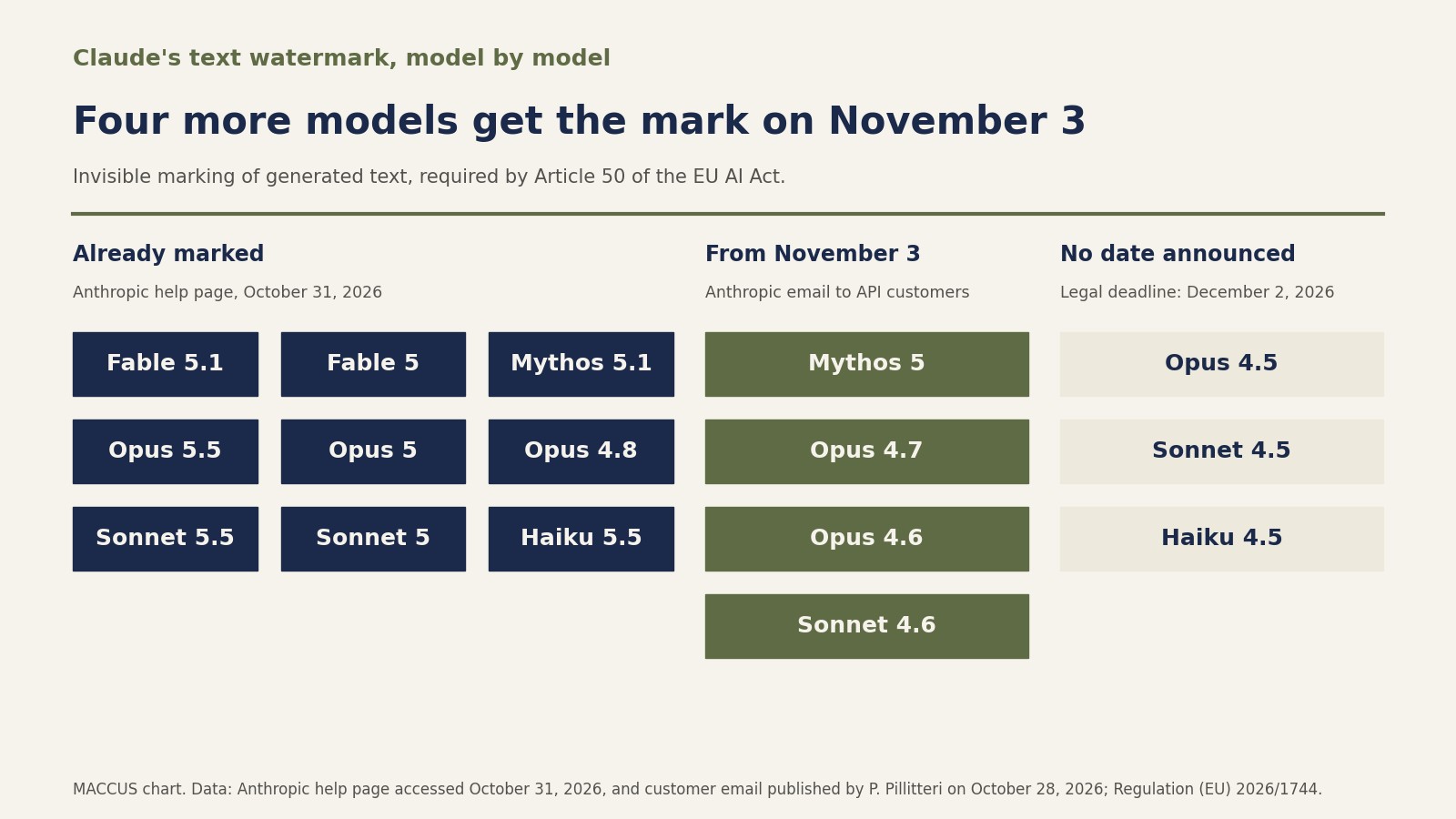

Starting November 3, 2026, Anthropic will apply its text watermark to the output of four older Claude models: Mythos 5, Opus 4.7, Opus 4.6 and Sonnet 4.6. The company announced the change in an email to organizations that use at least one of these models on its API, the Claude Platform, and a screenshot of that email became public on October 28. The message says it is the same watermark that newer models, including Claude Opus 5.5, already carry, and that the rollout on Amazon Bedrock “may take a few additional days.”
Italian consultant Pasquale Pillitteri published the screenshot on his blog. The email is titled “Text watermarking is coming to more Claude models.” As of October 31, Anthropic’s help page did not mention the November 3 date, and the release notes for its platform mentioned only the watermark on newer models. On the evening of October 30, a thread on the subject was among the most popular on r/ClaudeAI, where one user summed up their complaint: the people whose text carries the mark can’t check it themselves.
Four more models on November 3
Anthropic’s help page on content marking, updated October 28, lists 16 models in a table. In the October 31 version of the page, nine already carry the text watermark, both on Anthropic’s own services and through its cloud partners: Fable 5.1, Fable 5, Mythos 5.1, Opus 5.5, Opus 5, Opus 4.8, Sonnet 5.5, Sonnet 5 and Haiku 5.5. For the other seven, including the four named in the email, the table has a check mark only under Content Credentials (C2PA), the metadata added to files.
After November 3, three models will still have no specific date: Opus 4.5, Sonnet 4.5 and Haiku 4.5. Sonnet 4.5 is due to leave the Claude API on November 30, 2026, according to Anthropic’s September 30 release notes. Haiku 4.5 was scheduled to leave the model picker on the Free, Pro and Max plans on October 29, according to Anthropic’s October 15 announcement, but it remains available through the API. Our guide to Claude models explains how these generations fit together.
Anthropic followed the same pattern in September. An email dated September 24, reported by The Decoder and then by heise online, announced that Fable 5, Sonnet 5 and Opus 4.8 would be watermarked starting September 30. According to heise, Anthropic planned to watermark the remaining affected older models by December 2. Opus 5, released earlier, had also been retrofitted, the same article said.
A timeline set by the EU AI Act
Anthropic cites the European Union’s AI Act as the basis for the watermark. Article 50, which became applicable on August 2, 2026, requires providers of systems that generate text, audio, images or video to ensure their outputs are “marked in a machine-readable format and detectable as artificially generated or manipulated.” Anthropic is among the roughly 190 signatories of the EU Code of Practice on Transparency of AI-Generated Content, which it signed in July, according to its August 14 blog post.
Regulation (EU) 2026/1744, known as the Digital Omnibus, added extra time for systems placed on the market before August 2. Article 111(4) gives them until December 2, 2026, to comply with the marking requirement. The November 3 date puts the four models about a month ahead of that deadline.
The law includes an exception: the obligation does not apply to the extent that AI systems “perform an assistive function for standard editing” or do not substantially alter the input data. Anthropic’s help page says embedded watermarks will apply to all generated text.
The mark lives in word choice
The watermark is based on a version of SynthID-Text, the method Google DeepMind described in Nature in 2024, according to the technical post Anthropic published on August 14. When several words would fit equally well, the choice is no longer left to ordinary randomness: it is set by a secret key combined with the preceding words. Nothing is added to the text, which gains no hidden characters and no extra tokens. Anthropic also says the mark can’t be traced to a specific person, organization or chat.
The marking happens at the model level. It covers the API, the Claude apps, Claude Code, Claude Cowork and Claude Tag, as well as the models served through AWS, Google Cloud and Microsoft Foundry. It applies wherever Claude is offered because, Anthropic says, there is not yet a durable way to limit it by region.
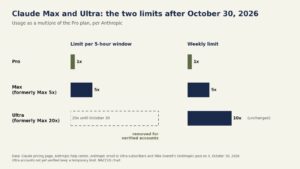
Neither the help page nor the blog post mentions a way to turn it off, not even on the most expensive plan, the former Max 20x plan, renamed Ultra on October 30. According to heise online, users can’t disable it. Files that Claude creates, such as PNG or JPEG images, carry signed metadata under the C2PA standard, which the free Claude Content Checker tool can verify.
Who can detect the mark?
The detection API for the text watermark is in private preview. According to the help page, it is open to organizations eligible under EU law, such as regulators, law enforcement, media, fact-checkers, independent researchers, educational organizations and EU civil society groups. Companies that must verify watermarking for their own compliance can also get access. Anthropic says it plans to expand access over time and offers a request form.
OpenAI made a different call. On October 5, TechCrunch reported that its textGrain watermark would be applied to ChatGPT and Codex in the European Union only, and offered to API developers as an opt-in feature that is off by default. As with Anthropic’s detection API, access to OpenAI’s detector is limited at first to approved researchers and expert organizations.
The limits Anthropic acknowledges
Anthropic describes a detected mark as a signal that is “not fully conclusive.” Marked text may have been written elsewhere and only proofread, translated or summarized by Claude, or edited afterward. The absence of a mark doesn’t prove a human wrote the text either: a passage that is too short, heavy rewriting, paraphrasing, translation or a model that predates the marking can all explain it.
The August 14 post says light editing probably won’t remove the whole watermark, while a rewrite that replaces every word will. A translation produced by Claude is marked, because every word in it is chosen by the model. The signal is weaker in factual passages, code and light proofreading, where few words are interchangeable. Anthropic says the watermark has no practical impact on output quality, citing its internal testing and the Google DeepMind study, but it publishes no false-positive rate.
The August announcement drew protests from some subscribers. On August 15, Gizmodo, citing Business Insider, reported that some users did not want their clients or teachers to spot their AI-generated text. Anthropic told Business Insider it had not seen cancellations rise.
What it means
So far, according to the help page, Opus 4.7, Opus 4.6, Sonnet 4.6 and Mythos 5 have produced text without a watermark, including in tools and automations built on the API. After November 3, only three models will be left without a specific date, and one of them, Sonnet 4.5, leaves the Claude API at the end of November. For agencies, translators and writers who work with Claude, nearly all text drafted or translated by the model will now carry the mark. A light proofread, by contrast, often leaves too little to detect, according to Anthropic.
The watermark does not settle the labeling question. Article 50(4) creates a separate duty for deployers: anyone who publishes AI-generated or manipulated text “with the purpose of informing the public on matters of public interest” must disclose it. That duty does not apply when the text has gone through human review or editorial control and a person or company holds editorial responsibility. Anthropic’s help page itself says businesses that build Claude into their products need to assess their own Article 50 obligations.
Anthropic says quality is unchanged and that the mark survives light edits. Without a public detector, only the organizations admitted to the preview can test those claims, including the false-positive rate. One question has no public answer yet: where the line falls between a Claude proofread that carries the mark and the “standard editing” the law exempts.
Starting November 3, the help page and the release notes should reflect the change. According to Pasquale Pillitteri, the email gives no date for Google Cloud or Microsoft Foundry. No specific date has been announced for Opus 4.5 and Haiku 4.5, although in September Anthropic was targeting December 2 for its older models. Anthropic has also promised wider access to the detection API beyond eligible organizations, without giving a timeline.
Sources
- How Claude marks AI-generated content, Anthropic (help center), updated October 28, 2026, accessed October 31, 2026
- How Claude’s text watermarking works, Anthropic, August 14, 2026
- Claude Text Watermark Arrives on Opus 4.7, 4.6 and Sonnet 4.6 on November 3, Pasquale Pillitteri (blog, screenshot of Anthropic’s email), October 28, 2026
- Claude Platform release notes, Anthropic, accessed October 31, 2026
- Article 50: Transparency obligations for providers and deployers of certain AI systems, European Commission (AI Act Service Desk), accessed October 31, 2026
- Article 111: AI systems already placed on the market or put into service and general-purpose AI models already placed on the market, European Commission (AI Act Service Desk), accessed October 31, 2026
- Watermarks for AI texts: Anthropic expands application, heise online, September 25, 2026
- OpenAI will start watermarking ChatGPT’s text in the EU, TechCrunch, October 5, 2026
Header image: MACCUS chart, data from Anthropic (help page accessed October 31, 2026, customer email published by Pasquale Pillitteri on October 28, 2026) and Regulation (EU) 2026/1744.