As of October 16, 2026, Anthropic’s current Claude lineup has four models open to all customers: Haiku 5.5, Sonnet 5.5, Opus 5.5 and Fable 5.1. Through the API, prices run from $0.10 to $50 per million tokens, depending on the model and on whether the text goes in or comes out. In the Claude app, what you get depends mostly on your plan: the free tier includes Sonnet and Haiku, Opus requires a paid plan, and Fable is only included in some plans.
For most work, Anthropic recommends starting with Opus 5.5 and keeping Fable 5.1 for demanding reasoning, long-running agent work or cases where Opus falls short. This guide covers the naming, what each model is good for in a small business, what they cost in three worked examples and how to read a retirement notice.
A token is a piece of a word. It’s the unit the API uses to count and bill the text you send to the model (input) and the text it writes back (output). According to Anthropic, a million tokens is roughly 2.5 million characters with the current tokenizer.
Four model families and a version number
A Claude model name has two parts. The family tells you where the model sits in the lineup, from Haiku, the fastest and cheapest, through Sonnet and Opus, up to Fable, the most capable model open to all customers.
The number gives the major version, then the minor one: Opus 5.5 succeeds Opus 5, and Fable 5.1 extends Fable 5. The families don’t move in lockstep. Fable 5.1 came out on September 1, 2026, Opus 5.5 on September 22, Sonnet 5.5 on September 28 and Haiku 5.5 on October 7. Earlier versions, from Haiku 4.5 to Fable 5, are still available through the API.
For developers, each model has an ID, such as claude-opus-5-5. Since the 4.6 generation, these IDs carry no date, and each one points to a fixed snapshot: Anthropic doesn’t change the weights or configuration behind an existing ID, and any update ships under a new ID. Older models carried a date, like claude-sonnet-4-5-20250929, with a shorter alias that pointed to the latest dated snapshot.
If a model’s answers shift for no obvious reason, Anthropic notes that the infrastructure around it (request routing, safety classifiers) can change and slightly alter its behavior while the ID stays the same.
Claude models compared, as of October 16, 2026
The table covers the four current models on Anthropic’s models page. Prices come from its API pricing page, per million tokens, in US dollars before tax, with the euro equivalent at the European Central Bank reference rate of October 15, 2026 (€1 = $1.1208).
Verified on October 16, 2026 against Anthropic's model pages, pricing page and plan comparison.
| Model | Input, per million tokens | Output, per million tokens | Context and speed | Where to use it |
|---|---|---|---|---|
| Claude Haiku 5.5High volume, fast responses: classification, extraction, routing | $0.10 (€0.09)$0.50 (€0.45) for prompts over 100,000 tokens | $0.50 (€0.45)$2.50 (€2.23) for prompts over 100,000 tokens | 1 million tokensFastest | App: every plan, including Free.Claude API, Amazon Bedrock, Google Cloud, Microsoft Foundry, Claude Platform on AWS. |
| Claude Sonnet 5.5The best combination of speed and intelligence, according to Anthropic | $2 (€1.78) | $10 (€8.92) | 1 million tokensFast | App: every plan, including Free.Claude API, Amazon Bedrock, Google Cloud, Microsoft Foundry, Claude Platform on AWS. |
| Claude Opus 5.5Coding and knowledge work handed to an agent over long sessions | $4 (€3.57) | $20 (€17.84) | 1 million tokensModerate | App: Pro, Max, Team, Enterprise.Claude API, Amazon Bedrock, Google Cloud, Microsoft Foundry, Claude Platform on AWS. |
| Claude Fable 5.1Demanding reasoning and long-horizon agent work | $10 (€8.92) | $50 (€44.61) | 1 million tokensSlowest | App: Max and Team Premium seats up to 50% of the weekly limit, Enterprise; Pro and Team Standard seats through usage credits.Claude API, Amazon Bedrock, Google Cloud, Microsoft Foundry, Claude Platform on AWS. |
Anthropic API prices in US dollars, before tax, with the euro equivalent at the European Central Bank reference rate of October 15, 2026 (€1 = $1.1208). Prompt: all the text sent in one request. Cache reads, per million tokens: $0.01 on Haiku 5.5 (prompts up to 100,000 tokens), $0.10 on Sonnet 5.5, $0.20 on Opus 5.5, $0.25 on Fable 5.1. The Batch API cuts prices in half. Method: every row comes from Anthropic's model page, pricing page and plan comparison; we recheck the table whenever Anthropic announces a new model or a retirement, and update the date above when we do.
All four models write up to 128,000 tokens per response and read both text and images. Their reliable knowledge runs through June 2026, according to Anthropic. For a look at the competition, we compared Claude with Gemini 4 Argon, Google’s latest model, and with Muse Wonder, the model Meta is pitching against Opus 5.5.
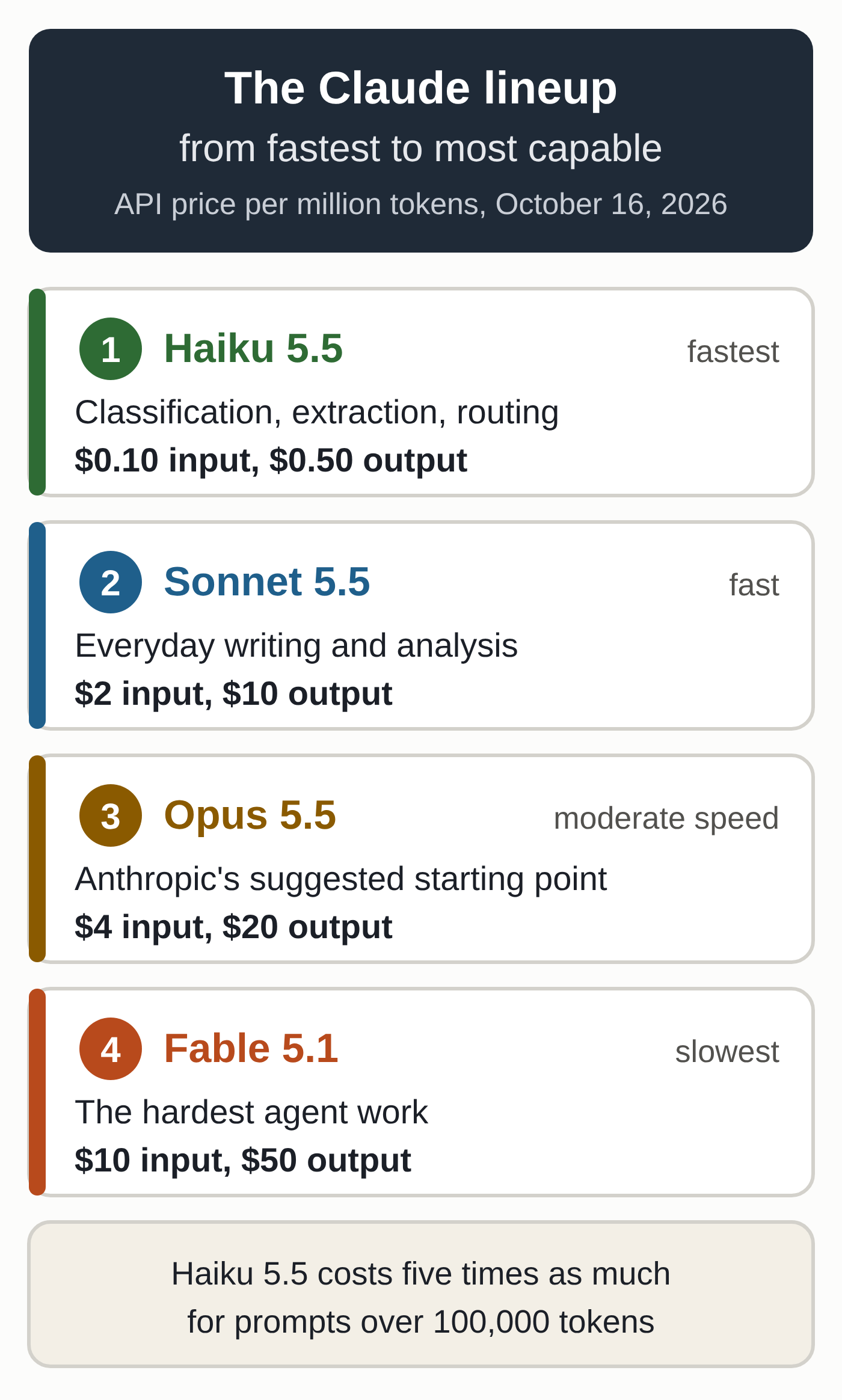
Haiku, Sonnet, Opus and Fable, one model at a time
Claude Haiku 5.5 for sorting and extraction at volume
Haiku 5.5 is built for repetitive work where speed and cost matter more than depth. Anthropic lists classification, extraction, routing and subagent work, where a small model handles one step for a bigger one. In a small business, that means sorting incoming email, pulling the amounts off an invoice or tagging form submissions. Its effort setting defaults to “medium.”
Its price depends on the size of the request. For prompts up to 100,000 tokens (a prompt is all the text sent in one request), it costs $0.10 per million input tokens and $0.50 per million output tokens. Above that, each request pays five times as much, even if part of the text comes from the cache.
It also counts about 30% more tokens than Haiku 4.5 for the same text. Our article on Claude Haiku 5.5’s price cut runs the numbers on 1,000 emails.
Claude Sonnet 5.5 for everyday work
Anthropic describes Sonnet 5.5 as the model with the best mix of speed and intelligence. Its suggested uses fit a small business well: writing content, analyzing data, understanding images, generating code and letting an agent use tools. It thinks before answering when the task calls for it, with effort set to “high” by default.
At $2 per million input tokens and $10 per million output tokens, it costs half as much as Opus 5.5, and the app offers it on the free plan. For letters, meeting notes or a spreadsheet to analyze, it’s the model to start with.
Claude Opus 5.5, Anthropic’s suggested starting point
Opus 5.5 is built for coding and knowledge work handed to an agent over long sessions. Anthropic’s examples include an agent that codes on its own for hours, a large-scale code refactor and work that involves reading lots of images or operating a computer. Its thinking is always on and can’t be turned off; effort is the main dial, and it defaults to “medium.”
Opus 5.5 costs $4 per million input tokens and $20 per million output tokens, down from $5 and $25 for Opus 5. On Anthropic’s API, a fast mode that generates output up to 2.5 times faster costs double: $8 and $40. In the app, Opus requires a paid plan.
Claude Fable 5.1 when Opus isn’t enough
Fable 5.1 is the most capable model Anthropic offers to all of its customers. Its suggested uses: agent sessions that run for hours, multistep deep research, analysis carried all the way to a finished document, spreadsheet or slide deck. It’s also the slowest model in the lineup and costs 2.5 times as much as Opus 5.5: $10 per million input tokens and $50 per million output tokens.
Anthropic recommends Fable 5.1 for demanding reasoning and long-horizon agent work, or when Opus 5.5, set to a high effort level, still fails your own tests. In the app, Fable is included in Max for up to half of your weekly limit. On Pro, it runs on usage credits, which you pay for on top of the subscription at API rates.
Claude Mythos 5.1, for verified organizations only
Mythos 5.1 has the same capabilities as Fable 5.1, at the same price. Anthropic reserves it for organizations verified through one of its programs, such as the Cyber Verification Program for security professionals. A small business outside that field can skip it.
How much does a month of API usage cost?
With the API, you pay for the tokens you send and the tokens the model produces. The model’s thinking is billed as output, even when it doesn’t show up in the response. The three profiles below rest on simple assumptions; your numbers will depend on your texts and the effort level you pick.
First profile: sorting 2,000 emails a month with Haiku 5.5, at 2,000 tokens in (instructions included) and 300 tokens out (thinking included) per email. Input: 4 million tokens at $0.10, or $0.40. Output: 0.6 million at $0.50, or $0.30. Total: $0.70 a month, about €0.62, or half that with the Batch API if the sorting can wait.
Second profile: drafting 100 quotes or meeting summaries a month with Sonnet 5.5, at 8,000 tokens in (instructions, notes, a template to follow) and 3,000 tokens out per document. Input: 0.8 million at $2, or $1.60. Output: 0.3 million at $10, or $3. Total: $4.60 a month, about €4.10.
Third profile: analyzing a large file with Opus 5.5, 20 times a month, at 150,000 tokens in (about 375,000 characters) and a 20,000-token report, thinking included. Input: 3 million at $4, or $12. Output: 0.4 million at $20, or $8. Total: $20 a month, about €17.84.
The same file costs $10 on Sonnet 5.5 and $50 on Fable 5.1. On Haiku 5.5 it comes to $2.50, but every request crosses the 100,000-token threshold and pays the higher rate. For several questions about the same file, caching changes the math: on Opus 5.5, rereading the file from the cache costs $0.20 per million tokens instead of $4, after a cache write billed at $5 per million for five minutes, or $8 for one hour.
For comparison, the Pro plan costs $20 a month when billed monthly. The first two profiles cost under $5 a month; for automations like these, the time spent setting them up and keeping an eye on them outweighs the tokens.
App plans and the models they unlock
In Claude on the web, desktop and mobile, you pay for a plan that comes with usage limits. Claude’s plan pricing page lists these prices in US dollars, before tax:
- Free, no charge: Sonnet and Haiku, no Opus or Fable, and up to five projects.
- Pro, $20 a month, or $17 a month on an annual plan ($200 billed up front): adds Opus, plus Fable through usage credits.
- Max, $100 a month for 5 times Pro’s usage, or $200 for 20 times: Opus, and Fable up to 50% of the weekly limit. Billed monthly only.
- Team, for 2 to 150 people: Standard seats at $25 a month ($20 on an annual plan), Premium seats at $125 ($100 annually). Opus on every seat; Fable up to 50% of the weekly limit on Premium seats and through usage credits on Standard seats.
- Enterprise: $20 per seat per month, billed annually, 20-seat minimum, plus usage billed at API rates. Fable included.
For a Belgian account, claude.ai listed Pro at €18 and Max at €90 or €180 a month before tax on September 28, 2026; our guide to choosing between Pro, Max and Team covers those prices, VAT and a one-week test to help you decide. Projects, which hold your documents and instructions together, are changing shape: Anthropic has started moving some Pro and Max subscribers’ projects to a new version, as explained in our article on Claude Projects.
Max and Team also come with a monthly API credit: $100 on Max 5x, $200 on Max 20x, and on Team, $20 per Standard seat and $100 per Premium seat, pooled and capped at $500 a month. The credit doesn’t roll over and doesn’t cover interactive Claude Code. Pro and Enterprise aren’t eligible. For a young company, it matters all the more now that the Claude for Startups program turned down every pending application on October 13, 2026.
On the data side, training on your conversations depends on a setting you can switch off on Free, Pro and Max, and doesn’t happen by default on Team and Enterprise. The details are in our tool-by-tool table of privacy settings.
Usage limits in plain terms
Every plan has a per-session limit that resets on a rolling five-hour window. Paid plans add a weekly limit on top. The web app, the desktop app, mobile and Claude Code all draw from the same pool.
There’s no fixed message count: how far you get depends on how long your conversations are, which model you pick and which features you use. Per five-hour session, Pro gives at least 5 times Free’s usage, Max 5 or 20 times Pro’s, and a Team Premium seat 5 times a Standard seat, which already gets more than Pro. The model is part of the equation: on Max, Fable can’t use more than half of the weekly limit.
When you hit the limit, you can wait for the reset, move up a plan or, on a paid plan, turn on usage credits billed at API rates. Settings > Usage shows where you stand. If you hit the cap often, our seven settings to make it through the month on Claude Pro help you stretch it.
Effort, a setting that matters as much as the model
Through the API, all four current models accept an effort setting with five levels: low, medium, high, xhigh and max. Effort applies to every token the model produces, including thinking, text and tool calls. The higher it goes, the deeper the model digs and the more the response costs. According to Anthropic, tuning effort is often a better lever than switching models.
The defaults differ: “high” on Fable 5.1 and Sonnet 5.5, “medium” on Opus 5.5 and Haiku 5.5. A request that doesn’t specify effort therefore runs one level lower on Opus 5.5 than it did on Opus 5. Anthropic recommends “low” for simple tasks and subagents, and “xhigh” for agent or coding tasks that run longer than 30 minutes. On Opus 5.5 and Fable 5.1, thinking can’t be switched off; on Sonnet 5.5 and Haiku 5.5, it can be dialed down.
Before switching models, test the same task at two effort levels and keep the lowest one that gets the result right. To split work across several models, such as a small one that executes and a larger one that handles the hard calls, see our guide to choosing an AI model and organizing work across several agents.
How to read a model retirement notice
Anthropic’s deprecations page uses four statuses. An active model is fully supported and recommended; a legacy model no longer gets updates and may be deprecated later. A deprecated model still works, but it has a named replacement and a set retirement date. A retired model no longer responds.
For publicly released models, Anthropic commits to at least 60 days’ notice before retirement, by email to customers using the model and in its documentation. A current example: on September 30, 2026, Anthropic announced that Claude Sonnet 4.5 will be retired on November 30, 2026, with Sonnet 5.5 as the replacement. An automation that still calls claude-sonnet-4-5-20250929 will stop working on that date.
For current models, the page gives an earliest possible date: Opus 5.5 won’t be retired before September 22, 2027, and Haiku 5.5 not before October 7, 2027. Haiku 4.5’s earliest date, “not sooner than October 15, 2026,” has passed with no retirement notice, and the model remains active. If it gets deprecated, the minimum 60-day notice will apply. On October 29, 2026, Haiku 4.5 leaves the model selector in the Claude apps on the Free, Pro and Max plans (see our article on Claude Haiku 4.5 leaving the selector).
When a notice comes in, find the tools that use that model (the Usage page in Anthropic’s Console exports usage by API key and by model), test the replacement on your real data, then switch the model ID before the deadline. These dates apply to Anthropic’s own platforms; Amazon Bedrock and Google Cloud set their own schedules.
The right model for your situation
You write, summarize and reply in the app
Start with Sonnet 5.5, available on the free plan. Switch to Opus 5.5, on a paid plan, for a long document to analyze or a multistep line of reasoning. If you’re still torn between two assistants, our Claude vs. ChatGPT comparison on five office tasks settles it with concrete cases.
You automate a repetitive task
Use Haiku 5.5 through the API, starting at “low” effort, the efficiency-first approach Anthropic recommends for simple high-volume tasks. Check about 50 results by hand before letting it run, then raise the effort or move to Sonnet 5.5 if the error rate is higher than you can accept.
You hand a long job to an agent
Start with Opus 5.5, at “high” or “xhigh” effort if the task runs long. Move to Fable 5.1 only if Opus still fails your own tests, keeping in mind that it costs 2.5 times as much and responds more slowly. The risks of an agent left without guardrails are covered in our article on Anthropic’s report about AI agents.
You work with very long documents
All four models can read up to a million tokens at once. On Fable 5.1, Opus 5.5 and Sonnet 5.5, a 900,000-token request pays the same per-token price as a 9,000-token one. On Haiku 5.5, prompts over 100,000 tokens pay five times the base rate. For a file you reread often, caching cuts the bill sharply.
Three picks for your admin work
In most small businesses, three choices cover the bulk of the work: Sonnet 5.5 in the app for day-to-day tasks, Opus 5.5 for long files, and Haiku 5.5 through the API for repetitive jobs. Revisit them with each new release: all four families got a new version between September 1 and October 7, 2026. For a first concrete task, our guide to AI by profession starts from your line of work.
Before paying for a plan or the API on behalf of your business, read the Anthropic terms that apply to your situation.
If you’d rather hand off your admin work without comparing models yourself, take a look at our AI assistant.