Since October 30, 2026, Google has been making bots wait on most of its google.com/goto redirects, the links that connect its search results to websites. A waiting page now holds automated requests for one to three minutes before the redirect, according to published measurements. Several of the APIs that collect search results for rank-tracking tools haven’t kept up. On October 31, five providers tested side by side by German SEO firm EverGrow SEO Solution returned a Google redirect or no link at all, instead of the site’s URL, for 55% to 85% of organic results.
SerpApi, one of the five, opened a public incident on October 30 at 10:39 UTC and announced a fix the next evening that covers only the top three results. Google has made no public statement about the change.
A waiting page before the redirect
Alex Greenland first spotted the goto format on June 23, 2026, and Search Engine Roundtable described it on July 8. It replaces a result’s direct link with a google.com/goto?url= address followed by a Google-specific code that obscures the destination. Google confirmed the rollout on August 26, according to PPC Land.
Through October 29, data providers resolved the real URL with one extra request per link before delivering results to their customers. On August 27, DataForSEO wrote that only 0.01% of the search results pages (SERPs) returned by its API could still contain an unresolved organic goto link.
At 01:30 UTC on October 30, that method stopped working for most links, according to cloro, a company that sells a Google SERP API. A request to a goto link now gets a “Verifying your request” page with a countdown and no error code, and only then redirects. In cloro’s traffic, the wait lasted 60 to 115 seconds and affected about 89% of the links it followed that day.
Hasan Kalkan, an SEO consultant in Aachen, Germany, and the author of the EverGrow study, saw the same thing on October 30 at 22:20 UTC. All 12 goto links on a fresh SERP returned the waiting page and redirected only after 180 seconds.
Up to 85% of results with no URL
The study opens with an example. On October 30, the author’s tool ranked a site outside the top 10 for its own brand name, with “google.com” among the other results. A second request, read from the “breadcrumb” field, showed the site at No. 1. The author cautions that two separate requests fall short of a controlled comparison.
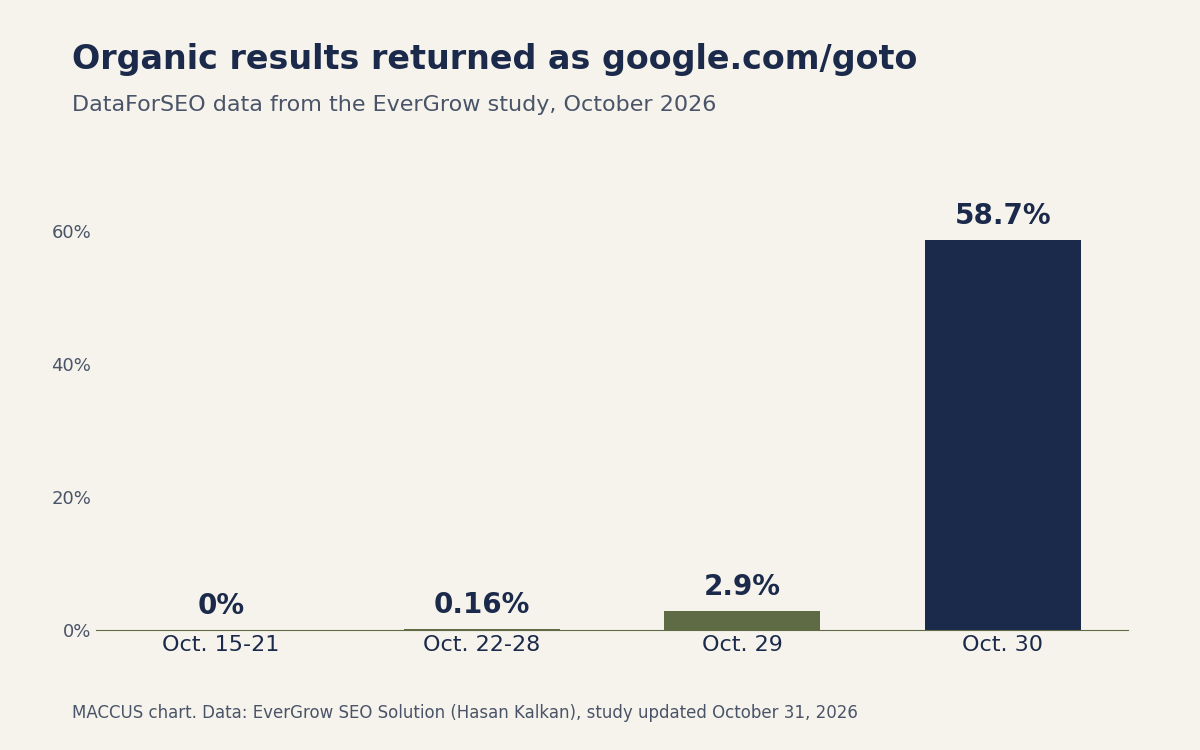
He then went back through his DataForSEO data. Among 71,531 organic results collected from October 15 to 21, on queries that varied by day, none carried a goto URL. From October 22 to 28, 99 out of 63,782 did. On October 29, the issue hit 27 SERPs, all between 12:19 and 13:20 UTC.
On October 30, in a sample of 508 SERPs across eight countries, 2,552 of 4,344 organic results (58.7%) came back with “google.com” as the domain and a goto URL. In France, the rate was 58.4% (153 of 262).
On October 31, he sent the same queries at the same time to five APIs in eight countries. None returned every URL. The share of organic results without a real URL reached 84.7% at SerpApi, 73.1% at Bright Data, 69.4% at Oxylabs, 59.9% at DataForSEO and 54.8% at Serper. Serper returned the real URL for the top three positions on every page, then left it out for about 80% of results from position four on.
Measurements by cloro point the same way. On its reference queries between 07:00 and 20:00 UTC on October 30, the share of real organic links fell to 13% at SerpApi, 29% at Oxylabs and 35% at DataForSEO, from 95% to 97% before. Its own share dropped from 100% to 24%.
An error that looks like a normal response
The problem doesn’t show up in error dashboards. DataForSEO’s responses come back with an “Ok.” status, the EverGrow study notes. SerpApi, DataForSEO and Oxylabs kept delivering pages full of goto links without flagging an error, cloro reports.
The result itself stays in the response, with its position, title and description; only the site’s URL is missing. In the October 30 sample, the domain appeared at the start of the “breadcrumb” field for 94.9% of the affected results. In all 189 cases the author checked, the redirect led to that domain.
So a tool that matches rankings to the domain of the returned URL, without reading the displayed link, credits Google with the site’s position. According to the study, rankings and visibility scores calculated that way may be too low from October 22 on, especially since October 30. The author recommends checking any drop in Search Console, using the same query, page, country and device. Search Console was already the go-to source during the September spam update, when rank-tracking data was incomplete.
The slowdown comes on top of the distorted results pages Google has been serving to rank-tracking bots since September. We covered them on October 14, then on October 28 after Semrush and Ahrefs confirmed them. The EverGrow study treats the two as separate problems.
Providers look for a workaround
On its status page, SerpApi says its Google Search API “is returning /goto links for organic results instead of direct links.” A fix announced on October 31 at 18:23 UTC restored direct links for the top three results only, and the incident was still open. A public GitHub ticket opened on September 18 had already reported intermittent goto links, which SerpApi had managed to reproduce only once in 100 searches, on October 28.
As of November 1, DataForSEO had posted nothing on its updates page. According to its support team’s replies, as summarized in the EverGrow study, Google now caps how many goto links from a single SERP can be resolved in a short window, and switching IP addresses or waiting doesn’t help, it says. On October 31 at 17:12 UTC, support confirmed that the API’s standard queue, which it had first said resolved every link, was returning goto links too.
DataForSEO’s support recommends goto_url_converter, a free endpoint that converts up to 100 goto URLs per request, including in previously collected data. In the author’s tests, it returned the correct domains, taking 31 to 41 seconds per SERP for fresh links.
From 20:20 UTC on October 30, cloro says it was back to 100% real links, using a different route through Google that it doesn’t describe. It acknowledges that the measurement window is short.
Limits of the published data
The numbers come from two sources. The first, cloro, is a direct competitor of SerpApi, DataForSEO and Oxylabs, and its product comes out on top in its own benchmark. The EverGrow study documents its method in detail, but the queries were hand-picked, so the 58.7% figure doesn’t apply to all Google searches, the author warns. It covers APIs and doesn’t measure the rank-tracking tools businesses buy.
The proposed cause, a per-page limit, comes from DataForSEO’s support team; the author finds it consistent with his own test but impossible to fully verify from the outside. As of November 1, Google had published nothing on the Search Central blog, in the Search documentation changelog or on the Search Status Dashboard. No published measurement shows whether people who click a result see the waiting page.
What it means
Nothing suggests that Google changed its rankings on October 30. It slowed down the step that lets a bot see which site holds which position. For a publisher or online retailer that tracks rankings in a third-party tool, the risk is a false signal: a drop, or even a missing brand result, with no actual loss in Google. Search Console runs on Google’s internal data and isn’t affected.
Google’s spam policies classify “scraping results for rank-checking purposes” as machine-generated traffic, which violates its terms of service. In an August 31 newsletter quoted by PPC Land, SISTRIX founder Johannes Beus argued that these data-collection restrictions were aimed primarily at Google’s competitors, such as ChatGPT, which draws on Google’s results without an index of its own. In his view, measurement tools were collateral damage. The October 30 change comes after Google dropped the num=100 parameter on September 14, 2025, rolled out goto links broadly in late August and began serving distorted pages in September.
Two independent sets of measurements pin down the timing, and SerpApi has acknowledged the incident. The explanation of the mechanism comes from one provider’s support team alone, and there’s no word on how long it will last.
Next up is EverGrow’s new measurement, scheduled for November 3. Also worth watching: whether SerpApi closes its incident, any word from DataForSEO or rank-tracking vendors, and a possible statement from Google, which has said nothing about the goto format since confirming its rollout.
Sources
- Study: Google goto links in SERP API data, EverGrow SEO Solution (Hasan Kalkan), October 31, 2026
- Study: Google goto links at SerpApi, Serper, DataForSEO, Bright Data and Oxylabs, EverGrow SEO Solution (Hasan Kalkan), October 31, 2026
- Google goto URLs: what broke on 30 October and who fixed it, cloro (Ricardo Batista), October 30, 2026
- [Google Search API] /goto links returned in organic_results->link, SerpApi Status, October 30 and 31, 2026
- [Google Search API] /goto links returned in organic_results -> link (issue #4315), SerpApi on GitHub, September 18, 2026
- Google’s Goto Rollout: We Already Resolve 99.99% of URLs, DataForSEO, August 27, 2026
- Google’s goto links force SISTRIX into added-cost tracking workaround, PPC Land (Luis Rijo), September 3, 2026
- Spam policies for Google web search, Google Search Central, accessed November 1, 2026
Header image: MACCUS chart. Data: EverGrow SEO Solution (Hasan Kalkan), measured October 31, 2026