
On October 28, 2026, Google launched a preview of its Connected Apps Platform, a single entry point that lets developers plug their services into AI Mode in Search and into the Gemini app. A connected app completes a task at the user’s request: filling a grocery cart, creating a graphic, booking a table. Until now, building one meant working closely with Google, as 9to5Google points out.
According to TechCrunch, the preview is open for now to US-based developers who sign up for a waitlist. On the Search side, Google’s help page limits the feature to AI Mode in the US, in English.
One console for Search and Gemini
Google’s blog post, by Chips Mistry (Group Product Manager, Search) and Mai Lowe (Group Product Manager, Gemini app), lays out the process. A service connects through a cloud-hosted MCP server, or through Android MCP with the AppFunctions APIs. The Model Context Protocol (MCP) is an open protocol that lets an AI assistant call a third-party service’s tools. Our directory of MCP servers and connectors lists existing ones by the business software they plug into.
The developer then registers the service, tests it and submits it through a new Google Connected Console. Before Google reviews it, the developer chooses where it will appear: Search, the Gemini app or both. Once the app is live, the console shows its traffic, latency and error rates. The publisher keeps control of its brand identity, with a verified logo and authenticated accounts.
The developer guide, updated October 27, says users can call an app with “@name” or mention it by name in a request. The app then stays in context for related requests in the same session. Google recommends clear server instructions, because the models rely on them to decide when to hand a task to the app. Each tool has to be declared as read-only or as an action that changes data, and developers can use the console to flag operations that require confirmation.
Apps running since the spring
On May 19, Google added MCP connections to Canva, OpenTable and Instacart in the Gemini app. On July 16, connected apps started rolling out to AI Mode in Search for US users, with Instacart, Canva and YouTube Music. Google says it has now launched more than 50 connected apps across Search and Gemini, in areas ranging from productivity and event ticketing to health and fitness.
Adobe, Experian, Localiza and Peloton already work in Gemini and are due in Search “in the coming weeks.” A new integration with the meditation app Calm is coming to both. For now, the Search help page lists Instacart, Canva, YouTube Music and two fantasy football services, Yahoo and Sleeper.
Users need an account with the service, which they link to their Google Account once. AI Mode handles the request and sometimes hands off to the app to finish it; checkout for a grocery order, for example, happens on Instacart. For a given task, Google may default to the last app used, and users switch to another one by naming it.
The rules app publishers must follow
The platform policy, dated September 28, 2026, bans third-party advertising and promotional material from apps; publishers’ own brand elements are still allowed. It prohibits “overly broad or deceptive” capability descriptions written to push the model toward one app over another. Hidden, dormant or undocumented features are off-limits too, as are evasion techniques such as cloaking or obfuscation used to get past review.
An app can’t simply wrap or repackage an API its publisher doesn’t own. It has to keep the data it exchanges to the minimum needed and publish a privacy policy. When an app breaks the rules, Google can reject it, suspend it or remove it from the platform, and can also suspend or terminate the developer’s account.
Availability in France
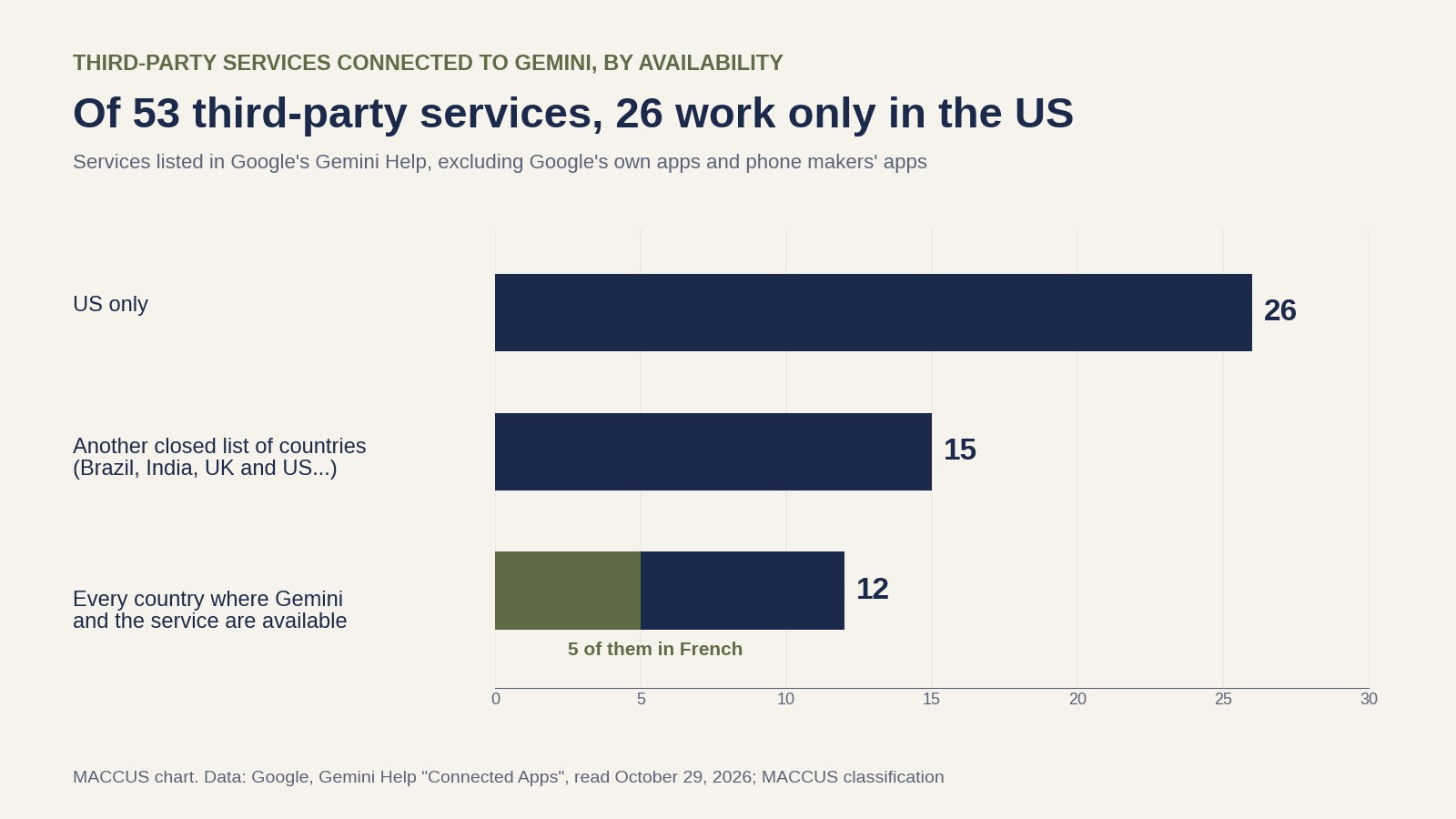
AI Mode and AI Overviews have been available in France since July 22, 2026, but without connected apps, which Search limits to the US. For the Gemini app, Google’s help page lists the countries and languages each connected app covers. By our count, of the 53 third-party services it lists (excluding Google’s own apps and those from phone makers), 26 work only in the US. Fifteen are restricted to their own short lists of countries, most often just Brazil or just India, and France is on none of those lists.
The remaining 12 are open wherever both Gemini and the service are available, and five of them support French: WhatsApp, Canva, Wix, Spotify and GitHub. On October 20, Google introduced its Gemini hub for small businesses and announced that the hub’s tools and new connected apps would roll out “globally for all Gemini app users.” The post named Shopify and Dropbox among the services Gemini can connect to. The Gemini help page, checked on October 29, still lists both as US only.
Google says it is opening access in phases and will add “more developers, markets, and Google products over the coming months.” TechCrunch reported that Google didn’t say when the platform would become more broadly available.
Early reactions
John Mueller, a Search Advocate at Google, wrote on LinkedIn that he was “super excited about connected apps as a search platform,” according to Search Engine Roundtable. “It’s still extremely early,” he added, though “the mix of standardized interface / MCP + Search opens up a lot of possibilities.” He noted that he doesn’t work on connected apps and was sharing his personal view.
On X, SEO consultant Marie Haynes recalled Google CEO Sundar Pichai saying that Search would become an “agent manager,” and wrote: “This is it!” TechCrunch’s Sarah Perez wrote that, much as SEO let companies and websites show up in search rankings, the move could be one of the first steps for businesses that want their services to be more visible on the agentic web. ChatGPT and Meta’s Muse agent, she noted, already offer their own takes on the idea.
Barry Schwartz of Search Engine Roundtable pointed out that searchers won’t necessarily see a published app: each user has to add it to their Google Account, as the help page explains.
The questions Google leaves open
Google promises developers they can reach “high-intent users” in Search and Gemini. The post gives no usage figures. The pages we read say nothing about how long review takes, how many developers have been admitted or whether publishers pay any fees or commissions.
How AI Mode chooses between two competing apps remains unclear. The help page mentions a list offered to the user and the last app used; the developer guide points to the server instructions the models rely on. Google doesn’t say whether other signals come into play, or how these apps sit alongside links to websites, whose placement in AI Mode changed on October 15.
What it means
Third-party services have been plugged in through MCP since May in Gemini and since July in Search, by partners that worked closely with Google. What changes is access. With the console, any developer admitted to the preview can submit an app on an open protocol, have Google review it and track its traffic. In Search, a business gets a second way to show up in AI Mode: alongside the pages cited as links, a service that acts on the user’s behalf.
First in line are services with customer accounts and an API: online retail, booking, ticketing and web-based software. In France and Belgium, the immediate impact is limited: the feature isn’t in Search there, and the preview targets US developers. In Gemini, 41 of the 53 third-party services aren’t available in France, and seven more support only English. The policy already goes after a tactic borrowed from SEO by banning overly broad or deceptive descriptions meant to steer the model’s choice.
It is still unknown when the platform will expand beyond the US, how much people actually use these apps and how Google weighs them against links to websites. Things to watch: the arrival of Adobe, Experian, Localiza and Peloton in Search, promised for the coming weeks; the opening of the preview to other countries; and whether connected apps reach AI Mode in France.
Sources
- Build and manage Connected Apps in one place, Google, October 28, 2026
- Connected Apps Platform, Google for Developers, accessed October 29, 2026
- Connected Apps Platform MCP server developer guide, Google for Developers, October 27, 2026
- Connected Apps Platform policy, Google for Developers, September 28, 2026
- Use & manage Connected Apps in Search, Google Search Help, accessed October 29, 2026
- Check the availability & requirements of Connected Apps in Gemini Apps, Gemini Apps Help, accessed October 29, 2026
- As AI agents reshape the web, Google opens Gemini and Search to more apps, TechCrunch, October 28, 2026
- You Can Now Build Apps For Google Search: Connected Apps Platform, Search Engine Roundtable, October 28, 2026
Header image: MACCUS chart. Data: Google, Gemini Help “Connected Apps”, read October 29, 2026; MACCUS classification