
Restaurants can now choose which third-party ordering services appear on their Google Business Profile in Search and Maps. Lisa Landsman, Google’s head of industry engagement and SMB success, announced the change on October 28, 2026, in a LinkedIn post. Instead of asking each delivery platform to pull its feed, the owner switches the provider off in the profile dashboard. Business Profile is the tool formerly known as Google My Business, and our guide for restaurants walks through its sections.
The rule Google sets for those platforms was updated on October 19. It now says all partner integrations “are enabled by default, but a merchant may disable a partner at any time.” Under the April 1 version, the last one archived, providers had to handle removal requests themselves within five business days. Business Profile rules had already changed in September, when Google tightened its policy on promotional text, as we reported on October 13.
One switch per platform, for pickup and delivery
Search Engine Journal describes the screenshot shared with the announcement: a “Manage provider” panel for a placeholder provider, www.provider.com. Under the heading “Show provider to customers,” two separate switches control pickup and delivery. A restaurant can keep a platform for delivery and hide it for pickup, or the other way around.
“One of the most frequent requests we hear from restaurant operators is simple: more control over their ordering links,” Landsman wrote. If an integration no longer fits a restaurant’s operations, margins or kitchen flow, she added, the owner can now turn it off without going back and forth with the platform.
In the same post, she made the case for keeping several services listed. Diners often stick to the platforms where they have an active subscription or a saved card, she wrote, and giving them a choice can capture an order that would otherwise go elsewhere. Barry Schwartz of Search Engine Roundtable gave Uber Eats, DoorDash, Instacart and Grubhub as examples of services restaurants should now be able to switch off, and called it a feature they “have been begging for for many years.”
The partner rule, updated October 19
The “Ordering Redirect Compliance Requirements” page sets out what ordering services must do when they send their links to Google through the Actions Center, its partner program. Search Engine Journal compared the current version with a copy archived in May. We ran the same comparison on October 30 against that archived copy, captured May 12, 2026.
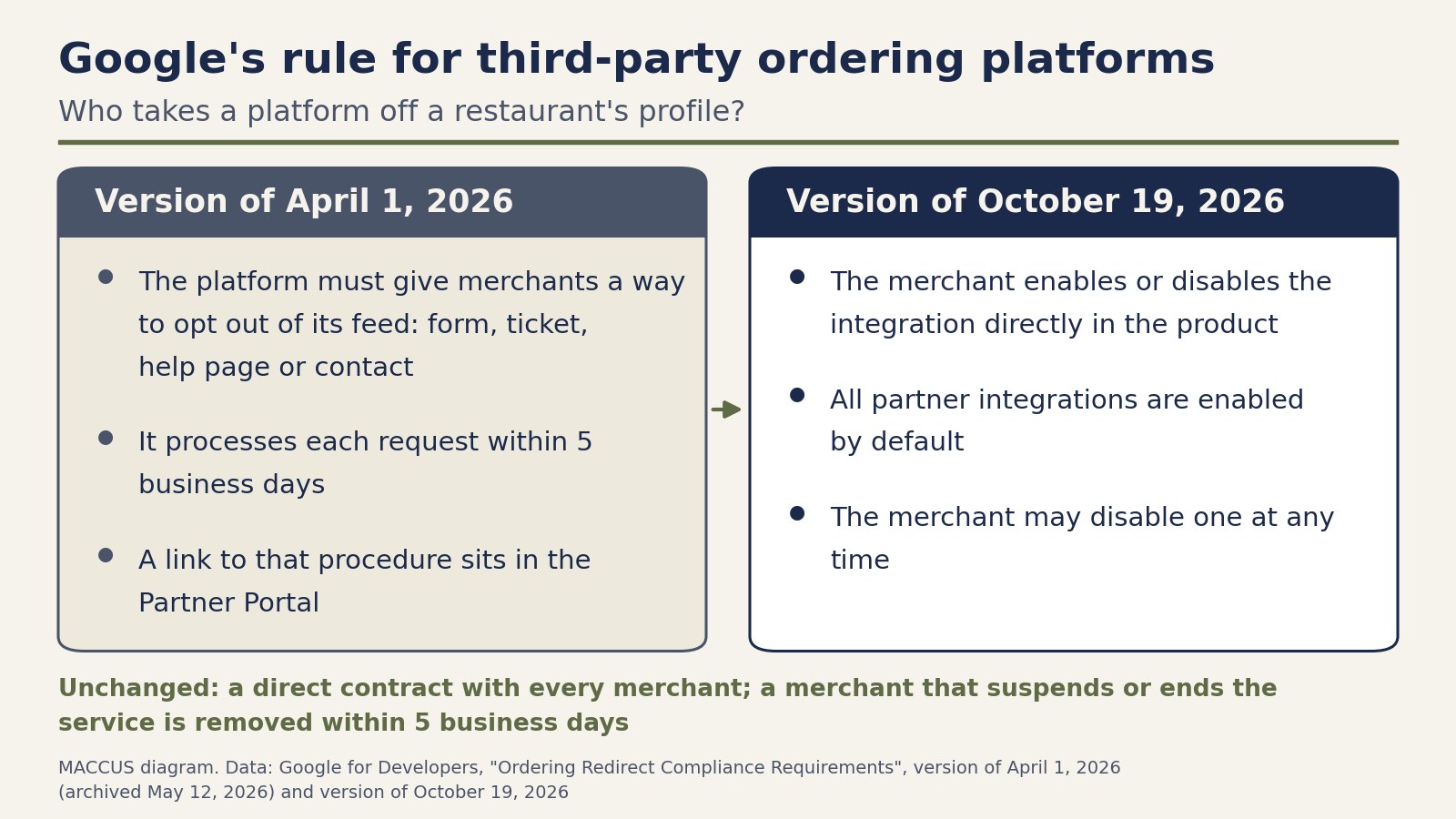
In the version dated April 1, 2026, the provider had to give restaurants a way to opt out of its feed and process each request within five business days. Google listed examples: an in-product opt-out page, a removal request form, a support ticketing system, a help page or a contact page. A link to that procedure had to appear in the Partner Portal.
The October 19 version deletes that paragraph. In its place, it says that merchants may enable or disable a partner integration directly through product controls, that all partner integrations are enabled by default and that a merchant may disable one at any time.
The rest of the text is unchanged. The provider still needs a direct contract with every merchant in its feed. It must remove any merchant that no longer has a contract or asks to leave, and, within five business days, any merchant that has suspended or ended the service. If a provider breaks the rules, Google can disable the integration, limit or suspend its access to other Google programs such as Business Profile, and notify the provider’s customers.
Google’s help page still describes the old process
As of October 30, the Business Profile help page “Manage online ordering options” did not mention the new switch, in English or in French. To remove a provider, it still points to a “Remove link” option, then says providers must take third-party links off a profile “within 5 business days.” Search Engine Journal flagged the same gap on that help page on October 28.
The same page describes two other settings. The first, “Accept orders on your profile,” works across the board: once it is off, “any third-party order options and links you add are hidden.” The second, “Set as preferred,” highlights a provider or a link for pickup or for delivery. The panel shown on October 28 adds a middle layer, with one setting per provider.
Which countries get it?
Asked in the comments which countries have the setting, a Google product manager, Michael G., replied “all,” Search Engine Journal reported. Neither the post nor the help pages give a list.
Google’s restaurant page on its French Business Profile site is narrower. It says merchants in Germany, Australia, Canada, the United States, Japan and the United Kingdom can work with online ordering providers to offer pickup or delivery on their profile. France and Belgium are not on that list.
Ordering buttons that point to delivery platforms do show up on French profiles, though. Two French companies that sell direct-ordering tools to restaurants, BungeeFood (August 30, 2026) and Savoryo (September 5, 2026), describe “Commander” (Order) buttons that lead to Uber Eats or Deliveroo even though the restaurant never added them. Removing them takes a request from the profile, they say, and Savoryo adds that the platforms handle the rest. For businesses outside the US, Google’s help page also describes “Place an order” links supplied by third-party providers.
European profiles have already seen changes of their own. In late September, search impressions for about 15,000 Business Profiles in the European Economic Area fell by more than 70%, according to a study by GMBapi. It is not yet clear whether the new panel shows up on French and Belgian profiles.
Questions the announcement leaves open
The announcement rests on a LinkedIn post and a screenshot with a placeholder provider. The binding document is the partner rule, and its new version sets out the principle without naming the setting or saying when it went live. As of October 30, we found no post on Google’s official blogs and no list of the platforms involved.
Commenters asked whether the setting works in bulk or through the Business Profile API, and the post does not say, Search Engine Journal noted. An agency or a restaurant chain that manages dozens of profiles does not yet know whether it will have to handle them one by one.
What it means
The decision moves from the platform to the restaurant. Under the April 1 version, the rule required each platform to offer its own opt-out procedure and carry it out. Now the restaurant flips the switch itself in Google’s interface, without waiting on its partner. The default stays the same: a platform that claims a contract with the restaurant shows up until someone turns it off.
Restaurants in the six countries Google lists, and the agencies that run their profiles, are affected first. The buttons matter because of where they sit: on the restaurant’s own profile, where customers also land when they are already searching for the restaurant by name. To BungeeFood, that means paying platform commissions on orders the restaurant could have taken directly. Landsman makes the opposite case: listing several services avoids losing customers who are loyal to their app.
The updated rule and the screenshot can be checked. Availability in “all” countries rests on a single reply in a comment thread, and Google’s French page does not reflect it. There is no word yet on the rollout date, on whether the panel will reach French and Belgian profiles or on API access. Two signals will show whether the setting has rolled out widely: an update to the help page, which still describes a removal request handled within five business days, and the setting appearing under “Food ordering” on profiles in France.
Sources
- Ordering Redirect Compliance Requirements, Google for Developers, October 19, 2026
- Ordering Redirect Compliance Requirements (version of April 1, 2026), Internet Archive, captured May 12, 2026
- One of the most frequent requests we hear from restaurant operators, Lisa Landsman (Google) on LinkedIn, October 28, 2026
- Manage online ordering options, Google Business Profile Help, accessed October 30, 2026
- Menus et présence pour les restaurants, Google Business Profile (France), accessed October 30, 2026
- Google Gives Restaurants Direct Control Over Ordering Providers, Search Engine Journal, October 28, 2026
- Google Business Profiles Adds Third-Party Ordering Controls For Restaurants, Search Engine Roundtable, October 28, 2026
- Bouton « Commander » sur la Fiche Google : le Faire Pointer vers Votre Propre Site, Savoryo, September 5, 2026
Header image: MACCUS diagram. Data: Google for Developers, “Ordering Redirect Compliance Requirements”, versions of April 1 and October 19, 2026