

On October 11, 2026, the Performance report in Google Search Console was more than 64 hours behind, according to Barry Schwartz of Search Engine Roundtable. He watched the delay climb to 67 hours during the day before a refresh brought it back down to 44 hours. The report normally runs only a few hours behind. Google hadn’t commented when Schwartz published his story.
The delay comes on top of three weeks of incomplete data from several rank-tracking tools. It’s bad timing. Google finished its September spam update on October 8, and you probably want to know whether your site lost ground. Here’s how to read your numbers without mistaking a gap in the data for a drop in traffic.
Search Console falls up to 67 hours behind
Schwartz took his screenshot around 7 a.m. ET on Sunday, October 11. Search Console often runs late, he notes, but the delays usually hit the page indexing report or other parts of the tool, rarely the Performance report. The last delay this large was in December 2025, when the report fell more than 60 hours behind. At the time, Google’s John Mueller said on Bluesky that only the reporting was affected, with no impact on crawling, indexing, or ranking.
This time, Google hasn’t said anything as of this writing. Its Search Console data anomalies page, checked on October 12, lists no incidents for September or October.
Overnight on October 11, the Search Console API returned no data later than October 9 for the property we queried. The hourly data, the same data behind the “24 hours” view, stopped on the evening of October 8, Pacific time.
Google says this view, launched in December 2024, runs only a few hours behind. In our checks, it showed nothing newer. Tools connected to the API, such as a Search Console dashboard or an automated client report, get the same delayed data.
Three weeks of spotty rank tracking
Rank trackers query the search engine every day, which Google doesn’t allow. Its spam policies, checked on October 12, give this example of machine-generated traffic: “scraping results for rank-checking purposes.” Google adds that such activities also violate its Terms of Service.
On September 16, Sistrix wrote on its status page that Google had once again changed how it delivers search results and that the company was collecting data at a reduced rate. Steve Paine of Sistrix, quoted by Search Engine Roundtable two days later, said Google had been making these changes for about a year, at a very fast pace lately. On September 26, the company added on the same page that Google was sometimes returning incomplete or distorted results and that Sistrix would refresh fewer keywords each day. On October 12, a banner on that page still said rankings were being updated less often than usual.
On September 18, Schwartz also reported that Google appeared to have been blocking rank trackers more effectively since around September 13. Consultant Glenn Gabe compared several tools on a site that had just recovered its traffic: one showed the recovery, another showed it late, and a third didn’t show it at all.
Ranktracker, which also sells a rank tracker, published an investigation on October 7 into its own data and more than 20 competing tools it didn’t name. It says search results pages started behaving differently around September 17 and that things got worse during the spam update. In some of its tests, only 1 to 3 first-page results were collected. As an example, it notes that a page ranking 38th can look lost if the tool stops at position 20, even though the page never moved.
As recently as October 11, an SEO professional on Reddit described drops of more than 50 positions in their rank-tracking data, even though their Search Console impressions and traffic hadn’t declined.
Which source should you trust for each period?
According to its Search Status Dashboard, Google launched the September spam update at 4:15 p.m. UTC on September 24 and declared it complete on October 8. The first anomalies Ranktracker noticed, around September 17, came a week before the launch. In our checks, Search Console covers the whole update, but it shows nothing after October 9 yet.
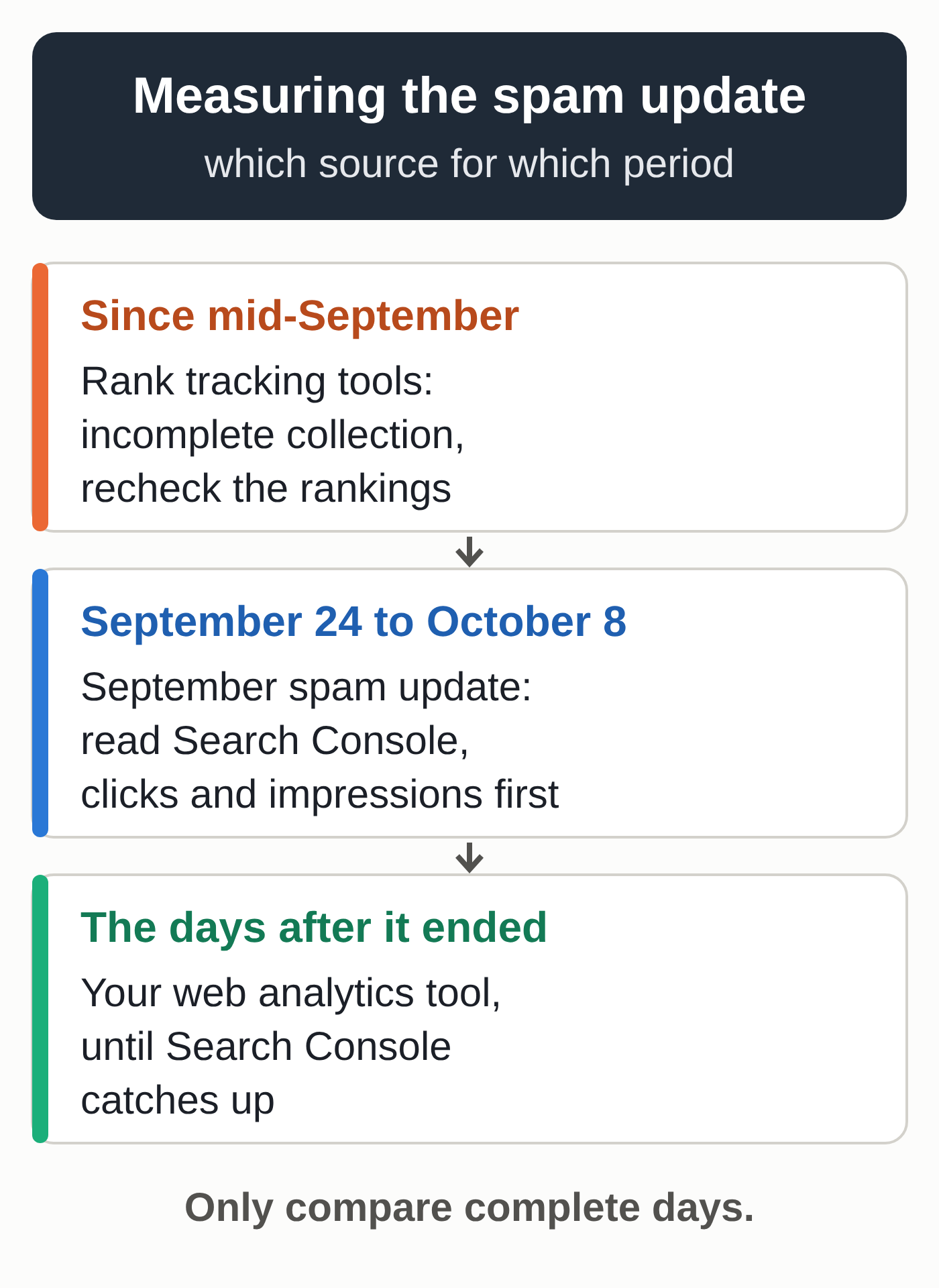
Our article on the September spam update explains how to check whether your site was hit. Before you compare anything, sort out your sources:
| Source | Status on October 12 | Recommended use |
|---|---|---|
| Search Console Performance report | nothing after October 9 in our checks | baseline for September 24 to October 8 |
| “24 hours” view | stopped on the evening of October 8 in our checks | ignore it while the delay lasts |
| Rank-tracking tools | incomplete data collection reported since mid-September | trends only, after verification |
| Your web analytics tool | not affected by either problem | visits from Google after October 9 |
Six checks before you call it a traffic drop
- Confirm how fresh your data really is. In the Performance report, look at the last day shown on the chart and the “last updated” note. Compare only complete days. Missing data isn’t a drop in traffic.
- Compare the spam update period with an equivalent period. That’s what Google’s documentation recommends for analyzing a drop, followed by a breakdown by query, page, country, device, and search appearance. For example, compare September 24 through October 8 with the previous 15 days or with the same dates in 2025. Regex filters in Search Console can help you isolate a group of queries.
- Look at clicks and impressions before position. Google says so in its guide to debugging traffic drops: “In general, you shouldn’t focus too much on your absolute position. Impressions and clicks are ultimately the measure of success for your site.”
- For the days after October 9, use your web analytics tool. It measures visits from Google Search on your own site, independently of Search Console. The two tools count differently, so compare trends.
- Treat rankings collected since mid-September with caution. Look for groups of keywords that disappear and come back together. Ranktracker recommends starting your rechecks with keywords that ranked between positions 20 and 100. Ask your provider how many positions it currently tracks, because according to the same investigation, some now track only the top 20, 30, or 50.
- Annotate your reports. If you send numbers to a client or to management, flag both unreliable periods on the charts: rankings since mid-September and Search Console after October 9. If a report you already sent showed a drop during the incomplete collection period, send a correction. A good provider checks its sources before alarming a client. We’ve covered other signs of a bad SEO agency.
Wait for complete data before changing pages in response to the spam update.
Signals to watch in the coming days
The first thing to watch for is a comment from Google, either on its Search Central accounts or on the data anomalies page. The second is a backfill of the missing days.
Google has filled gaps before. On August 21, 2026, the same page said missing impressions in the generative AI report for August 13 to 17 had been restored. Not every gap gets filled, though. The page also lists two days, one in late February and one in early March, missing from bulk data exports for some properties, and says that data won’t be recovered.
For rank tracking, keep an eye on your provider’s status page and on how deep its data collection actually goes.
Schwartz also notes that some people read the delay as a sign of an upcoming core update. He doubts it, though he thinks one should arrive soon. The last one, the May 2026 core update, finished on June 2.
What we still don’t know
Google hasn’t given a cause or said when things will return to normal. We can’t say every property has the same delay, because our checks cover a single site. We didn’t check the page indexing report for this story. Our guide to indexing explains how that part of Google works.
Most of the findings on rank trackers come from the companies that sell them, and Google hasn’t commented on the September changes they describe. Nor is there an established link between the spam update and these problems. Schwartz dates the start of the delay after the update, with no confirmation from Google.
Once the data is back, you’ll know what the spam update changed for your site. If you’d like a second opinion on those numbers, request our free SEO audit.