
On October 31, 2026, DeepSeek released dsh-superagent-prototype on GitHub, an MIT-licensed coding agent that works proactively on a single repository. The same day, the DeepSeek Harness team used a WeChat post to describe an always-on “Super-agent” that reacts to what happens around a team, a design the prototype partly implements. When one person oversees several agents at once, the team argues, that person’s attention sets the limit. The repository page warns in bold that the code is a “Research prototype for reference only, not an official DeepSeek product.”
On November 1, Bloomberg framed the release as a bid to challenge Claude Code, Anthropic’s coding agent, and the South China Morning Post placed it in a coding race between DeepSeek, OpenAI and Anthropic. DeepSeek’s own texts make no such comparison. The release came ten days after Anthropic launched Claude Duet, an agent that reaches out first, available only in the United States for now.
The repository holds a single commit, signed “DeepSeek Harness Team,” and showed about 5,600 stars and 530 forks in the early afternoon of November 1, Paris time. The prototype plugs into DeepSeek Harness, the company’s open-source agent platform, now in public preview. The Harness repository, created on August 13, has passed 260,000 stars. On October 17, DeepSeek had already opened a pay-per-call web search API to developers.
Three to five sessions per person
The post, written by Yujia Qiao, who also built the system, says up front that its architecture ideas do not describe current DeepSeek Harness features. It starts from the observation that agents still work one session at a time, which forces anyone juggling several tasks to switch between sessions and keep track of each context.
“In our observation, one person can usually keep up with only 3 to 5 active sessions at a time,” the team writes. With agents built this way, it concludes, a single task is limited by the model’s capability, while multitasking is limited by human attention. A Super-agent should therefore be continuous, efficient, proactive and persistent. Persistent here means always online and able to recover on its own when something goes wrong.
In the instance DeepSeek runs internally, a single task can carry over from a group chat to a GitHub pull request. The instance also monitors a public group chat and, without anyone tagging it, tracks down the root cause of a bug and submits a fix. A rule called “silently reproduce and fix” has it work on each reported problem in the background. The instance delivers a result only if it has confirmed the problem and found a simple fix; otherwise, it stays quiet.
A router that dispatches, workers that execute
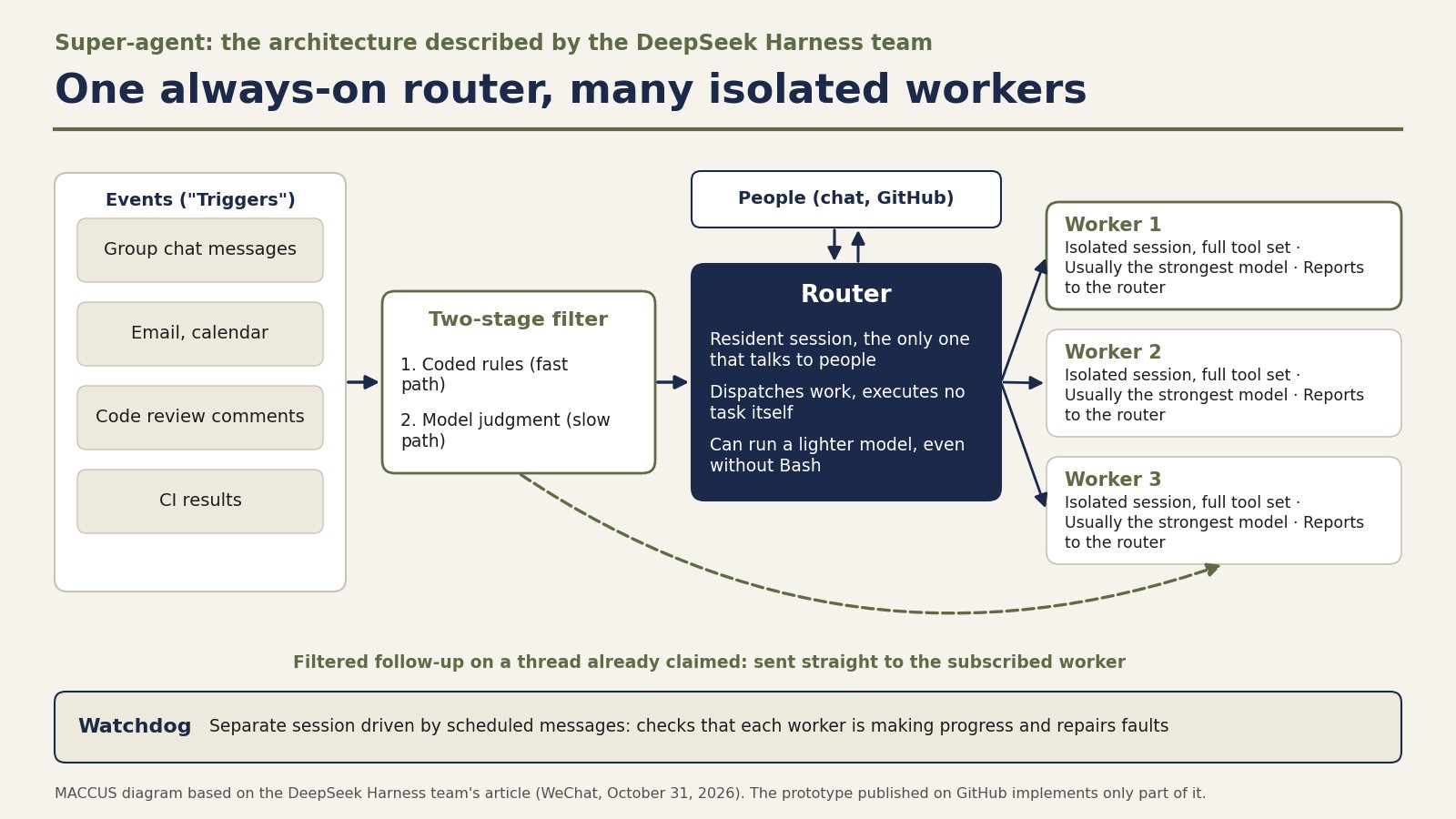
The architecture has two layers. An always-running “Router” handles all interaction with people and hands out the work without executing any task itself; it can even do without a Bash tool and run on a lighter model. “Workers” are isolated sessions with the full tool set and usually the strongest model. They report to the router, the only component that answers people.
Group chat messages, emails, calendar reminders, code review comments and continuous integration (CI) results become “Triggers.” Rule-based filters first sort them by source, group or sender, and the model judges whatever gets through. Follow-ups on a thread already assigned to a worker, such as a pull request, go straight to that worker without passing through the router again. A separate session, the “Watchdog,” regularly checks that each worker is making progress and fixes problems.
The post also proposes running the agent loop in the cloud and leaving work machines where they are, with a lightweight daemon on each one to execute commands. The team calls this consistent with Anthropic’s proposal for “decoupling the brain from the hands.”
Preliminary numbers from a simulated workload
In section 7.1, the team compares four setups on a simulated stream of group chat messages and CI results. Each setup ran five times, and each run contained about 300 messages, roughly 20 of them work requests buried among chitchat, follow-ups, stop requests and automated messages. A tool that does nothing but wait stands in for the coding work, and message intervals and work durations are cut to a quarter. That means the test measures scheduling and coordination, the team says.
The Super-agent completes a task in 12.4 minutes at the median and 15.7 minutes at the 95th percentile. It was up against a single session equipped with a subagent tool, which can hand off a piece of work to a secondary session. With a neutral prompt, that session never delegated in five runs, and its 95th-percentile time hit 29.5 minutes. Prompted to delegate, it did so in four of five runs and was still slower than the Super-agent.
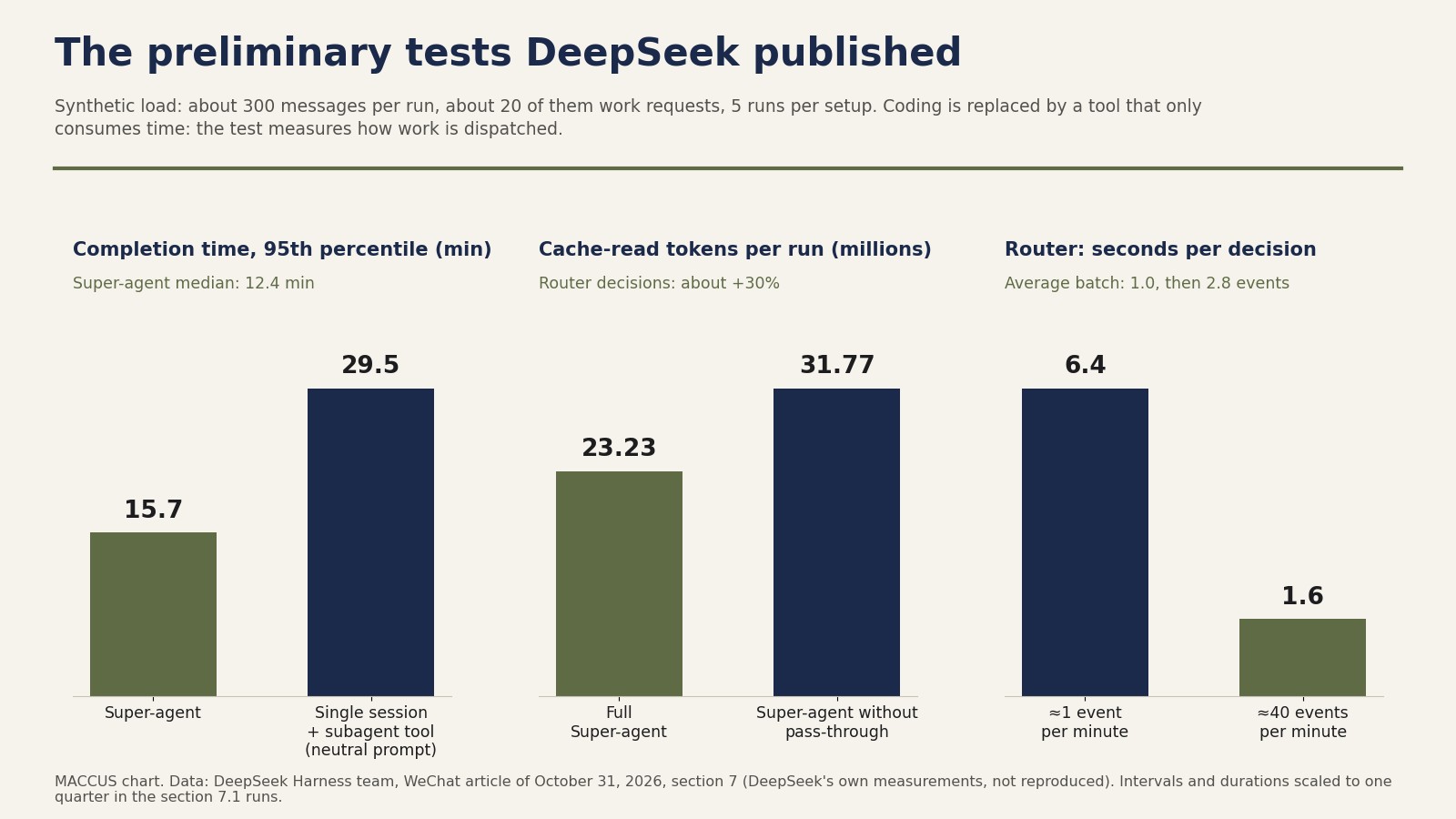
Because it maintains several sessions, the Super-agent reads more cached tokens than a single session does. With that direct routing to workers switched off, completion times stay almost the same, but the router makes about 30% more decisions and cache reads rise from 23.23 million to 31.77 million tokens per run, about 37% more. In a separate load test, as the stream rises from about 1 to 40 events per minute, the router’s average batch grows from 1 to 2.8 events and its inference time per decision drops from 6.4 to 1.6 seconds. DeepSeek offers these results “only as a preliminary reference.”
The prototype on GitHub
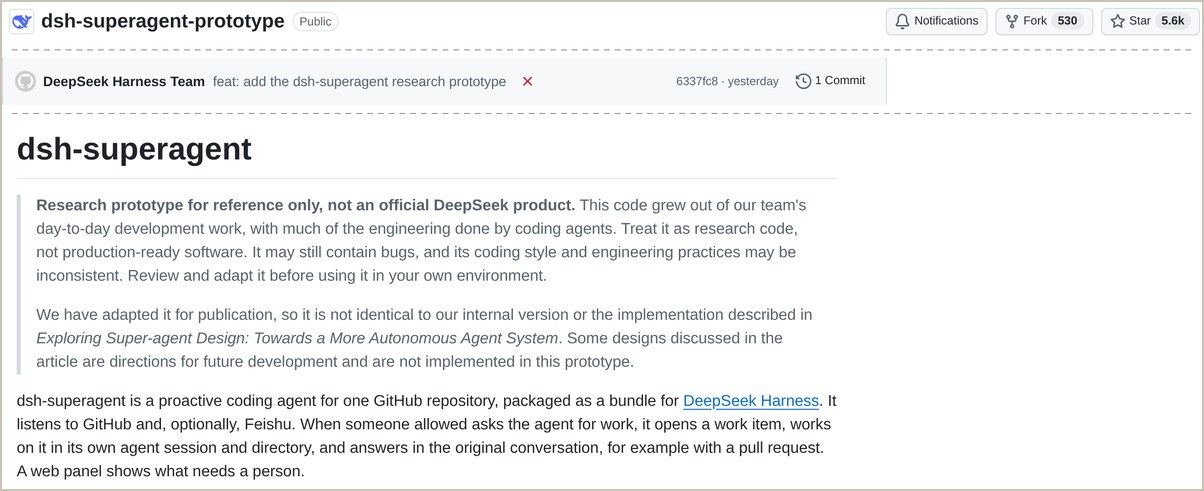
The dsh-superagent prototype watches a GitHub repository and, optionally, chats on Feishu, ByteDance’s workplace messaging app. When an authorized person asks it for work, it opens a work item, handles it in its own session and directory, and replies in the original conversation, for example with a pull request. A web panel shows only what needs a person’s attention.
To install it, users ask their own coding agent to read the SETUP.md file. The release comes as GitHub reports that more than 40% of pull requests in September started from an AI agent’s first draft.
According to the documentation, the agent acts only when a person the team has authorized asks it to, or when a rule the team wrote allows it. Work nobody asked for starts in “observe” mode, where the agent only records what it would have done. The setup guide recommends giving the agent its own GitHub account, separate from the operator’s, and advises against auto-merging pull requests at first. Its executor sessions, however, run commands without approval as the operator’s OS user.
The repository page says the code grew out of the team’s day-to-day work, that coding agents did much of the engineering and that it may still contain bugs. It differs from both the internal version and the implementation the post describes, and some of the post’s designs are still future work. The behavior that Bloomberg and the South China Morning Post highlighted, fixing bugs unprompted, comes from the internal instance. In the prototype, that kind of work requires a written rule and starts in observe mode.
The limits DeepSeek acknowledges
In the post’s security section, the team notes that an agent triggered by events around it runs a greater risk of taking in untrusted input. If the cloud-hosted loop were compromised, through a server intrusion or prompt injection, every connected machine would be at risk of being taken over. Even without an attack, credentials that enter the model’s context can leak. Until those questions are solved, the team writes, a Super-agent can only work within a small, trusted circle.
The post also leaves open how to scale the router, how to give the system memory that spans months and how to coordinate isolated agents within or across organizations. Liu Ming, a Beijing-based AI entrepreneur quoted by the South China Morning Post, wrote on Zhihu that “the challenge in AI software development today is ensuring reliability … rather than completing tasks faster.”
What it means
DeepSeek’s argument is that in teams already using coding agents, the bottleneck is shifting to the attention of whoever oversees the sessions. Its answer hands that oversight to the system, with a single point of contact and isolated workers. Anthropic is moving the same way with Claude Duet, which takes the form of a personal assistant.
The numbers measure how work gets organized under a simulated load, with a timer standing in for the coding. They come from DeepSeek alone, and no independent measurement had been published as of November 1. Headlines about a Claude Code rival oversell a prototype that DeepSeek itself says is not an official product.
The security section carries more weight than the numbers. An agent that reads a team’s conversations and runs commands without approval as its operator’s OS user, combines two well-known risks: poisoned inputs and exposed credentials. DeepSeek acknowledges this and lists the issue among its open problems.
It remains to be seen whether the architecture will make its way into DeepSeek Harness, where asynchronous handling of long-running tasks already exists but is off by default, and how far the internal instance differs from the published code. Only independent measurements on real coding tasks will show whether the gain holds up.
Sources
- Super-agent 设计探索:迈向更自主的 Agent 系统, DeepSeek Harness team (WeChat), October 31, 2026
- deepseek-ai/dsh-superagent-prototype (README), DeepSeek (GitHub), October 31, 2026
- 000 Philosophy, DeepSeek (GitHub), October 31, 2026
- 003 Execution, DeepSeek (GitHub), October 31, 2026
- SETUP.md, DeepSeek (GitHub), October 31, 2026
- DeepSeek Harness, DeepSeek, page accessed November 1, 2026
- DeepSeek Drops Enhanced Coding Agent With Aim to Rival Anthropic, Bloomberg (Debby Wu), November 1, 2026
- DeepSeek unveils AI ‘super agent’ in coding race with OpenAI, Anthropic, South China Morning Post (Ben Jiang), November 1, 2026
Header image: MACCUS diagram based on the DeepSeek Harness team’s article (WeChat, October 31, 2026).