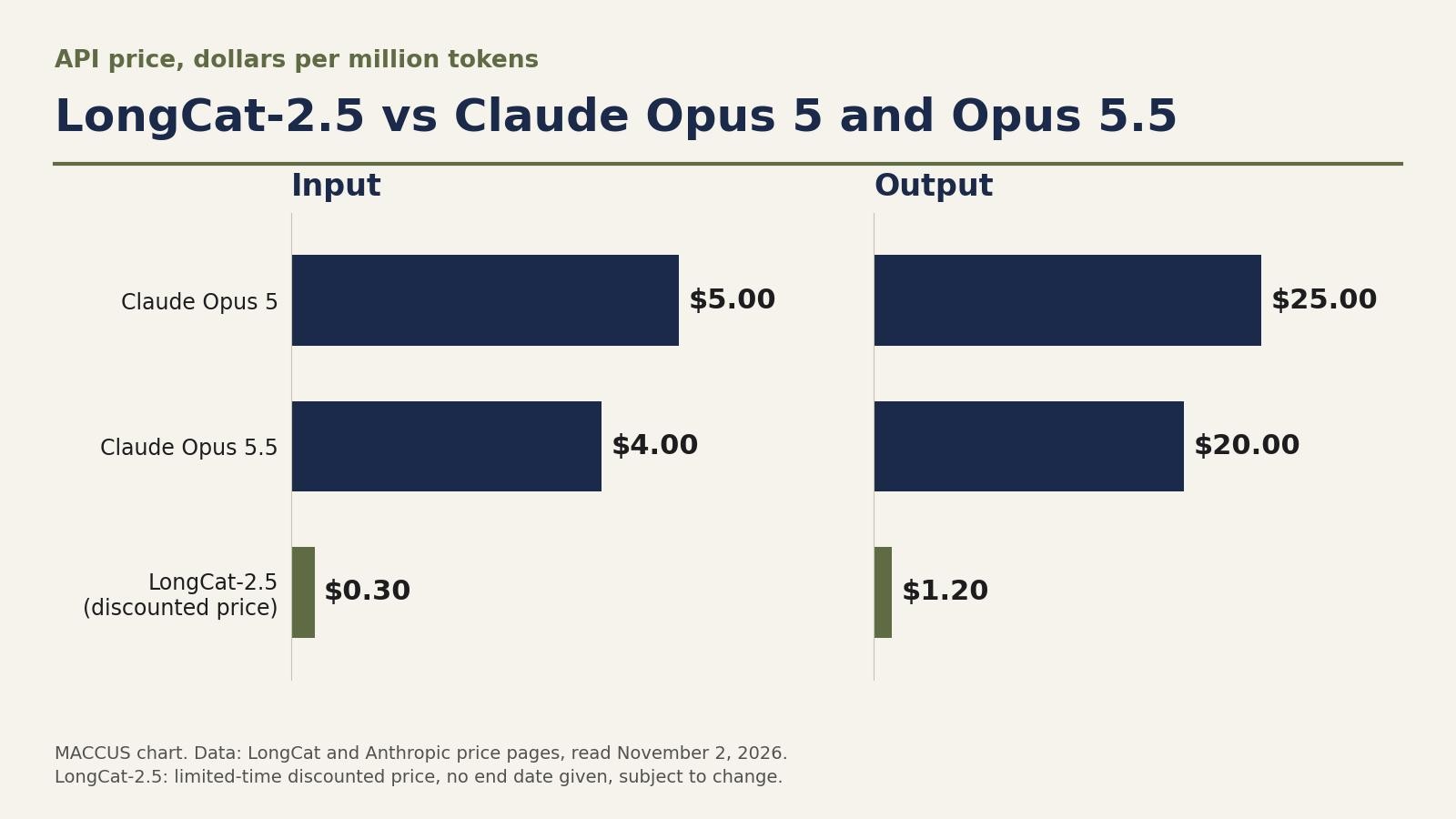

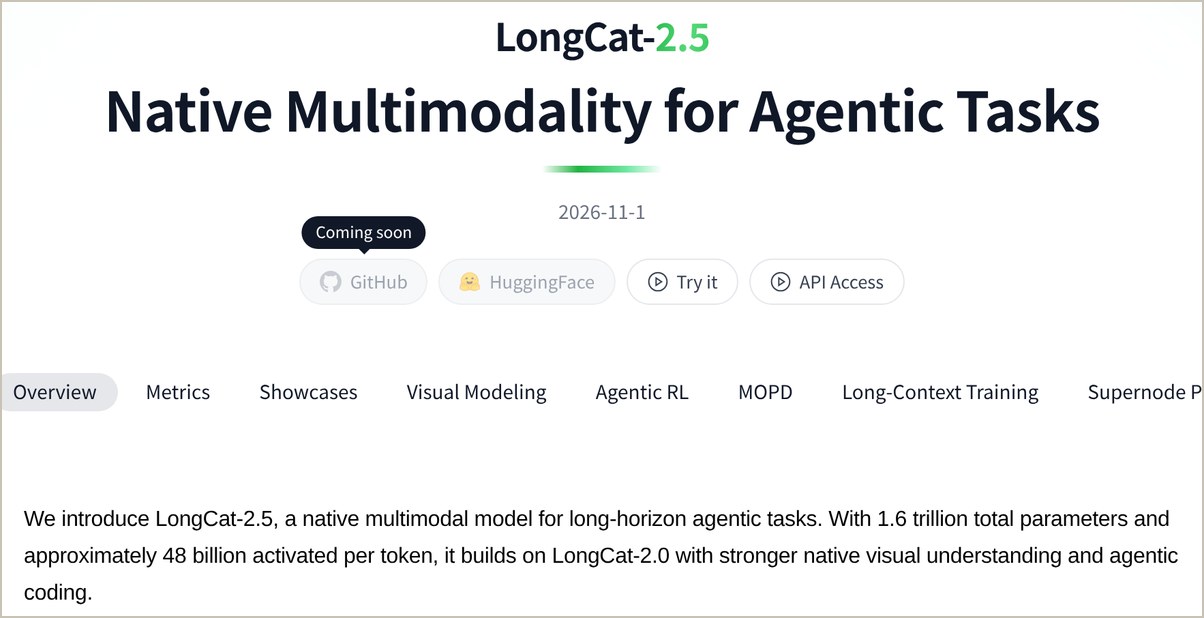
Meituan, a Chinese company best known for food delivery, began offering LongCat-2.5 through its API on November 2, 2026. Its LongCat team introduced the model in a blog post dated November 1, describing it as built for long-running agentic tasks, especially coding. LongCat-2.5 is a mixture-of-experts model with 1.6 trillion parameters, about 48 billion of them active per token, and it understands images natively. Meituan charges a “limited-time” discounted price of $0.30 per million input tokens and $1.20 per million output tokens.
Meituan’s documentation explains how to plug the model into Claude Code, Codex or OpenCode. The company compares LongCat-2.5 with Anthropic’s Claude Opus 5 and OpenAI’s GPT-5.6-Sol, leaving out the models both labs have released since. The weights are marked “coming soon” on GitHub and Hugging Face, with no date given. France’s Mistral AI, by contrast, published the weights of Mistral Large 4 on October 29.
A mixture-of-experts model Meituan says it tuned for Chinese chips
LongCat-2.5 builds on LongCat-2.0, released in late June, whose weights have been available under the MIT license on Hugging Face since July. According to the post, the team added more long agent trajectories to training, along with large-scale reinforcement learning, to improve the model on complex codebases and full-project builds.
To handle images, the model converts them into multi-level discrete tokens that run through the same network as text. Meituan highlights visual coding, creative design and 3D tasks. The post shows eight demos, from a real-time fluid simulation to a business analysis report.
The post emphasizes hardware. Long-context training and inference were optimized “on domestic AI accelerators” with less than 80 GB of memory each, grouped into “supernodes.” Meituan does not name the chipmaker. Sina Tech, in a report carried by the financial site Futu, says the model was trained entirely on Chinese computing power.
For inference, the team cut the precision of the expert weights and the activations to 4 bits (W4A4). In load tests against an 8-bit baseline, it measured a 42.8% gain in generation throughput and a 15.9% drop in time to first token.
Setup guides for Claude Code, Codex and OpenCode
The LongCat API accepts two request formats, OpenAI’s and Anthropic’s, each with its own endpoint. The quick start guide lists a 1-million-token context window and up to 128,000 output tokens. For Claude Code, Anthropic’s command-line coding tool, the documentation says to replace the API key, the base URL and the model names in the settings file with LongCat’s. The docs also cover Codex, OpenCode, Cline, Kilo Code, OpenClaw and Hermes Agent.
According to the changelog, a preview version, LongCat-2.5-Preview, went live on September 25. Since September 10, the platform has also offered enterprise verification, self-service invoicing and tiered discounts. The pricing page, checked on November 2, says prices “are subject to change” and gives no end date for the discount and no price for what follows. Cached input tokens cost $0.006 per million.
In Anthropic’s Claude lineup, Opus 5, the newest Claude model in Meituan’s charts, costs $5 per million input tokens and $25 per million output tokens, according to Anthropic’s pricing page as of November 2. The newer Opus 5.5 costs $4 and $20. At the discounted price, a million output tokens from LongCat-2.5 costs nearly 21 times less than the same volume from Claude Opus 5. What a task costs also depends on how many tokens a model burns to finish it.
Ahead of Claude Opus 5 on web research, behind on hard coding, by Meituan’s numbers
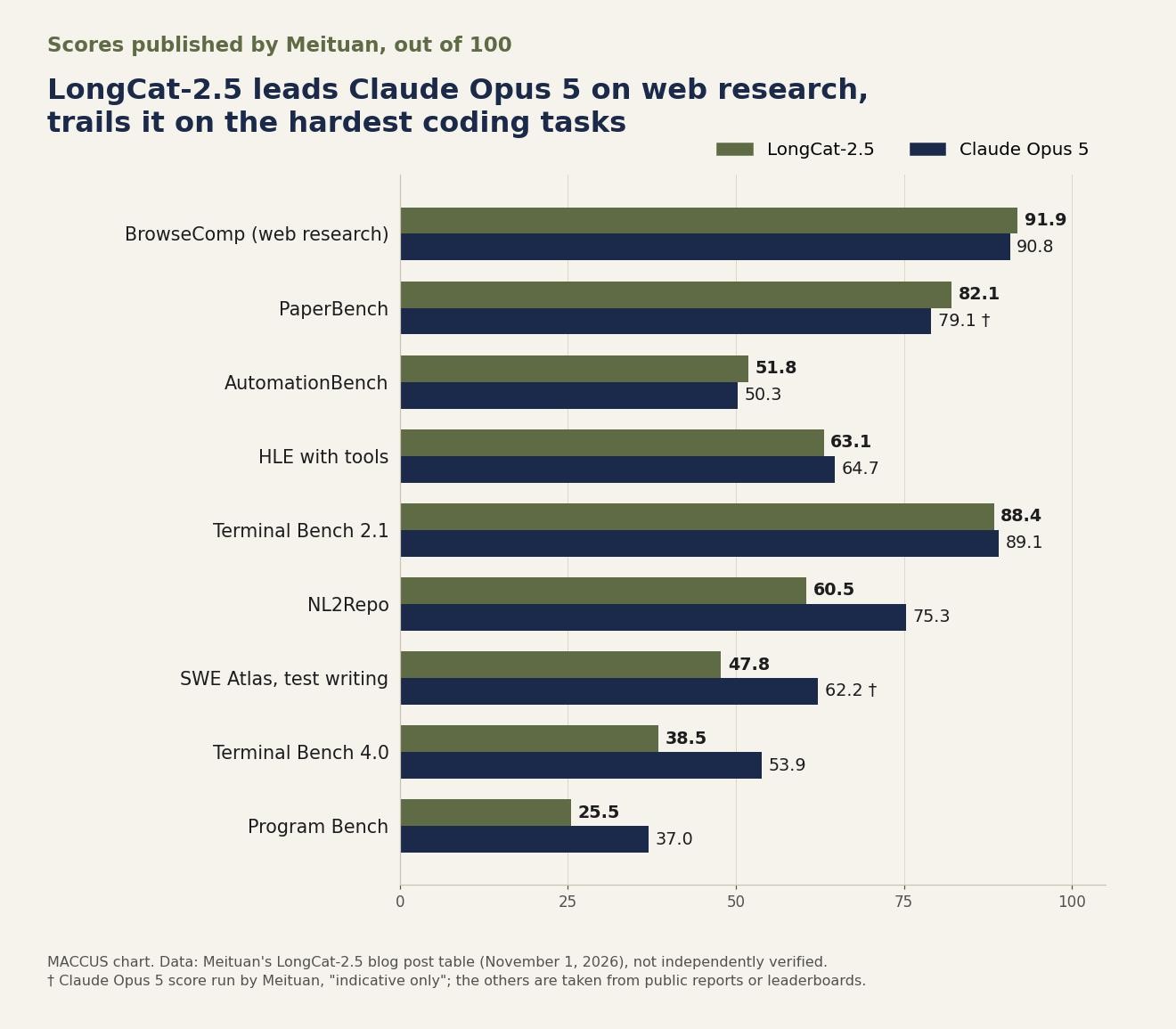
The post’s charts pit LongCat-2.5 against GPT-5.5, GPT-5.6-Sol, Claude Opus 4.8 and Claude Opus 5. The detailed table adds LongCat-2.0, GLM-5.3, kimi-k3 and DeepSeek-V4.1-Flash, the fast model from Chinese lab DeepSeek, which also sells a pay-per-call web search API. On BrowseComp, a web research test, LongCat-2.5 scores 91.9, ahead of DeepSeek-V4.1-Flash (91.5, measured by Meituan), Claude Opus 5 (90.8) and GPT-5.6-Sol (90.4). It also beats Claude Opus 5 on AutomationBench (51.8 to 50.3) and on PaperBench (82.1 to 79.1), where GPT-5.6-Sol stays on top at 83.3.
On the hardest coding tests, the gap runs the other way. Claude Opus 5 scores 53.9 on Terminal Bench 4.0 to 38.5 for LongCat-2.5, 37.0 to 25.5 on Program Bench and 75.3 to 60.5 on NL2Repo, which asks a model to build an entire code repository from a natural-language description.
Compared with LongCat-2.0, the same table shows clear progress: from 3.0 to 38.5 on Terminal Bench 4.0, from 9.7 to 64.6 on DeepSWE and from 15.8 to 51.8 on AutomationBench. According to Sina Tech, Meituan places its model between Claude Opus 4.8 and Claude Opus 5 on several mainstream tests, and above Opus 5 on a few.
Meituan’s caveats on its own numbers
All of these scores are published by Meituan. A note under the table says rival scores marked with an asterisk are taken from technical reports, blog posts or official leaderboards, while the others were run by Meituan and are “indicative only.” Meituan ran 13 of the 27 Claude Opus 5 scores itself, including PaperBench and two of the three SWE Atlas tasks. Several LongCat-2.5 tests ran with Claude Code as the harness, and answers on two SWE Atlas tasks were graded by Claude Opus 4.5, an Anthropic model acting as judge.
As of the morning of November 2, we had found no independent evaluation. Artificial Analysis, which ranks LongCat-2.0, had no page for the new version or for its preview. The newest models from Anthropic, OpenAI and Google, such as Claude Opus 5.5, GPT-6.1 Terra, launched October 26, or Gemini 4 Carbon, are missing from both the charts and the table.
On the post, the GitHub and Hugging Face buttons are grayed out and show “Coming soon” on hover. That same morning, the team’s Hugging Face account had no LongCat-2.5 repository. The newest one, LongCat-Flash-Lite-Sparse, dates from July 31.
Two sets of terms for API customers
Opening an account on the API platform means accepting LongCat’s general Terms of Use (version 3.1, June 30, 2026) and its privacy policy. Those terms describe the service as meant for personal use and ban commercial use without Meituan’s permission. They also refer API users to a second document, the API platform Terms of Use, which says it prevails in any conflict.
That second document, which does not repeat the commercial-use ban, is written for individual and enterprise developers who build the models into internal tools or into applications for their own users. It gives Meituan a free, worldwide license to customers’ inputs and outputs, including for service optimization and marketing, and points customers who want them kept out of model training to a separate agreement. It is governed by Singapore law, with arbitration in Singapore, while the general terms are governed by Chinese law.
The general terms place LongCat’s facilities in China. The API platform privacy policy, dated June 30, 2026, lists possible server locations in Frankfurt, Hong Kong and mainland China but does not say which ones handle API requests.
What it means
Meituan is selling a 1.6-trillion-parameter model that works inside Anthropic’s and OpenAI’s coding tools, and at the discounted price its output tokens cost nearly 21 times less than Claude Opus 5’s. For teams running coding agents all day, that gap adds up, and switching takes a few lines of configuration.
Meituan’s table describes a model that is strong at research and automation but still behind Claude Opus 5 on long coding tasks, the very work coding agents are built for. The comparison stops short of Claude Opus 5.5 and the GPT-6 lineup, and as of the morning of November 2 we had found no independent measurement. The “domestic accelerators” remain a claim until Meituan names their maker.
Selling tokens is not Meituan’s stated priority. On its second-quarter earnings call on August 28, CEO Wang Xing said the company would not become a “token factory” and that its models would support its core business, according to Sina Tech.
It is not yet known when the weights will be published or under what license (LongCat-2.0’s is MIT), when the discount ends, where API requests are processed, or what the first independent measurements will show. Published weights would let other hosts run the model outside Meituan’s facilities.
Sources
- Introducing LongCat-2.5, Meituan LongCat team, November 1, 2026
- LongCat API Platform Change Log, LongCat API Platform, November 2, 2026
- Models & Pricing (LongCat-2.5), LongCat API Platform, accessed November 2, 2026
- LongCat API Platform Quick Start Guide, LongCat API Platform, accessed November 2, 2026
- Claude Code Configuration, LongCat API Platform, accessed November 2, 2026
- LongCat AI Platform Terms of Use, Beijing Kuxun Interactive Technology, accessed November 2, 2026
- Pricing, Anthropic, accessed November 2, 2026
- Meituan Releases LongCat-2.5 Large Model, Continuing the “Domestic Chips, Domestic Models” R&D Strategy, Futu News (from Sina Tech), November 2, 2026
Header image: MACCUS chart. Data: LongCat and Anthropic price pages, read November 2, 2026.