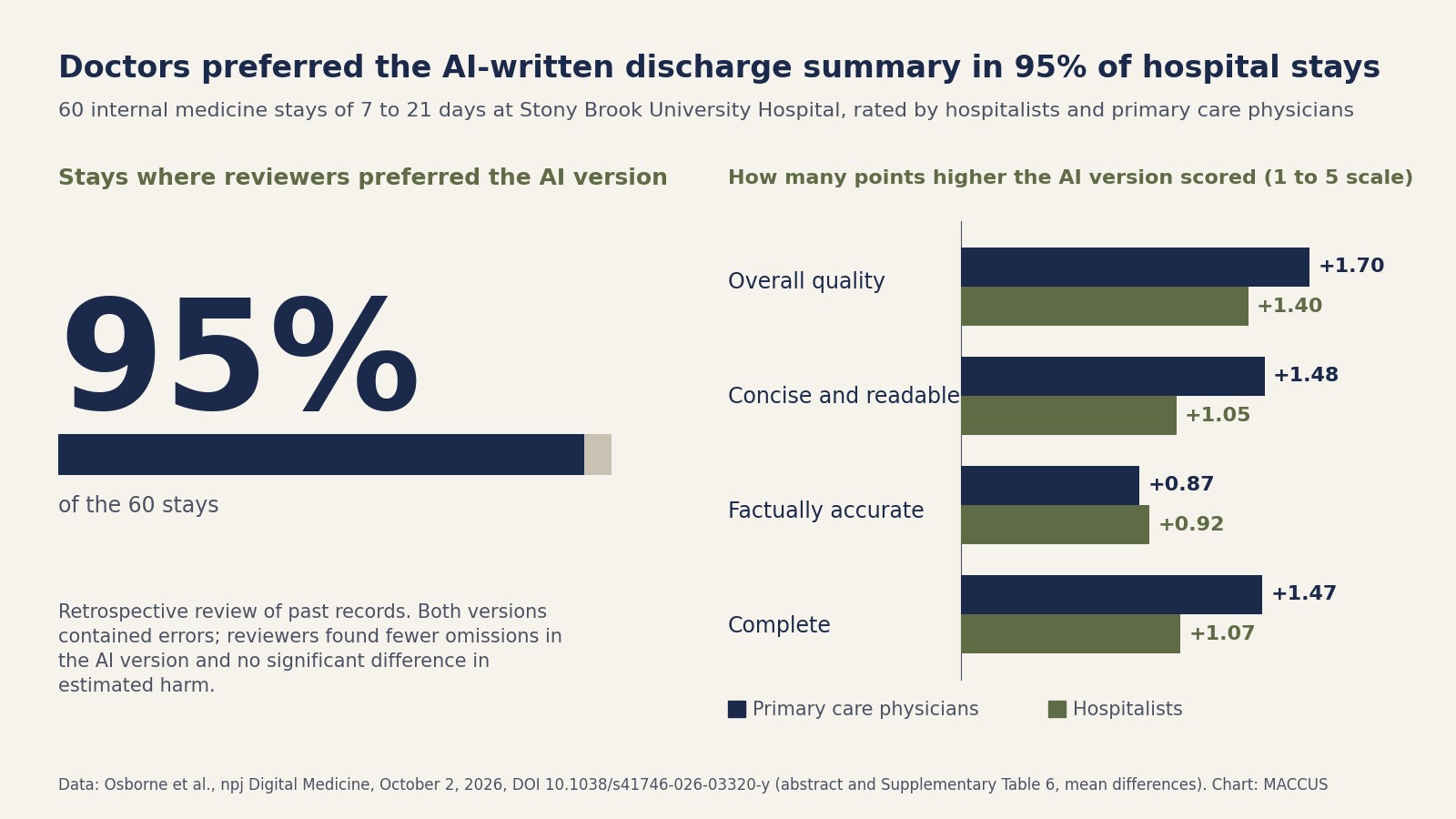

Doctors shown two versions of the summary a hospital writes when a patient goes home preferred the one drafted by AI for 95% of the 60 hospital stays they reviewed. The other version was the summary the hospital’s own doctors had written. The patient’s family doctor reads this document to learn what happened in the hospital, which drugs changed and what still needs follow-up.
The study comes from Stony Brook University in New York State and was published online in npj Digital Medicine on October 2. The university announced the results on November 2. It covers 60 internal medicine stays of 7 to 21 days at Stony Brook University Hospital and is a retrospective review of past records. The authors say a physician must still check every AI draft before it goes into a patient’s record.
Long stays, long records
A discharge summary sets out a patient’s treatment, medication changes, unresolved problems and follow-up needs, and primary care physicians rely on it to continue care, the university says. The longer and more complex the stay, the more notes there are to condense and the more time the paperwork takes. The paper notes that earlier evaluations of AI-written summaries mostly looked at shorter stays. Its 60 stays were drawn from 385 hospitalizations of the same length, according to the supplementary tables.
The system reads a patient’s notes in batches and keeps a running list of bullet points, which it may rewrite as new notes arrive, according to the prompts published with the paper. Each bullet has to cite the notes it came from, and the model is told never to output a point “that cannot be supported by the EHR documentation” (the electronic health record). A separate step scans radiology reports for incidental findings: unexpected results on a scan that may need follow-up. A last step writes the narrative.
Clinicians helped design the process around what doctors need after discharge, and it produced the core of a summary “all within just a few minutes,” the university says. The release, the paper’s abstract and the supplementary material do not name the model.
Higher scores, fewer omissions
Two kinds of doctors reviewed both versions for each stay: hospitalists, who run care inside the hospital, and primary care physicians, who take over when the patient goes home. They rated the AI summaries higher for overall quality, readability, factual accuracy and completeness. On a 1-to-5 agreement scale, the AI version’s quality score was 1.70 points higher on average among primary care physicians and 1.40 points higher among hospitalists, the supplementary tables show. Primary care physicians also found the AI summaries easier to understand, easier to explain to patients and caregivers, and more useful for follow-up care.
Both versions contained errors. Reviewers marked fewer factual inaccuracies or clinically relevant omissions in the AI summaries, “primarily due to fewer omissions,” the paper says. The study counts as an omission any missing information that would hurt the patient’s care after discharge if the next doctor were not told. The estimated harm potential and likelihood of those errors did not differ significantly between the two versions.
The model also pulled 31 incidental findings from radiology reports. Reviewers judged 29 of them, or 93.5%, correctly reported, and 27, or 87.1%, worth putting in the summary.
In debriefing sessions reported in the supplementary material, one hospitalist said the AI “did an exponentially better job” at tracing the cascade of events that brought the patient to them. A hospitalist also said that results still pending at discharge, which often “fall through the cracks,” were flagged in the AI drafts with a note on who should follow up, something “essentially not found” in the summaries hospitalists had written. Rachel Wong, a co-corresponding author and clinical associate professor at Stony Brook’s medical school, said in the release that the results “provide evidence that artificial intelligence can support discharge documentation for complex hospital stays.”
AI scribes in the US and England
The study arrives as hospitals hand other paperwork to AI. Ambient AI scribes record a consultation and draft the clinical note, and their effects have been measured at scale.
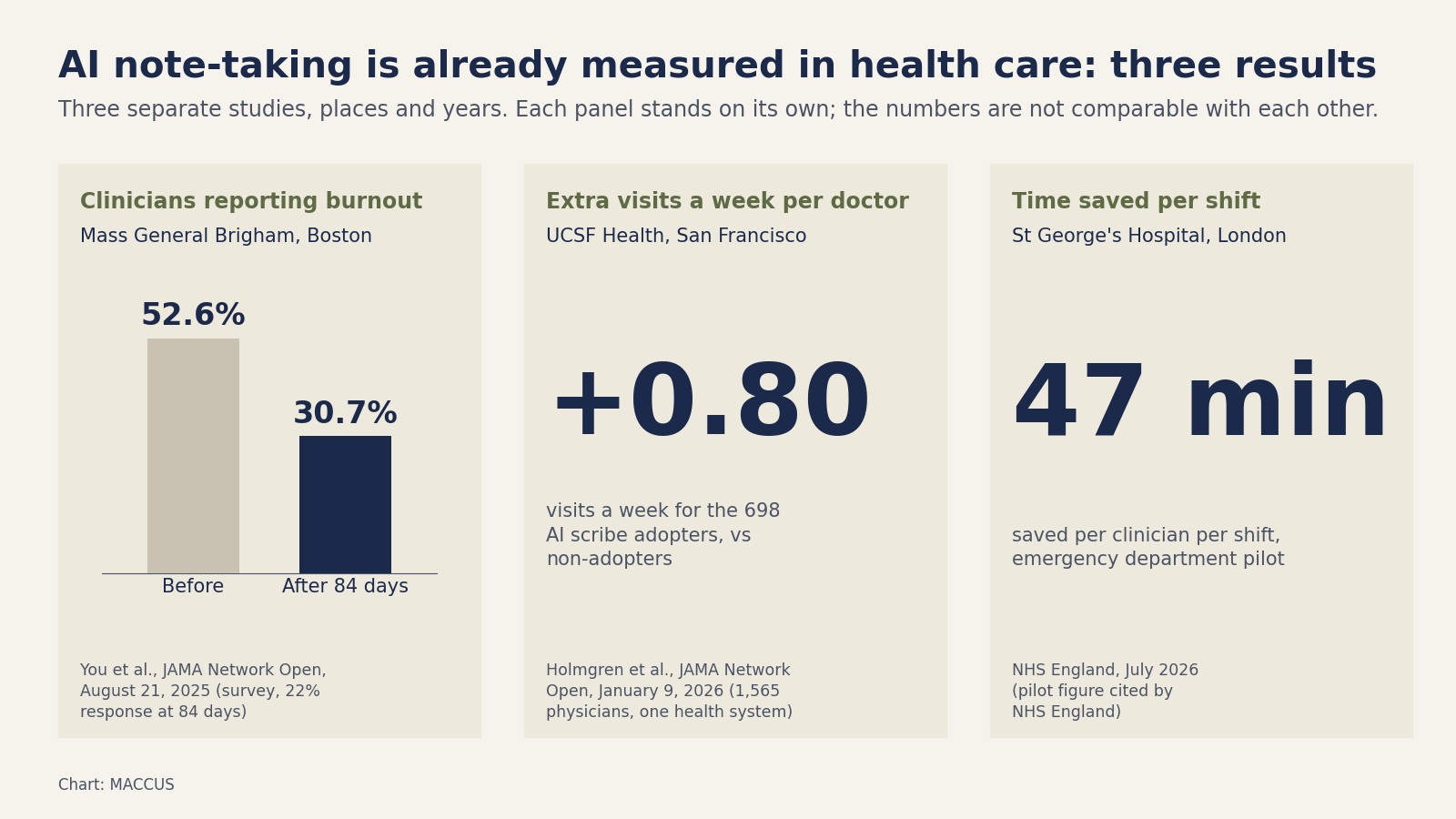
At UCSF Health in San Francisco, a study in JAMA Network Open published January 9 followed 1,565 physicians across 1.2 million outpatient visits from January 2023 to April 2025. The 698 physicians who adopted an AI scribe had 0.80 more visits a week afterward, relative to those who did not, and billed 1.81 more relative value units a week, which the authors value at $3,044 a year per physician at 2025 Medicare rates. The share of claims denied did not differ between the two groups.
At Mass General Brigham, the Boston-area health system, a 2025 survey study of clinicians piloting AI note-taking found that the share who reported burnout fell from 52.6% to 30.7% after 84 days.
In July, NHS England said it would support a national rollout of AI note-taking, starting with hospital appointments that do not require an overnight stay. It cites a pilot in the emergency department of St George’s Hospital in London that saved clinicians an average of 47 minutes per shift, and says Alder Hey Children’s and Manchester University NHS Foundation Trusts are expanding their programs to more than 3,000 clinicians.
Doctors are also putting their clinical questions to AI: one medical AI went from 355 to 703,265 US clinicians a month in 30 months, according to a JAMA study published in October.
The limits of the evidence
Sixty stays at one hospital is a small sample, and no AI draft was used in a live discharge. No figure for time saved has been published. Fusheng Wang, the other co-corresponding author, says the next steps include assessing accuracy, safety, “actual time savings for physicians” and how the tool would fit into clinical workflows. He says Stony Brook Medicine is considering a pilot in everyday practice.
The two groups of reviewers did not weigh the errors the same way: primary care physicians flagged more omissions than hospitalists did and rated harm as more likely. Trust came up in the debriefs. “Trust but verify,” one hospitalist said. A hospitalist also predicted that “no one’s going back and fact checking” once the drafts arrive fully written.
The scribe figures have their own limits. The UCSF result comes from one health system whose doctors chose whether to adopt the tool, and the Mass General Brigham burnout figures come from a nonrandomized pilot in which 22% of clinicians answered the 84-day survey.
What it means
The paperwork that follows a long hospital stay now has a peer-reviewed test: on this sample, doctors preferred the AI drafts, and those drafts drew fewer error flags, mostly because the human summaries left more out. Both versions made errors, so the comparison that counts is against the human baseline, the yardstick Waymo used when its own data showed its robotaxis had 95% fewer serious crashes than human drivers over the same miles. On harm, the discharge study found no significant difference between the two versions.
Hospitals that already let AI scribes write notes during visits, such as UCSF, Mass General Brigham and the NHS trusts, could extend AI drafting to the discharge summary. The study does not show the time saved. Japan’s government already estimates that figure for its own staff: regular users of its civil service AI report saving about 110 minutes a week. The study also leaves open how carefully a doctor checks a draft on a busy ward, the risk the hospitalist who expected nobody to fact-check was pointing at.
The next result to watch is Stony Brook’s pilot, if it goes ahead: summaries written with the tool on real wards, with the time saved and the errors caught counted before each one reaches the family doctor.
Sources
- SBU Study: AI May Improve Patient Discharge Summaries, Stony Brook University, November 2, 2026
- Clinician-centered evaluation of large language model-generated discharge summaries for longer hospitalizations, Osborne et al., npj Digital Medicine, October 2, 2026
- Supplementary Information: Clinician-Centered Evaluation of Large Language Model-Generated Discharge Summaries for Longer Hospitalizations, Osborne et al., npj Digital Medicine, October 2, 2026
- Ambient Artificial Intelligence Scribes and Physician Financial Productivity, Holmgren et al., JAMA Network Open, January 9, 2026
- Ambient Documentation Technology in Clinician Experience of Documentation Burden and Burnout, You et al., JAMA Network Open, August 21, 2025
- NHS accelerates artificial intelligence rollout to cut waiting times and improve care for millions, NHS England, July 2026
Header image: chart by MACCUS, data from Osborne et al., npj Digital Medicine (October 2, 2026, abstract and Supplementary Table 6)