On November 4, 2026, OpenAI released Images 2.6, the new version of its image generator. ChatGPT can now make animated GIFs, short images that play on a loop, in one step from a written prompt or a photo. The company is rolling it out to all users worldwide, on the web, desktop and mobile. It is also coming to Codex, OpenAI’s coding tool.
Developers get two new models, Flare for speed and Sunburst for quality, at the same prices as the previous version. They use them through the API, the paid service that lets businesses build OpenAI’s models into their own software. OpenAI also says image generation is now 50% faster. A safety document released the same day counts how many rule-breaking images slipped past OpenAI’s moderation in testing, GIFs included.
GIFs in a single step
Until now, ChatGPT couldn’t make a GIF in a single step, The Verge noted when it reported the feature on November 4. Users now describe the animation they want, such as “a cat dancing,” or upload a photo. Once the GIF is ready, they can change its playback speed, view and edit each frame one by one, and then share it.
OpenAI leads with business uses. Its announcement mentions animating a brand mascot for a campaign, turning a product shot into a loop, and making reactions and memes for social media. It also cites animated storyboards, sequences of drawings that plan the shots of a video, as a way to test how a character moves before filming. One example in the announcement shows a pen sketch of an owl turned into an animated character.
Sample prompts that OpenAI published, created by the company OpenArt, show how an animation is built. They ask the model for six images on a single sheet, laid out in a grid of three columns and two rows. The sixth image leads back into the first, so the loop plays without a jump.
Two models for developers, at version 2.5 prices
In the API, OpenAI offers a fast model and a precise one. It already does the same with its text models, where each AI model has its own uses. GPT-Image-2.6 Flare is built for speed: OpenAI says it can produce an image in as little as six seconds at low quality. The company also credits it with better layouts for posters and product visuals.
GPT-Image-2.6 Sunburst aims for quality at the medium or high setting. It also focuses on keeping images consistent from one edit to the next.
On OpenAI’s API pricing page, the two 2.6 models cost exactly the same as the 2.5 versions released in September. Prices are set in tokens, the units OpenAI bills by. Input, meaning images sent to the model, costs $8 per million image tokens. Output, the images the model produces, costs $30 per million.
OpenAI’s guide warns that the same price per token doesn’t mean the same cost per image. The number of tokens depends on the model and the quality setting. The pricing page also lists a half-price Batch rate for deferred jobs, meaning requests sent as a group whose results come back later. For now, that rate covers the 2.5 models and the older gpt-image-2 model, but not the 2.6 models.
The API also gets three new tools. The first, image markup, lets developers mark the exact area of an image they want changed; ChatGPT already had it. The second, SVG export, is only in the API. SVG is a vector image format that stays sharp at any size and can be used on a website, in an app or in print.
The third is a new setting called “complexity,” which controls how much planning the model does before it draws. A low level suits a quick edit; a higher level suits a busy scene. The setting defaults to high and isn’t billed separately.
In the API, a GIF can have 2 to 64 frames, with 9 by default. Each frame stays on screen for 20 to 2,000 milliseconds, with 200 by default. At those defaults, an animation lasts 1.8 seconds before it starts over. GIFs can only be made when generating a new image: the API’s function for editing an existing image doesn’t offer them.
Four billion images a week, according to OpenAI
OpenAI says its users now create 4 billion images a week across ChatGPT, Codex and the API. When version 2.5 launched in September, the company reported more than 3 billion a week. The tech site The Next Web points out that both figures come from OpenAI itself and cover every image created, GIFs included.
The November 4 announcement doesn’t say how many GIFs each ChatGPT plan allows. Separately, an OpenAI help page updated October 31 says Codex will share a single usage limit with ChatGPT starting in December for subscribers on the Plus, Pro and Business plans.
The safeguards OpenAI tested
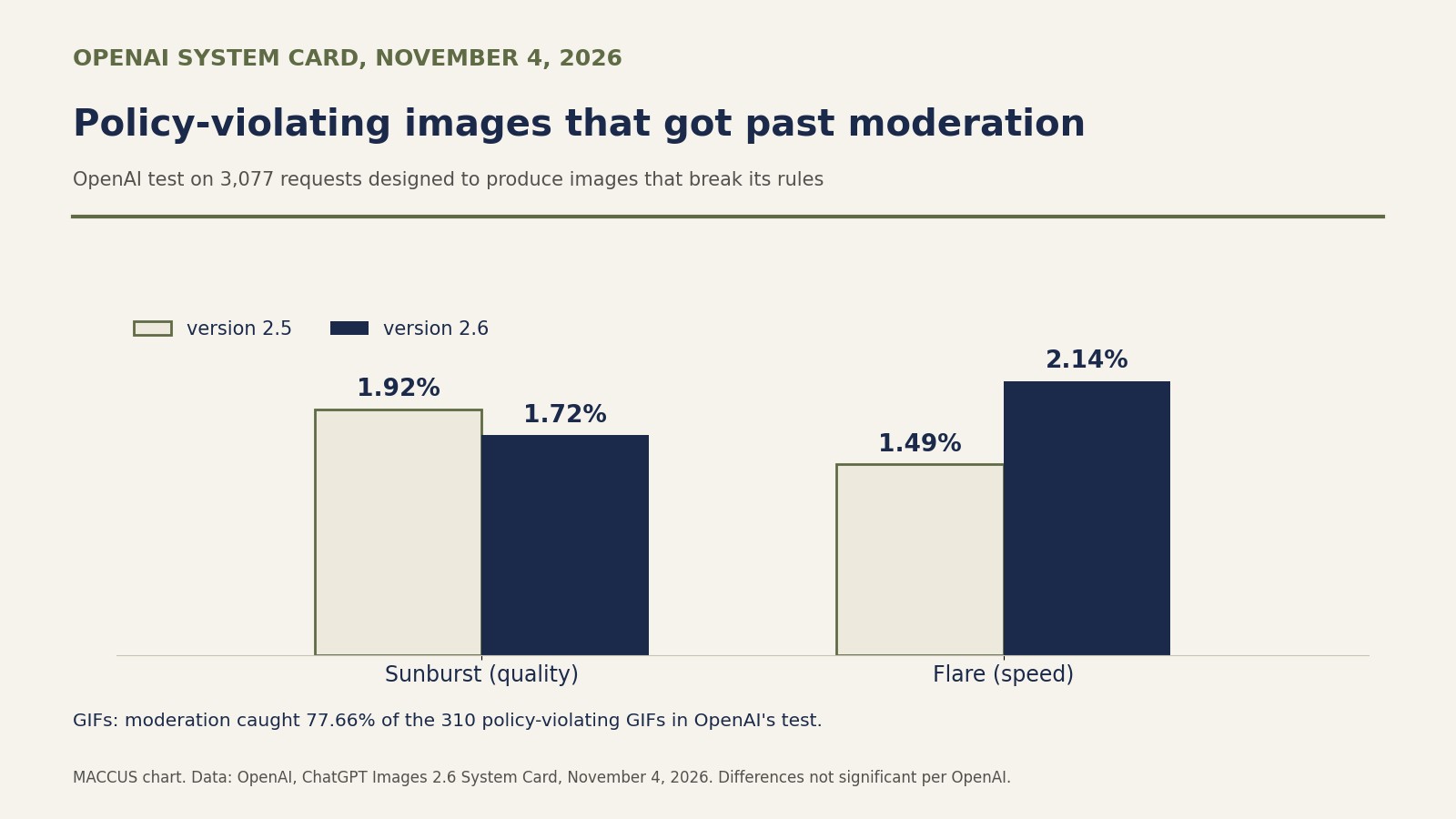
The safety document, which OpenAI calls a system card, describes the tests it ran before launch. OpenAI gave each model 3,077 requests designed to produce images that break its rules, such as violent or sexual content. It then counted the rule-breaking images that its moderation failed to block.
Sunburst let fewer of those images through: 1.72% of the test requests with version 2.6, down from 1.92% with version 2.5. Flare let more through: 2.14%, up from 1.49%. That is 66 images out of 3,077, compared with 46 before. OpenAI says neither change is statistically significant, meaning both could be due to chance.
Before any moderation, 75.04% of Flare’s images follow the rules, down from 78.36% for its predecessor. The company says that drop is statistically significant.
GIFs raise a separate problem. According to the system card, each frame can look acceptable on its own while the movement between frames suggests a sexualized scene or a harmful message. So OpenAI’s moderation reviews the whole grid of generated frames, along with its caption. For GIFs, some content categories are also blocked more broadly than for still images.
In OpenAI’s test, moderation caught 77.66% of the 310 GIFs judged to break its rules. That means slightly more than one in five got through. “Motion-related violations remain challenging to detect,” the company acknowledges.
OpenAI notes that these results come from test sets. They don’t measure how often harmful content shows up once the service is live.
OpenAI says it marks images from ChatGPT, Codex and the API in two ways, to show where they come from. It attaches C2PA metadata, a record of the image’s origin written into the file under an industry standard. It also adds SynthID, an invisible watermark made by Google DeepMind, Google’s AI research lab. According to OpenAI’s technical guide, editing, converting or sharing a file can strip the metadata, while the watermark may survive some changes.
Other AI labs are watermarking the text their models write. Anthropic, maker of the Claude assistant, announced it would extend Claude’s invisible watermark to four more models starting November 3. SpaceXSI, formerly xAI, makes the Grok assistant. It will watermark Grok text in its API starting November 7.
OpenAI’s claims and their limits
OpenAI highlights characters, products and brand details that stay consistent from one edit to the next. Its own image generation guide is more cautious. In a section on all its GPT Image models, the guide says they may still occasionally struggle to keep a recurring character or brand elements identical across images. They can also have trouble placing text precisely, and complex prompts can take up to two minutes.
OpenAI hasn’t published how it measured the 50% speed gain or the 4 billion images a week. The announcement also gives no maximum length for a GIF in ChatGPT; only the API’s limits are documented.
What it means
The most visible change is in ChatGPT, where every user can now make a GIF in one step. OpenAI’s examples include mascots, product shots and reactions for social media. According to the announcement, they are aimed at “marketers and creators” and at businesses that are active on those platforms.
For developers, the price per token is unchanged, and the news is in the tools: image markup, SVG export and the complexity setting. OpenAI’s guide notes that the actual cost of an image still depends on the model and quality chosen. The half-price Batch rate isn’t open to the 2.6 models yet.
The system card tempers the launch claims. Before moderation, Flare, the fast model, produces more rule-breaking images than its predecessor. In OpenAI’s test, moderation let slightly more than one in five rule-breaking GIFs slip through.
Several questions remain open. OpenAI hasn’t said how many GIFs each plan allows, or how long an animation can run in ChatGPT. It also remains to be seen whether recurring characters actually stay consistent across images, as promised. And it’s still unclear whether the 2.6 models will join the Batch price list, where the 2.5 models cost half as much for deferred jobs.
Sources
- Introducing Images 2.6, OpenAI, November 4, 2026
- ChatGPT Images 2.6 System Card, OpenAI, November 4, 2026
- Image generation, API guide, OpenAI, accessed November 5, 2026
- Pricing, image generation, OpenAI, accessed November 5, 2026
- Content provenance, OpenAI, accessed November 5, 2026
- ChatGPT will now make you animated GIFs, The Verge, November 4, 2026
- ChatGPT can now make animated GIFs with OpenAI’s Images 2.6, The Next Web, November 4, 2026
Header image: MACCUS chart, data from OpenAI’s API image generation guide, accessed November 5, 2026.