Ollama, a free program for running publicly available AI models on your own computer, has dropped the free plan from its cloud service. Since November 9, 2026, free accounts have had to buy credits to use the models Ollama runs on its own servers, such as gemma4:31b or gpt-oss:120b. Developers who tried those cloud models for free now pay from the first request.
The November 9 date comes from an Ollama announcement that modelrelay, an open-source project whose documentation tracks free AI tiers, passed on. Ollama did not post about the change on its blog. Copies saved by the Internet Archive show that Ollama’s pricing page changed between the evening of October 26 and the morning of October 27. The same page says that running models on your own machines stays free and unlimited.
A free plan wiped from the pricing page
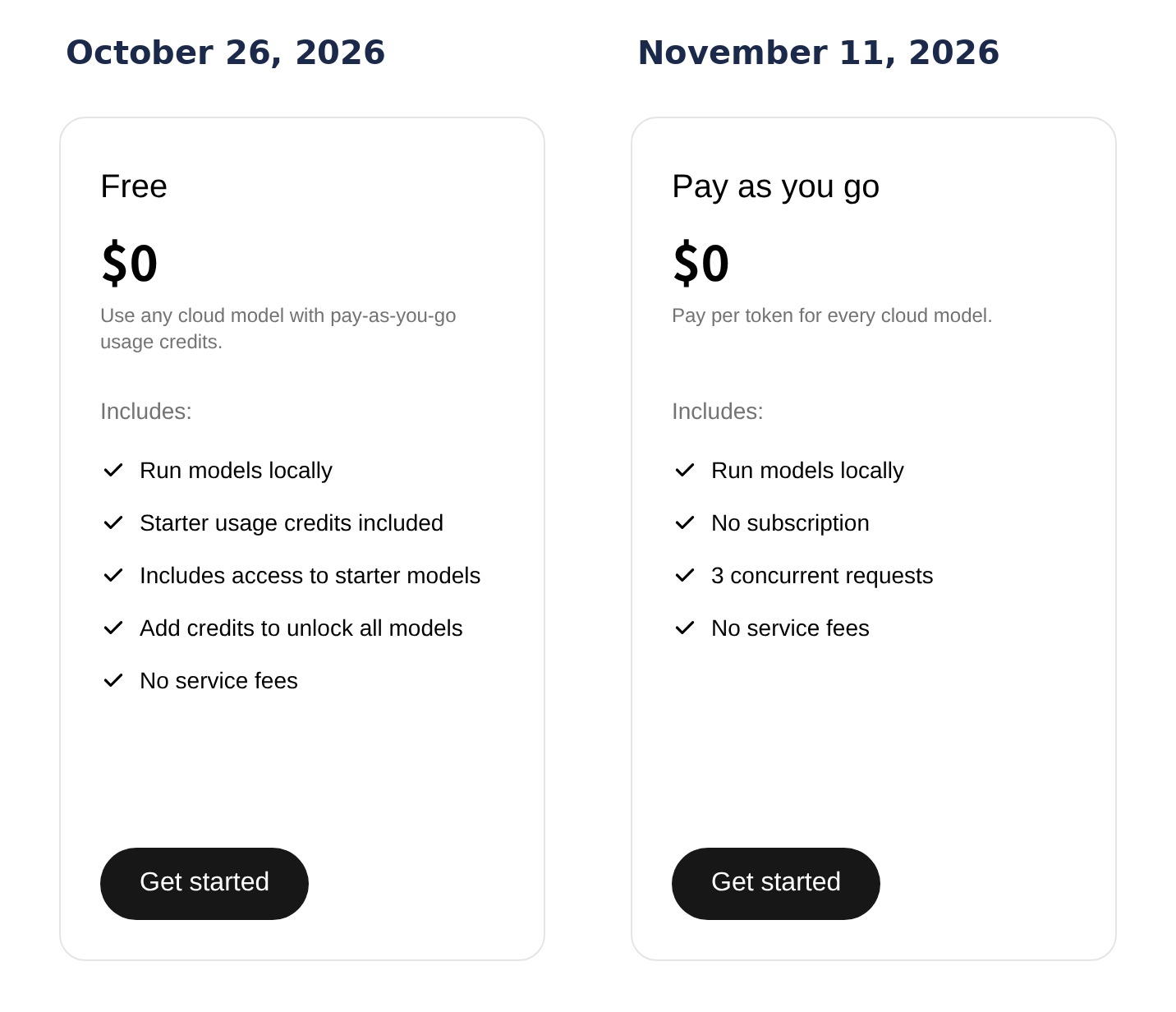
In the Internet Archive copy taken at 8:15 p.m. UTC on October 26, the pricing page still listed a “Free” plan that cost nothing. It came with starter usage credits, access to a set of so-called starter models and one request at a time. The next copy, taken at 5:39 a.m. UTC on October 27, shows a “Pay as you go” plan in its place. Signing up still costs nothing, but the plan includes no credits, so every request to a cloud model is billed.
The FAQ on the same page changed between those two copies. The sentence that promised free accounts a starter amount of usage on a smaller set of models is gone. The new plan does allow three requests at the same time, up from one on the old plan.
Ollama had already changed the free offer on August 31, 2026, when it moved its plans to billing per token. A token is a fragment of a word, the unit of text that AI model providers count and charge for. In a blog post that day, Ollama said the free plan included “a small amount of monthly usage for a set of starter models.”
November 9: existing accounts switch over
The pricing page does not mention November 9. On October 30, modelrelay posted a summary of Ollama’s announcement on GitHub, a site where developers share code. According to that summary, free-plan accounts need credits from that date for six models: gemma4:31b, gpt-oss:120b, gpt-oss:20b, nemotron-3-super, nemotron-3-ultra and nemotron-3-nano:30b. Without credits, modelrelay warns, those models return a 402 error, the code for “payment required.”
OmniRoute is an open-source tool that lists free AI offers, among other things. On November 8, one of its maintainers opened a ticket on GitHub to remove Ollama Cloud from that list. On November 10, a user wrote in the same thread that all remaining free quota had been removed from every account. The post included a screenshot of an error.
On Reddit, an Ollama user says they got a message about insufficient credit on the morning of November 10. A few days earlier, they had used less than 20 percent of their free quota.
Beam, an AI model made by a company called Reflection, has lost its free access too. On October 16, Ollama made Beam free to use “for a limited time.” Beam is Reflection’s first open-weight model, meaning the trained model itself is public and anyone can download it. It now has a price: the saved copy of the pricing page from November 4 does not list it, and the copy from November 6 does.
Cloud prices as of November 11
Ollama lists its prices in US dollars. The euro figures below use the European Central Bank’s reference rate for November 10, 2026, when 1 euro was worth 1.1214 dollars. The Pro plan costs 20 dollars a month, about 17.84 euros, and includes 60 dollars of credits, about 53.50 euros.
The Max plan costs 100 dollars a month, about 89 euros, and includes 300 dollars of credits, about 268 euros. The Team plan costs 500 dollars a month, about 446 euros, with no limit on the number of users. It includes 1,000 dollars of shared credits, about 892 euros. Unused plan credits do not roll over to the next month.
Accounts without a plan now pay from the first request for the models modelrelay lists. The prices are the ones the page already showed on October 26. Of those models, the cheapest for generated text is gpt-oss:20b. It costs about 0.06 euros per million tokens sent to it and 0.27 euros per million tokens it generates.
For gpt-oss:120b, the prices are 0.13 euros per million tokens sent and 0.54 euros per million generated. For nemotron-3-ultra, generated tokens cost 2.68 euros per million. At the gpt-oss:120b price, the 60 dollars of credits in the Pro plan pay for 100 million generated tokens, not counting the tokens sent.
The November 11 price list names 22 models in all, including Mistral Large 4, whose weights the French company Mistral AI released at the end of October.
Local use stays free
The pricing page says that running models on your own hardware is “always unlimited.” The software is free to download and is released under the MIT license, an open-source license that lets anyone reuse and modify the code. On GitHub, Ollama’s project page had 186,583 stars on November 11, 2026. Stars are the bookmarks users leave on projects.
Ollama launched cloud models as a preview on September 19, 2025, to run models too large for a personal computer. In the Ollama app and on the command line, these models carry the word “cloud” in their name, as in gemma4:cloud or gpt-oss:120b-cloud. They run with the same commands as the models installed on the machine.
Ollama says it hosts its cloud models “primarily in the United States” and may route requests to Europe to handle global demand. It says it never logs prompts, the text users send to a model, and never trains models on them.
Ollama’s documentation also describes a “local only” mode, which turns off both the cloud models and Ollama’s web search feature. Users turn it on with an option in the Ollama server’s configuration file, or by setting the environment variable OLLAMA_NO_CLOUD=1. In that mode, every model has to fit in the machine’s memory, so the model’s size determines the hardware needed for local AI in a business.
Questions left open
Ollama has published no explanation on its blog or its pricing page. The user who first reported the change, in a discussion on OmniRoute’s GitHub page on November 7, says the announcement went out by email to every account. The Reddit user who ran out of credit says they saw no message at all. The announcement itself is not public, so the November 9 date and the list of six models come from the projects that relayed it.
Ollama did explain an earlier change. On August 31, it said it had moved to per-token pricing because of user feedback. As its cloud grew, it said, billing by GPU time had become hard to predict, especially as open models got much larger. GPUs are the graphics chips that run AI models.
The pricing page also does not say whether web search is still free. Ollama launched that feature in September 2025 with a free tier for individuals.
One of the six models modelrelay names, nemotron-3-nano, was still on the price list on November 7. It is missing from the November 11 list, and the page says nothing about the model being retired.
What it means
Ollama now draws a clear line between its two businesses: free software for running models on your own machine, and a paid cloud sold by subscription or per token. The free plan let a developer try a model too large for their machine without paying anything. Now that trial requires buying credits from the first request.
Hardest hit are tools and scripts that call a cloud model from an account with no credits. According to modelrelay’s summary, they now get an error instead of an answer. Teams that only run models installed on their own machines see no change.
Ollama is not the only local AI tool to charge for part of what it offers. Open WebUI, a free, open-source web interface for chatting with AI models, launched an app called Tether in early November. Tether links a computer to an Open WebUI server, and businesses need an Enterprise License to use Tether. In both cases, the core software stays free and the extras built around it cost money.
Ollama has not said whether it will bring back a small free allowance for new accounts, or what will happen to free web search. The next versions of its app will also show whether users can tell local and cloud models apart more easily.
Sources
- Pricing, Ollama, November 11, 2026
- Pricing (copy of October 26, 2026, 8:15 p.m. UTC), Ollama via Internet Archive, October 26, 2026
- Pricing (copy of October 27, 2026, 5:39 a.m. UTC), Ollama via Internet Archive, October 27, 2026
- Ollama’s transparent pricing, Ollama, August 31, 2026
- Reflection’s Beam is freely available on Ollama for a limited time, Ollama, October 16, 2026
- FAQ (How do I disable Ollama’s cloud features?), Ollama, November 11, 2026
- Note the upcoming Ollama Cloud pay-as-you-go change in the free tier docs, modelrelay (GitHub), October 30, 2026
- Ollama Cloud has no free tier anymore, remove ollama-cloud from the free catalog, OmniRoute (GitHub), November 8, 2026
Header image: MACCUS chart, data from Ollama (pricing page, November 11, 2026)