LinkedIn has explained how one of its feed systems helps decide which strangers see a post. The system, called Profile Relevance, compares the text of a post with a summary of each member’s public profile. LinkedIn described it on its engineering blog on November 9, 2026.
Profile Relevance is one of the systems that suggest posts to members from people outside their network. It relies on large language models, the AI models built to process text. A post is recommended this way only after it gets at least one like, comment or share from a member LinkedIn calls “unconnected,” which by our reading means someone outside the author’s network.
The blog post was written by LinkedIn engineer Shiyong Lin and 12 co-authors. According to the write-up, in tests with real members the rate at which members hid posts fell 18.8%, and the number of posts viewed in the feed rose 0.54%. LinkedIn does not say when the system went live or which countries it covers.
LinkedIn matches a profile summary with post text
LinkedIn uses the label “Unconnected Content” for posts from people a member is not connected to and does not follow. According to the write-up, traditional recommendation systems lean heavily on two signals. One is how closely the reader and the author are linked; the other is engagement, such as likes, comments and shares. That can make posts from outside a member’s network harder to find, “particularly for creators who are still building their audience.”
Profile Relevance begins with the member’s profile. For each member, LinkedIn builds a structured summary that it calls a “prompt,” the term for the text given to an AI model. It includes the profile’s headline and summary, key skills and education (schools, fields of study, degrees). It also lists work history: companies, job titles, how long each job lasted and its description.
The prompt leaves out the member’s name and gender. LinkedIn says recommendations are based on the professional information members choose to include in their profiles.
For posts, the system reads the text, titles and transcripts. It adds information about the author, such as the author’s location when it is available. Profiles and posts are then turned into embeddings, strings of numbers that capture what a text means. Comparing two embeddings shows how closely two texts cover the same subject.
LinkedIn tested two designs. In the first, a large text-generating model pulls the key topics out of profiles and posts, and a smaller model turns those topics into embeddings. In the second, an embedding model converts the full raw text directly. That keeps more nuance but takes more computing power.
The write-up mentions two open-source models, which are freely published. LinkedIn fine-tuned both, meaning it trained them further for the job. One extracts the “Top 10 Topics” from profiles, and the other computes the embeddings. LinkedIn does not say which models they are.
Two adjustments: country and a first reaction
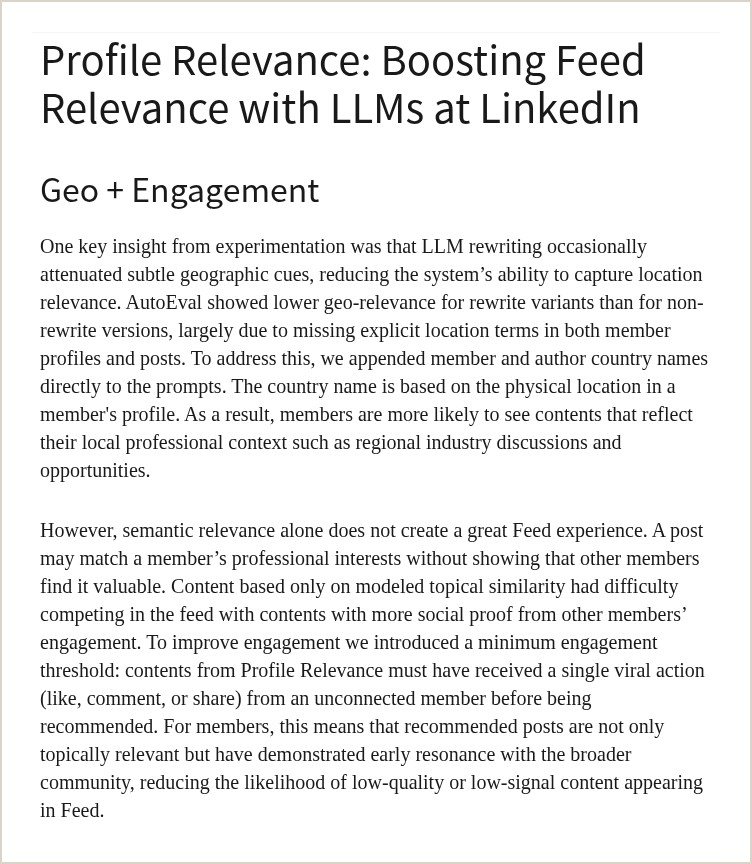
Testing exposed a weakness in the first design: summarizing the text sometimes blurred clues about location. So LinkedIn added the member’s country and the author’s country to the prompt, based on the location listed in each profile. According to the write-up, members are now more likely to see posts tied to their local professional context, such as discussions about an industry in their region.
LinkedIn also set a minimum level of engagement. A post that matched a reader’s profile, with no other signal behind it, struggled to compete in the feed against posts that had already drawn reactions. So before Profile Relevance recommends a post, the post must have received at least one “viral action” from an “unconnected member.” In LinkedIn’s terms, a viral action is a like, a comment or a share.
The numbers LinkedIn published
LinkedIn compares Profile Relevance with MemberEBR, the system that previously supplied this kind of recommendation. To judge relevance, the team built AutoEval, an automated grading system based on a language model. AutoEval checks whether each post matches a member’s profile on several factors, including topic, location, job title, company, industry, seniority and education.
Automation let the team grade 1,000 examples for each model it tested, up from about 20 examples labeled by hand. The team says it checked AutoEval’s verdicts against those of human reviewers, then refined AutoEval’s instructions.
The offline tests were not run on the live feed, and AutoEval scored them. Every result is a relative change compared with MemberEBR, and LinkedIn does not publish the starting rates. Profile Relevance raised the share of posts rated on topic by 34%. It cut the share of posts irrelevant on every factor by 33%, and the share of generic content, where no factor applied, by 24%.
One more offline figure is measured per member. LinkedIn counted members for whom at least 5 of the system’s top 10 pre-selected posts matched their topic. The share of such members rose 39%.
In live tests with real members, the final version raised the number of posts viewed in the feed by 0.54%. It also raised what LinkedIn calls the “viral rate” by 0.94%, without defining it. The hide rate, the share of posts members choose to hide, fell 18.8%. Among less active members, who have little activity history, LinkedIn measured 17.7% more viral engagement and 1.8% more daily active users.
Part of a wider feed overhaul that began in March
Profile Relevance is part of the feed overhaul LinkedIn described on the same blog on March 12, 2026. In that earlier post, Hristo Danchev wrote that the feed serves “more than 1.3 billion professionals.” He announced the rollout of a new ranking system built on large language models. Ranking is the step that sets the order of posts in the feed.
That ranking system combines profile information (industry, experience, skills, geography) with each member’s history of reading and reacting to posts. The November 9 write-up calls Profile Relevance “a key Unconnected Content source,” but it does not say what share of the feed the system supplies.
Posts distributed outside the author’s network also go through LinkedIn’s filter against “AI slop,” generic AI-generated content. On October 8, Tim Jurka, one of LinkedIn’s engineering leaders, said the filter had recently been expanded to all posts distributed beyond the immediate network. Our article on AI slop on LinkedIn explains that change. Jurka is among the leaders thanked at the end of the November 9 write-up.
LinkedIn is also testing the opposite approach: a “Network” feed limited to posts from a member’s connections and the accounts the member follows. The company announced the test on October 15, among the new features it unveiled in mid-October. The test starts with the U.S., India, the U.K. and Australia; France and Belgium are not on that first list. Instagram’s feed also mixes posts from followed accounts with recommendations, as our guide to Instagram’s algorithm explains.
Gaps in LinkedIn’s account
The numbers come from LinkedIn alone, and outsiders cannot check them. The offline results table gives only relative changes. Those tests were scored by AutoEval, which is itself based on a language model and tuned by the team that created the system. For the live tests, LinkedIn gives no margin of error, no duration and no number of members involved.
The write-up also does not say how long Profile Relevance has been running or what share of out-of-network posts it supplies. Nor does it say whether the system handles posts in French the same way as posts in English. It says the choice of models balanced quality, the cost of running them, how fresh the data is and “member consent policies.” It does not explain those policies.
Social Media Today, a site that covers social platforms, went beyond LinkedIn’s write-up on two points. On November 9, it reported that each member’s summary takes into account the profile “and posting history.” LinkedIn’s write-up lists only profile information for that summary. Reading and reaction history is used elsewhere, in the ranking system described in March.
The site also presents AutoEval’s grading factors as the factors the recommendation system itself uses. In LinkedIn’s write-up, those factors are used to grade recommendations. LinkedIn does not say the system uses them directly to pick posts.
What it means
LinkedIn has given a detailed account, with figures, of one way its algorithm puts a post in front of strangers. The yardstick is the reader’s public profile. A post is matched with members whose headline, skills and work history cover the same subject as its text. Country is an explicit part of that match, and according to LinkedIn, that favors content tied to the reader’s local context.
The first-reaction rule is hardest on small accounts. LinkedIn presents the system as a help to creators still building an audience. Yet the rule assumes that a first “unconnected” member has already found the post some other way. The write-up does not say how.
For accounts that post in French, language and country remain the main unknowns: the write-up does not say which markets these results come from.
Two questions remain open. Will LinkedIn publish the share of the feed that comes from these recommendations? Will the “Network” feed reach France? The analytics LinkedIn gives authors may one day show how much of their audience comes from this source.
Sources
- Profile Relevance: Boosting Feed Relevance with LLMs at LinkedIn, LinkedIn Engineering Blog (Shiyong Lin et al.), November 9, 2026
- Engineering the next generation of LinkedIn’s Feed, LinkedIn Engineering Blog (Hristo Danchev), March 12, 2026
- LinkedIn explains its improved content recommendation system, Social Media Today (Andrew Hutchinson), November 9, 2026
- The Technology Behind LinkedIn’s Fight Against AI Slop, LinkedIn (Tim Jurka), October 8, 2026
- New Ways to Build Meaningful Connections, Grow Your Side Hustle, and Earn on LinkedIn, LinkedIn Pressroom, October 15, 2026
Header image: MACCUS chart, data from the LinkedIn Engineering Blog (November 9, 2026)