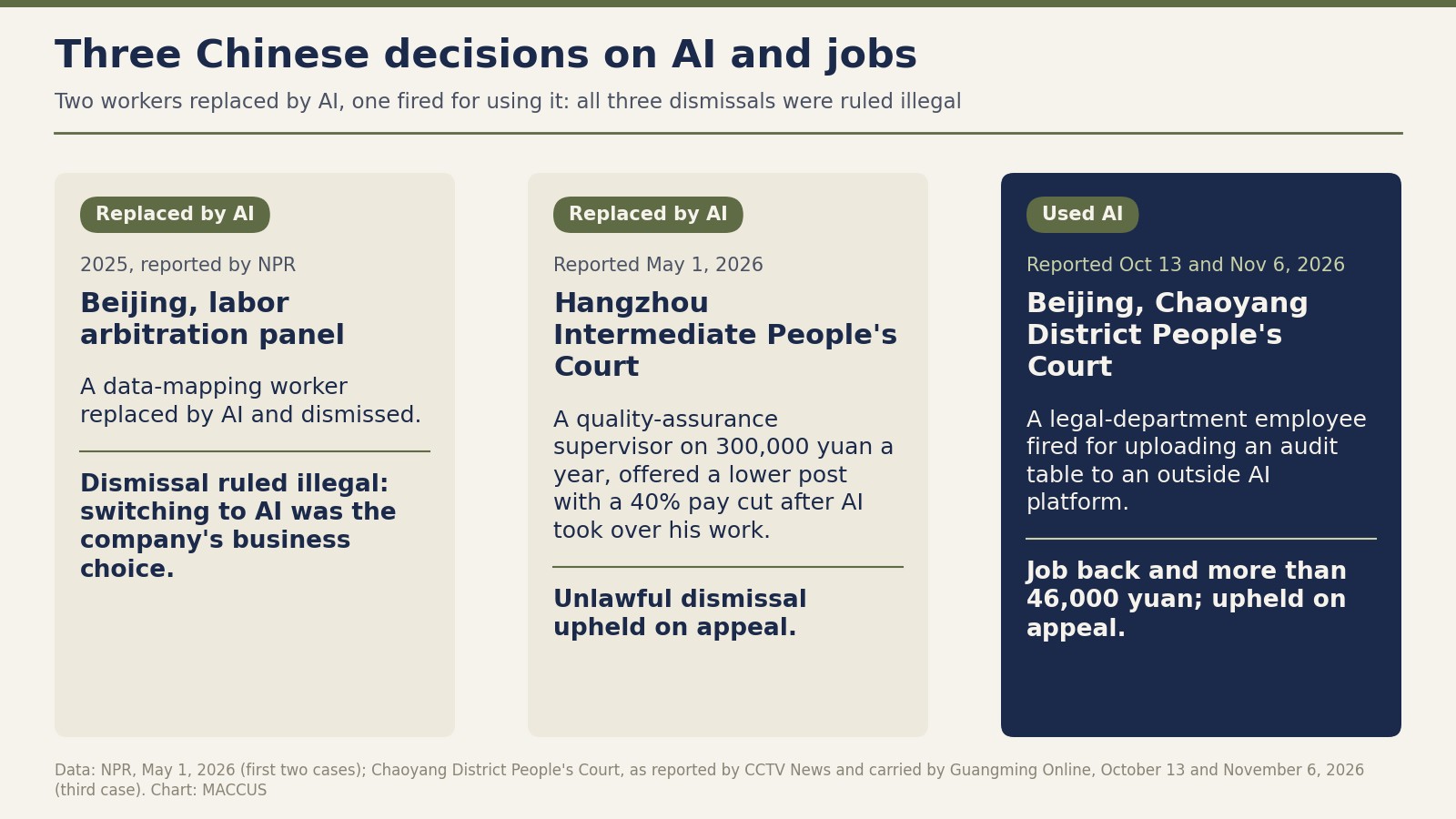
An office worker in Beijing who was fired for putting a work spreadsheet into an AI tool has her job back, plus more than 46,000 yuan (about $6,900) in lost wages and bonuses. A district court in Beijing found that her employer, an insurance company, had never told staff which files must stay out of AI tools. It also found that her own managers had recommended those tools. An appeals court upheld the ruling.
That court, the Chaoyang District People’s Court, made the case public on October 13, 2026. The story spread across China on November 6, when the state broadcaster CCTV aired the presiding judge explaining the ruling. On November 9, Shanghai Daily, an English-language newspaper in China, ran the first English report MACCUS found.
The upload and the firing
The employee, identified in Chinese reports only by her surname, worked in the legal department of an insurance company in Beijing. Neither the court nor news reports named the company. Her job covered compliance audits and risk checks, and she had signed several confidentiality agreements.
In July 2024, she uploaded a table of audit issues to an AI platform run by an outside company, according to the CCTV report carried by Guangming Online, the website of the national newspaper Guangming Daily. She had sorted and edited the table herself. She wanted help building a PowerPoint presentation and analyzing the data. The reports do not name the AI platform.
A month later, the company ended her contract. Its stated reason, in Shanghai Daily’s translation, was “seriously violating information security and related rules.” The insurer also withheld her performance bonus for that month and her annual bonus for the year.
The insurer called the table highly confidential internal information. In the court’s October account, it also argued that AI platforms collect and keep user data to improve their models, which creates a serious risk of leaks. As a legal and compliance employee, it added, she owed a stricter duty of confidentiality than other staff and had attended information security training.
She replied that her department head and her direct supervisor had recommended AI tools several times. The file contained no sensitive information, she said, and the company had lost nothing.
Arbitration, then two courts
She first took her case to the Chaoyang District labor arbitration committee, a local panel that rules on workplace disputes. The panel canceled the termination notice and ordered the insurer to keep employing her and pay the salary owed. Both sides rejected that decision and went to court.
The district court began with the company’s own rules. The clauses the insurer cited applied only when an employee intended to leak information. The court found no such intent.
Judge Chai Xu, who presided over the case, pointed to three facts: she had edited the file herself, she wanted to work faster, and managers had suggested she use AI tools. “Her subjective purpose was to work more efficiently and make a PPT,” he told CCTV, as translated by Shanghai Daily.
The court then looked at the company’s written rules. They covered confidentiality and information security. But the insurer had never banned outside AI tools, set rules for using them or trained staff on them. The insurer therefore could not decide after the fact that her use of AI broke its rules, the court said.
The insurer also failed to prove that the table was confidential, or that the upload had caused any leak, financial loss or damage to its reputation. A leak risk inferred only from AI platforms keeping user data was not enough to show a serious breach of the rules, the court said.
The district court canceled the termination notice and ordered the insurer to keep employing her. It also ordered the company to pay her more than 46,000 yuan in total, covering lost wages, the shortfall on her annual bonus and other sums. That is about $6,900 at the European Central Bank’s exchange rates for November 10, 2026. The insurer appealed, the appeals court dismissed the appeal, and the ruling is now in effect.
From a court bulletin to a national story
The court’s account first ran on October 13 on CCTV News and was carried by Guangming Online. It already said the ruling was in effect. CCTV’s November 6 broadcast, with Judge Chai on camera, was picked up the same day by Chinese news sites, including the tech site MyDrivers.
That day, a hashtag on Sina, a Chinese news portal, read in translation: “Company that fired an employee for using AI ordered to pay 46,000 yuan.” The post that carried it called the money compensation. The court’s account describes lost wages and bonus shortfalls, on top of reinstatement.
Online reactions split two ways, the U.S.-based Chinese-language outlet Sing Tao USA reported on November 6. Some internet users said companies should set clear rules for AI instead of punishing staff after the fact. Others suspected that some employers use information security as a pretext to over-restrict staff or to serve other management goals.
Workers replaced by AI, and AI at work elsewhere
The case against the Beijing insurer concerns a worker who used AI. Two other Chinese disputes, reported earlier, involved workers whom AI replaced.
The first case comes from Hangzhou. On May 1, 2026, NPR reported on a ruling by the Hangzhou Intermediate People’s Court, which heard the appeal. It upheld a lower court’s finding that a tech company unlawfully dismissed a worker.
The worker, a quality-assurance supervisor identified as Zhou, earned 300,000 yuan a year (about $45,000 at the same ECB rates) checking answers produced by AI language models. When AI took over that work, the company offered him a lower position with a 40% pay cut. He refused, and it ended his contract. The court found that the company’s grounds did not meet the legal conditions for ending the contract, and that the pay cut was not reasonable.
The second is a separate 2025 case in Beijing, also described by NPR. An arbitration panel there ruled for a data-mapping worker who had been replaced by AI and dismissed. Switching to AI was a business choice, the panel said. By ending his contract, NPR reported, the company shifted the cost of the technological transformation onto the employee.
Courts and employers outside this case are dealing with AI too. The two judges who lead Britain’s employment tribunals say many urgent claims now show signs of AI drafting. In Shenzhen, China, judges each closed about 50% more cases in 2025 than in 2024, with the help of an AI system. In the United States, employers named AI as the reason for 38,579 job cuts in May 2026.
The limits of the ruling
The Beijing insurer case is one dispute, decided by a district court and upheld on appeal. It covers one employee and one company. MACCUS could not find the full judgment online. The details here come from the court’s account to CCTV and the reports based on it.
The ruling rests on what this insurer could prove. It could not show that the file was confidential or that the upload caused harm. The court treated the insurer’s concern about data kept by AI platforms as a general risk, and found that insufficient on these facts.
The court also had a warning for workers. Information that an employer has clearly marked as confidential, or as a trade secret, should not go into an outside AI platform for convenience, it said. Du Jie, a judge’s assistant at the court, told CCTV in October that employees should learn their company’s rules. They should never upload core secrets, unpublished data or classified files to public AI platforms, Du said.
What it means
Courts and arbitrators in Hangzhou and Beijing have now ruled on AI at work from both sides. In the Hangzhou case and the 2025 Beijing arbitration, replacing a worker with AI did not, on its own, justify ending the contract. In the Beijing insurer case, using AI tools that managers encouraged did not justify firing an employee whose company had never said what was off limits.
At this insurer, AI use ran ahead of the rules, and catching up now falls to employers. Judge Chai said companies need written rules that grade documents by how secret they are and tell staff exactly what must never be uploaded. Du Jie also recommended AI usage policies and regular training.
For workers, the case shows what protected this employee: her managers had encouraged the tools, no written rule forbade the upload, and the insurer could not prove harm. Uploading a file marked confidential, after training on AI tools and against a clear rule, would put very different facts before a court. The next thing to watch is whether other courts follow the Chaoyang court’s reasoning in similar disputes. Another is whether Chinese employers now publish AI rules and secrecy grades for documents before they discipline anyone.
Sources
- 女子使用AI辅助办公被开除!法院判了:公司赔偿工资损失、年终奖差额等共计4.6万余元, Guangming Online (CCTV report), November 6, 2026
- 员工借助AI辅助办公遭辞退,法院:合理使用不违规, Guangming Online (CCTV News), October 13, 2026
- Worker Fired for Using AI at Work Wins 46,000 Yuan, Shanghai Daily (Wang Xiang), November 9, 2026
- 北京員工使用AI輔助辦公被解僱 法院裁定公司違法須賠償, Sing Tao USA, November 6, 2026
- A tech worker in China is laid off and replaced by AI. Is it legal?, NPR (Jennifer Pak), May 1, 2026
- Euro foreign exchange reference rates, European Central Bank, November 10, 2026
Header image: diagram by MACCUS, from the Chaoyang District People’s Court account reported by CCTV News, October 13 and November 6, 2026