On Thursday, November 12, 2026, Google changed the AI model that writes the answers in AI Mode, the conversational version of its search engine. That model picks and summarizes the sources each answer cites, so the change directly affects websites.
Gemini 4 Hydrogen, Google’s new fast AI model, is now the default in AI Mode. Google says it is available “globally” for all users, which includes France and Belgium. Google also uses it for the hardest questions in AI Overviews, the AI-generated summaries it shows at the top of some search results pages.
Google calls it “the biggest model upgrade to Search yet.” It promises more visual answers and “a broader range of helpful links,” but gives no numbers.
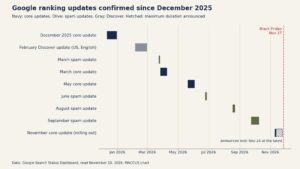
The switch comes two days after the start of the November core update, a broad change to how Google ranks results. That rollout can take up to two weeks. Until it ends, sites will have trouble telling which of the two changes moved their traffic.
The November 12 announcement
Google’s post went up on the company’s official blog at 7 p.m. Paris time (1 p.m. Eastern). It is signed by Robby Stein, VP of Product for Google Search. The post runs only a few lines and says: “Hydrogen is now available globally in Google Search for all users.”
The post doesn’t mention AI Overviews. Stein added that detail himself the same evening on X, the social network formerly called Twitter. Hydrogen is “now the new default model in AI Mode” and is “being used for your hardest questions in AI Overviews,” he wrote. Google doesn’t say how it decides which questions count as the hardest.
The same day, a second Google post introduced the model itself. It is signed by Koray Kavukcuoglu, senior vice president at Google DeepMind, the company’s AI research division. It describes Hydrogen as a fast model for everyday work. The Gemini 4 family also has two frontier models, Gemini 4 Carbon and Gemini 4 Argon, both built for long, deep reasoning.
Google pitches Hydrogen to developers as an upgrade over Gemini 3.8 Flash, its previous fast model. In Google’s own tests, Hydrogen finishes tasks 2.5 times faster than Gemini 3.8 Flash. That figure is for Hydrogen’s default thinking level, the setting that controls how much reasoning the model does.
In AI Mode, the first two Gemini 4 models are reserved for paying subscribers. According to PPC Land, a site that covers online advertising, Argon reached AI Mode on October 13 for subscribers to the Google AI Pro and Ultra plans. The same site reports that Carbon started rolling out in AI Mode on November 10, for Ultra subscribers only. Hydrogen is the first of the three that everyone can use in Search.
Four improvements, as Google tells it
The first improvement is about understanding questions. Google says its search engine now does a better job with multi-part requests, very specific queries and queries made hard to read by typos. The post also mentions better “tool calling,” meaning the model’s ability to call on other services to answer. It doesn’t say which ones.
The second improvement matters most to websites. AI Mode relies on a technique Google calls “query fan-out.” The engine splits a question into several subtopics and runs a batch of searches at the same time. Google France described it that way when AI Mode launched in France on July 22, 2026.
According to the post, Hydrogen “supercharges” that technique and connects people to “a broader range of helpful links than before.” Google adds that this helps users “find sites you previously might not have discovered.”
The third improvement is about how answers look: more images, structured responses, comparison tables and “custom tools built for you.” The post gives no example. PPC Land points to one Google showed in late 2025 with Gemini 3, the previous generation: a mortgage calculator built right into an answer.
The fourth improvement is about languages. Google says answers will be more nuanced “across all supported AI Mode languages.” The post doesn’t list them. Google’s AI Mode help page lists French as one of them. It also names France, Belgium, Switzerland and Canada among the countries where AI Mode is available.
A core update already under way
The November core update is a change to Google’s ranking systems that began on November 10 at 7:06 p.m. Paris time. Its rollout can run until about November 24. Since November 12, the switch to Hydrogen has been running at the same time.
Barry Schwartz, of the search news site Search Engine Roundtable, asked whether the new model might affect only AI Overviews and AI Mode. The ranking of regular links would then stay the same. As of the morning of November 13, Google had not commented on that point.
A Search Console error and a new page on Google traffic
Search Console, Google’s free tool for tracking how a site shows up in its results, had a data problem from November 9 to 11, 2026. According to Google’s page that lists data anomalies, a logging error lowered the impressions in the report on generative AI in Search. An impression is one appearance of a link to the site in Google’s results. Google says the error affected only how the data was recorded.
On November 12, the day of the Hydrogen announcement, Google published a documentation page on how to spot visits from its search engine. Site owners can do that in their analytics tools or in their server logs, the files where a web server records every request it receives. The page relies on the HTTP Referer header, the piece of data in which a browser tells a site which page the visitor came from.
In that header, Google sends only its base address, such as https://www.google.com/ or a local Google domain. The page doesn’t mention AI Mode or AI Overviews. It also warns that figures in analytics tools often don’t match the clicks Search Console reports.
What the announcement leaves out
Stein’s post contains no data. It doesn’t say how many searches AI Mode runs for one question, how many links an answer contains, or whether those links get more clicks than before.
PPC Land points out other gaps. The post doesn’t name the model Hydrogen replaces in Search, and it says nothing about advertising. It also doesn’t say which of Hydrogen’s four thinking levels Search uses.
Hydrogen’s performance figures, such as its speed gain, come from Google itself or from tests Google chose. PPC Land notes that they have not been reproduced independently.
The promise of “a broader range of helpful links” isn’t new. PPC Land notes that when Gemini 3 arrived in AI Mode on November 18, 2025, Google already promised more searches and more web content shown to users. On October 15, 2026, Google also moved links higher in AI Mode answers. It did not say how many clicks those links send.
On Reddit this week, SEO specialists, who work on getting sites to rank in search engines, described sites with lots of impressions and few clicks. One of them attributed this mainly to rankings for broader queries, where AI Overviews often push the regular links further down the page. Another asked how to build a report that proves a traffic drop comes from those summaries. None of these posts includes figures that can be checked.
What it means
To get traffic from AI Mode, a website has to clear two steps: getting cited in the answer, then getting the click. Google says it is improving the first. It publishes no data on the second.
PPC Land notes that comparison tables and tools generated inside the answer do part of the job of comparison, review and calculator sites. If the answer is enough, the user has no reason to click. No public data yet measures that risk for Hydrogen.
Five associations of French publishers make the same argument. On October 29, they filed a complaint against Google with the European Commission, the European Union’s executive body, over AI Overviews and AI Mode. The day before, Alphabet, Google’s parent company, acknowledged that AI Mode earns less from ads than traditional search. Alphabet gave that as one of the reasons for slower growth in its search revenue.
Measuring Hydrogen’s effect on a site’s traffic will stay difficult at least until the core update ends. The core update overlaps with both the new model and the Search Console logging error. Google’s new documentation page offers no way to tell a click from AI Mode apart from a click on a regular link.
Three things are worth watching. The core update should finish by around November 24. Google may correct the Search Console data for November 9, 10 and 11. It did so on August 21 for a similar error that hit the same report from August 13 to 17. The last open question is whether Google will publish any figures on links and clicks in AI Mode.
Sources
- Google Search gets a major upgrade with Gemini 4 Hydrogen, Google (Robby Stein), November 12, 2026
- The biggest model upgrade to Search yet has landed, Robby Stein on X, November 12, 2026
- Introducing Gemini 4 Hydrogen, Google (Koray Kavukcuoglu), November 12, 2026
- Get AI-powered responses with AI Mode in Google Search, Google Search Help, accessed November 13, 2026
- Identify Google Search traffic in your web analytics or server logs, Google Search Central, November 12, 2026
- Data anomalies in Search Console, Search Console Help, accessed November 13, 2026
- Google Search Gets Massive Upgrade With Gemini 4 Hydrogen, Search Engine Roundtable, November 12, 2026
- Google Search gains Gemini 4 Hydrogen for all users, not just subscribers, PPC Land, November 12, 2026
Header image: MACCUS timeline, based on Google’s announcements, November 2026