On Monday, November 16, 2026, Google added three options to the Search Analytics API, the application programming interface that lets software pull data from Search Console. Search Console is Google’s free tool that shows site owners how their pages perform in Google search.
The first option lets dashboards and SEO (search engine optimization) tools separate branded queries from the rest automatically. Branded queries are searches that name a site or one of its products. With the other two, the same tools can isolate searches made with an image and group several countries or devices in a single request. All three options were already available in Search Console’s web interface.
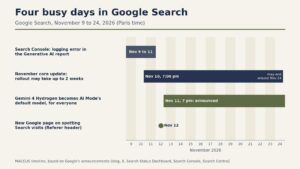
The announcement lands in the middle of Google’s November core update, a broad change to how Google ranks pages that began rolling out on November 10. It also comes as third-party rank trackers, the outside tools that check where pages appear in Google, have become less reliable.
Three options first offered in the web interface
The announcement appeared on the Google Search Central blog, Google’s blog for website owners and developers. Its authors are Daniel Waisberg, Nati Yosephian and Karin Gadasi of the Search Console team. Google says it is responding to requests from “the ecosystem” for custom reporting and automated workflows.
Each option reached the web interface first, over the past year. The branded queries filter was introduced on November 20, 2025, and opened to all eligible sites on March 11, 2026. A filter for searches made with images followed on September 24, 2026.
Search Engine Roundtable, a search industry news site, spotted on October 6, 2026, that several countries could be selected at once, a change Google announced on LinkedIn. It reported the same for device types on November 4.
Google decides what counts as branded
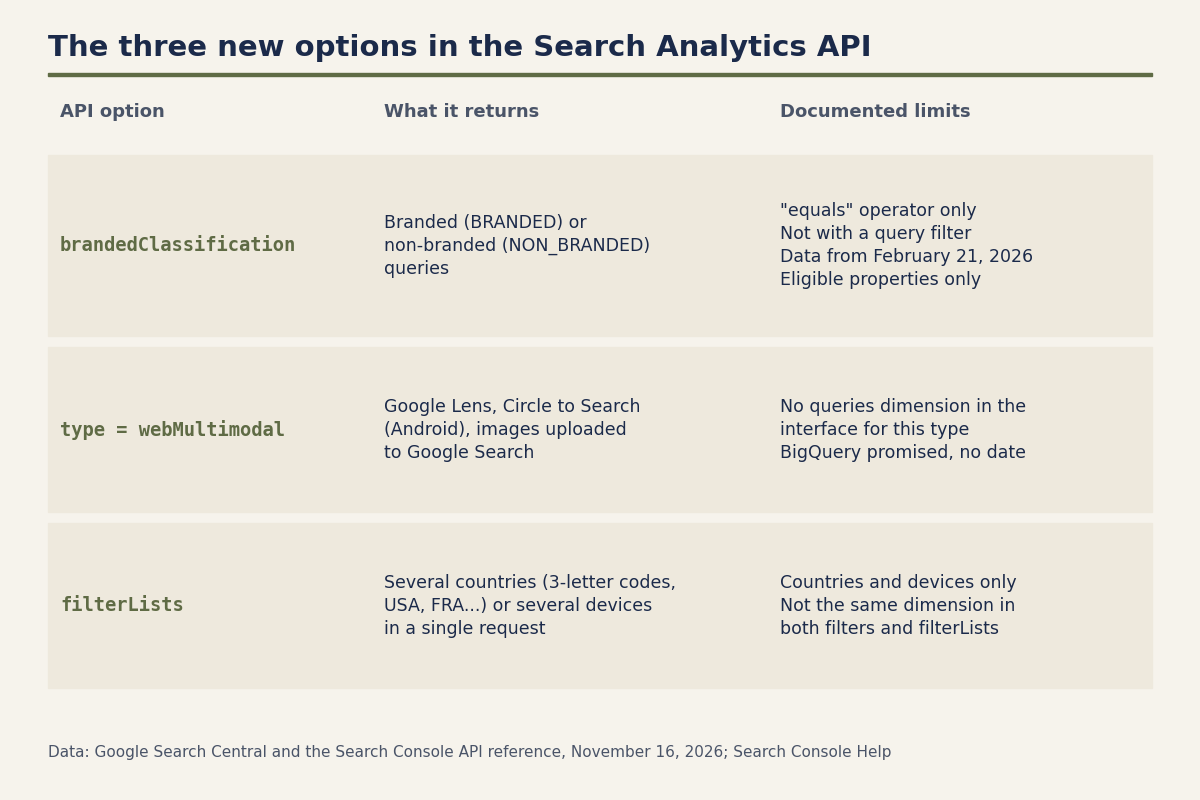
In the API, branded sorting is a new dimension, the API’s term for a category used to group or filter results. The dimension is called brandedClassification. It takes two values: BRANDED for a branded query and NON_BRANDED for everything else.
Google pitches branded sorting as a way to avoid “maintaining complex keyword regex lists.” Regex, short for regular expressions, are hand-written text patterns. Here they are used to pick out a brand name in search queries, as our guide to Search Console regex filters explains.
Google alone decides what counts as a branded query. In its November 2025 post, it said the classification comes from an internal, “AI-assisted system.” The classification doesn’t rely on regular expressions that include or exclude keywords.
The classification treats the site’s brand name as branded in any language, including typos. It also covers searches that leave out the name but refer to a product unique to the site, such as Gmail for google.com. Google warns that some queries may be misclassified. It adds that the classification has no effect on how a site ranks.
The API reference, Google’s technical documentation for developers, was updated on November 16 and sets several limits. For this dimension, filters accept only the “equals” operator, so a request asks for either the branded queries or the rest. A request also can’t combine the dimension with a filter on the query text. Branded data in the API starts on February 21, 2026.
In Search Console, a property is a site, or part of a site, that an owner tracks. Only “top-level” properties qualify, and Google doesn’t define that term. Google’s November 2025 post rules out properties limited to one section of a site, such as example.com/blog, and properties that cover only a subdomain, such as shop.example.com.
A property also needs enough queries and impressions, and Google doesn’t disclose the threshold. Impressions are the times a site’s pages were shown in search results. When a property doesn’t qualify, the API returns an empty response. According to PPC Land, a digital marketing news site, neither Google’s post nor the API reference describes a message or flag that tells this case apart from a site with no branded traffic.
Image searches get their own category
The second option is a new search type called webMultimodal. Search types are the categories the API uses to separate kinds of searches, such as Web. This one covers three sources of searches that start from an image.
The first is Google Lens, which runs a search from a phone’s camera. The second is Circle to Search, an Android phone feature that starts a search when the user circles part of the screen. The third is an image uploaded to Google Search.
The interface’s list is slightly longer: in September, Google also counted the right-click “Search this image” feature in Chrome, which the API reference doesn’t mention.
Search Console Help says these searches rely mostly on images. For that reason, the interface doesn’t show the Queries table, the list of search terms, for this type. The API reference doesn’t say whether the API returns queries for webMultimodal.
Google adds that the image search data will also be sent to BigQuery, its cloud service for analyzing large data sets. That applies to sites that have turned on the bulk data export, which copies Search Console data into BigQuery. Google gave no date.
Several countries or devices in one request
The third option is a parameter, or request setting, called filterLists. It accepts a list of values for only two dimensions: country and device. According to Google, a single API request can now target a group of countries and several device types.
The post cites three regional groups as examples: EMEA, for Europe, the Middle East and Africa; LATAM, for Latin America; and DACH, for Germany, Austria and Switzerland. Countries use three-letter codes, such as FRA for France and BEL for Belgium. The device values are DESKTOP, MOBILE and TABLET.
Until now, filters in a request could only be combined with “and”: France and mobile, for example. A list adds “or” within a single dimension: France or Belgium. The reference says “or” between two different filters, such as France or mobile, is still “not yet supported.”
The same dimension also can’t appear in both a regular filter and filterLists. A request can pair a regular device filter with a list of countries. It can’t add a regular filter that excludes one country on top of a country list.
Third-party rank trackers have been less reliable since September
Since mid-September, Google has been sending falsified results pages to some third-party rank trackers. Two SEO software makers confirmed it: Ahrefs on October 22 and Semrush on October 27, as we reported in our article on the distorted Google results sent to SEO tools.
On November 16, Barry Schwartz of Search Engine Roundtable noted that chatter around the November 2026 core update had been unusually quiet. He suspected the cause was tracking tools that were “somewhat being blocked” and struggling to measure the update’s effects. He added that Search Console’s performance reporting had been “a bit laggy.”
On Reddit, overnight from November 16 to 17, a member of an SEO forum reported that Search Console was very slow. The poster guessed that more people were using it since Google started making life harder for third-party data aggregators, the outside services that collect search data in bulk. The poster called Search Console the only data source left.
A short data history and open questions
Google pitches branded sorting as automatic. Its documentation describes a classification set by Google alone, with no documented way to change it.
Google’s pages also disagree on how far back branded data goes. The help page for the web interface mentions 16 months, while the API reference starts the data on February 21, 2026. Through the API, a year-over-year comparison of the branded share of a site’s search traffic won’t be possible before February 21, 2027. A full-month comparison, March 2027 against March 2026, will have to wait until April 2027.
Google’s post doesn’t mention connectors, the ready-made links that feed Search Console data into a dashboard without any coding. One example is the connector in Data Studio, Google’s dashboard tool, which was called Looker Studio until April 2026. The post also doesn’t say whether branded classification will be added to the BigQuery export.
The update gives Google’s AI-written answers no search type of their own. Those answers appear in AI Overviews, summaries shown above the regular results, and in AI Mode, a chat-style search. According to Google’s documentation, clicks from both are still counted with everything else under the Web search type. That gap is described in our article on Google Search traffic and clicks from AI answers.
What it means
The update gives software access to data that people could already see in the web interface. Google’s post pitches the options as help for site owners, international businesses and third-party tool builders. Until now, as PPC Land notes, each tool rebuilt branded sorting with its own keyword lists. The sorting now comes ready-made, with Google’s definition and its possible errors.
During a core update, the branded split shows which visitors a site is losing: people who already know it, or people discovering it for the first time. The API now lets that check run automatically on Google’s own data, at a time when third-party rank trackers are less reliable.
Branded sorting remains limited to top-level properties with enough traffic. Its data covers almost nine months, since February 21, 2026, which also limits comparisons. The other two options are open to every site.
Three things are worth watching: when image search data reaches BigQuery, how quickly SEO tools and connectors adopt branded sorting, and whether Google adds a search type for AI answers.
Google said the November core update, which started on November 10, could take up to two weeks to roll out, which puts its end around November 24.
Sources
- New filtering and reporting capabilities in the Search Analytics API, Google Search Central, November 16, 2026
- Search Analytics: query, Google for Developers (Search Console API reference), updated November 16, 2026
- Introducing the branded queries filter in Search Console, Google Search Central, November 20, 2025
- Announcing web multimodal Search performance reporting in Search Console, Google Search Central, September 24, 2026
- Performance report (Search results): Dimensions and data groupings, Search Console Help, accessed November 17, 2026
- Google Search Console Performance Report Multi-Select Country Filters, Search Engine Roundtable (Barry Schwartz), October 6, 2026
- Google November 2026 Core Update Ranking Volatility, Search Engine Roundtable (Barry Schwartz), November 16, 2026
- Google’s Search Console API now splits brand traffic, back to February 21, PPC Land, November 16, 2026
Header image: MACCUS diagram, data from Google Search Central and Search Engine Roundtable, November 2026