On November 13, 2026, Hari Srinivasan, LinkedIn’s chief product officer, announced two changes aimed at low-quality, AI-generated comments. The comments stay up, but they drop lower in the default comment view, and the post’s author may no longer be notified about them.
According to Srinivasan, views of these comments have already fallen by more than 20% in LinkedIn’s tests. The rollout to all members is due “soon,” with no date and no list of countries.
“AI slop” is the common term for low-effort content churned out with AI tools. LinkedIn uses the term but has not given it a fixed definition. On July 30, Srinivasan wrote that “AI and slop are not the same thing,” because many members use AI to refine their thinking.
Two changes announced on November 13
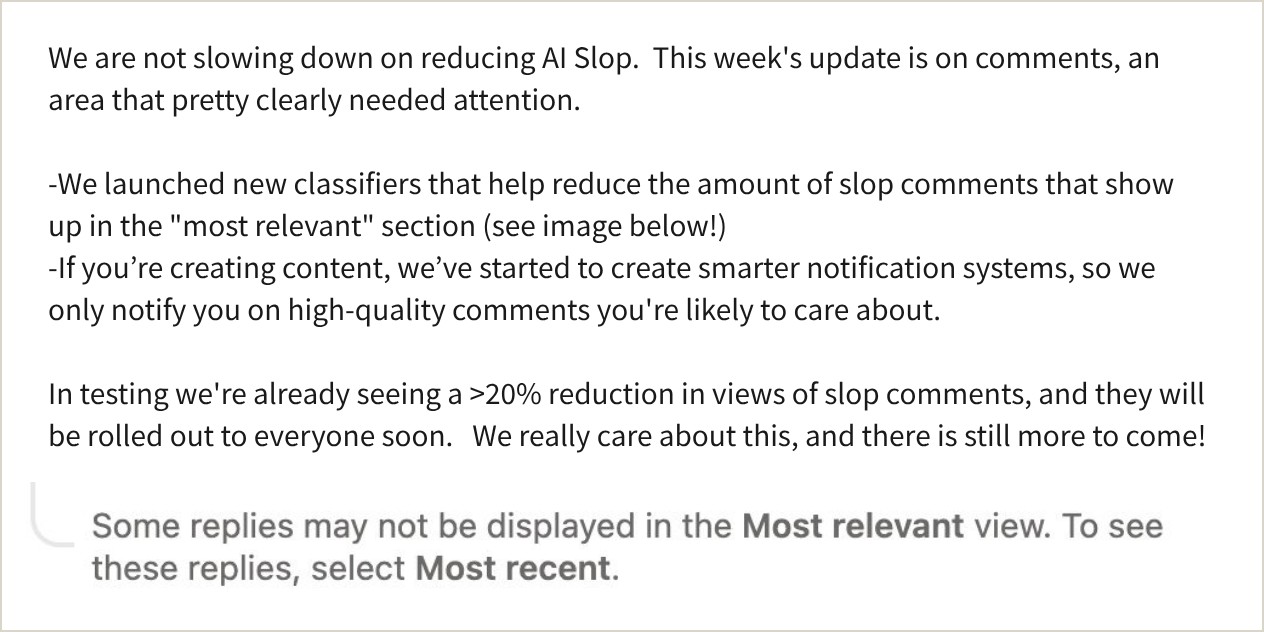
Srinivasan made the announcement in a short post on his own LinkedIn profile. “This week’s update is on comments, an area that pretty clearly needed attention,” he wrote.
The first change affects the order of comments. LinkedIn offers two ways to sort the comments under a post, called views. “Most relevant,” the default, lets LinkedIn set the order, and “Most recent” lists comments by date. New classifiers, programs that automatically label content, now push comments judged low-value further down the default view.
Srinivasan’s post includes an image of a LinkedIn notice. It says some replies may not appear in the Most relevant view, and readers have to switch to Most recent to see them. The demoted comments are still published.
LinkedIn’s help page on comments says the same thing: “Some comments will only be visible under Most recent view.” Social Media Today, a trade site that covers social media, sums up the approach: LinkedIn re-ranks suspected AI replies instead of removing them.
The second change is for the people who write posts, or members “creating content,” as Srinivasan’s post puts it. LinkedIn has started building “smarter” notifications that alert them only to high-quality comments they are likely to care about. The post does not say whether this applies to every member or only to some.
Earlier steps against AI slop and automated comments
Before November 13, LinkedIn was already tackling comments in two ways: it blocked automated comments, and it let members flag AI slop. On July 30, 2026, Srinivasan said LinkedIn was catching “hundreds of thousands of automated comment attempts” every day. He added that LinkedIn had blocked billions of other automation attempts, such as mass posting, over the previous couple of months.
The same July 30 post announced the gradual rollout of a feedback option. It lets members tell LinkedIn that a post or comment “seems like AI slop.” On August 19, Srinivasan said the option was in the three-dot menu of every post and every comment.
In that August 19 post, he said more than a million people had used the option since its launch two weeks earlier. He also said members were seeing 40% fewer views of content LinkedIn classifies as AI slop than a few weeks before. He also announced that a post with enough community feedback could show its author a message in Post Analytics. Post Analytics is the page of statistics LinkedIn gives authors for each post.
On October 8, Tim Jurka, a LinkedIn vice president of engineering, said the AI slop filter now covered every post distributed beyond the author’s immediate network. Those are posts shown to people who are not connected to the author. We covered that change in our article on AI slop and the reach of LinkedIn posts. The November 13 update goes further: it changes the order in which comments appear under posts.
LinkedIn’s rules already covered comments. Its help page says LinkedIn may limit how many comments a member or a LinkedIn Page, an organization’s account, can post in a given period. To set that limit, LinkedIn looks at the member’s interactions, how many members block the profile, and whether the profile’s information is verified. “If we detect excessive comment creation or use of an automation tool, we may limit the visibility of those comments,” the page says.
LinkedIn’s User Agreement, the terms every member accepts, goes further. It bans using “bots or other unauthorized automated methods” to “create, comment on, like, share, or re-share posts.” Bots are programs that act automatically in place of a person.
Comments also matter for how far a post travels. On November 9, LinkedIn’s engineering blog described Profile Relevance, one of the systems that recommend posts to people outside the author’s network. According to that blog post, the system recommends a post only after it has received at least one like, comment, or share from a member who is not connected to the author.
How many comments are written by AI?
LinkedIn does not publish the share of comments written with AI. On July 9, 2026, Pangram, a company that sells a detector for AI-generated text, published an analysis of more than a million posts. The posts came from LinkedIn and other networks, collected from users of Pangram’s Chrome browser extension who had agreed to share their data.
In that data, an original LinkedIn post was 1.35 times as likely as a comment to be AI-generated. Pangram says the gap reverses when length is taken into account: at the same length, comments were slightly more likely than posts to be AI-generated. The figures have two limits. The sample is made up of volunteers, and the detector is the one Pangram sells.
Early reactions, mostly positive
Andrew Hutchinson of Social Media Today wrote that LinkedIn is likely ahead of other networks on this, and that they will probably need similar filters. He expects that to be harder for Meta, which owns Facebook and Instagram, and for TikTok and X, all heavily invested in AI. He also ties the move to LinkedIn’s place among the sources AI chatbots cite most often, since chatbots tend to cite platforms with some form of user vetting and content validation.
Blog du Modérateur, a French digital news site, pointed to a practical effect. Moderating the comments on a post now means switching to Most recent, because the default view can hide some replies.
Most of the replies under Srinivasan’s post that can be read without signing in welcome the change. Two members, however, say they have seen legitimate comments removed or buried. Another member asks whether mentioning someone else, adding a link, or attaching an image changes the odds of a comment being classified as AI slop.
Unverifiable figures and unpublished criteria
The drop of more than 20% in views comes from LinkedIn’s own tests. The November 13 post does not say how long the tests ran or what share of members took part. It gives no error rate, meaning how often a comment written by a person gets classified as AI slop.
LinkedIn does not define a “slop comment” either. In the same July 30 post, Srinivasan acknowledged that “slop is hard to define and the definition changes.”
The criteria for the new notifications are not public. LinkedIn describes no appeal process for a member whose comment is demoted by mistake. The timing is also unclear: the rollout is due “soon,” with no date, no list of countries, and no word on whether company Pages are covered.
What it means
Until now, LinkedIn’s filters against AI slop mostly acted on how far posts travel. The November 13 update reaches comments: it changes their order under a post and which ones trigger a notification for the post’s author. A comment judged low-value stays online, but it drops lower in the default view, and the post’s author may not hear about it.
Members who let an AI tool write their comments, or who post generic replies in bulk, are the first to be hit. The change adds to another recent comment feature: pinning, which lets a post’s author put a helpful comment at the top of the list. Pinning was announced on October 15, along with LinkedIn’s other new features.
Post authors should get fewer notifications. Community managers, who run brand and company accounts, will need to check the Most recent view to see every reply.
The only figures on the change’s effect come from LinkedIn. The drop of more than 20% measures views of these comments, and LinkedIn does not say how many of them were classified correctly. The two members who say they have seen legitimate comments removed or buried point to the main risk of this kind of filter. That risk is false positives: comments written by people but wrongly classified as AI slop.
The next thing to watch is the date of the rollout to all members, including in France and Belgium. Another open question is whether the Post Analytics message announced on August 19 will be extended to flagged comments.
Sources
- We are not slowing down on reducing AI Slop, Hari Srinivasan, LinkedIn, November 13, 2026
- AI slop is a top priority for all of us, Hari Srinivasan, LinkedIn, July 30, 2026
- One more follow up on AI Slop, Hari Srinivasan, LinkedIn, August 19, 2026
- Comment on posts and reply to a comment, LinkedIn Help, accessed November 17, 2026
- User Agreement, LinkedIn, accessed November 17, 2026
- AI Content Is Everywhere on Social Media, Especially LinkedIn, Pangram, July 9, 2026
- LinkedIn cracks down on AI-generated comments, Social Media Today, November 15, 2026
- LinkedIn s’attaque enfin aux commentaires générés par IA, Blog du Modérateur, November 16, 2026
Header image: MACCUS diagram. Data: Hari Srinivasan’s LinkedIn posts (July 30, August 19 and November 13, 2026) and Tim Jurka’s article (October 8, 2026)