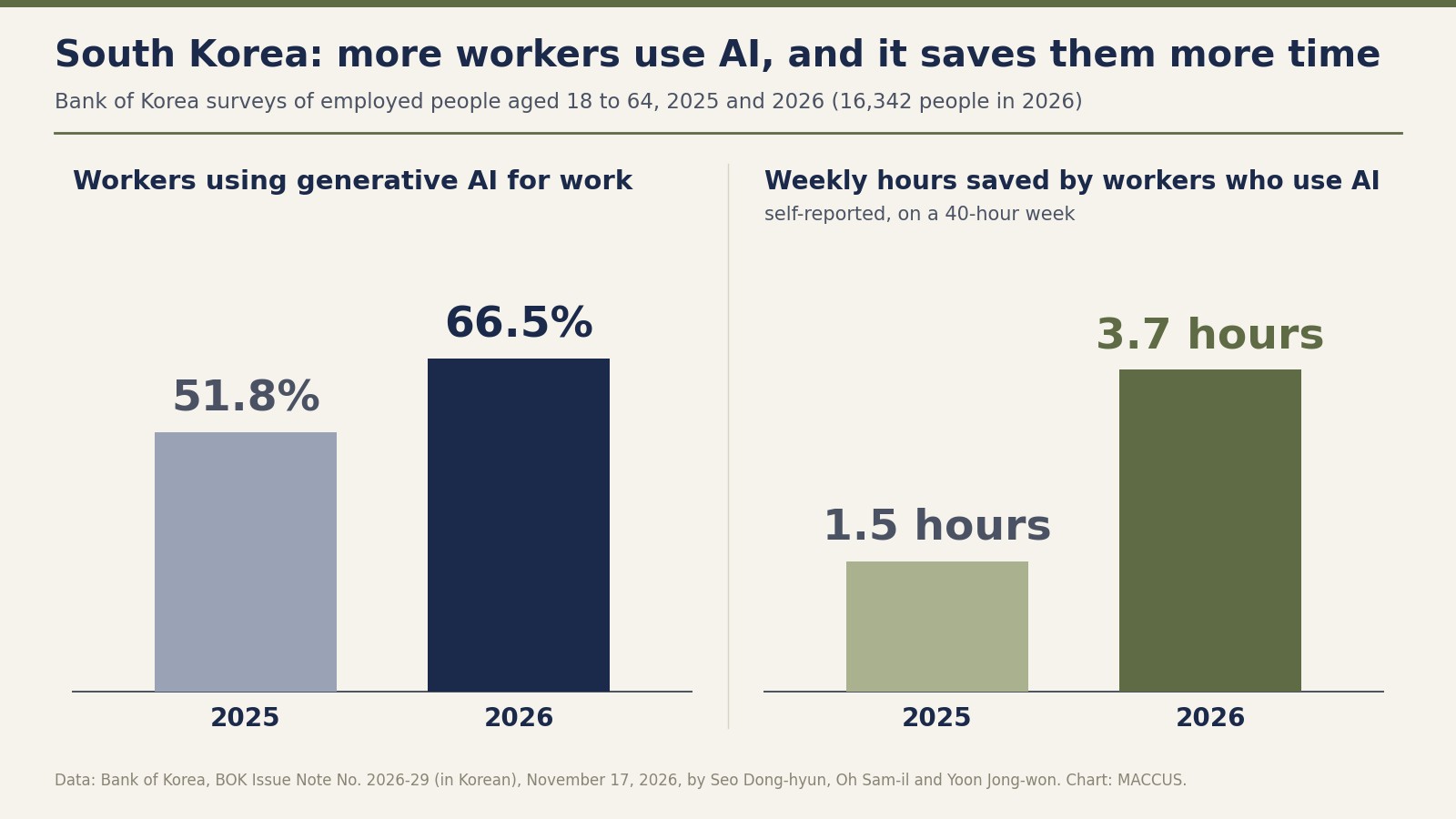

South Korean workers who use AI on the job say it saves them about 3.7 hours of a 40-hour week on average, nearly half a working day. A year earlier, the figure was 1.5 hours. The figures are self-reported, from a Bank of Korea survey of 16,342 working people published on November 17, 2026.
Two in three Korean workers (66.5%) used generative AI for work in 2026, up from 51.8% in 2025. That is the highest share among the countries the central bank compares.
Output has not caught up. Workers who saved the most time did not report proportionally more work than the others. The bank’s economists also suggest that better AI tools may explain much of the jump in time saved.
A central bank survey, repeated a year apart
The study, BOK Issue Note No. 2026-29, is a research paper in Korean by Seo Dong-hyun, Oh Sam-il and Yoon Jong-won of the bank’s employment research team. The note says it gives the authors’ views, not the bank’s official position.
The survey ran from August 14 to September 23, 2026, among employed people aged 18 to 64, with a margin of error of plus or minus 0.77 percentage points. The team also re-surveyed 2,024 people from the 2025 round, a group called a panel, to follow the same workers over a year. Averages for hours and time saved cover workers who used AI for work in the week before answering.
Two in three workers use AI, and for longer
Most of the rise in use came from regular users, whose share of all workers grew from 17.1% to 30.6%. AI users spent 8.0 hours a week with it, up from 5.9 hours. That is 22.4% of the hours they actually worked.
Women have caught up: 66.6% used AI for work in 2026, up from 47.7%, against 66.5% of men. Age and education still divide workers. Use reached 78.4% among people in their 30s but 53.7% among those aged 50 to 64. It was 86.0% for graduate degree holders and 51.2% for workers without a college degree.
Among AI users, 28.4% paid for a subscription themselves. They spent 49,000 Korean won a month on average, about $37 at the European Central Bank’s November 17 rate. Employers paid for 28.2% of users, and the two groups can overlap. Across the workforce, the bank puts workers’ own spending at about 2.8 trillion won a year (about $2.1 billion).
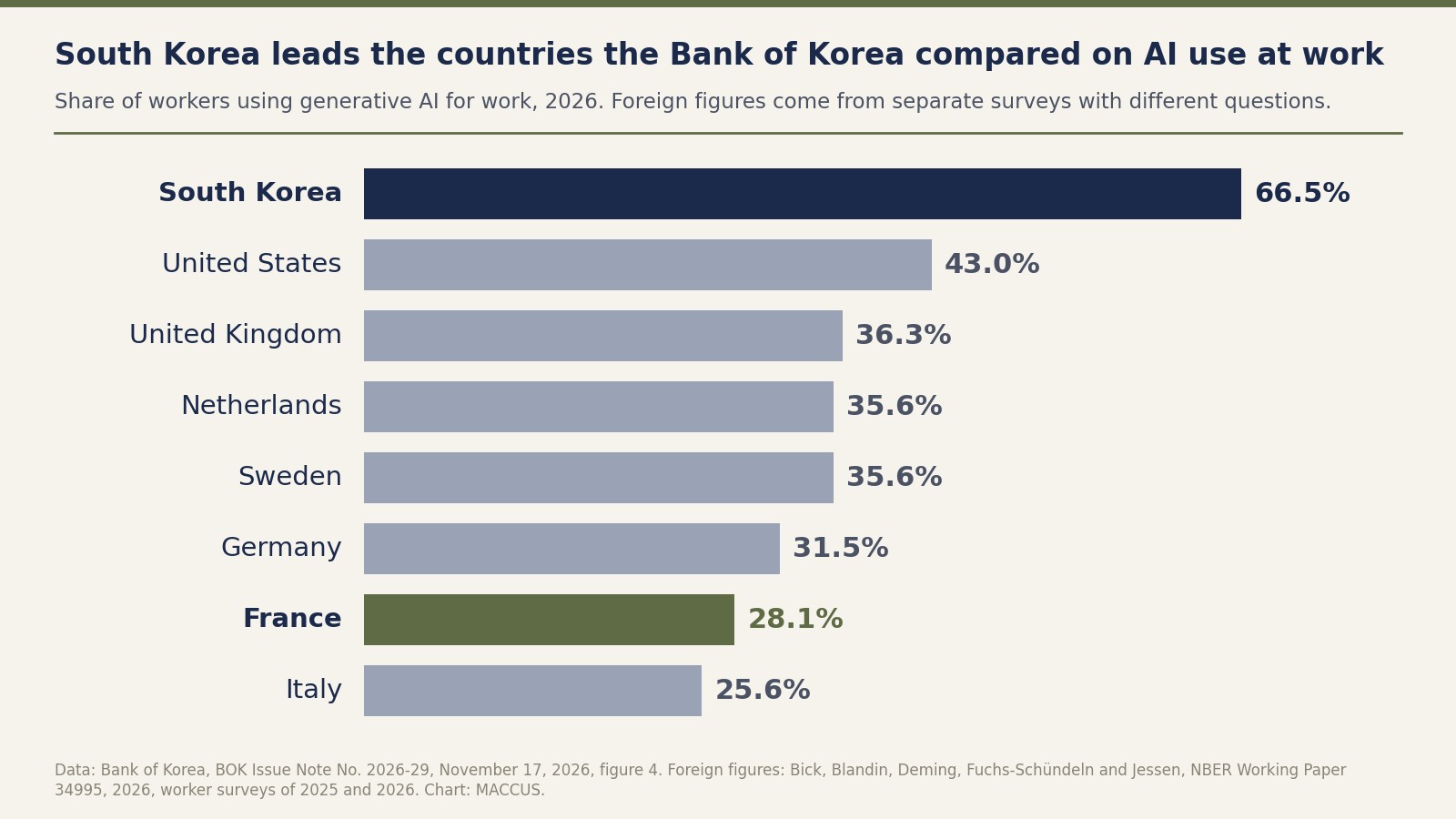
Korea’s 66.5% is about twice the 33.7% average for the United States and six European countries, according to the note. Those rates come from a separate study of 2025 and 2026 worker surveys by Alexander Bick and co-authors, published by the US National Bureau of Economic Research. It puts use at 43.0% in the United States, 36.3% in the United Kingdom, 31.5% in Germany and 28.1% in France.
In Britain, a government survey of companies found that one in three UK businesses used AI in 2026, up from one in six in 2025.
From 1.5 to 3.7 hours a week
AI users’ savings rose from 3.8% of their working time in 2025 to 9.2% in 2026, 2.4 times as much. The share of tasks where AI cut the time needed by more than 20% rose from 4.7% to 17.4%. Japan has its own estimate: government staff who use the state’s AI tool weekly report saving about 110 minutes a week on the tasks they give it.
Savings were bigger with better access. Users who paid nothing themselves saved 8.3% of their time, against 11.4% for those paying for their own subscription and 11.6% for those whose employer paid. The authors caution that paying users may also be the keenest, so the paid tools may not explain the whole gap.
In 2026, workers with more education also saved more time, and unlike in 2025 the gap was statistically significant, meaning unlikely to be chance. The authors say gaps in results deserve attention, along with gaps in access.
The panel points to the tools themselves. Among otherwise similar workers, those who already used AI in 2025 did not save significantly more time than those who started in 2026. For people who used AI in both years, savings did not grow significantly faster for heavier 2025 users or for those who had trained since. The authors conclude that progress in AI itself may explain much of the rise, as models got better and easier to use.
Active habits did matter: testing prompts (instructions to the AI), checking the output, analyzing errors, saving prompts or building AI into routines. Workers with these habits saw their savings grow 3.6 percentage points more than others.
Counting non-users too, the bank values the time saved at about 61.1 trillion won (about $46 billion), or 4.8% of all employee pay in 2025. The authors stress that this is a potential value, not realized income, and cannot be compared directly with the 2.8 trillion won workers spend. If every saved hour went back into production, their model gives a potential output gain of about 2.6%, up from 1.0% a year earlier. The note says this is not actual GDP growth.
Saved time and the output gap
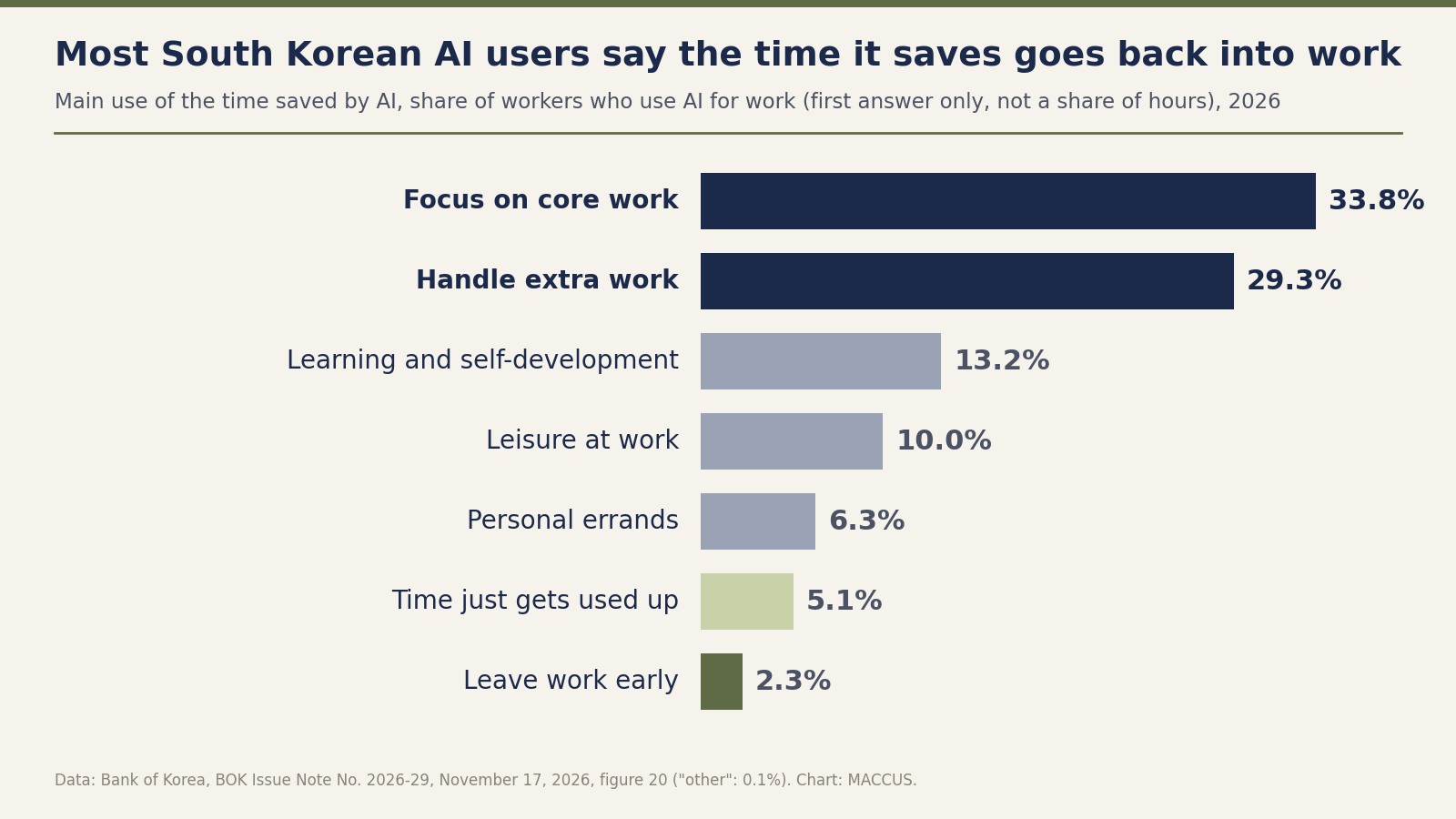
Asked what they mainly do with the time AI saves, 33.8% of users said they focus on core work and 29.3% that they handle extra work, 63.1% in all. Learning and self-development drew 13.2%, leisure at work 10.0% and personal errands 6.3%. Another 5.1% said the time just gets used up, and 2.3% leave work early. These are shares of workers’ first answers, not of the hours saved.
That extra work does not yet show clearly in output. The authors measured the link on a scale where 0 means no relationship and 1 a perfect one. The correlation between time saved and the change in work volume was 0.08, up from 0.00 in 2025, and 0.09 with work quality. Output may still have risen, the authors note, but workers who saved more time did not report proportionally bigger gains.
In June 2026, the same team called this gap a “productivity disconnect.” Its note on the 2025 data said AI had reached an efficiency stage, where tasks go faster, but not yet a productivity stage, where output rises. It called this typical of the early years of a general-purpose technology, one used across the economy. Economists call such a lag between adoption and results the J-curve or the Solow paradox.
The new note reads the slightly higher correlation as a possible sign that time savings are starting, little by little, to turn into results. If a worker finishes the same tasks sooner but gets no extra work and demand does not grow, output may barely rise, the authors explain. Turning individual speed into more output takes changes in workflow, organization and staffing, they write. Workers with a larger share of core tasks reported bigger quality gains, so in core work, AI’s benefits may show up more in quality than in volume.
In Britain, the Bank of England estimated on November 5 that businesses building and selling AI made up almost a fifth of UK growth this year. It traced that growth to AI suppliers rather than to companies using AI.
What the survey does not show
Every number on time, volume and quality is self-reported, and the bank did not measure output directly. Its statistical models find links after accounting for other factors, but the authors say these do not establish cause and effect.
Use also remains shallow, the note finds. Workers who spent more of their week on core tasks were less likely to use AI that week. In managerial, professional and office jobs, reported time savings fell well below a theoretical estimate of what AI could do on their tasks. The two measures use different criteria, the authors caution.
The country comparison puts the bank’s survey next to other researchers’ surveys, which asked different questions at different dates. The authors call their results a snapshot of a fast-moving transition.
What it means
Reported time savings more than doubled in one year. The panel suggests that better tools drove much of that jump, since experience and training made no significant difference. If that reading holds, savings should keep rising as models improve, fastest for workers who test and check the AI’s output, a skill the authors want supported.
Output is the open question, and the note treats it mostly as a matter of how firms organize work. For now, most users name the job as the main use of the time saved, but the survey cannot yet see it in output. Another question the authors raise is how the benefits are divided between workers and firms.
What to watch next is the data the authors ask for: repeated surveys, a longer panel, and worker data linked to company data. A correlation that keeps climbing from 0.08 would be one sign of the efficiency stage turning into a productivity stage.
Sources
- AI 확산과 생산성 효과: 더 널리, 더 효율적으로, 그러나 아직 얕게 (BOK Issue Note No. 2026-29), Bank of Korea (Seo Dong-hyun, Oh Sam-il, Yoon Jong-won), November 17, 2026
- AI 도입은 생산성을 높이는가? 초기 3년의 효과 분석 (BOK Issue Note No. 2026-12), Bank of Korea (Seo Dong-hyun, Oh Sam-il, Yoon Jong-won), June 7, 2026
- Mind the Gap: AI Adoption in Europe and the U.S., National Bureau of Economic Research, Working Paper 34995 (Bick, Blandin, Deming, Fuchs-Schündeln, Jessen), March 2026
Header image: MACCUS chart drawn from Bank of Korea, BOK Issue Note No. 2026-29 (November 17, 2026)