
Just under a fifth of the UK’s economic growth since January came from businesses that build and sell artificial intelligence, the Bank of England estimated on November 5, 2026. Companies that use AI told the Bank how it is changing their hiring: they are replacing fewer people who leave, recruiting more slowly and taking on fewer trainees.
Both findings are in the Bank’s November Monetary Policy Report, published the day after its rate-setting committee voted to raise interest rates by a quarter point, to 4%. The Bank’s regional agents, staff who interview companies around the country, had already described the job side on October 30. Their summary of business conditions says AI’s effects on the labor market show up mainly “through lower replacement hiring, slower recruitment and reduced trainee intakes rather than widespread job losses.”
Almost a fifth of growth, mostly from AI suppliers
The UK economy has held up better than the Bank expected this year, despite a Middle East conflict that pushed up energy prices. Bank staff now expect the economy’s output in the last quarter of 2026 to be about 2.2% higher than a year earlier. In the last quarter of 2025, the same measure was a little under 1%.
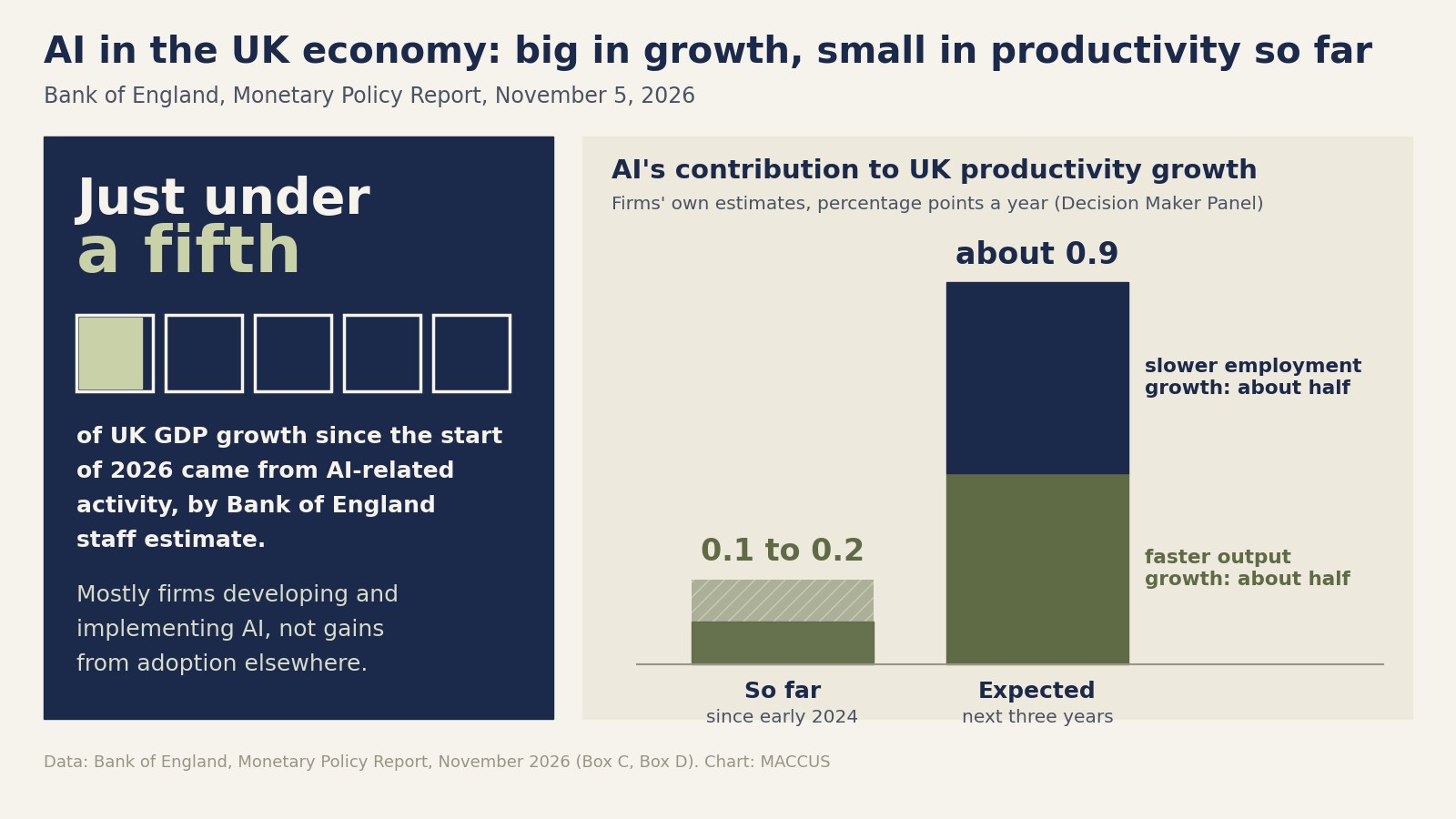
To measure the AI share, Bank staff used three industries as a stand-in, or proxy: computer programming and consultancy; information services such as data processing and data centers; and publishing, which in official statistics includes developing AI agents and AI software. The Bank says not all of their output is AI, and part of their growth would have happened anyway as the tech sector expands. Stripping out that long-run trend, staff concluded that “novel AI-related activity accounts for just under a fifth of GDP growth since the start of 2026.”
So far, the Bank says, that growth comes from the firms that develop, install and host AI rather than from its users. “The contribution to growth from AI to date appears to reflect activity in the upstream development and implementation of AI technologies rather than broader gains from their adoption elsewhere in the economy,” the report says. Citing the UK’s official statistics agency, it adds that many of the fastest-growing businesses in those three industries work on AI and cloud computing.
Business investment grew by nearly 5% in the first half of 2026, and the Bank’s agents name AI spending as one of the drivers. In the minutes of the November 4 meeting, the rate setters said AI’s impact on the UK economy “was uncertain but was likely to affect both demand and supply”: how much people and firms spend, and how much the economy can produce.
Fewer replacements, fewer trainees
The jobs evidence has two sources. The first is the Decision Maker Panel, a regular survey of UK businesses that the Bank draws on. Taken together, those firms “report close to zero impact of AI on employment so far.” The second is the agents, whose contacts “report that AI adoption is reducing the likelihood of firms hiring or replacing workers, but not materially increasing the likelihood of firing workers so far.”
The agents’ October summary draws on talks with businesses in the six weeks before early October. It says AI use is “increasingly moving from experimentation to deployment at scale across a wide range of sectors.” AI is most deeply embedded in professional and business services. Firms report productivity gains (more output per hour of work) in document review, coding, research, forecasting, customer service and office administration.
“Entry-level and routine professional roles remain the most exposed,” the agents write, “while demand is increasing for AI-literate, technical and judgement-intensive roles.” Some of those roles come with higher pay, contacts say.
On the agents’ evidence, the change hits newcomers first: trainees and applicants for entry-level roles. The UK unemployment rate fell to 4.7% in the three months through August, and the Bank sees few signs of a rise in layoffs.
Outside the UK, similar signs have appeared. At Anthropic, the maker of Claude, juniors fell from 27% to 9% of technical hires, according to the company’s own data. In Japan, more than one in five big companies in a Nikkei newspaper survey said they may hire fewer university graduates from 2029.
Firms expect a bigger effect in the next three years
For now, the productivity gain is small. Firms in the Decision Maker Panel estimate that AI has raised their productivity by around 0.5% in total over the past three years. The Bank converts that into about 0.1 to 0.2 percentage points of extra productivity growth a year since early 2024. In information and communication, a sector heavily exposed to AI that covers tech, telecoms and media, productivity growth has picked up but is no faster than its pre-pandemic average.
The same firms expect AI to lift productivity growth by “about 0.9 percentage points per year on average over the next three years, split roughly equally between slower employment growth and faster output growth.” About half would come from producing more and about half from headcount growing more slowly than it otherwise would.
For that forecast, the Bank cites “Firm Data on AI,” a working paper revised in October for the National Bureau of Economic Research, a US research group. Its authors, including Ivan Yotzov, Nicholas Bloom and Steven J. Davis, surveyed nearly 9,000 executives this summer in seven countries: the US, the UK, Germany, Australia, Canada, Mexico and South Africa.
In that seven-country survey, 78% of firms use AI, and executives say it has had “essentially no net effect on firm employment over the last 3 years.” The net figure hides movement in both directions: more than 40% of firms expect AI to raise or cut their own headcount, and the two roughly cancel out. Across the seven countries, executives put AI’s productivity boost at 0.2% a year so far and expect 0.6% a year over the next three.
In the UK, adoption is still spreading. One in three businesses with five or more staff used AI in 2026, up from one in six a year earlier, according to a government survey published on October 29. In finance, a survey by the Bank of England and the Financial Conduct Authority, the UK’s financial watchdog, came out on October 26. It found that 86% of responding firms use AI and 80% have deployed AI agents, but only 2% of respondents let agents act with broad autonomy.
What the report does not show
“The precise contribution of AI is difficult to quantify,” the report says, and the fifth-of-growth figure rests on the three-industry stand-in. The survey figures on productivity and jobs are firms’ own estimates, and the agents’ evidence is what their contacts tell them.
Most of the recent strength in productivity growth “appears to have been driven by cyclical factors,” the Bank adds, meaning the business cycle’s ups and downs. Part of that, the Bank suggests, comes from firms that held on to staff when workers were scarce in 2022 and 2023. They have been hiring fewer people since early 2024, an adjustment the Bank says cannot go on indefinitely. Some firms have also cut low-paid jobs after increases in the minimum wage and in employers’ national insurance contributions, a payroll tax.
Others are more skeptical. In The Register, a British tech news site, Carly Page wrote on November 6 that “selling AI is proving rather more lucrative than actually using it.” She cited a survey by the research firm Gartner in which just 3% of organizations had hit their AI targets. In October, Torsten Slok, chief economist at the investment firm Apollo, made a similar case about the US, saying AI had brought no financial payoff to companies outside tech.
What it means
The Bank of England has put a number on AI’s place in a large economy: just under a fifth of this year’s growth, most of it from the companies that build and run the technology. Based on firms’ own estimates, AI has added only about 0.1 to 0.2 points a year to productivity growth so far. If UK firms deliver the 0.9 points a year they expect, AI alone would add almost as much as the 1% a year the Bank assumes for long-run productivity growth. The Bank’s central forecast does not count on that: it has productivity growth falling back toward 1% and treats AI as a reason it could come in higher.
For workers, the effect so far is fewer openings for trainees, juniors and replacements for staff who leave, with few signs of more layoffs. If about half of the expected gain does come through slower employment growth, as firms predict, the agents’ reports suggest it will hit entry-level and routine professional roles first.
The next checks come soon. The statistics office publishes new quarterly productivity figures, under a revised method, on November 17, and industry-level figures in February. The agents’ next summaries will show whether firms keep taking on fewer trainees.
Sources
- Monetary Policy Report – November 2026, Bank of England, November 5, 2026
- Bank rate increased to 4% – November 2026 Monetary Policy Summary and Minutes, Bank of England, November 5, 2026
- Agents’ summary of business conditions – October 2026, Bank of England, October 30, 2026
- Firm Data on AI (Working Paper 34836), National Bureau of Economic Research, revised October 2026
- Artificial intelligence in UK financial services – 2026, Bank of England and Financial Conduct Authority, October 26, 2026
- Bank of England pours cold water on AI productivity boom, The Register (Carly Page), November 6, 2026
Header image: chart by MACCUS, from figures in the Bank of England Monetary Policy Report of November 5, 2026 (Box C and Box D)