An estimated 77% of 61 patients with newly diagnosed pancreatic cancer that had already spread were alive one year after starting a daily pill with standard chemotherapy, according to the pill’s maker. Revolution Medicines, a California company, released the figure for its drug, daraxonrasib, in a press release on November 19, 2026. The release came ahead of a talk on November 20 at the ENA symposium in Barcelona. That cancer research meeting is run by the European cancer research organization EORTC and two US bodies, the National Cancer Institute and the American Association for Cancer Research.
The figure comes from an early trial with no comparison group, so it cannot show how much of the result is due to the pill. The results have not yet appeared in a peer-reviewed journal.
The 77% still stands out because pancreatic cancer has the lowest survival rate of all common cancers in the UK, according to the BBC. About 80% of pancreatic cancers are found only after they have spread, and about 3% of those patients are alive five years later, according to the company.
The pill, sold as Rasonque, has already been tested alone in a larger trial of patients whose cancer had kept growing after chemotherapy. It doubled median survival, the time by which half of the patients have died. On that basis, US regulators approved it in August, and the European Commission followed this week.
Scans and survival in 61 patients
The 61 patients had metastatic pancreatic adenocarcinoma. Adenocarcinoma is the most common form of the disease, and metastatic means the cancer had spread to other parts of the body. None had been treated before joining the trial.
Each took 200 mg of daraxonrasib by mouth with two standard chemotherapy drugs, gemcitabine and nab-paclitaxel, given by infusion. By the September 28 data cutoff, half the patients had been followed for 18.3 months or more.
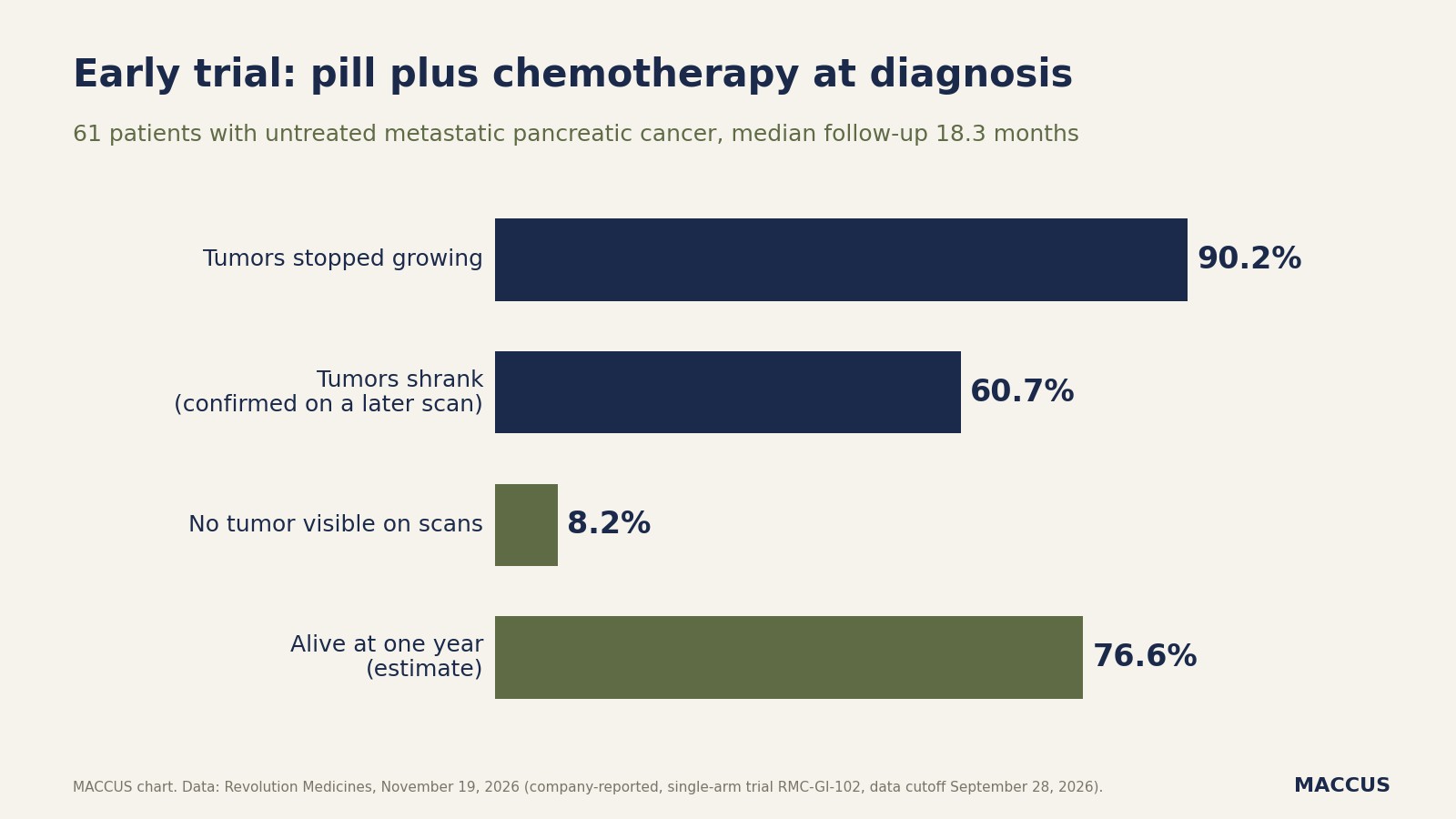
According to the company’s release, tumors stopped growing in 90.2% of patients. They shrank in 60.7%, and a later scan confirmed the shrinkage. In 8.2%, about 1 in 12, scans no longer showed any tumor.
Half of the patients went at least 12.8 months before their cancer grew again or they died. An estimated 76.6% were alive at one year, the release says. The estimate’s margin of error runs from 63.7% to 85.4%.
“The emerging survival signal is meaningful and is estimated at 76.6% for patients to be alive at one year,” said Dr. Wungki Park, an oncologist at Memorial Sloan Kettering Cancer Center in New York who is presenting the data in Barcelona. The company says side effects matched those already known for the pill and for the chemotherapy.
For comparison, the trial that made this chemotherapy pair a standard treatment was published in the New England Journal of Medicine in 2013. It reported that 35% of patients were alive at one year on the two drugs, with a median survival of 8.5 months. That trial enrolled 861 patients in a different era and under different conditions, so the two figures cannot be compared head to head.
The randomized trial behind the approvals
Daraxonrasib targets RAS, a family of proteins that act as on-off switches for cell growth. In more than 90% of pancreatic cancers, mutations jam the switch in the “on” position. Dr. Sam Godfrey of Cancer Research UK, a British cancer charity, told BBC News that the drug “found a way of drugging the undruggable.”
Regulators relied on RASolute 302, a phase 3 trial, meaning the large, late stage of testing in people. It was presented in late May at the American Society of Clinical Oncology’s annual meeting in Chicago and published the same week in the New England Journal of Medicine. The trial randomly assigned 500 patients whose cancer had kept growing after earlier treatment to the pill taken alone or to chemotherapy.
Median survival was 13.2 months with the pill against 6.7 months with chemotherapy. At 12 months, 53.2% of patients on the pill were alive, compared with 17.3% on chemotherapy, the oncology news site OncLive reported. Treatment-related side effects led 1.2% of patients to stop the pill, compared with 11.2% of those on chemotherapy.
The US Food and Drug Administration approved the pill on August 26, 2026, for patients already treated or unable to take combination chemotherapy. More than 5,000 patients in the United States had received it by September 30, the company said in its third-quarter results.
Europe’s review took just over 100 days
The European Commission approved Rasonque for previously treated patients, with or without a RAS mutation, the company announced on November 16. The Commission’s own statement followed on November 17.
The European Medicines Agency, the EU’s drug regulator, reviewed the file in stages. Its positive opinion, a formal recommendation to approve, came “in just over 100 days,” The Brussels Times reported. The previous legal deadline was 210 days, the paper noted. The agency’s scientific committee adopted the opinion on October 15.
The approval covers the 27 EU countries plus Iceland, Norway and Liechtenstein, but not the United Kingdom or Switzerland. Each country still has to set a price and decide on reimbursement, so patients will not get the pill everywhere at once. A joint clinical assessment, in which EU countries review the drug’s medical benefit together, is due in December. It is meant to support access across the EU.
In the United Kingdom, about 11,500 people are diagnosed each year and about 10,200 die of the disease, according to Cancer Research UK figures quoted by the BBC. The charity called the pill “the biggest leap forward in decades” for pancreatic cancer patients.
The limits of a 61-patient trial
The first-line figures, from patients getting their first treatment after diagnosis, are the company’s own, from a trial with no comparison group. They come from a company release and a conference talk, and no peer-reviewed paper has been published yet.
The release itself warns that results from open-label studies “with limited patient numbers” may not predict later results. Open-label means everyone knows which treatment is given. The 76.6% is an estimate, with a margin of error from about 64% to 85%.
Doctors stress that the treatment should not be seen as a cure, the BBC reports. “Cancer can come back and even if scans show there is no sign of it, you don’t necessarily know you are cancer-free until more time has passed,” said Godfrey of Cancer Research UK. The pill-and-chemotherapy combination is not approved anywhere for newly diagnosed patients.
The pill also has frequent side effects. Its US prescribing label, written for the pill’s approved use, gives rates from clinical trials in patients with pancreatic cancer. Skin rash or other skin reactions affected 86% of those treated, diarrhea 63% and mouth sores 57%. Serious adverse reactions occurred in 30%. The company’s release gives no separate rates for the pill combined with chemotherapy.
What it means
For decades, chemotherapy was the main treatment for pancreatic cancer that had spread, and survival improved slowly: median survival was 8.5 months in the 2013 trial. A 2023 trial of 770 patients, published in the Lancet, put a newer chemotherapy combination, NALIRIFOX, at 11.1 months, compared with 9.2 months for the 2013 pair. In a randomized trial of previously treated patients, the RAS-targeting pill then doubled median survival, and it won US and EU approval less than six months after those results. Other treatments built around a disease’s own biology are at very different stages. They range from a vaccine made from each patient’s melanoma, whose phase 3 results were presented in October, to a gene therapy that a startup says it injected into the brain of a mouse with epilepsy.
Park says the first-line results provide “a compelling rationale” to test the pill as a first treatment. Weight-loss drugs have already moved this way, from one disease into trials for heart failure and addiction. For newly diagnosed patients, the answer will come from RASolute 303, a phase 3 trial of about 900 untreated patients that compares the pill alone, the pill with chemotherapy and chemotherapy alone. The company expects to finish enrolling patients worldwide in the first half of 2027, and the US trial registry gives April 2028 as the estimated end of its main data collection. The pill is also in a phase 3 trial in lung cancers that carry a RAS mutation, with first results expected in 2027.
Sixty-one patients is a small group, and the one-year survival figure could be as low as 64% within its margin of error. In the randomized trial of previously treated patients, the gap in median survival was 6.5 months: 13.2 months on the pill compared with 6.7 on chemotherapy. For patients and doctors in Europe, the next dates are the joint EU assessment in December, then national decisions on price, then the RASolute 303 results.
Sources
- Revolution Medicines Presents Updated Phase 1/2 Data for RASONQUE (daraxonrasib) Plus Chemotherapy in First-Line Metastatic Pancreatic Cancer at ENA 2026, Revolution Medicines, November 19, 2026
- European Commission Approves Revolution Medicines’ RASONQUE (daraxonrasib), the First Broad RAS-Targeted Medicine in Metastatic Pancreatic Cancer, Revolution Medicines, November 16, 2026
- Rasonque, European Medicines Agency, October 15, 2026
- Daraxonrasib or Chemotherapy in Previously Treated Metastatic Pancreatic Cancer, The New England Journal of Medicine, May 31, 2026
- Daraxonrasib Gains EC Approval in Previously Treated Metastatic Pancreatic Cancer, OncLive, November 16, 2026
- Groundbreaking cancer drug approved in record time under EU reforms, The Brussels Times, November 17, 2026
- Massive hope for pancreatic cancer pill after trial saw tumours vanish, BBC News, November 20, 2026
- Increased Survival in Pancreatic Cancer with nab-Paclitaxel plus Gemcitabine, The New England Journal of Medicine, October 16, 2013
Header image: MACCUS chart, data from Revolution Medicines (November 19, 2026), The New England Journal of Medicine and OncLive (RASolute 302) and Von Hoff et al., NEJM 2013 (MPACT).