Only 45% of US Glassdoor reviews that mention AI are positive about it in 2026, down from 82% in 2019. Glassdoor is a site where employees review their employers. This year, 51% of those reviews list AI only as a con. A worker who brings it up is now more likely to complain than to praise it.
The figures come from Indeed Hiring Lab and Glassdoor Economic Research, the research teams of the job site Indeed and of Glassdoor. They published them on November 18, 2026, in a chapter of their 2027 US Hiring and Worklife Trends report titled “There is no AI Jobpocalypse, but plenty of AI-nxiety.”
The same chapter shows employers moving fast in the other direction. The share of US job ads on Indeed that mention AI doubled in a year, from 3.6% in September 2025 to 7.2% in September 2026. That is about one ad in 14. Nearly two-thirds of the job titles that now include AI are outside traditional tech, from truck drivers to physical therapists.
Both numbers come with caveats. In September 2026, only 2.7% of Glassdoor reviews mentioned AI at all, although that was 2.6 times the share a year earlier. The job ads figure counts every posting that mentions AI, whatever the job.
One US job ad in 14 now mentions AI
That figure comes from Indeed’s AI Tracker, a monthly average of the share of US job postings on Indeed that mention AI or generative AI. The share of companies with at least one AI-related posting rose 44% over the past year, to 7.6% of the firms posting on Indeed in September 2026.
In a separate July 8 analysis, Indeed counted 822 “AI-touched” job titles in the US in the first quarter of 2026, up from 264 in early 2022. Of those, 63% were outside tech occupations. Indeed calls a title AI-touched when at least five of its postings in a quarter have AI in the title.
The November chapter gives truck drivers, retail sales associates and physical therapists as examples. Employers who add AI to such titles “are clearly signalling that they expect workers to understand and use AI tools across a wide array of professions,” the authors write.
Demand also held up in the jobs AI could change most. Indeed gives each occupation an exposure score: its estimate of the share of the job’s skills that generative AI could substantially transform. Between September 2025 and September 2026, postings grew more, on average, in higher-scoring occupations, according to Indeed’s trend line.
Over the same period, software development postings rose about 19%. Senior roles made up 71% of the recent increase, and 37% of it came from postings with AI in the title. At the other end, postings for childcare, driving, dental care and education fell 10% to 14%.
By a separate count, US employers hired about 113,000 software engineers in a year, less than half as many as in 2022. New roles are also appearing, such as the engineers who install AI inside client companies.
The build-out of data centers is adding hands-on work. In Indeed data through the first half of 2026, a quarter of data-center job postings were for installation and maintenance workers. Their advertised wages were 42% higher than for similar jobs outside data centers. Indeed concludes that “there is little evidence of widespread job losses driven solely by AI.”
More Glassdoor reviews now criticize AI than praise it
The sentiment figures cover reviews by current US employees, full-time and part-time, with 2026 data through September 30. A review counts as mentioning AI if it uses “AI,” “artificial intelligence,” “ChatGPT,” “GPT” or “LLM.”
A review is positive when AI appears only in its pros section, critical when it appears only in its cons, and mixed when it appears in both. The positive share fell every year, from 82% in 2019 to 72% in 2022, 62% in 2023, 58% in 2024, 55% in 2025 and 45% in 2026. The critical share rose from 15% in 2019 to 51% in 2026, the first year in the series in which critical mentions outnumber positive ones.
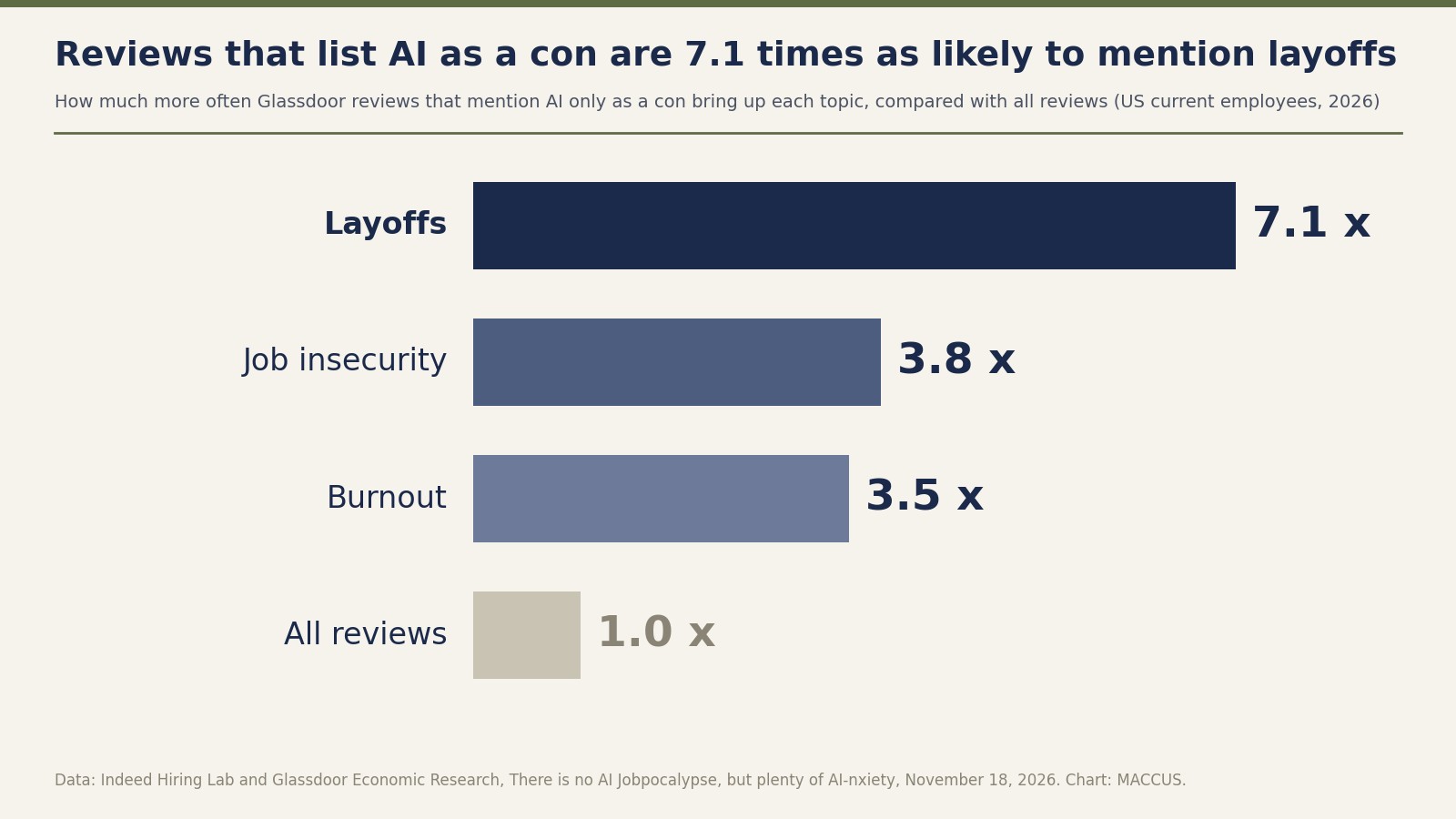
Reviews that criticize AI also raise other problems. Compared with all reviews, AI-critical ones are 3.5 times as likely to mention burnout, 3.8 times as likely to mention job insecurity and 7.1 times as likely to mention layoffs. One in five reviewers who list AI as a con also mention layoffs.
AI critics also take a dimmer view of their company. Only 37% of AI-critical reviewers approve of their CEO, against 89% of AI-positive ones. Only 31% see a positive business outlook, against 85%. The gaps hold even after the authors account for each review’s overall star rating, so they do not simply reflect angrier reviews.
Many complaints are about the tools themselves. In comments posted between June 2025 and May 2026, workers often said AI had made the experience worse for staff and customers. One reviewer described a “big push for use of AI tools that have provided little value.” The authors found no strong link between workers’ negativity and their occupation’s exposure to AI. Some criticism does come from highly exposed jobs, such as insurance adjusters.
Workers use AI more, and productivity shows no break yet
Indeed’s Workforce Insights Survey, run by the polling firm YouGov in spring 2025 and spring 2026, shows AI use rising. Among employed Americans, 53% now use AI at least weekly in their personal lives, up from 44% a year earlier. At work, regular use rose from 36% to 42%.
Employers are slower to adopt it. In the survey, 31% of workers say their employer has adopted AI little or not at all, while 25% report high adoption. More than half, 56%, did not agree that AI makes, or could make, them more efficient. Among regular users at work, the time they say AI saves them each day fell from 2.3 to 2.1 hours.
National data show no break either. Labor productivity is output per hour of work. In the US nonfarm business sector, it has grown 2.1% a year since late 2019, according to the Bureau of Labor Statistics.
That is faster than the 1.5% pace of 2008 to 2019 and in line with the average since 1947. “An AI-driven productivity boom hasn’t arrived yet,” the chapter says.
Business leaders expect AI to reshape jobs more than to add them. Also on November 18, The Conference Board, a business research group, presented a report based on a survey of 775 leaders worldwide and 35 interviews.
Over the next two years, only 5% expect AI to increase their overall headcount. Another 39% expect a slight reduction and 8% a significant one. A further 32% expect little or no net effect, and 17% say it is too early to tell.
What the data cannot show
The review figures describe a small slice of reviews, written by employees who chose to post one. The link between AI complaints and layoffs is an association in the text of those reviews. It does not show that AI caused the layoffs the reviewers mention. Layoffs are tracked separately: US employers have named AI in some of their own announcements of job cuts this year.
The exposure scores estimate what generative AI could do to each occupation’s skills. They do not measure change that has already happened.
The time savings are workers’ own estimates in a survey. Indeed’s and Glassdoor’s 2026 figures are for the United States. The authors write that “we still don’t know precisely how broad, deep, or durable these shifts are.”
What it means
In one year, the share of US job ads that mention AI went from about one in 28 to one in 14. Most of the job titles that carry it are now outside tech. That pattern fits a general-purpose technology spreading through ordinary jobs. The numbers also match Indeed’s reading that there is little evidence of widespread job losses driven solely by AI.
A productivity boom is not visible yet, and the strain shows up in reviews from the people asked to use the tools. Workers mention AI more often, more of those mentions are complaints, and the reviews that complain are also far more likely to mention burnout and layoffs. The report says a relatively weak labor market has let employers ignore workers’ AI concerns so far. Its warning: employers that adopt AI “without bringing workers along risk losing them when the market turns.”
Three measures will show which way this goes. One is the critical share in 2027 Glassdoor reviews. Another is whether productivity growth moves above its long-run average. The third is whether the 47% of Conference Board respondents who expect AI to cut headcount follow through.
Sources
- There is no AI Jobpocalypse, but plenty of AI-nxiety, Indeed Hiring Lab and Glassdoor Economic Research, November 18, 2026
- Indeed & Glassdoor’s 2027 U.S. Hiring and Worklife Trends Report: Consolidated Methodology, Indeed Hiring Lab, November 18, 2026
- AI Is No Longer Just a Tech Occupation Story: It’s Spreading Across Job Titles in the US and Europe, Indeed Hiring Lab (Pawel Adrjan), July 8, 2026
- Report: Just 11% of Companies Have Fully Integrated AI Implications into Workforce Planning, The Conference Board (press release, PR Newswire), November 18, 2026
Header image: MACCUS chart drawn from Indeed Hiring Lab and Glassdoor Economic Research, There is no AI Jobpocalypse, but plenty of AI-nxiety (November 18, 2026)