

NS (Nederlandse Spoorwegen, or Dutch Railways), the Netherlands’ national railway operator, will move 30 of its software applications to Microsoft’s Azure cloud from early 2027, the Dutch IT news site Computable reported on November 19, 2026. The same day, NS announced it would put more of its systems in the public cloud: computing power and storage rented from a provider’s data centers rather than run on its own servers. NS’s chief information officer, Jasper ten Hove, who runs the company’s IT, explained the trade-off: “The security of our data weighs more heavily than sovereignty, because cyberattacks are a much bigger threat and our daily reality.” In Dutch: “De veiligheid van onze data weegt zwaarder dan soevereiniteit.”
Sovereignty here means digital sovereignty: keeping data and IT systems under European control and out of reach of foreign governments. NS is owned by the Dutch state, which holds 100% of its shares.
NS’s press release does not name a supplier. NS confirmed to the transport trade site Mobiliteit.nl that the cloud is Microsoft Azure, in a report the site published on November 20. A company spokesperson defended the choice: “If it could have been European, we would have signed right away.”
A move meant to cut outages
NS says moving to the public cloud should cut the risk of IT failures that disrupt train service. It expects the cloud to reduce the number of outages considerably and to let it add computing capacity quickly when passenger traffic spikes. NS is the country’s largest transport operator and handles large amounts of data every day, for uses including travel information, maintenance and planning. It calls itself a “vital organization,” meaning one the country depends on.
Computable describes an example NS gave of such a failure. In August, the power supply to one system was switched off, and NS could no longer adjust its timetable. That meant fewer trains could run and arrive on time. According to the same report, NS’s current setup still relies on physical servers and manual work.
The 30 applications are the first phase of a wider overhaul: in total, NS wants to bring about 350 applications onto a more modern infrastructure, Computable reports. The site does not say how many of those will end up on Azure. NS already runs some systems on Azure, the trade site Dutch IT Channel reported. NS says its choice followed a selection process, and that its experience with the public cloud so far has been positive.
“The cloud is almost always American”
Ten Hove presented the decision as a dilemma. “As a vital organization, sovereignty weighs seriously in the choices we make every day,” he said in the release, before putting security first. He told Computable that “at the moment the choice from the European market is still limited, but it seems to be developing fast.”
The NS spokesperson went further in comments to Mobiliteit.nl: “de cloud is bijna altijd Amerikaans” (the cloud is almost always American). European alternatives, she said, have only just started and are still too small to be an option.
NS also told Computable that its data in Azure is stored on European territory and falls under European law. It said it is in talks with StackIT, the cloud business of Germany’s Schwarz Group, which owns the Lidl and Kaufland retail chains. According to NS, its Microsoft contract includes exit terms meant to make a later move to a European platform possible. NS considers such a move premature for now.
NS also plans to test a sovereign option. Its release announces pilot projects with an unnamed “sovereign public cloud provider.” The company also belongs to a working group of large Dutch organizations that share results on digital sovereignty.
The critics’ case
Simon Besteman, of the Nederlandse Soevereine Datacenter Coöperatie (NSDC), an interest group for Dutch data center companies, rejects NS’s reasoning. “I firmly dispute that NS has no choice,” he told Mobiliteit.nl. In his view, large firms such as KPN, the Dutch telecom operator, can supply sovereign cloud services that comply with European law. His group’s members are the kind of European suppliers that would stand to gain from such contracts.
Besteman’s main argument is legal: under US law, he says, it means nothing that NS’s data sits on European soil. He points to the CLOUD Act, a US law passed in 2018. According to the US Justice Department, the law makes explicit that a company under US jurisdiction “can be required to produce data the company controls, regardless of where it is stored.” If such an order clashes with a foreign country’s law, the department says, US courts can be expected to weigh the interests of both countries.
Besteman then described a scenario he says he is not predicting. In it, a crisis breaks out between the EU and the US, US law bars Microsoft from serving NS, and everything NS runs is on Azure. “Then the trains stop,” he said.
NS has chosen a US firm before. Earlier this year, it handed part of its IT management to Enterprise Services Nederland, a Dutch subsidiary of the US IT services company DXC Technology. That decision drew questions in the Dutch parliament, Computable notes. At the time, the government said no critical processes had been outsourced.
What NS has and has not shown
Much of the plan is still a statement of intent: the migration only begins in early 2027. NS has not published the contract’s value, its length or the exit terms it describes. The pilots’ sovereign provider is still unnamed, and only Computable reports the StackIT talks. None of the Dutch reports includes a comment from Microsoft.
Fewer outages are still only an expectation, and Microsoft’s own services fail too: its online office suite, Microsoft 365, was down for some users for more than a day on November 12 and 13, as our report on that outage details. Attackers also have more flaws to exploit: software security flaws published in 2026 passed 100,000 on November 13, more than double the 2025 total.
What it means for Europe
Our reading: NS has put into plain words a trade-off that sovereignty policy often leaves vague. In NS’s account, a large operator that faces cyberattacks every day must choose between much smaller European providers and a US “hyperscaler,” one of the giant clouds run by Amazon, Microsoft and Google. Security won, and sovereignty shows up as pilot projects, a working group and an exit clause, while 30 applications are set to move to Azure.
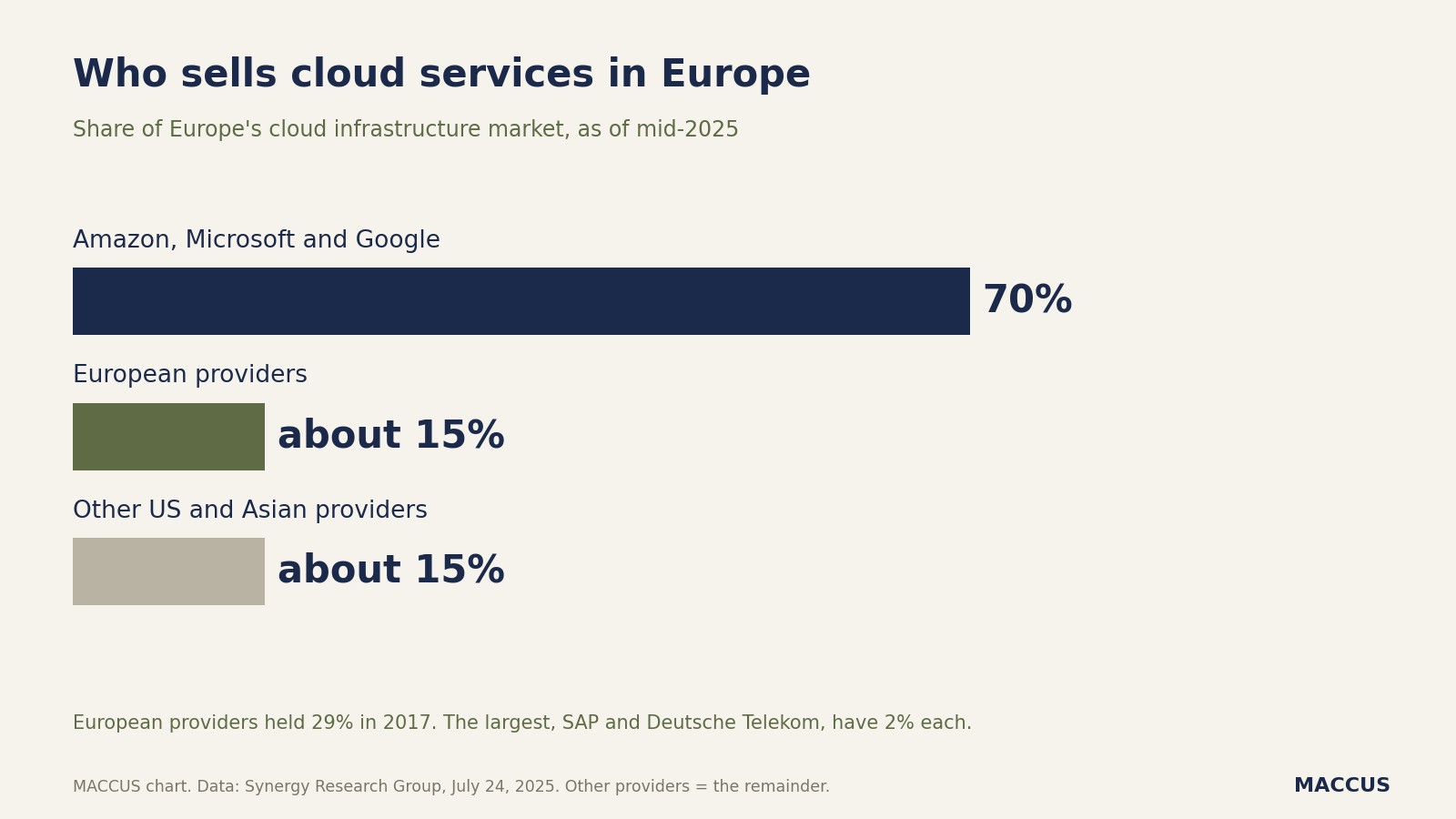
European providers’ cloud revenue in Europe more than tripled from 2017 to 2024, but the whole market grew sixfold, to €61 billion in 2024, according to the market research firm Synergy Research Group. Their share of that market fell from 29% in 2017 to 15% by 2022 and has stayed near 15% since. As of mid-2025, Amazon, Microsoft and Google held 70%, while the largest European players, Germany’s SAP and Deutsche Telekom, had 2% each. On November 13, Arthur Mensch, chief executive of the French AI company Mistral, put the gap another way: only 20% of European digital services run on European infrastructure.
Whether NS’s choice turns out to be a prudent call or a missed chance depends on a question NS cannot settle alone: whether a European cloud can take on a large share of the roughly 350 applications NS is modernizing. It would have to be ready by the time the exit terms in the Microsoft contract come into play. The next things to watch are the pilots and the name of their sovereign provider.
Sources
- NS vernieuwt IT-landschap en zet in op meer flexibiliteit, NS (Dutch Railways), November 19, 2026
- NS: Europees alternatief voor Azure nog niet veilig genoeg, Computable, November 19, 2026
- Kritiek op keuze NS om opnieuw IT-diensten in Amerikaanse handen te brengen: “Genoeg Europese alternatieven”, Mobiliteit.nl, November 20, 2026
- NS brengt meer applicaties naar Microsoft Azure, Dutch IT Channel, November 20, 2026
- Nederlandse staatsdeelnemingen, Government of the Netherlands (Rijksoverheid), consulted November 22, 2026
- Promoting Public Safety, Privacy, and the Rule of Law Around the World: The Purpose and Impact of the CLOUD Act, US Department of Justice, April 2019
- European Cloud Providers’ Local Market Share Now Holds Steady at 15%, Synergy Research Group, July 24, 2025