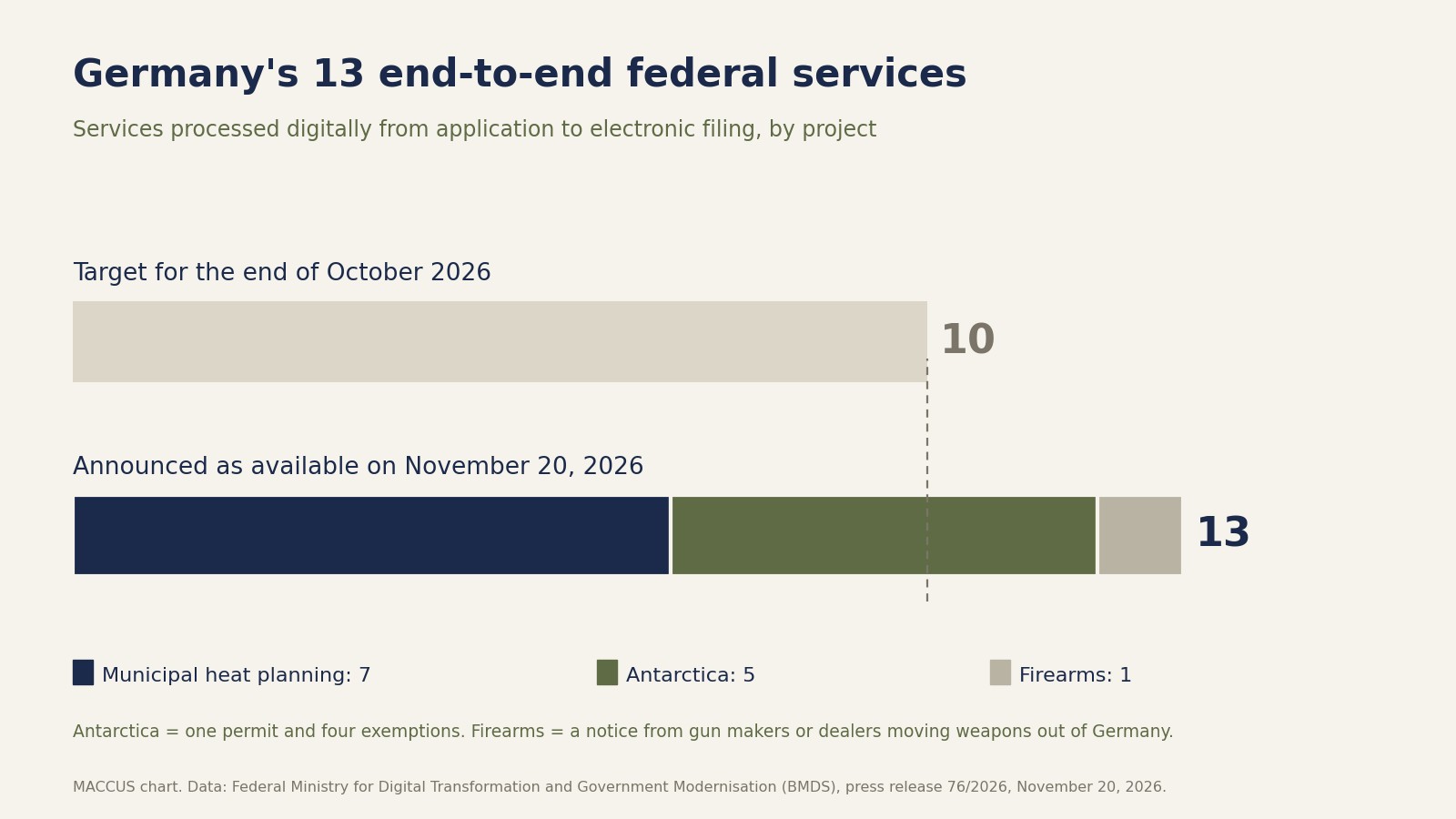
Germany’s federal government says 13 of its administrative services now run digitally from start to finish, with no paper at any step. Five of them concern activities in Antarctica: one permit and four exemptions. The Federal Ministry for Digital Transformation and Government Modernisation (BMDS) announced the count on November 20, 2026, against a target of 10 by the end of October. Of the other eight, seven help towns plan how their buildings will be heated, and one handles a notice from gun makers and dealers.
The announcement concerns the work behind the online form. By the end of 2024, the federal government had already put online the 115 services it ranked as most important, including child benefit and education loans. The tech news site heise online reported the figure at the time, citing the federal Interior Ministry. The new count tracks whether a request is then checked, decided and filed without anyone printing it out or typing it into another system.
The release defines end-to-end processing in one sentence: “Von der Antragstellung über die Bearbeitung und den Bescheid bis zur elektronischen Ablage läuft alles ohne Medienbrüche, also ohne Papier und ohne Wechsel zwischen Systemen.” In English: from the application through processing and the decision to electronic filing, everything runs without media breaks, meaning without paper and without switching between systems.
Gitta Connemann, a parliamentary state secretary at the ministry, called it a promise kept: “Versprochen. Gehalten. Sogar mehr als das.” (Promised. Kept. Even more than that.) The pledge had been 10, she said, and “13 sind es geworden” (it turned out to be 13).
Seven services for heat plans, five for Antarctica, one for firearms
The 13 services come from three projects. Seven run through a digital data room for municipal heat planning, a project of the Federal Ministry for Economic Affairs and Energy. A heat plan sets out how a town’s buildings will be heated in the future. The data room is an online platform for exchanging heat-planning data.
Three of the seven let a municipality draw up its plan, under a standard, simplified or “small” procedure. The other four move data through the data room: one carries chimney sweeps’ records on heating systems, another data from federal and state authorities. A third carries data from energy suppliers and from operators of energy grids, metering points and heat networks. The fourth carries data taken from municipal heat plans.
The plans have legal deadlines. Under Germany’s Heat Planning Act, they were due by June 30, 2026, for municipalities with more than 100,000 inhabitants, and are due by June 30, 2028, for all others.
Five services belong to the German Environment Agency (Umweltbundesamt, or UBA), which is Germany’s permitting authority for Antarctica. Any planned activity there that is organized in Germany or leaves from German territory needs a permit from the agency. The five services are that permit and four exemptions.
One exemption covers taking Antarctic mammals or plants, or harming Antarctic animal and plant life. Another covers bringing non-native animals or plants into Antarctica. A third covers entering, driving through or flying over a specially protected area. The fourth covers discharging liquid waste into the sea in the Antarctic region.
The 13th service belongs to the Federal Office of Administration (Bundesverwaltungsamt). It is part of an EU notification service for firearms and ammunition. Commercial gun makers and dealers use it to report that they are moving firearms or ammunition out of Germany.
The ministry’s case
According to the ministry, the platform automatically checks whether entries are plausible, so applicants now get fewer follow-up questions and never have to enter the same information twice. Inside the agencies, it says, manual steps disappear and data can be managed, exchanged and analyzed securely. The BMDS says it supplied the platform as a central service and helped the agencies digitize their services “in kurzer Zeit” (in a short time).
The work belongs to a program the ministry calls end-to-end digitalization (Ende-zu-Ende-Digitalisierung, or E2E). The ministry, created in 2025, says Germany’s Online Access Act of 2017 focused on giving people digital access to services. E2E, it says, also covers “die Arbeitsabläufe hinter dem Antrag” (the workflows behind the application). The platform is already in use in the federal administration, and “perspektivisch” (in the longer term) the approach is meant to be used outside it too.
The release says the program brings standards, automation and artificial intelligence into administrative work. It does not say whether any of the 13 services uses AI.
Other governments have made their own decisions on AI for civil servants. Japan opened an AI tool to 180,000 civil servants. The Dutch government is counting partly on AI as it plans for about 25,000 fewer civil service jobs by 2035. In October, Sweden’s Government Offices cut their staff’s direct access to ChatGPT and Claude on work computers and steered them toward approved tools such as Microsoft Copilot.
German tech sites react to the selection
The tech site mobiFlip wrote on November 20: “Die Auswahl ist durchaus speziell” (the selection is quite specialized). Anyone who thinks of everyday visits to a government office when they hear “digital administration” will have little use for Antarctic permits, the site added. For most people, it said, these specialized procedures matter little for now. The more interesting question, in the site’s view, is when end-to-end processing will reach services people use often.
Another German tech site, Caschys Blog, left the verdict to its readers the same day: “Slow clap oder standing ovations.” (Slow clap or standing ovations.) Its one-line summary of the list was “viel Wärme-Gedöns, aber auch die Antarktis” (a lot of heating stuff, but also Antarctica).
What the release does not show
The release gives no usage figures. The services are live, but the release does not say how many applications they handle in a year. That leaves no way yet to tell how many people or companies the change reaches. The release also does not say when the services went live: the target date was the end of October, and the announcement came on November 20.
The count also covers only the federal administration. Germany’s 16 states and its municipalities are responsible for three-quarters of all administrative services, according to the 2026 Behörden-Digimeter, a study of how many public services can be used online.
The German Economic Institute (IW) carried out the study for the Initiative Neue Soziale Marktwirtschaft (INSM), a lobby group funded by employers’ associations in the metal and electrical industries. It found that at the start of 2026, only 823 of 7,509 services were available online across the whole country, just under 11%. The federal level had digitized two-thirds of its own services “auf einem grundlegenden Niveau” (at a basic level), the study says.
That 11% figure measures something different from the ministry’s 13. It counts services people can apply for online everywhere in Germany, whether or not anyone behind the form still prints the application out. The Online Access Act originally gave the administration until the end of 2022 to put its services online. The INSM noted in March that the deadline had passed three years earlier.
What it means for Europe
Our reading: Germany’s federal government has offered online forms for its main services since the end of 2024 and is now working on the part behind the form. On that measure it now counts 13 services, three more than it promised, on a platform the ministry wants to reuse beyond the federal level. In these 13 services, the ministry says, an application goes from request to electronic filing without paper or retyping.
Most people will not feel the result yet, because the 13 services cover specialized procedures (Antarctic expeditions, heat-plan data, a gun dealers’ notice) rather than the ones most residents meet. The gap is the administration as a whole: at the start of 2026, only 823 of 7,509 services across all levels of government could be used online nationwide, a different measure from end-to-end processing.
At the pace the INSM study measured, putting all 7,509 services online would take more than 19 years. That estimate holds even under the older, more generous method, which treated a bundle of services as done once a single one of them was online. The test is whether the platform spreads to the services people use most and to the states and municipalities, and the release gives no date for either. The next thing to watch is which services the ministry adds, and whether millions of people use any of them.
Sources
- Modernisierungsagenda: Bund bringt 13 Verwaltungsleistungen vollständig digital an den Start, Federal Ministry for Digital Transformation and Government Modernisation (BMDS), November 20, 2026
- Deutschland digitalisiert 13 Behördendienste: Doch wer profitiert?, mobiFlip, November 20, 2026
- Bund: 13 Verwaltungsleistungen, von heiß bis kalt, laufen jetzt komplett digital, Caschys Blog, November 20, 2026
- Online Access Act: Federal government has digitized 115 important services, heise online, January 2, 2025
- INSM-Behörden-Digimeter 2026: Deutschlands Verwaltung bleibt Digitalwüste, INSM, March 12, 2026
- § 4 WPG, Pflicht zur Wärmeplanung, German Federal Ministry of Justice and Consumer Protection (Gesetze im Internet), consulted November 23, 2026
- Schutz der Antarktis, German Environment Agency (Umweltbundesamt), consulted November 23, 2026