

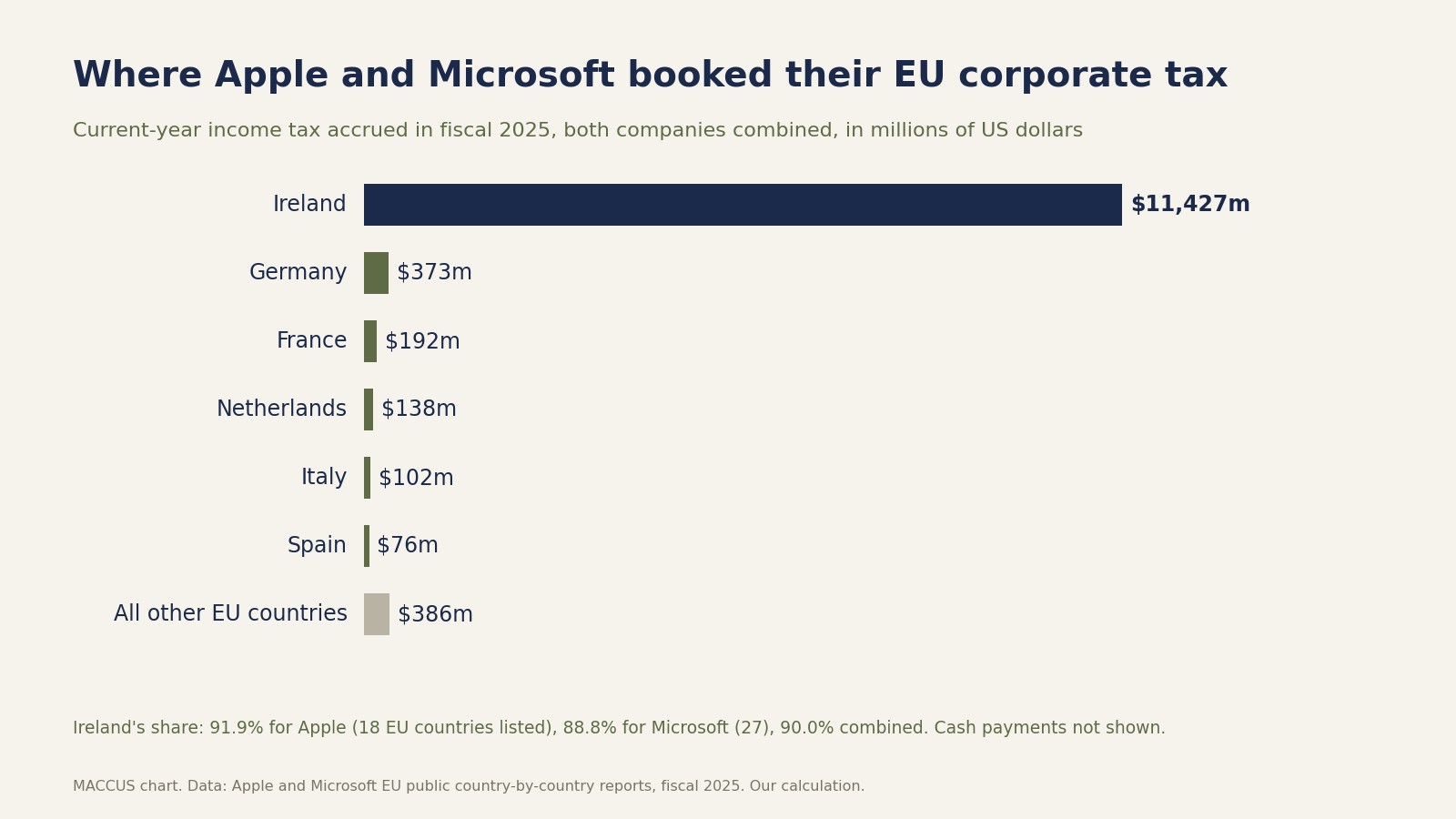
Apple and Microsoft booked about 90% of their EU corporate income tax for fiscal 2025 in one member state, Ireland, their own filings show. Ireland accounts for $11.4 billion of the $12.7 billion in tax the two accrued on that year’s profits across the EU. Germany accounts for $373 million and France for $192 million. The Fair Tax Foundation, a British not-for-profit that certifies companies’ tax conduct and campaigns on corporate tax, flagged the pattern in a November 16, 2026, report.
“Around nine-tenths of the EU tax reported by Apple and Microsoft for 2025 was accrued in Ireland, while their subsidiaries in market countries earn only routine returns,” the report says. Market countries are where customers are, and routine returns are small, standard profits. We checked the Irish share in the filings: 91.9% for Apple, 88.8% for Microsoft and 90.0% for the two together.
Under an EU directive adopted in 2021, large multinationals must publish a country-by-country report: their revenue, profit, employees and the income tax they accrue and pay in each member state. Microsoft published its first one on June 30, 2026. The Fair Tax Foundation combined these reports with new tax disclosures in the companies’ US annual reports. It says this allowed it “for the first time” to estimate the tax gap of six large US tech groups in Europe.
Ireland compared with the rest of the EU
Apple’s report covers its fiscal 2025, the accounting year from September 29, 2024, to September 27, 2025, and lists 18 EU member states. Apple’s Irish companies accrued $4.78 billion in tax, out of $5.21 billion across the 18 countries. They reported $34.6 billion in profit before tax and 5,575 employees. Apple’s German operations, with $2.72 billion in revenue, accrued $152 million in tax, against $60.5 million for France, $43.2 million for Italy and $36.8 million for Spain.
Microsoft’s report covers its fiscal year from July 1, 2024, to June 30, 2025, and all 27 member states. Ireland accounts for $6.65 billion of the $7.49 billion Microsoft accrued in the EU, with $47.1 billion in profit before tax and 6,654 employees. Germany had the largest revenue after Ireland, $11.7 billion, and accrued $221 million in tax on $661 million in profit.
The Fair Tax Foundation says Ireland accounts for 38% of Microsoft’s global profit but just 3% of its staff. For Apple, Ireland’s shares are 26.1% of global profit and only 3.4% of employees. Microsoft’s subsidiaries in Germany, France, Italy, Spain and the Netherlands booked profits of 5% to 7% of revenue and accrued $0.55 billion in tax, the report says. Had they earned the Microsoft group’s overall profit margin, it calculates, they would have owed about $3.9 billion at local tax rates.
Ireland also came up this month in a privacy case: Italy’s privacy regulator fined Meta €805 million, imposed the fine on Meta’s Irish subsidiary and refused Meta’s request to hand the case to its Irish counterpart.
Accrued tax and cash paid
The figures above are accrued tax: the tax charged on the year’s profit. The reports also list tax paid in cash during the year, which for Apple looks very different. Apple paid $17.1 billion in tax in Ireland in fiscal 2025, more than three times the $4.78 billion it accrued there.
Apple’s report says the payment was “primarily due to the release of escrowed funds to Ireland pursuant to the European Commission State Aid Decision.” Escrowed money is held aside until a dispute is settled. Apple says it booked the matching tax expense in fiscal 2024.
In 2016, the European Commission found that Ireland had given Apple illegal tax benefits worth €13 billion under EU state aid rules, which limit government help to individual companies. The General Court, the EU’s lower court, annulled that decision in 2020, in cases brought by Ireland and two Apple companies. The EU’s top court, the Court of Justice, upheld the Commission’s decision on appeal on September 10, 2024. The Fair Tax Foundation leaves Apple’s $15.8 billion payment to Ireland under that decision out of its cash figures.
A €23 billion yearly estimate for Europe
The report covers six US tech groups it calls the Silicon Six: Alphabet, Amazon, Apple, Meta, Microsoft and Netflix. Its method splits each group’s global profit between countries in proportion to sales, then applies each country’s standard corporate tax rate. On that basis, it estimates the six paid $316.7 billion less in corporate income tax worldwide over the decade ending in 2025 than they would have paid at those rates.
For Europe, the report gives two figures. Counting tax paid anywhere in Europe, Ireland included, it puts the gap at about €49 billion from 2023 to 2025. Counting only tax paid in the customers’ countries, it puts the shortfall at “around $26bn (€23bn) a year,” or about €69 billion over the three years. Europe here is the region as each company defines it, UK included.
The report ranks Meta worst of the six, with Apple fifth and Microsoft sixth, the least bad. It credits Apple and Microsoft for publishing full EU reports. Amazon, Meta, Alphabet and Netflix have so far published only partial ones, it says.
What the numbers do not show
The €23 billion is an estimate built on one assumption. The report takes the UK’s ratio of tax paid to tax due, around a fifth, and applies it to the tax the six would owe across Europe as a whole under its method. A footnote calls the result “an illustrative extrapolation, not a measurement.”
The report says its figures “indicate the scale of the issue rather than any company’s tax liability.” It does not accuse Apple or Microsoft of breaking the law, and nothing in their filings suggests they did.
Apple’s report adds its own caveat: when a parent company’s home country taxes the profits of its foreign subsidiaries, that tax appears under the parent’s country, so the tax and profit shown for one country “may not directly correspond.” Microsoft says its report follows EU rules that differ from those used in its US accounts.
Microsoft has defended its tax arrangements. In a June 30 post, Jeff Bullwinkel, its deputy general counsel for Europe, the Middle East and Africa, wrote: “Microsoft pays the taxes we owe in every country where we operate.” He said Microsoft paid $6.3 billion in income tax in cash in the EU in fiscal 2025, not counting payroll, VAT, property and other taxes. He wrote that the company aims for a tax structure reflecting “where our people work, where we invest, and where functions, assets, and risks occur,” and called Ireland “our largest hub in the region.”
What it means for Europe
Our reading: the gain is visibility, because the EU’s disclosure rule now shows the tax in each of 18 member states for Apple and all 27 for Microsoft. For these two, the only groups of the six with full reports, the tax is booked overwhelmingly in one country: $11.4 billion in Ireland, against $742 million for Germany, France, Italy and Spain, the bloc’s four largest economies. Beyond these two, OECD figures cited by the Fair Tax Foundation show that groups based in the EU’s five largest economies paid cash tax equal to 28.7% of their profits in 2023, against 20.8% for US-based groups. Its report puts the Silicon Six’s cash tax at 12.3% of their profits in 2025.
On November 21, European Council President António Costa proposed a draft EU budget for 2028 to 2034 that includes a 3% levy on net revenue “from online advertising, digital intermediation services and user-generated data,” RTÉ reported. It would apply to companies with at least €50 million a year in EU digital revenue and more than €750 million in total revenue worldwide. Online advertising is also where a study for the European Commission found that the Digital Markets Act, the EU law on the largest online platforms, had done little to improve transparency. In France, the National Assembly voted at first reading on October 30 for a tax per gigabyte of data sent to internet subscribers, which the government opposed.
The levy is a proposal that all 27 governments must accept with the budget, and Ireland does not support it: “Global taxation has to be done globally,” Taoiseach (prime minister) Micheál Martin said on November 21, The Irish Times reported. Sweden’s Europe minister, Jessica Rosencrantz, said of new taxes last week: “It’s money taken from somewhere else.” The European Parliament wants a broader 5% levy, which it estimates could raise up to €25.2 billion a year, five times the Commission’s estimate for a 3% levy, Euronews reported in September. EU leaders discuss Costa’s draft in Brussels this week, and the Fair Tax Foundation says fuller disclosures are coming, starting with the first complete EU country-by-country reports due by the end of 2026.
Sources
- The Silicon Six and their widening $300bn global tax gap, Fair Tax Foundation, November 16, 2026
- Public Country by Country Report (on income tax information), fiscal year 2025, Apple, accessed November 23, 2026
- Report on Corporate Income Tax Information in compliance with chapter 10a of Directive 2013/34/EU, FY2025, Microsoft, June 30, 2026
- Context on our country-by-country tax footprint, Microsoft On the Issues, June 30, 2026
- Tax rulings: the Court of Justice sets aside the judgment of the General Court concerning tax rulings issued by Ireland in favour of Apple, Court of Justice of the European Union, September 10, 2024
- EU proposes tax on big tech companies to fund budget, RTÉ, November 21, 2026
- Exclusive: EU-wide digital levy might generate up to €25bn annually for next budget, Euronews, September 29, 2026
- ‘Global taxation has to be done globally’: Martin says Ireland does not support António Costa’s EU digital tax proposal, The Irish Times, November 21, 2026