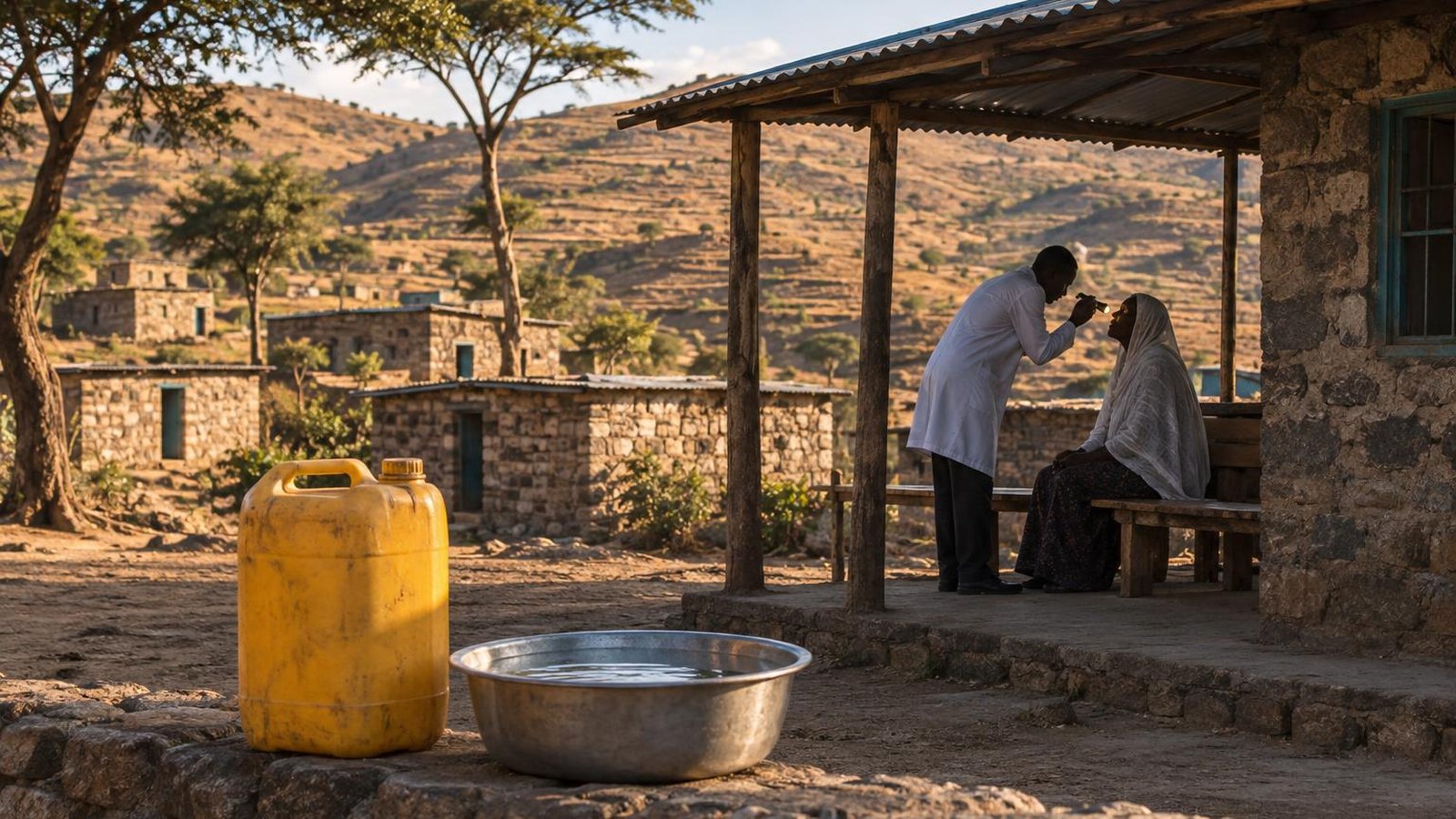

The disease is trachoma, a bacterial eye infection that spreads from person to person and that WHO calls the world’s leading infectious cause of blindness. Years of repeated infections scar the inside of the eyelid until it turns inward and the eyelashes scrape the eyeball, which can cause blindness. On November 16, 2026, the World Health Organization validated Eritrea’s elimination of trachoma as a public health problem. That WHO standard means the disease has fallen below set thresholds in every district where it was once common, even though some cases can remain.
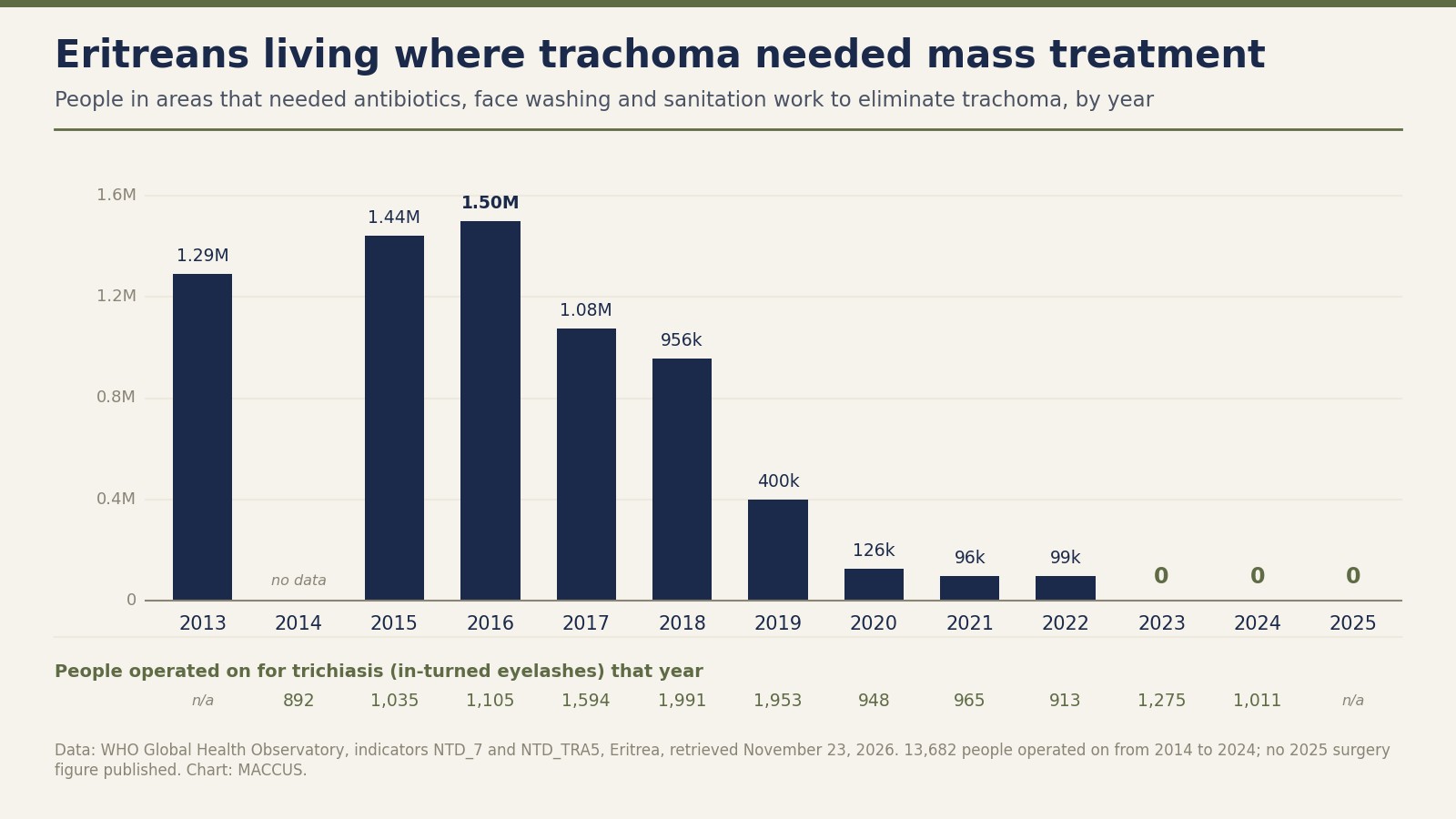
In 2016, about 1.5 million Eritreans, nearly half the population by the World Bank’s estimate, lived in areas that needed mass treatment for trachoma, according to WHO data. Since 2023, that number has been zero, and Eritrea got there with the four measures WHO recommends, known as SAFE. Whole communities received azithromycin, an antibiotic donated by Pfizer, and about 13,700 people whose eyelashes had already turned inward had surgery from 2014 to 2024. The other two measures were face washing, and cleaner water and sanitation through a community-led sanitation drive on “limited external funding,” in WHO’s words.
Eritrea’s yearly trachoma numbers come from the Global Health Observatory, WHO’s data portal, where countries report their own figures. WHO’s announcement itself gives no totals for Eritrea. Eritrea is the 11th country in WHO’s African Region and the 34th worldwide to be validated for trachoma. It is also the 66th country to eliminate at least one neglected tropical disease, according to WHO. The agency lists 21 such diseases and disease groups, which mostly affect people living in poverty and in remote areas.
Twenty years of surveys, pills and surgery
Eritrea, on the Red Sea in the Horn of Africa, has about 3.6 million people, by the World Bank’s 2025 estimate. Between 2006 and 2020, the country surveyed all 58 of its sub-zobas, or districts, WHO says. It scaled up treatment wherever trachoma was endemic, meaning the disease was regularly found there. Health workers used digital tools to collect data and map the affected communities, including villages that are hard to reach. “After two decades of determined effort, Eritrea has consigned trachoma as a public health problem to history,” said Dr. Tedros Adhanom Ghebreyesus, WHO’s director-general.
The antibiotic campaigns were large. About 1.36 million people received antibiotics for trachoma in 2007, and about the same number in 2008, according to WHO data. A later push reached 743,984 people in 2017. The last year with any treatment in the data is 2021, when 94,025 people received antibiotics. The data show none in 2022, 2023 or 2024.
Over those years, the number of people living in areas that needed treatment fell. It went from about 1.5 million in 2016 to 1.08 million in 2017 and about 400,000 in 2019. Fewer than 100,000 people lived in such areas in 2021 and 2022, and none did in 2023.
Surgery was for people the infection had already harmed. In the advanced stage, called trichiasis, the eyelashes rub against the eye. That causes constant pain and can permanently scar the cornea, the clear front of the eye. Eritrea operated on 13,682 people for trichiasis from 2014 to 2024, with a peak of 1,991 in 2018, according to WHO’s surgery figures.
Dr. Mary Stephen, the WHO representative in Eritrea, credited the work of communities, the Ministry of Health, development partners and health workers. She also credited The Fred Hollows Foundation, an Australian charity that works against avoidable blindness. “This success belongs first and foremost to the people of Eritrea,” she said.
How trachoma spreads and who it hits
Trachoma spreads through hands, clothes, bedding and flies that carry discharge from an infected person’s eyes or nose, according to WHO. Young children carry most of the infection. Where the disease is common, as many as 90% of preschool children can have active trachoma, the inflamed stage of the disease. The family is where it most often passes from one person to the next.
The damage shows up decades later. Sight loss usually starts between the ages of 30 and 40. Women are blinded up to four times as often as men, probably because they are in closer contact with infected children, WHO says. Worldwide, about 1.9 million people are blind or have impaired vision because of trachoma.
The test Eritrea had to pass
WHO validates a country only after an independent review group it appoints has examined the evidence. The group must confirm that two thresholds are met in every district where trachoma was once common. It must also confirm that systems are in place to detect and manage future cases.
In adults aged 15 and over, fewer than 0.2% may have trichiasis that the health system does not know about. That is about 1 case per 1,000 people of all ages. In children aged 1 to 9, fewer than 5% may show signs of active infection. That level must hold for at least two years without mass antibiotic treatment. The country also needs a working system to find and treat new trichiasis cases, with the money to run it.
What is not solved
Elimination as a public health problem does not mean the last case is gone. People infected years ago can still develop trichiasis. Eritrea operated on 1,275 people for trichiasis in 2023 and 1,011 in 2024, after mass treatment had stopped. WHO says the country has set up systems to find and manage new cases and will keep watching for the disease after the validation.
Outside Eritrea, trachoma is still a public health problem in at least part of 28 countries, according to WHO. By the agency’s count, 92 million people lived in areas where it was endemic as of March 2026. In 2025, 98,829 people worldwide had surgery for trichiasis, and 47.4 million received antibiotics for trachoma.
Funding for this kind of work has fallen. WHO published its global report on neglected tropical diseases on November 4, 2026. It said resources for these diseases remain 30% below pre-COVID-19 levels. A small number of donors provided nearly 80% of international aid for these diseases between 2018 and 2024. Abrupt cuts in that aid have disrupted mass treatment and disease monitoring and put donated medicines at risk of expiring, the agency said.
What it means
Eritrea reached this result with old tools. WHO adopted the SAFE strategy in 1993, and the antibiotic was donated. Much of this year’s medical news has been about new products, such as a pill for advanced pancreatic cancer, a cancer vaccine made for each patient and diabetes drugs now tested against addiction and heart failure. Eritrea surveyed every district and applied the same four measures for about two decades before an outside panel checked the result.
WHO estimates that about 1.5 billion people worldwide needed interventions against trachoma in 2002. By November 2025, the number was below 100 million, a drop of about 94%. Mauritania, Burundi and Senegal were among the countries validated in 2025. WHO’s road map for neglected tropical diseases sets 2030 as the target for eliminating trachoma as a public health problem worldwide. That replaced the original target of 2020.
Keeping the result now depends on two routine jobs: finding and operating on adults whose eyelashes still turn inward, and watching for any return of the infection. WHO’s data portal does not show Eritrea’s 2025 surgery count yet. That count and the next WHO figures for Eritrea will show whether the work continues after the validation.
Sources
- Eritrea eliminates trachoma: a major public health milestone, World Health Organization, November 16, 2026
- Trachoma, World Health Organization, November 20, 2026
- Population in areas that warrant treatment with antibiotics, facial cleanliness and environmental improvement for elimination of trachoma as a public health problem, WHO Global Health Observatory, retrieved November 23, 2026
- Number of people who received treatment with antibiotics for trachoma, WHO Global Health Observatory, retrieved November 23, 2026
- Number of people operated for trachomatous trichiasis, WHO Global Health Observatory, retrieved November 23, 2026
- Progress against neglected tropical diseases requires sustained action, World Health Organization, November 4, 2026
- Population, total: Eritrea (SP.POP.TOTL), World Bank, retrieved November 23, 2026