

China’s broadcasting regulator has banned cable TV and IPTV operators from playing an ad when a viewer switches on the set-top box. The ban comes in two regulations that took effect on November 27, 2026, and make a full-screen live channel the box’s default start screen. An operator that breaks the rule faces an order to comply, a warning and public criticism from broadcasting authorities at county level or above. In serious cases it also faces a fine of 10,000 to 100,000 yuan (about $1,500 to $15,000), according to the text of the IPTV order.
The ban binds the operators that supply these set-top boxes. In China, IPTV is television that a licensed provider sends over a telecom carrier’s closed network to a set-top box. Internet TV, which reaches smart TVs and streaming boxes over the open internet, is left out, and so are TV makers. On day one, reporters in the eastern city of Jinan filmed ten homes and found a start-up ad in the three that watch internet TV services, the Chinese news outlet Haibao News reported.
Live TV by default and new service duties
The regulator, the National Radio and Television Administration (NRTA), adopted the two orders on October 23. It published them on October 27, which gave operators a month to comply. Order No. 17 is a revised cable rule that replaces a 2011 version. The regulator says Order No. 18 is the first rule written specifically for how IPTV services are run.
The core rule reads the same in article 12 of Order No. 17 and article 11 of Order No. 18. Operators “must adhere to the principle of live broadcast first” and show full-screen live TV when the box is switched on. They must offer a way into catch-up viewing of programs that have already aired, and they “must not play start-up advertisements” (translations from the Chinese in this article are ours). Hotels and other businesses that run TV for their guests fall under the same live-first rule.
Viewers keep a choice. Operators must add a setting that lets users choose to start on live TV or on the interactive home page. That home page, down to its navigation bar, status bar and “recommendation slots,” must “meet the relevant requirements” of the national broadcasting authority, the orders say. Breaking these home-page rules or the free-section rule brings the same fines in serious cases.
The orders also set service duties. The home page must include a free section, and paid sections must be trimmed and their prices shown. Boxes must start faster, and one button on the remote must jump to live TV. Operators must also offer “elderly,” “minor” and “accessibility” modes and cut fees for the poorest households and for care homes.
IT Home, a Chinese tech news site, summarized the deadlines. Faults must be fixed within 24 hours in towns, 48 hours for major faults and 72 hours in rural areas. Complaints must be answered within 10 working days.
A campaign the regulator began in 2023
Since 2023, the NRTA has run a campaign against what Chinese viewers call “nesting doll” fees, and the orders turn it into regulation. The term means paid packages stacked inside other paid packages, and the campaign also went after menus that older viewers struggle with. Slow boxes were a target too. By the end of 2023, the longest time a box took to start had been cut from 118 seconds to no more than 35, the regulator said, according to Shanghai Daily.
Cable TV had about 205 million subscriber households at the end of June 2026 and IPTV more than 400 million users, IT Home reported. They are separate services, so the two counts should not be added. In its official Q&A on the orders, the regulator says more than 284 million cable and IPTV users already start on live TV with no ad. It also says 183,000 hotels with 11.59 million rooms made their TVs easier to use, and that paid packages of all kinds were cut by more than 70%.
Where the ads remained on day one
Haibao News reporters in Jinan picked ten households at random on November 27 and filmed each TV as it switched on. No cable or IPTV box in the test showed an ad. The four cable homes went straight to a live channel, and the three IPTV homes opened on live TV or on the home page.
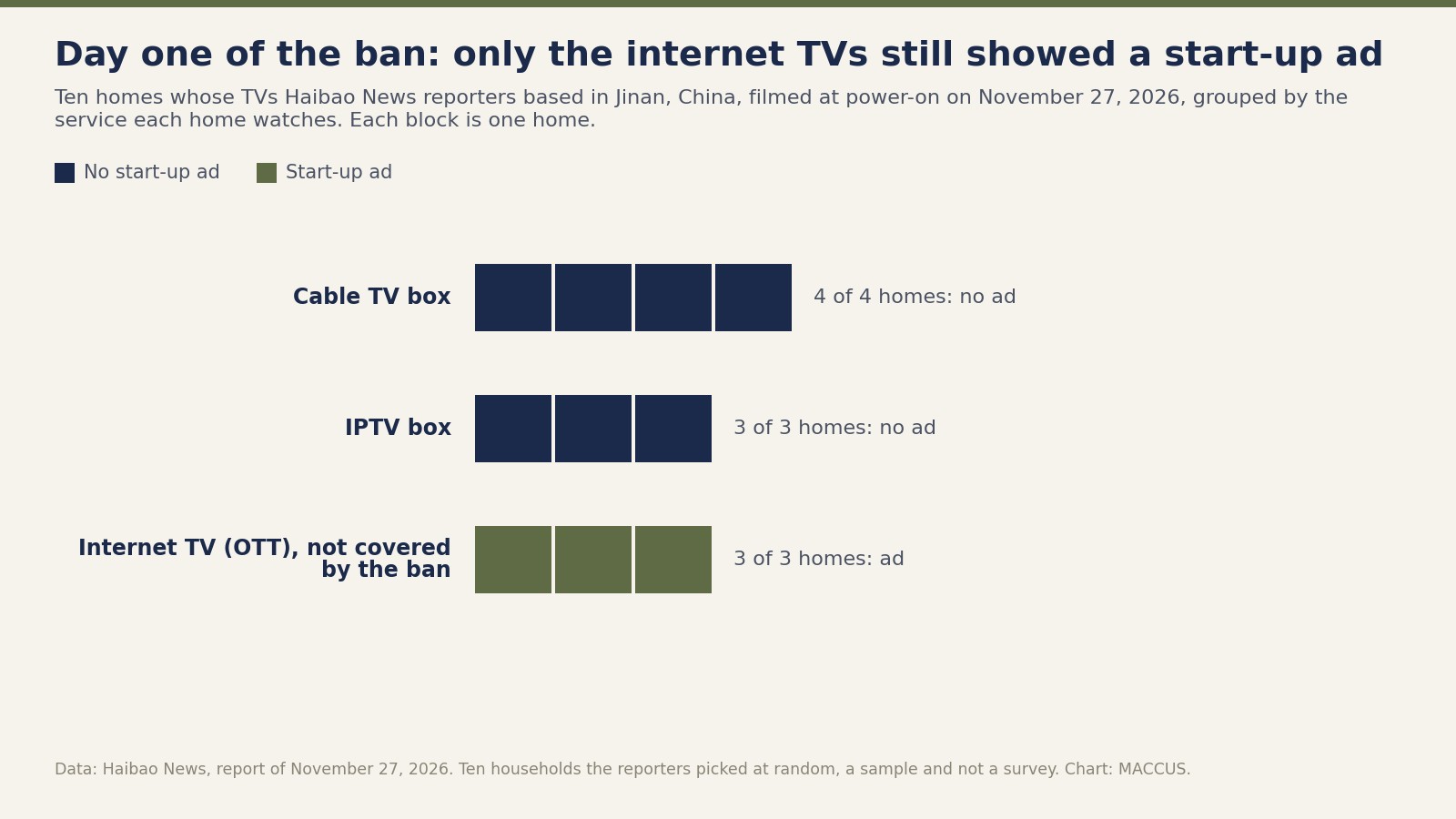
All three homes that watch internet TV services saw an ad. One home that uses the internet TV service Huashu TV got a start-up ad for a TV drama, more than 10 seconds long. A Xiaomi TV usually opened on its home page with no ad, but once during the test it played a health-product commercial of more than 10 seconds that had to be closed by hand. After a restart, the same set showed a picture-in-picture KFC ad video in the middle of the home page.
Other newsrooms also found start-up ads left on TV sets. Reporters at the Chinese newspaper Nandu tested TVs from Xiaomi, Sony, Hisense and other brands. Some still showed start-up ads, including product commercials longer than 10 seconds and ads for home broadband.
A reporter for Dafeng News, another Chinese outlet, found a TCL set that still showed an ad. China Telecom said its IPTV ads had been switched off and that the remaining ad came from the TV’s own system. TCL’s customer service switched the ad off after follow-up questions from the reporter, the report says.
What the rules leave out
The ban covers only the operator’s box. For TV sets, the orders only say that a smart TV “should support” showing live channels first and give users an easy setting. They contain no “must not play” line for TV makers, and TV makers are absent from the penalty articles, which name operators and hotels. IT Home says internet TV is outside the direct scope of both orders, and that ads built into TV makers’ own systems still depend on other rules or on the makers’ own restraint.
Ads inside video apps stay too. The viewers Haibao News spoke to shared one complaint: they pay for video memberships and still get ads before an episode and in the middle of it, and one of them mentioned pop-ups in the apps. Outside China, video apps are also changing how they treat the TV screen: YouTube now adds viewers it estimates are watching together on a TV to its public view counts.
The figures in this story have limits. The 284 million users and the 70% cut in paid packages are the regulator’s own figures, not an independent count. The Haibao News test covers ten homes on one day, a newspaper’s sample that does not measure China as a whole. None of the November 27 reports we read mentions a fine actually imposed under the new rules.
What it means
Viewers who want a box they pay for to behave like a TV again can point to the regulator’s own count: more than 284 million users already switch on to a channel with no commercial. The orders add a free section, a live-TV button and repair deadlines. Europe is also asking what users pay with when a service calls itself free: an EU court adviser said Facebook cannot call itself free if users must hand over personal data. The same article in both orders that lets viewers choose the home page also puts that page under the regulator’s requirements.
Read from the other side, the same articles decide what people see first: live broadcast by default, and a home page whose recommendation slots must meet the regulator’s requirements, which the sources we read do not spell out. Article 3 of both orders says the service must uphold its “ideological” attribute alongside its public-service and technology-industry ones. Regulators elsewhere are also extending broadcast rules to new screens: France’s media regulator will apply TV election rules to the biggest news video creators in 2027. Against that reading, the text lets any viewer switch the start screen to the home page, and the day-one tests found the remaining ads on internet TV services and in TV makers’ software, not on the cable and IPTV boxes.
The next step concerns the TV sets: the NRTA plans to fold the box into the screen with devices such as “integrated TVs,” sets with the operator’s box built in as software; its Q&A says about a million are already installed. It is working with China Broadnet, China Telecom, China Unicom and China Mobile to deploy tens of millions of such devices this year and more than 150 million by 2030. On our reading, that would bring the operators’ rules, start-up ban included, inside the TV itself. Until then, the first local fines and any binding rule for TV makers’ software are the two things to watch.
Sources
- 国家广播电视总局令第17号:《有线广播电视运营服务管理规定》, National Radio and Television Administration, October 27, 2026
- 国家广播电视总局令第18号:《交互式网络电视运营服务管理暂行规定》, National Radio and Television Administration, October 27, 2026
- 《有线广播电视运营服务管理规定》和《交互式网络电视运营服务管理暂行规定》答记者问, National Radio and Television Administration, October 27, 2026
- 有线电视与 IPTV 广告禁令今日生效:开机看全屏直播,违者最高罚 10 万元, IT Home, November 27, 2026
- 开机广告禁播首日,记者实测:十户仍有三户出现开机广告, Haibao News (via Sohu), November 27, 2026
- 广电禁播电视开机广告首日实测:部分仍有超10秒商品广告,电视普遍设有“免费专区”,有的界面已设置“回看”等导航栏, Nandu N Video (via ifeng), November 27, 2026
- 广电新规首日部分电视仍有开机广告 执行情况参差不齐, Dafeng News (via china.com), November 27, 2026
- China Sets Rules for Ad-Free Start-up and Direct Access to Live TV, Shanghai Daily, November 2, 2026