On November 19, 2026, Arcom, the regulator that oversees broadcasting and online platforms in France, published its rules for the 2027 presidential election. For the first time, some video creators will have to follow the same rules on political balance as TV and radio stations. Their channels must give candidates fair exposure, then equal time, and cover the campaign with restraint and honesty. The two rounds of voting are set for April 18 and May 2, 2027.
“There is a new phenomenon, it is here and it is massive,” Arcom president Martin Ajdari said as he presented the rules, according to Agence France-Presse (AFP), the French news agency. He drew a parallel with American podcaster Joe Rogan. Audio-only podcasts are excluded.
A 1962 law applied to online channels
The rules come from a recommendation Arcom adopted on November 4, 2026, and presented to the press on November 19. Arcom bases them on a law of November 6, 1962, that governs the election of the French president. Article 3 of that law requires “audiovisual communication service publishers” to treat candidates fairly, then equally. That wording reaches beyond radio and television.
The same wording also covers on-demand audiovisual media services, known in French law by the acronym SMAD. A 1986 media law defines it as a service that lets viewers choose when to watch programs from a catalog the publisher selects. According to Arcom, a channel hosted on YouTube or on Dailymotion, a French video site, can qualify. Arcom says the EU’s rulebook for TV and on-demand video, the Audiovisual Media Services Directive revised in 2018, allows the same reading.
Arcom places editorial responsibility with the creator. It treats the person who chooses the guests, topics, editing and titles as the publisher of the service, and YouTube as only a host. Arcom’s press kit says “tens of thousands of content creators” in France publish on such a service.
Three tests decide which channels are covered
Arcom’s page for industry professionals first lists what makes a channel a SMAD. Among other things, the channel needs a lasting catalog of videos made of audiovisual programs, selected by the creator and watched on demand. It must also earn money in some form: ad revenue, partnerships, product placements, subscriptions and donations all count.
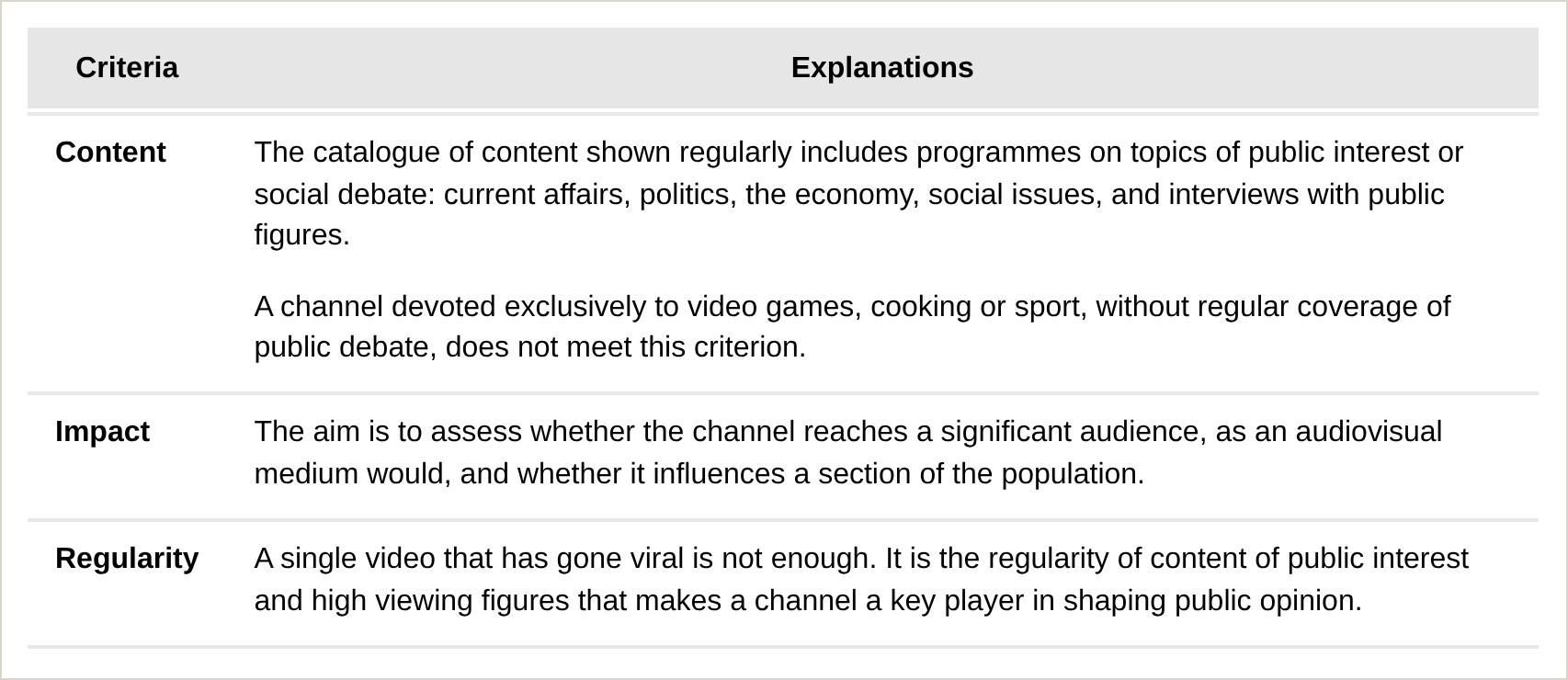
Arcom then mainly targets channels whose influence compares with a TV or radio station’s. They must meet all three tests. The first is content: the channel regularly covers news, politics, the economy or social issues. A channel devoted only to video games, cooking or sports does not qualify.
The second is impact: a channel that does not reach “hundreds of thousands of people” will not be a priority. The third is regularity: one viral video is not enough.
France Info, the public broadcaster’s news service, reports that Arcom named four channels: HugoDécrypte, a YouTube news channel; YouTuber Gaspard G; Legend, Guillaume Pley’s video outlet; and Brut, an online video news outlet. Speaking on RTL, a French radio station, Ajdari said the rules would affect “a very tiny minority” of influencers.
HugoDécrypte has 3.8 million YouTube subscribers. AFP cited the 2026 report of the Reuters Institute, a journalism research center at Oxford University. It found that HugoDécrypte has become the main news source for young people in France and reaches 28% of those under 35.
Fairness from March 16, equal time from April 5
The fairness period runs from March 16 to April 4, 2027. It starts the day France’s Constitutional Council, the court that oversees presidential elections, publishes the list of candidates. It ends the day before the official campaign begins.
During that period, each candidate gets exposure in proportion to their standing and to how much they drive the campaign debate. Standing reflects past election results, polls and the number of elected officials.
Equal time starts on April 5, the first day of the official campaign. All candidates and their supporters must then get the same speaking time. They must also get the same airtime, which includes coverage devoted to them. According to Arcom’s press kit, that period ends on April 30.
Adding up minutes is not enough: candidates must also appear in comparable conditions. For a video channel, that covers the format, length, title, thumbnail, place in the catalog and promotion. Creators do not have to invite every candidate. The ones they host must be treated in a balanced way over the whole period.
Arcom says it will take into account creators’ good faith and practical problems, such as a candidate who turns down an invitation. Ajdari gave an example of a breach, as quoted by AFP: “If, during the official campaign, an influencer invites one or two candidates and disparages the others, we would have to step in.”
Paid political partnerships are already banned
French law already covers political advertising. Article L. 52-1 of the Electoral Code, which compiles France’s election laws, bans commercial advertising for campaign purposes in the six months before the election month. Because the first round falls in April 2027, the ban has applied since October 1, 2026. Arcom says a paid partnership between a candidate and a creator to promote a candidacy falls under that ban.
Article 14 of the 1986 media law goes further and bans “political advertising broadcasts” at all times. These bans add to rules that already require influencers to disclose their brand deals.
A blackout also applies: starting at 12 a.m. on the day before each vote, no campaign message can be posted. No result can be shared before the last polling station in mainland France closes.
Platforms asked to flag paid posts and AI content
Arcom also published recommendations for the largest online platforms and search engines, presented in the same press kit. It asks them to check that influencers’ commercial posts meet the transparency rules. It also asks them to let users spot accounts that earn money from their content. Undisclosed ads have already surfaced on TikTok, with accounts that use AI-generated women to sell apps.
Arcom also recommends that platforms help users identify content generated or substantially altered by AI, including deepfakes. On a page about AI during elections, Arcom notes that the EU’s artificial intelligence law, the AI Act, has imposed transparency obligations since August 2, 2026. Labeling of AI-generated content applies from December 2, 2026, to AI systems put on the market before August 2.
Sanctions, and pushback from creators
“We can impose sanctions” if creators break the rules, Ajdari warned, according to AFP. Arcom’s responses range from a warning to a formal notice to comply, then to fines for repeated breaches. He added, according to France Info, that “our approach is not sanctions, it is dialogue.”
The regulator will mostly act on complaints. In the press kit, Arcom board member Catherine Jentile de Canecaude says Arcom is targeting breaches that are “manifest, repeated and likely to have an impact on the debate.” The press kit lists 29 TV and radio services that report candidates’ speaking time and airtime to Arcom. No creator is on that list.
Several creators pushed back. Umicc, a French trade group for influencers and content creators, disputes that these channels are SMADs, according to Journal du Net, a business news site. Its vice president, YouTuber Gaspard G, spoke on Instagram and to AFP, as reported by France Info. He said a TV channel can schedule segments to rebalance candidates’ exposure: “A creator can’t.”
“It outrages me,” said Jean Massiet, host of the online political show “Backseat,” as quoted by France Info. He promised to cover the legal fees of any creators Arcom might go after.
Questions Arcom’s documents leave open
Arcom’s documents give two start dates for related requirements. According to the press kit, the recommendation requires “restraint” and “honesty” in covering election news “from March 16, 2027.” The same document says that “from January 2027,” Arcom will look at the accuracy and honesty of information.
France Info puts the date at January 4, 2027, the day the recommendation takes effect in the press kit’s calendar. Arcom’s page for industry professionals says the accuracy and honesty requirements apply “from the beginning of the recommendation’s application.”
The audience threshold has no exact figure. Arcom refers to “hundreds of thousands of people” and says it will decide case by case whether a channel is a SMAD. No list yet shows which channels will have to apply equal time in the spring.
What it means
Arcom is applying decades-old TV and radio rules on fairness and equal speaking time to a few video channels that cover politics. It is doing so without a new law, by reading the 1962 election law and the 1986 media law together. The regulator cites a “need for consistency.” A candidate’s appearance on a TV news bulletin counts in the time totals, while a long interview on a big YouTube channel does not.
By Arcom’s own account, few channels are affected. Channels devoted only to cooking, gaming or sports fail the content test, and those that do not reach hundreds of thousands of people are not a priority. For brands and agencies that work with creators, the rule that matters already exists. A paid partnership with a candidate to promote their candidacy has been banned since October 1, 2026.
The legal basis is disputed. Arcom says the law requires it to cover SMADs, while Umicc rejects that classification. Jean Massiet has offered to fund the defense of any creator Arcom pursues.
Enforcement will depend on complaints from the public, and Arcom writes that it is not seeking to review all content. Three developments are worth watching: the Constitutional Council’s list of candidates, expected on March 16; the first complaints filed against a video channel; and any court challenge by a creator to their classification. According to Arcom’s press kit, the European Commission also opened a consultation in early November 2026 on new election guidelines that could strengthen Arcom’s recommendations.
Sources
- Content creators: the rules laid down by Arcom during the 2027 presidential election, Arcom, November 19, 2026
- Présidentielle 2027 : les créateurs de contenus sont-ils aussi concernés ?, Arcom, accessed November 21, 2026
- Présidentielle 2027 : règles et préconisations de l’Arcom (dossier de presse), Arcom, November 19, 2026
- Préconisations aux plateformes et moteurs de recherche en ligne en vue de l’élection présidentielle des 18 avril et 2 mai 2027, Arcom, November 2026
- Les enjeux liés à l’intelligence artificielle en période électorale, Arcom, November 19, 2026
- Présidentielle 2027 : les créateurs de contenus devront respecter le pluralisme politique, Maddyness with AFP, November 19, 2026
- L’Arcom impose l’équité des temps de parole aux influenceurs et créateurs vidéo, Journal du Net, November 20, 2026
- On vous explique les nouvelles règles de pluralisme que l’Arcom veut appliquer aux influenceurs comme HugoDécrypte ou Guillaume Pley pour la présidentielle, France Info, November 20, 2026
Header image: MACCUS chart, data from Arcom (November 19, 2026)