
For two months, the story of AI in science was a story about math. Anthropic’s Claude and other models produced long, computer-checkable proofs, because a proof turns computing power straight into a result a machine can confirm. In the last week of November 2026, that pattern reached the wet lab, where researchers work with real cells and chemicals, and the physical sciences. Now the thing produced is a molecule tested in an animal, a protein that sticks in a dish, or a calculation about gravity.
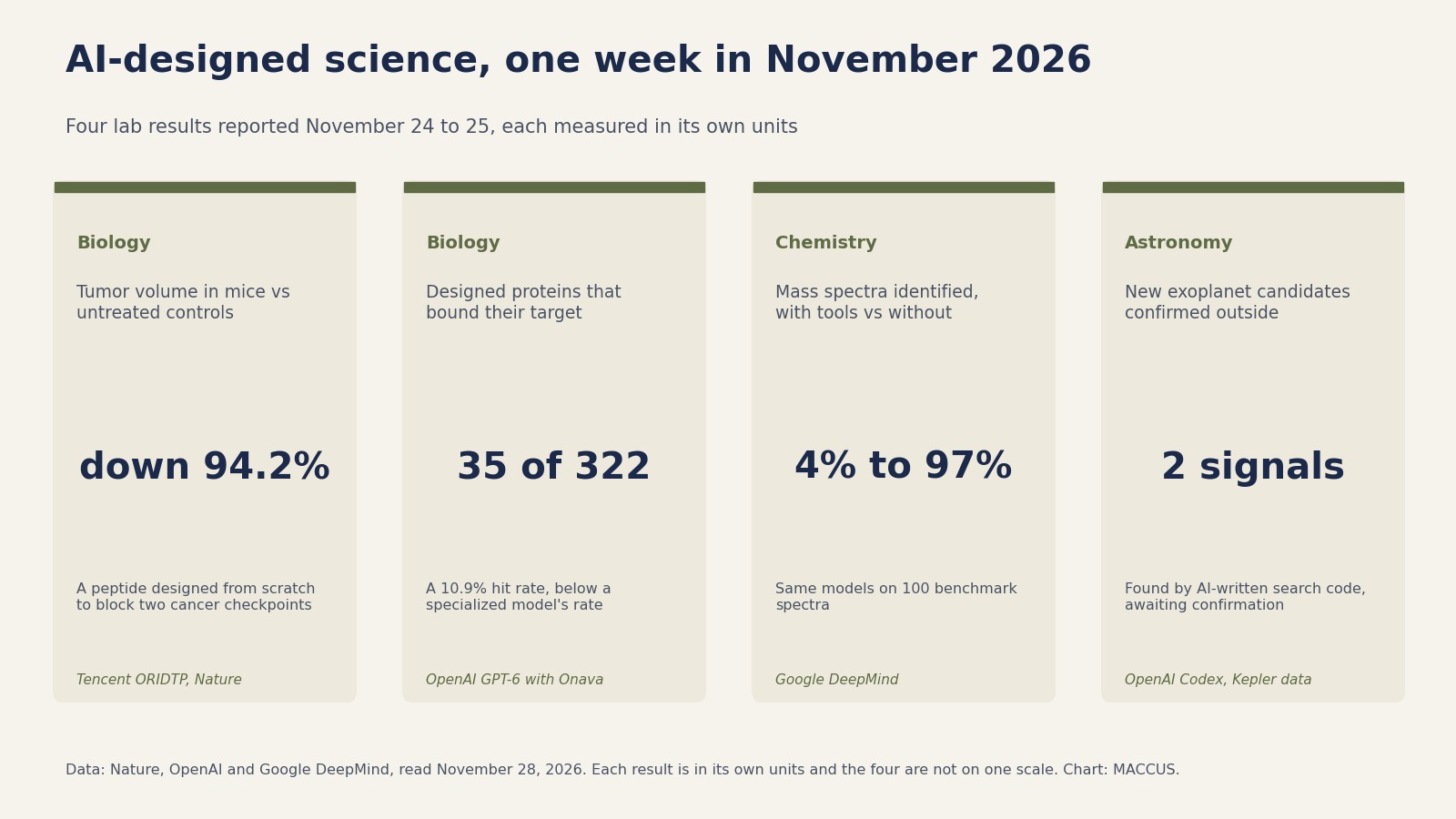
The most concrete single result came on November 25, 2026, when the journal Nature published a paper in which an AI platform designed drug peptides, short chains of amino acids, from scratch. One of those designed molecules cut the volume of tumors in mice by 94.2% against untreated controls. In the same week, OpenAI said its GPT-6 models designed proteins that bound their targets in a partner’s lab, Google DeepMind showed an agent that reads chemical fingerprints software rarely cracks, and a Stanford physicist posted a new quantum-gravity calculation worked out with an OpenAI model. maccus.fr covered the math-proof wave that came first, the proofs of long-standing problems like the Riemann hypothesis.
Tencent’s platform designed drug peptides tested in mice
The Nature paper describes ORIDTP, an AI platform from Tencent’s labs that designs peptides aimed at hitting two biological targets at once. It designs them de novo, meaning from scratch, without starting from a known molecule. The study is the single clearest example of the week’s shift, because its output is a drug candidate measured in live animals.
On the metabolic side, ORIDTP designed co-agonists, molecules that switch on two receptors at once, for the GLP-1 and glucagon receptors, the same receptor family behind weight-loss drugs like Ozempic. Six of the designed peptides beat the strongest natural binder of each receptor in lab tests. The lead one caused what the authors call substantial weight loss and better blood sugar in obese and diabetic mice, “without inducing nausea or aversion,” a common side effect of that drug class.
In a separate test the platform had not been tuned for, it designed peptides to block two cancer-immunity checkpoints, PD-1 and CTLA-4, the molecular brakes that tumors use to evade the immune system. Of 15 designed peptides, 8 blocked both checkpoints, and 3 slowed tumors in mice. The lead peptide, called IC-Dual.P3, produced the 94.2% drop in tumor volume. Tencent is reporting its own result here, so the numbers come from the Nature paper rather than from a company summary, and the code sits in a public repository. Every figure is from mice, not people.
OpenAI’s models designed proteins that stuck to their targets in a partner’s lab
OpenAI published results on November 24, 2026 for its GPT-6 models and protein design. The claim is that the models design both a protein’s shape and its amino-acid sequence using general reasoning and code, without calling the specialized biology models the field usually relies on. This follows earlier work where AI matched protein-only systems at reading and writing sequences.
With a research partner, Onava, OpenAI tested 322 small designed proteins, called minibinders, against five targets in the lab. Thirty-five of them, or 10.9%, stuck to their intended target. OpenAI notes that this rate sits below the one reported for RFdiffusion, a specialized protein-design model, and that hit rates depend heavily on how strictly a team filters designs and defines binding. Specialized models still supplied sequences and picked which candidates to make.
DeepMind’s agent read chemical fingerprints that software rarely cracks
On November 25, 2026, Google DeepMind described Mass Spec Skills for its Antigravity agent. The tools let a Gemini agent read a tandem mass spectrum, the fingerprint-like pattern of pieces a molecule breaks into, and propose the molecule’s chemical structure. The problem is real: even after a decade of building reference libraries, matching a molecule’s spectrum against them identifies on average only about 5% of the molecules in a sample, and researchers call the rest the dark matter of mass spectrometry.
DeepMind ran a benchmark of 100 spectra, three attempts each, across three Gemini models. With no tools, all three stayed below 4% accuracy at naming the molecule. With the Mass Spec Skills added, all three identified the exact molecule in about 97% of attempts, and the lightweight Gemini 3.8 Flash matched the two top models while using far fewer tokens, which means less computing work. The jump is a tooling result: the benchmark ran the same models with and without a set of chemistry tools, so the gain belongs to the tools and the workflow around them, not to any change in the models.
A gravity paper and a planet search filled out the week
A fourth result is a physics preprint, a paper posted before peer review. Venkatesa Chandrasekaran, a theoretical physicist at Stanford, posted a new quantization of gravity, a fresh way to describe gravity with quantum theory. In his version, a key calculation involving the graviton, the hypothetical particle thought to carry gravity, comes out finite where the standard method breaks down. The approach also reproduces a known formula for black-hole entropy. In the acknowledgments he writes that several calculations and proofs “were developed through detailed, back and forth collaboration with GPT-6 Astra over the course of many months, amounting to about 400 million total tokens.” The paper has not been peer reviewed, and forums including r/accelerate are already arguing over it. It extends the pattern maccus.fr described in its piece on AI and a physics conjecture.
The fifth and lightest result is in astronomy. Two amateurs used OpenAI’s Codex coding tool and its Astra model to write programs that search for transits, the small dips in a star’s light when a planet passes in front of it, then ran them on public telescope data. One search of about 100,000 stars from NASA’s Kepler telescope flagged more than 200 signals, including 10 known planets and two new candidates; a SETI Institute astronomer ran his own search and recovered the same two. A second search of about 19 million stars turned up 49 candidates, one now being followed up by the NASA TESS team. These are candidates awaiting confirmation, which can take months or years, not confirmed planets.
What the results do not show
Every result here is still early. Each was tested only in animals or on a computer, or has not yet been peer reviewed. The Tencent peptides worked in mice, with no human patient tested, and the metabolic ones are a research result far from any approved drug. The OpenAI proteins bound in a partner’s lab, their 10.9% hit rate trails a specialized model, and specialized models still did part of the work. The mass-spec result compares the same models with and without the chemistry tools. The gravity paper proposes a calculation that has not been peer reviewed. The planet-search dips are candidates, not confirmed planets.
Across all four fields, a human still chose the target, ran the experiment and will judge the output. What the AI did was generate the thing to be tested, faster and at lower cost than before. That speed is the shift this week.
What it means
The common objection to AI math proofs was that a machine could check them but no person had read them. The experimental sciences answer that objection differently. Here the check is physical: an animal, a binding test in the lab, a spectrometer or a telescope, instead of another program. That raises the stakes of each result and also its cost, since a wet-lab test takes weeks, while a Lean proof, run through math-checking software, takes only computing time.
What is accelerating is how cheaply and quickly AI can produce something scientists can test: a candidate molecule, a protein design, a proposed structure, a calculation. Validation has not sped up, and validation is still what decides whether any of this is real. The shift toward AI that reaches real medicine also runs through Anthropic’s own drug programs, and it now touches biology, chemistry, physics and astronomy at once rather than math alone.
Labs have noticed. Moonshot AI’s Kimi for Science program, announced on November 26, 2026, offers selected researchers up to 20,000 dollars in API credits, free access to its AI models, to run exactly this kind of AI-assisted work. The things to watch next: whether any Tencent peptide reaches a first human trial, whether OpenAI’s protein hit rate climbs on harder targets, whether the mass-spec tools work on real unknown molecules instead of a benchmark, and whether anyone peer reviews the gravity paper.
Sources
- De novo design of high-potency dual-target therapeutic peptides with ORIDTP, Nature, November 25, 2026
- GPT-6 models demonstrate intrinsic protein-design capabilities, OpenAI, November 24, 2026
- From spectrum to structure: identifying molecules with Mass Spec Skills for Google Antigravity, Google DeepMind, November 25, 2026
- An algebraic quantization of gravity from the null cone, arXiv, November 25, 2026
- Searching for distant planets with Astra, OpenAI, November 24, 2026