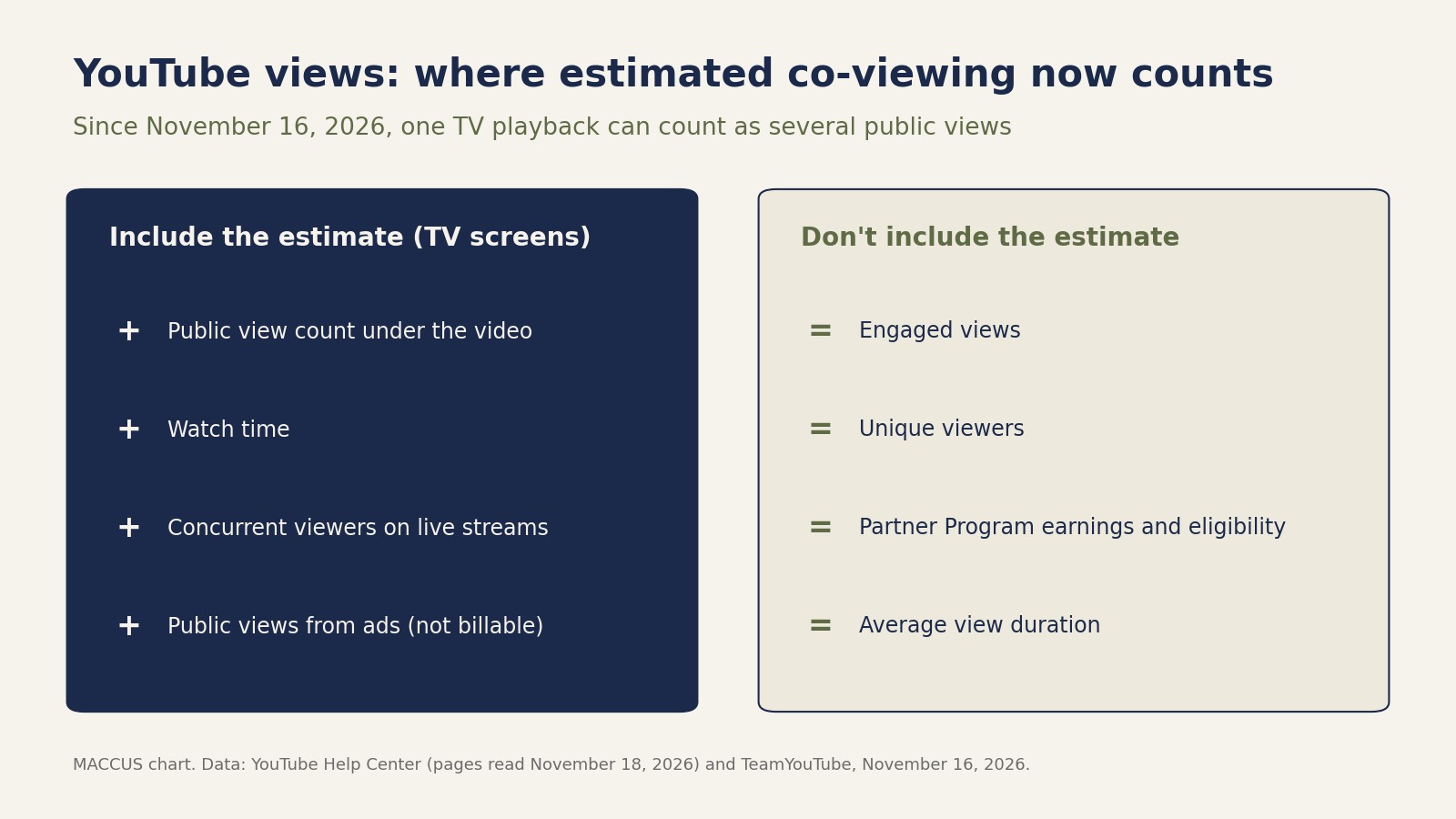

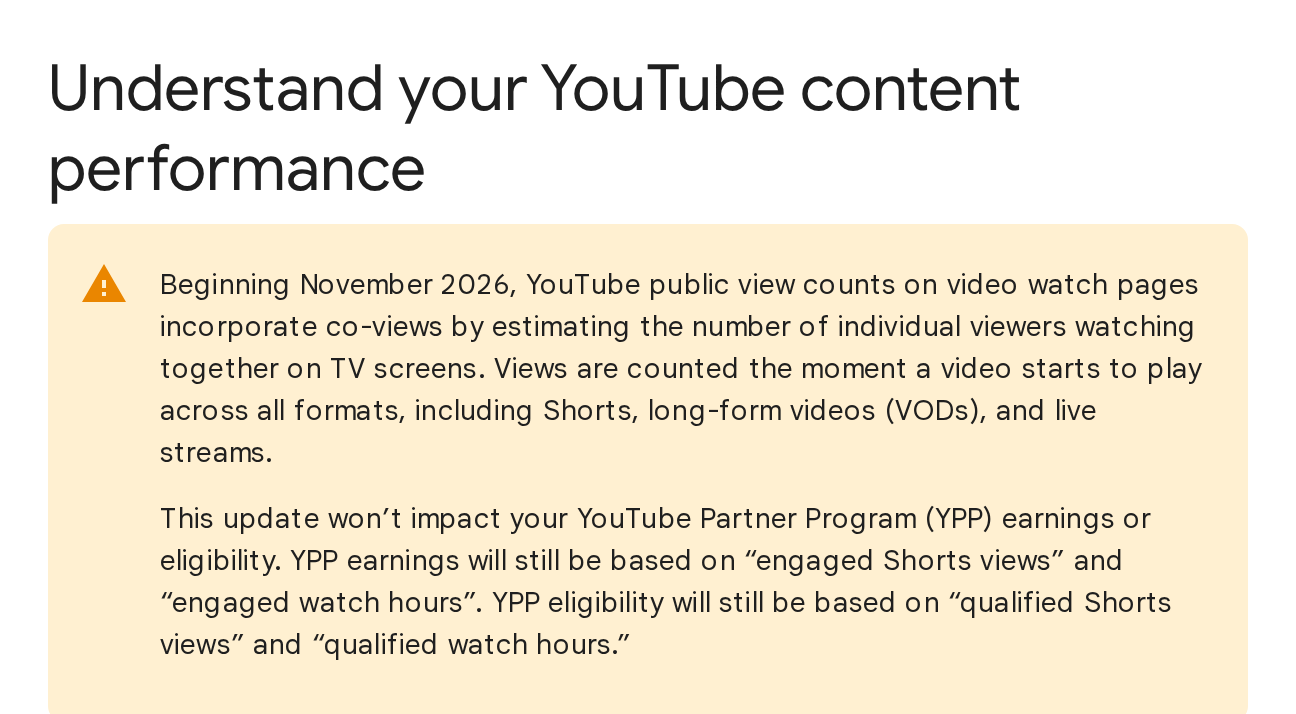
As of November 16, 2026, the public view count under YouTube videos includes an estimate. When a video plays on a TV, YouTube now adds the extra people that a Google statistical model estimates are watching the same screen. A playback on a phone, computer or tablet still counts as one view.
Creator pay doesn’t change. It is still based on engaged watch hours and on “engaged views,” which leave the estimate out. An engaged view is a playback that continues past the first few seconds. The public count is therefore moving further away from the numbers YouTube uses to pay creators.
TeamYouTube, the platform’s support team, announced the change on YouTube’s support forum, the YouTube Help Community. Creator Insider, YouTube’s news channel for creators, also covered it. Creators can track the effect in Insights, the YouTube Studio stats page announced on November 13 as the replacement for Analytics. YouTube Studio is the tool creators use to run their channels.
This is the second change in three months to how YouTube counts public views, after the August switch to counting a view from its first frame.
TV co-viewers now go into the public count
Co-viewing means two or more people watching the same video at the same time on a shared TV. “Until now, one TV playback has only counted as a single public view, even if several people watched together on the same living room screen,” TeamYouTube wrote on November 16. YouTube was already estimating these co-viewers in YouTube Studio, under a private metric called “Views (Co-viewed).” Now those estimates go into the public count.
YouTube’s Help Center sums it up: “Beginning November 2026, YouTube public view counts on video watch pages incorporate co-views by estimating the number of individual viewers watching together on TV screens.” The change covers long-form videos, Shorts (YouTube’s short vertical videos) and live streams. According to YouTube, as reported by the tech news site 9to5Google, it only applies going forward: existing view counts won’t be recalculated.
YouTube justifies the change with the size of its TV audience. Viewers now watch “over 1 billion hours” of YouTube on TVs every day, according to TeamYouTube. The platform says it is aligning with TV industry standards: broadcasters have long estimated the total number of people who saw a program.
YouTube also pitches the change to creators as a selling point with brands: “More data for brand deals.” Brand deals are the paid collaborations between a brand and a creator.
Google research scientists built the model, according to TeamYouTube. It relies on signals such as demographic patterns, content metadata (descriptive data about each video) and viewing times. TeamYouTube says YouTube “never uses cameras, microphones, or device sensors to measure co-views.”
According to Creator Insider, as reported by the creator economy news site Net Influencer, the model is calibrated against ground-truth sources, meaning real measurements. Industry panels, samples of viewers whose viewing is measured, are one example.
A co-view rate that only creators can see
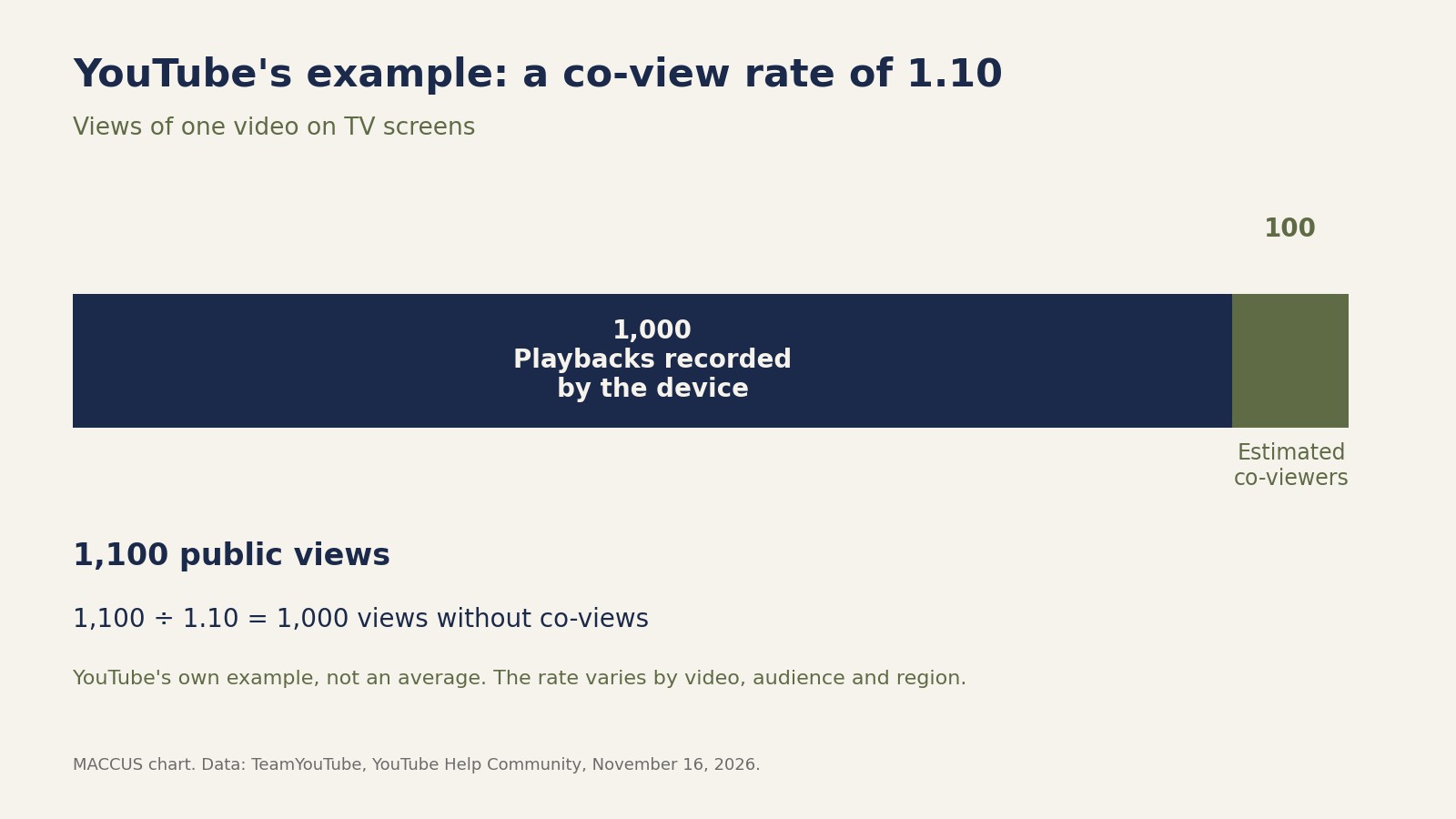
Creators get a new private metric called Co-view rate. It shows how much estimated co-views add to a video’s overall view count. It sits in Insights, in Advanced Mode, under the Device Type breakdown. In TeamYouTube’s example, a rate of 1.10 means that out of every 1,100 TV views of a video, 1,000 are playbacks recorded by the device and 100 are estimated co-viewers.
To get the number of views without co-views, YouTube says to divide total views by the rate. The rate varies by playback, video, viewer demographics and region, TeamYouTube says. It can also change over time as more people watch and new co-views are added. The older “Views (Co-viewed)” metric stays available in Advanced Mode until May 2027, according to the Help Center.
Because the rate is private, a brand, agency or journalist can’t remove the estimated share from a public count unless the creator shares their stats.
Metrics with and without the estimate
The estimate also reaches other metrics. According to the Help Center, watch time “includes watch time from co-views.” On live streams, peak and average concurrent viewers (people watching at the same moment) include it too. Unique reach, YouTube’s estimate of how many individual people saw a video or channel, accounts for shared viewing on TVs.
Other metrics leave co-viewing out, starting with engaged views. The unique viewers metric, an estimate based on engaged views, leaves it out too. Average view duration, also calculated from engaged views, isn’t affected.
The YouTube Partner Program (YPP) shares ad revenue with the channels it admits. “This update won’t impact your YouTube Partner Program (YPP) earnings or eligibility,” the Help Center says. Admission to the program still depends on what YouTube calls qualified views and qualified watch hours. “Co-views don’t impact ad revenue or YPP thresholds,” Creator Insider wrote, as quoted by the tech news site Engadget.
For advertisers, the Help Center separates two kinds of views in Google Ads, Google’s advertising tool. TrueView views are billable, meaning advertisers pay for them. One example is a skippable ad of 11 to 30 seconds that the viewer watches in full.
An ad’s “YouTube public views” are not billable. They count toward the public view count from the moment the ad starts to play, and on TVs they now include the co-viewing estimate. When a brand runs a video as an ad, that video’s public count therefore includes an estimated share. Billable views are still TrueView views.
An August precedent, and co-viewing data advertisers have had since 2022
The co-viewing estimate follows another counting change. Since August 24, 2026, a public view has counted from the very first frame of a video, in every format. YouTube was bringing all formats in line with the rule it already used for Shorts, 9to5Google reported on August 17. Before that, creators had long assumed a long-form video needed about 30 seconds of viewing to count, according to Net Influencer.
Advertisers have had co-viewing metrics since 2022. On April 13 of that year, Google announced them in Google Ads and Display & Video 360, two Google tools for planning and measuring ad campaigns. It planned a global rollout by the end of the second quarter of 2022. What is new in November is the estimate’s use in the public count.
At the time, Google cited a study with Nielsen, the US audience measurement company. It found that multiple adults were watching together during 26% of YouTube viewing time on TV screens. The figure was 22% for linear TV, meaning traditional channels that air on a fixed schedule.
Co-viewing figures vary with who measures them and how. In February, the Video Advertising Bureau, the US TV industry’s trade group, released a study with TVision, another audience measurement company. According to Net Influencer, it found co-viewing in 45% of the YouTube ad impressions it measured, compared with 60% for premium streaming services. That study counted ad impressions, meaning individual ad displays, while the 2022 study measured a share of viewing time.
Few details on the model, and an effect that varies by channel
YouTube says it is giving creators “full credit” for the audience they’ve built on TVs. It hasn’t published the model’s details, its margin of error or an average co-view rate. The 1.10 rate cited above is only an example picked by TeamYouTube.
YouTube doesn’t name the panels used to calibrate the model either. It also doesn’t say whether European audience measurement organizations contribute, such as Médiamétrie, which measures TV audiences in France. TeamYouTube mentions TVs “around the world” but gives no list of countries.
The effect should vary from one channel to the next. Only TV playbacks are affected, so a channel watched mostly on phones will see little change. An October study by TVision, cited by Net Influencer, found that large creators such as MrBeast generate more co-viewing than smaller channels. Niche creators, the same study found, draw more viewers who watch alone.
What it means
For TV viewing, the public count under a video now combines recorded playbacks with a Google estimate. Creator earnings, engaged views and the Partner Program thresholds leave the estimate out.
The people affected first are those who see only the public count: brands and agencies comparing creators, media buyers and newsrooms. A jump in views after November 16 can come from a bigger audience or from the estimate. Only the creator can see the rate that would tell the two apart.
Brands that base deal payments on public views rather than engaged views are the most exposed. This is the second rule change in three months that pushes counts up without changing what YouTube pays creators. The first was first-frame counting in August. Counts for a video from June and a video from December are now harder to compare.
YouTube is bringing its public count closer to TV audience measurement, where audiences are estimates calibrated against panels. Other platforms are also chasing TV viewing: in late October, Instagram launched its Apple TV app in the US, alongside a test of 90-minute videos.
Three things are worth watching: whether YouTube publishes average co-view rates by country or type of content, whether it names the panels that calibrate the model, and how audience measurement organizations respond. The “Views (Co-viewed)” metric goes away in May 2027. Until then, creators can export its data from YouTube Studio, according to Net Influencer.
Sources
- Updating TV view counts to reflect your true audience: Introducing Co-view rate!, TeamYouTube, YouTube Help Community, November 16, 2026
- Understand your YouTube content performance, YouTube Help, read November 18, 2026
- How engagement metrics are counted, YouTube Help, read November 18, 2026
- YouTube ‘Co-Views’ try to guess how many people are watching your TV, rolling out now, 9to5Google, November 17, 2026
- YouTube will start boosting public view counts when you watch on a TV, Engadget, November 18, 2026
- YouTube Adds Estimated TV Co-Views to Public View Counts, Net Influencer, November 16, 2026
- YouTube now counts video views immediately, ‘from the very first frame’, 9to5Google, August 17, 2026
- Helping advertisers make the most of connected TV, Google, April 13, 2022
Header image: MACCUS chart. Data: YouTube Help Center and TeamYouTube, November 16 and 18, 2026