

Poland’s defense ministry signed a five-year contract worth about $300 million with Palantir on November 27, 2026. The deal covers Palantir’s Maven Smart System, AI software that every command and every branch of the Polish armed forces is to use. The $300 million figure, about 1.23 billion zloty, comes from Defense Minister Władysław Kosiniak-Kamysz, according to PAP, Poland’s national news agency. The ministry says the system will pull together data from many sources and give commanders possible courses of action faster.
Why a US company? “There is no product on the world market today that delivers such capabilities for armed forces,” the minister said, according to the ministry’s statement. In Polish: “Nie ma dzisiaj na rynku światowym produktu, który by dostarczał takie możliwości dla sił zbrojnych.” “There was probably no more analyzed contract in the ministry’s history, no more tests and searching for firms that may have similar capabilities in Poland and Europe,” he said, PAP reported. The ministry says Palantir will have no access to the data or to the encryption keys that lock and unlock it, and no remote access to the system.
A contract for every command
The ministry describes the purchase as software “for an AI-assisted decision-support system,” meaning a tool that helps people make decisions. Its stated goals are faster analysis of information, quicker recognition of threats and recommendations for commanders. Inside the Polish military, the system will run under the codename “Saturn,” the Polish defense news site CyberDefence24 reports.
The minister’s list of users covers the General Staff, the Operational Command, the General Command, the Cyberspace Defense Forces Command, the Territorial Defense Forces Command and the Armed Forces Support Inspectorate. It also covers the air force, navy, land forces and special forces. “This is one of the biggest steps in the transformation of our armed forces,” he said. He compared the contract’s importance to buying F-35 fighter jets or Apache helicopters.
The signing took place at the Polish Army Museum in Warsaw, CyberDefence24 reported. Zbigniew Podosek, head of the Armed Forces Cyberspace Resources Center, signed for the ministry, and Maciej Łaska, managing director of Palantir Technologies Poland, for the company, PAP reported. Palantir’s chief executive, Alex Karp, attended.
Gen. Wiesław Kukuła, chief of the General Staff, said the choice followed the armed forces’ own recommendation, PAP reported. He said the software “will improve our position in the Alliance,” meaning NATO. He added that the military is working on a new airspace management system, “Atlas,” to be based partly on data processed by the Palantir system.
Maven grew out of Project Maven, a program the US Department of Defense started in 2017. The English-language site Notes from Poland reports that the software is advertised as supporting military “command and control,” helping identify military targets and managing battlefield information. The ministry says an authorized person always makes the decision on any action.
Who holds the keys
The ministry says the software will run on the military’s own closed infrastructure and that information will be processed there. The armed forces will decide who can access what, it says. “All the keys, servers and information are and will remain in the exclusive possession of the Polish military,” Kosiniak-Kamysz said. “We are buying a tool, but the information we put into it and take out of it belongs only to Poland.”
Palantir’s Łaska told CyberDefence24 there were no “black boxes, backdoors or other surprises.” The company says the client manages the encryption keys, administrator accounts, user permissions, network traffic and access to data. “The client can manage and maintain the Palantir platform without involving our engineers,” Łaska said. According to the British tech site The Register, Palantir says it coined the term forward deployed engineer for the engineers it sends to build systems inside client organizations.
Palantir also told CyberDefence24 that, as a software vendor, it is not covered by the CLOUD Act. That US law can require companies to hand data to US authorities. The company says it has never received a request under that law.
CyberDefence24 adds that a source-code audit of Palantir’s software, a review of the underlying program code, found no backdoors or unauthorized data transfers. Germany’s Fraunhofer Institute carried it out for the Bavarian police; the outlet does not say which Palantir product it covered. In June, NATO’s version of Maven received full security accreditation, formal approval to run on the alliance’s classified network, the outlet reports. The minister said the contract followed public procurement law and that Poland’s military counterintelligence service checked the system with other NATO countries’ services.
More than two years of tests, and the critics
Polish soldiers first tried Maven in May 2024 at an exercise called FEX-24, CyberDefence24 reports, and a memorandum of cooperation followed in December 2024. In October 2025, the minister signed a letter of intent with Palantir, setting out plans ahead of a contract. According to the Polish news channel TVN24, it mentioned a “Maven Smart System Poland (MSS-P).” Throughout those trials, soldiers used the full system but only on test and open-source data, meaning publicly available information, according to CyberDefence24.
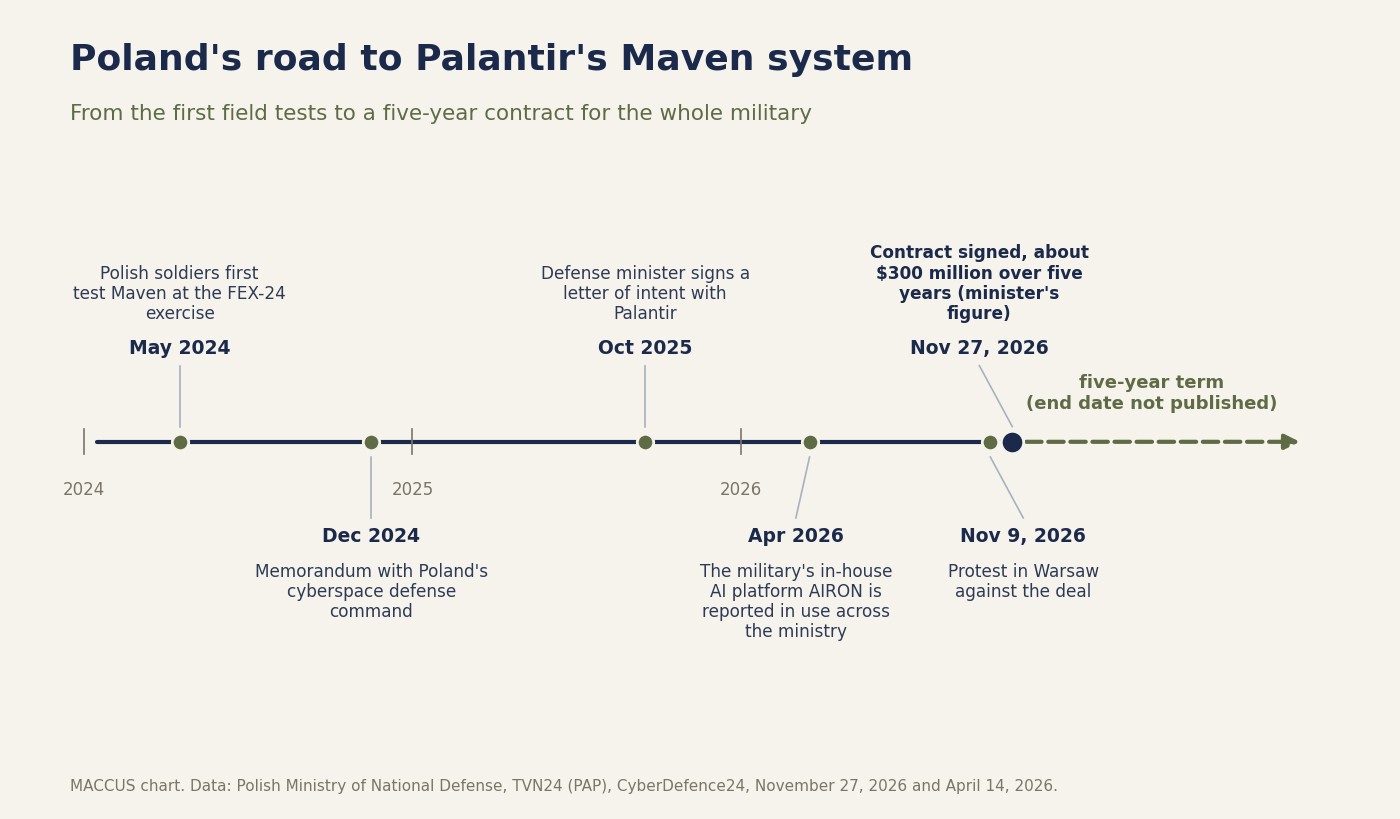
The deal drew opposition. On November 9, protesters in Warsaw raised concerns about who would see the data, where it would go and whether the company could switch the system off, CyberDefence24 reported.
At the signing, Karp answered critics. “It is Poland’s enemies who shout loudest against Palantir,” he said, adding that they persuade “useful idiots.” Notes from Poland reported his words, quoting a Polish translation of his remarks.
The same day, Palantir wrote on X that the Maven Smart System “is universally recognized as the vanguard of next-generation AI warfare.” The company has faced criticism over its work on immigration enforcement in the United States and on Israel’s military operations in Gaza, Notes from Poland writes.
What the ministry has not shown
The $300 million figure comes from the minister’s remarks. The ministry’s own statement gives no value, and the start and end dates of the five-year term have not been announced.
The system is not yet in use across the commands: the ministry speaks of it in the future tense. The guarantees on data are statements by the ministry and Palantir. We have not seen the Fraunhofer audit itself.
Kosiniak-Kamysz also said the contract was much more favorable than, for example, a similar one concluded with Great Britain, PAP reported. He gave no figures to back it. The British deal’s main terms are public.
A UK government notice shows Britain’s Ministry of Defence signed a £240.6 million agreement with Palantir Technologies UK on December 30, 2025. This enterprise agreement covers licensing and support for data analytics across UK defense from April 1, 2026, to March 31, 2029. It was a direct award, without a competitive tender.
At the European Central Bank’s November 27 exchange rates, the British deal comes to about €288 million over three years. Poland’s comes to roughly €275 million over five years. The two contracts cover different things, so the figures do not show which country got the better deal.
The ministry says it is building its own tools, AIRON and NEFRYT, which “in the future could replace the supplier’s tools.” It gives no date. PAP relayed a more cautious ministry line: the in-house systems may “perhaps in the future” provide what Palantir provides now.
In April, CyberDefence24 described AIRON as an AI platform that chats, translates, summarizes documents and builds custom chatbots. The site said the military’s AI Implementation Center built it and that it was already in use across the ministry. The ministry has not said what NEFRYT does.
What it means for Europe
Our reading: Europe’s debate about depending on the United States for defense has mostly been about hardware, from fighter jets to air defense. This contract moves the debate to software that turns a military’s sensors and records into options for commanders. The case for Poland’s choice rests on allies: NATO uses Palantir’s technology, the ministry notes, and Britain has its own £240.6 million Palantir agreement. Poland is also building its own tools: AIRON cost nothing extra, CyberDefence24 reported, because the military’s experts assembled it from publicly available components.
The gap shows in where Poland buys its weapons: from 2021 to 2025, almost all of its arms imports came from outside Europe. South Korea supplied 47% and the United States 44%, according to the Stockholm International Peace Research Institute (SIPRI), which tracks the global arms trade. Europe’s own AI efforts, such as EUROPA, the EU’s open AI model, are still at the training-trial stage. The chief executive of Mistral, a French AI company, said on November 13 that only 20% of European digital services run on European infrastructure.
What to watch is whether the ministry puts a date on AIRON and NEFRYT. Also open is what the contract says about the data and workflows built on Maven when the five years end. Atlas, the planned airspace system, is to draw partly on data processed by Palantir’s software.
Sources
- Wojsko Polskie sięga po nowoczesne i sprawdzone technologie wykorzystujące sztuczną inteligencję, Polish Ministry of National Defense, November 27, 2026
- Umowa MON z Palantirem podpisana. Władysław Kosiniak-Kamysz: serwery są i będą u nas, TVN24 (PAP), November 27, 2026
- Poland signs $300m deal with Palantir for AI-powered battlefield software platform, Notes from Poland, November 27, 2026
- Palantir wchodzi do Wojska Polskiego. Jakie dane zobaczy Maven?, CyberDefence24, November 27, 2026
- Platforma AI od Wojska Polskiego. Działa już w MON-ie, CyberDefence24, April 14, 2026
- MOD Palantir Enterprise Agreement, UK government, Find a Tender, January 23, 2026
- Trends in International Arms Transfers, 2025, SIPRI, March 9, 2026