
OpenAI countersued Apple on Friday, November 27, 2026, in the lawsuit Apple filed against it in July. It accuses the iPhone maker of obtaining its hardware secrets through an employee who returned to Apple, and of pressuring suppliers the two companies share; no court has ruled on these allegations or on Apple’s own claims.
A counterclaim is a defendant’s own claim against the party suing it, filed in the same case. The 81-page filing comes from OpenAI Group PBC, a public benefit corporation, and io Products. OpenAI bought that hardware startup in July 2025; it is now OpenAI’s consumer hardware division.
Two individuals also bring claims: Tang Tan and a second former Apple engineer now at OpenAI. Tan, a former Apple vice president of product design, is now OpenAI’s “Chief Hardware Officer, Consumer Products.” The device at the center of the fight is unreleased, though OpenAI has given its own account of some of its device design work elsewhere.
Apple sued first in July
On July 10, 2026, Apple sued Tan, the second engineer, two OpenAI entities and io Products in federal court in San Jose, California. Its case rests on the Defend Trade Secrets Act, the federal law on trade secrets, and on the Intellectual Property Agreement Apple employees sign. A trade secret is business information that is valuable because competitors do not know it.
According to 9to5Mac’s summary, Apple alleges that confidential engineering and hardware details were taken to help OpenAI’s device effort. On Friday, the defendants also withdrew their request to dismiss the case, which the court heard on October 14 but never ruled on. They answered the complaint instead: “Defendants deny that they stole Apple’s trade secrets.”
Six months at OpenAI and a return to Apple
OpenAI’s trade-secret claim centers on a longtime Apple worker in hardware and quality inspection, whom the filing calls only “Employee X.” In late 2025, while still at Apple, he approached former Apple colleagues at OpenAI about a job and, the filing says, told interviewers he was sick of Apple. He started on December 2, 2025, under agreements requiring him to return company information and delete copies on personal devices, cloud storage or email.
OpenAI says he sent company documents to his personal email and phone numbers from “within weeks of joining” until “the day before he left.” On February 5, 2026, he sent a 76-page supplier inspection procedure for an unreleased component to his personal number. On May 8, he sent “Color Data Template Resin (2).xlsx,” a spreadsheet of nonpublic color targets.
On May 28, he sent three archives to a personal Chinese phone number. One, “structure.zip,” holds 3D scanning and inspection material that OpenAI says reveals the geometry of an unreleased device. On June 1, the day before his last day, he sent six more to a personal Singapore number, including “CPK_GRR.zip,” with measurements of a device’s lower casing.
On May 19, he had told his supervisor he was leaving to care for his family in China, without saying he was returning to Apple. He left on June 2, 2026, and “rejoined Apple shortly after,” the filing says.
OpenAI makes its next claim “on information and belief,” a legal phrase meaning a party believes something but does not claim firsthand knowledge of it. It alleges that in July 2026, at Apple’s request, he briefed senior Apple operations staff in Asia-Pacific on OpenAI’s confidential hardware activities and unreleased-product roadmap.
A letter in October and a “shell game”
On October 9, 2026, OpenAI sent Apple a cease-and-desist letter asking it to investigate, preserve evidence, and contain and account for OpenAI’s information. OpenAI says Apple then “played a shell game to create delay.” Apple, it says, agreed to look into the matter only if OpenAI shared its trade secrets outside the court-supervised process.
Discovery is the pretrial exchange of evidence. OpenAI says Apple is refusing its discovery requests about Employee X and “will not search for documents specifically in response to this Request.”
In an October 12 letter from its outside counsel, filed in court two days later with parts blacked out, Apple said its investigation was ongoing. “To date, we have not learned about any presentation [Employee X] gave to Apple employees about unreleased OpenAI products,” the letter added, asking for details such as the date, location or attendees.
Apple’s court filing of October 14 said it “had been unable to locate any OpenAI confidential information.”
Two suppliers and an overnight shift
“For many functions, OpenAI has one or two qualified suppliers,” the filing says, and many of them also work for Apple. OpenAI argues that, as a young device business, its orders “cannot offset the major revenue that shared suppliers would lose if they were to cross Apple.” On information and belief, OpenAI says Apple’s supply-chain staff demand that suppliers identify their OpenAI projects and the names and assignments of workers with Apple experience. On the same basis, it says Apple has moved orders away from suppliers that start serving OpenAI or resist those demands.
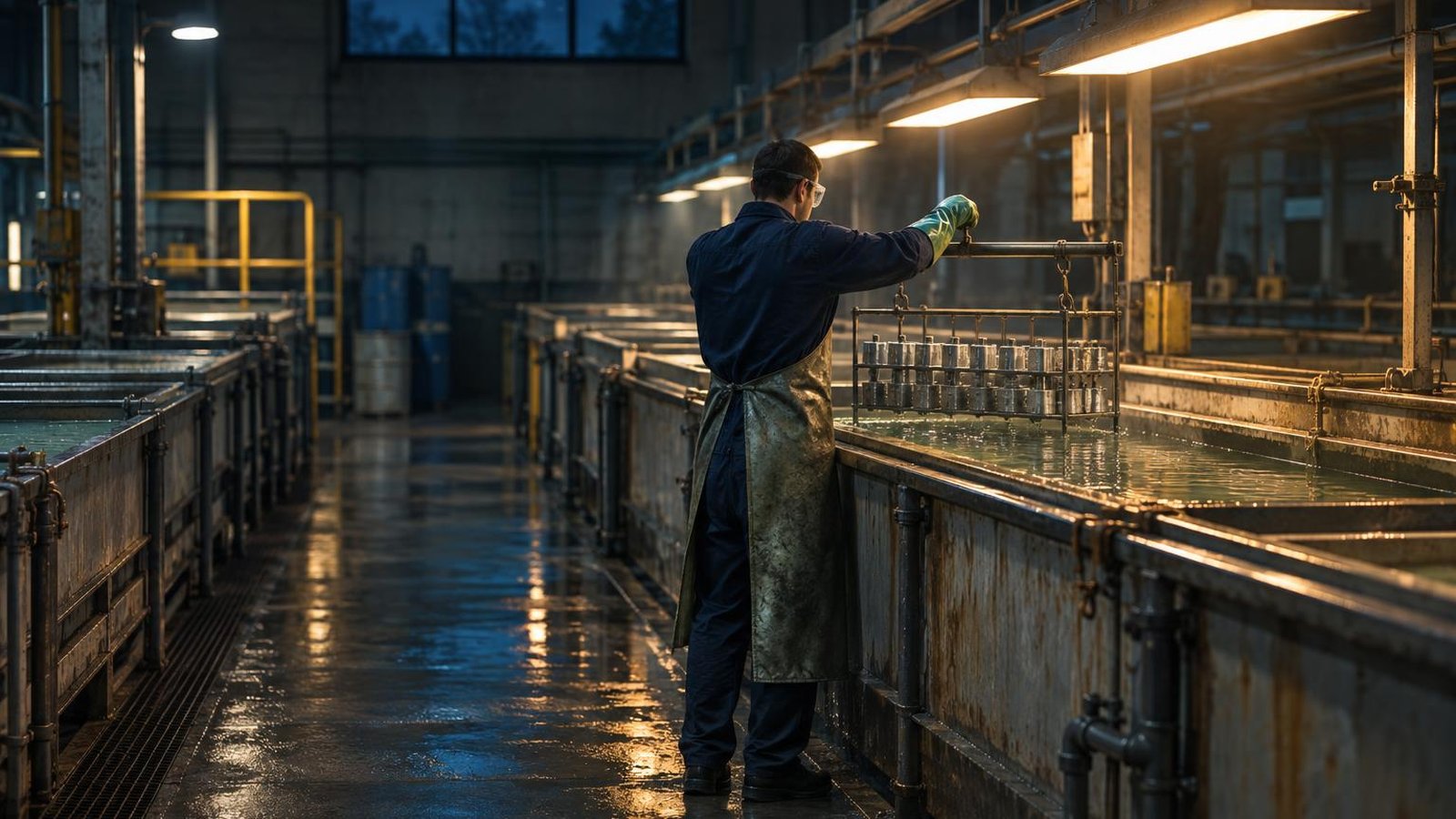
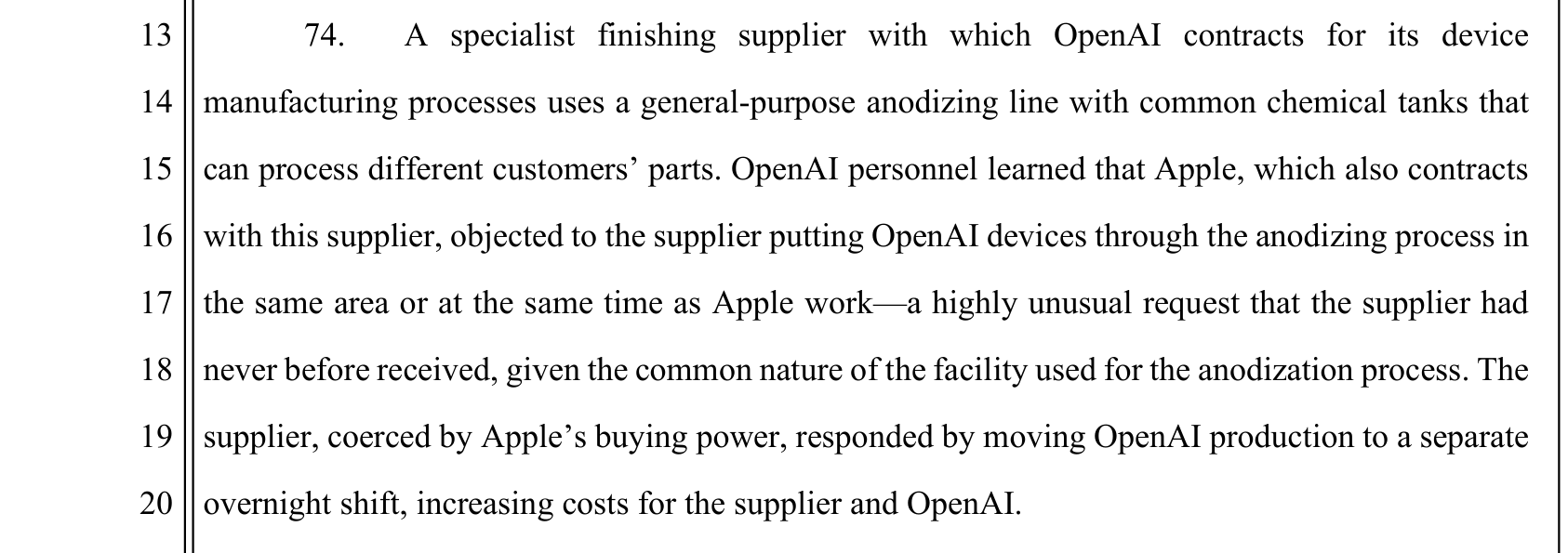
The first of two examples is a finishing company whose anodizing line handles both Apple and OpenAI work. Anodizing is an electrochemical treatment that hardens and colors the surface of aluminum parts such as device casings.
OpenAI says its staff learned that Apple objected to OpenAI devices going through the line in the same area or at the same time as Apple work. OpenAI calls that “a highly unusual request.” The supplier moved OpenAI production to a separate overnight shift, raising costs for itself and for OpenAI, the filing says.
The second example is a manufacturer OpenAI calls a key supplier. According to the filing, its representative said it “could no longer undertake the planned work with OpenAI because of threats from Apple.” OpenAI says the loss required it to significantly revamp its operations, staffing and contracting.
OpenAI says it is not challenging “lawful dedicated-capacity contracts or necessary confidentiality safeguards.” Such contracts reserve a supplier’s output for one customer.
OpenAI’s iCloud argument
The filing opens by saying Apple’s recruits were “joining Hotel California: ‘you can check out any time you like, but you can never leave.'” OpenAI says 400 Apple employees have left for OpenAI so far and that Apple “wants to scare the next 400 away.”
OpenAI says Apple “encourages and incentivizes its employees to store Apple work files in their personal iCloud accounts.” Staff leaving for OpenAI are escorted out the day they give notice, it says, with no time to separate work and personal files.
In OpenAI’s telling, a former employee who keeps those files risks a theft accusation. One who deletes them risks an accusation of spoliation, the destruction of evidence. The filing says Apple offered Tan free extra personal iCloud storage if he linked that account to his work devices. The second engineer says Apple and a forensic contractor reviewed his personal messages, including some sent after he left Apple.
Twelve claims and no dollar figure
Of the twelve legal claims, OpenAI Group PBC and io Products bring four, including a federal trade-secret claim and a California claim of interference with supplier contracts. The second engineer brings five, including invasion of privacy. Tan brings three, mainly over the Intellectual Property Agreement Apple invokes against him.
The counterclaims seek compensatory damages “in an amount to be proven at trial,” plus interest and attorneys’ fees, but name no dollar amount. They also ask for court declarations, injunctions and restitution, the return of money gained unfairly. The filing demands a jury trial.
Where the filing hedges
The dates, file names and contract clauses about Employee X are stated without the “on information and belief” caveat. That caveat covers the July briefing at Apple, the demands by Apple’s supply-chain staff, the shift of orders away from suppliers, and Apple’s acquisition and use of the files. The filing names neither supplier, does not identify Employee X and gives no product name or launch date.
In an October 14 court filing, OpenAI had said Employee X sent “over a hundred highly confidential files” to his personal accounts. Friday’s filing says “dozens of OpenAI documents.”
Apple did not immediately respond to CNN’s request for comment, and Engadget reported it had yet to comment. No Apple statement or new filing had appeared at the time of writing. OpenAI declined to comment beyond the filing, CNN reported.
What it means
Each company now accuses the other of obtaining device secrets through people who changed employers. When Apple sued in July, its case mainly targeted two former employees. The counterclaims extend the fight to the factories both companies depend on.
By OpenAI’s account, a newcomer with one or two qualified suppliers for many functions has little leverage when a far larger customer objects. Apple’s role in both supplier examples rests on what OpenAI’s staff learned or were told.
In the iCloud argument, work files kept in personal accounts become evidence for both sides. OpenAI calls Apple’s practice “highly atypical and not industry-standard.” It also says Apple relies in this case on private messages obtained from the second engineer’s personal account.
Already a defendant in lawsuits from California over its AI agents and from Texas, which also names Sam Altman, OpenAI is now an accuser in the Apple case.
Two steps come next: Apple’s reply to the counterclaims, not yet filed, and the court’s handling of OpenAI’s discovery requests about Employee X. The docket, the court’s official case record, sets a final pretrial conference for June 28, 2027. 9to5Mac reports that trial is set for July 19, 2027.
Sources
- Defendants’ Counterclaims and Answer, No. 5:26-cv-07078-EJD (ECF 217), US District Court for the Northern District of California, November 27, 2026
- Docket, case 5:26-cv-07078, CourtListener, November 27, 2026
- Exhibit 2, Letter dated Oct. 12, 2026 (ECF 177-2), Apple’s counsel, filed in the US District Court for the Northern District of California, October 14, 2026
- Response re Supplemental Brief (ECF 177), Apple Inc., filed in the US District Court for the Northern District of California, October 14, 2026
- Supplemental Brief re Joint Case Management Statement (ECF 176), OpenAI defendants, filed in the US District Court for the Northern District of California, October 14, 2026
- OpenAI countersues Apple, alleging trade secret theft and supplier threats, 9to5Mac, November 27, 2026
- OpenAI countersues Apple in ongoing trade secrets fight, CNN, November 27, 2026
- OpenAI countersues Apple and accuses it of stealing trade secrets, Engadget, November 27, 2026