

Since July 22, 2026, Google has shown AI Overviews in France (Aperçus IA in French), summaries written by its AI on the results page, and has offered AI Mode (Mode IA), a conversational search. Both answer the question on Google’s own page, then link to a handful of sites. For a business website, the stakes come down to clicks: how many searches end at Google’s answer, and how many visitors still arrive through the cited links.
This guide brings together the rules Google has published, the studies that measure the effect on clicks, a method for reading the effect on your own pages, and our own survey of French searches that trigger an AI Overview, dated October 10, 2026, and repeated every month on the same queries. The dated facts were checked on October 10, 2026.
AI Overviews and AI Mode are two separate features
An AI Overview is a block of generated text inserted into the usual results page, along with links to the pages used to write it. It doesn’t appear on every search: in its announcement of July 22, 2026, Google France wrote that these overviews “only appear when our systems determine that an AI-optimized answer is helpful.”
AI Mode works like a conversation. You ask a question by typing, by voice or with an image, then ask follow-up questions, and the answer builds up over the exchange. Google says it runs on Gemini 3.5 and that an AI Mode search is on average three times longer than a traditional search.
The two features don’t always give the same answers. Google’s documentation for site owners states that they may use different models and techniques, and so cite different links for the same question.
Launch dates in France and Belgium
Google started rolling out AI Overviews worldwide in May 2024. Belgium got them in May 2025: RTBF reported them available on May 21, 2025, for users aged 18 and over. France followed more than a year later, on July 22, 2026, on mobile, on desktop and in the Google app.
The tools for site owners followed their own timeline. On June 3, 2026, Google announced a setting and reports in Search Console, first tested with a share of UK sites. On July 22, Google France announced the setting was available in France, and since August 31, 2026, the setting and the report have been available to every site worldwide.
How cited pages are chosen
Google describes these answers as “grounded” in its index. According to its optimization guide for generative AI features, updated on July 10, 2026, the model relies on the usual search ranking systems to find relevant, recent pages, writes its answer, then links to the pages that support it.
Three conditions are enough to be eligible. The page has to be indexed, it has to be able to appear in results with a snippet, and the site has to be included in the Search Console setting for generative AI (set to “Include” by default, or to inherit from the parent property when a broader property covers yours). There is no other technical requirement, and an eligible page has no guarantee of being cited.
Query fan-out
Before writing, the system runs several related searches in parallel, which Google calls “query fan-out.” Its example: for “how to fix a lawn overrun with weeds,” it also searches its index for the best lawn weed killers, weeding without chemicals and weed prevention.
What this means for you is that a page can be cited because it answers a sub-question well, even if it doesn’t rank for the main query. Across 100,000 French queries collected on August 7 and 8, 2026, SE Ranking found that 60.46% of the pages cited in AI Overviews were among the top ten traditional results for the query. The other cited pages were not. In the same survey, YouTube appeared in 51.31% of AI Overviews.
In the Seer Interactive study published on April 24, 2026, which covers queries for 53 brands without specifying their country, 95.4% of comparison queries and 85.9% of queries phrased as a question triggered an AI Overview.
Ideas Google says won’t help
Google’s optimization guide includes a list of things that are useless. Files meant for AI, such as llms.txt, special markup or Markdown versions of pages: Google Search doesn’t use them, and having them neither hurts nor improves your visibility. Breaking text into small chunks isn’t necessary either; Google writes that there is no ideal page length. Structured data is still useful for rich results, but no particular schema.org markup is required for generated answers. Markdown versions and llms.txt are mainly useful for AI agents that read a site on a customer’s behalf: see our guide to an agent-ready website.
The same guide warns against a temptation: creating a page for every variant of a question that query fan-out could produce. When it’s done to manipulate results, this practice violates Google’s policy on scaled content abuse. Our article on Google penalties and AI content explains what exposes a site to a manual action.
How many clicks do AI Overviews take away?
The published figures disagree because they don’t measure the same thing.
Pew Research Center tracked the browsing of 900 American adults in March 2025, covering 68,879 Google searches. When an AI summary appeared, users clicked on a traditional result in 8% of visits, compared with 15% without a summary. They clicked on a link inside the summary itself in 1% of cases, and ended their browsing on 26% of pages with a summary, compared with 16% without one.
Seer Interactive measures organic click-through rate across 5.47 million tracked queries for 53 brands, from January 2025 to February 2026. On queries with an AI Overview, that rate fell to 1.3% in December 2025 before climbing back to 2.4% in February 2026, while it reached 3.8% without an AI Overview. A brand cited in the AI Overview got 120% more clicks per impression than a brand that was absent, while still sitting 38% below the level of informational queries without an AI Overview. The authors point out that these are correlations.
Google offers a different reading. In a post dated August 6, 2025, Liz Reid, head of Google Search, said the total volume of organic clicks to websites had remained “relatively stable” year over year. She added that Google sends slightly more “quality clicks,” the ones after which the user doesn’t immediately return to Google. The same post acknowledges that these changes lower traffic for some sites and raise it for others.
For France, SE Ranking found that 52.63% of the 100,000 queries collected on August 7 and 8, 2026, triggered an AI Overview, with wide gaps between sectors (the details are in the survey below). In the first month after their March 2025 launch, SE Ranking had measured 27.86% in Germany, 33.23% in Spain and 26.56% in the Netherlands: France started at nearly double the rate of Germany and the Netherlands. Longer queries triggered more of them: 71.32% for nine-word queries, compared with 49.48% for a single word.
These averages tell you nothing about your own site, and Seer itself concludes that your own data should drive decisions.
Measuring the effect on your site
The generative AI performance report
This Search Console report covers AI Overviews and AI Mode. According to its help page, it has been rolled out to all sites since August 31, 2026. It counts impressions, meaning the number of times a user saw links to your site in a generated answer, and breaks them down by page, country, date and device. The help page doesn’t mention clicks, click-through rate or position. On the Microsoft side, the AI Performance report in Bing Webmaster Tools counts citations of your site in Copilot.
Two details change how you read it. If two links to your site appear in the same answer, the chart total counts only one impression. And all dates follow Pacific time, nine hours behind France for most of the year. If the report doesn’t appear for your property, Google gives two possible causes: too few impressions in these features, or a site excluded by the setting.
It shows you which pages of your site appear in these answers, and in which countries: for a Belgian business that also sells in France, the Countries tab separates the two markets.
Clicks mixed in with the rest of Google traffic
Clicks from an AI Overview or AI Mode are counted, but without a label of their own. Google’s documentation says they appear in the Performance report under the “Web” search type, mixed with clicks from traditional results.
In Google Analytics, these visits should show up as Google organic traffic. In May 2025, links from AI Mode in the United States carried an attribute that made them look like direct visits. Search Engine Journal reported on May 28, 2025, that the bug had been fixed, as noticed by consultant Aleyda Solis among others. To check this on your own site, click a link to your site from an AI Mode answer yourself and check the source assigned to that visit. Some visits from ChatGPT, Copilot or Perplexity have had their own channel since May 2026: see our guide to AI traffic in Google Analytics.
The same-position click-through rate method
Since the clicks aren’t separated, you read the effect indirectly. On a query where your position hasn’t moved and the number of searches hasn’t changed, a drop in click-through rate signals that something above your link is catching people’s attention. The method fits in a spreadsheet.
- In the Search Console Performance report, filter on France as the country and export queries with clicks, impressions, click-through rate and position, for two periods of the same length with the same days of the week: four weeks before July 22, 2026, then four recent weeks.
- Keep the queries whose average position moved by less than half a position between the two periods, and that have enough impressions for the click-through rate to mean something.
- Sort them by type: product or service name alone, question, comparison, query with a price, local query, your brand name.
- Compare each group’s click-through rate between the two periods.
- Adjust for seasonality. Do the same calculation for the same weeks of the previous year and divide the 2026 change by the change from the year before.
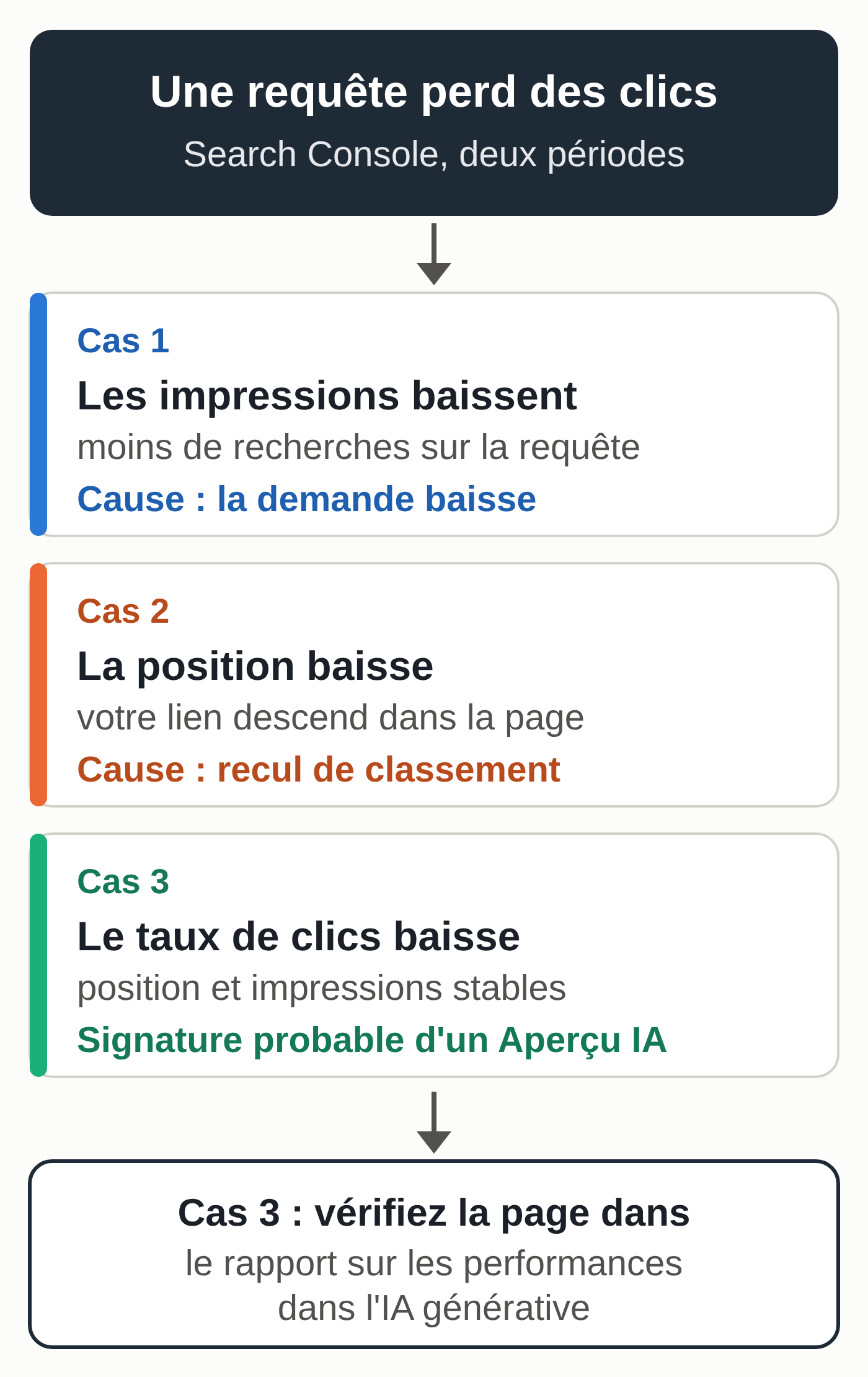
- Read the gaps group by group. Falling impressions point to falling demand, a falling position points to a ranking drop, and a falling click-through rate with stable position and impressions is the likely signature of an AI Overview, or of another Google block added above your link.
There is a trap waiting at step 5. On its data anomalies page, Google reports a logging error that distorted impressions, click-through rate and average position from May 13, 2025, to April 27, 2026. Clicks were not affected.
For the seasonal adjustment, run the calculation on clicks, in 2026 as in 2025, instead of on rates. Another option, which avoids the 2025 data: compare against a market where AI Overviews already existed before July, over the same weeks of 2026, such as Belgium for a French-language site.
On our main site, a French-language recipe site, this method showed nothing in August 2026. A gap appeared in September, concentrated on queries made up of a dish name alone, while searches containing the word “recette” (recipe) moved much less. Your own breakdown by query type will tell you where your exposure lies.
Our monthly survey of AI Overviews in France
This survey tracks the same list of French queries every month, chosen from the questions that a small business’s customers ask.
The method: 33 queries across 11 sectors, run on Google with a location in France and the French language, on desktop, with 10 of them also run on mobile (Android), through the API of a search results data provider. For each query, we record whether an AI Overview appears, how many pages it cites and whether it cites at least one .fr site. Each query is collected once per device: Google can show a different page from one search to the next, and a one-off survey remains a snapshot.
Survey carried out and checked on October 10, 2026.
| Query typed into Google (France, French), with English meaning | Sector | AI Overview on desktop | Pages cited | At least one .fr site cited | AI Overview on mobile |
|---|---|---|---|---|---|
| comment créer une micro-entreprise (how to set up a sole proprietorship) | Starting and running a business | Yes | 9 | Yes | Yes |
| sasu ou eurl (two French single-owner company types) | Starting and running a business | Yes | 12 | Yes | not checked |
| comment faire une facture (how to make an invoice) | Starting and running a business | Yes | 9 | Yes | not checked |
| symptômes carence en fer (iron deficiency symptoms) | Health | Yes | 11 | Yes | Yes |
| ostéopathe ou kiné pour mal de dos (osteopath or physical therapist for back pain) | Health | Yes | 6 | Yes | not checked |
| comment soigner une tendinite (how to treat tendinitis) | Health | Yes | 7 | Yes | not checked |
| assurance habitation obligatoire locataire (is renters insurance mandatory) | Insurance | Yes | 10 | Yes | not checked |
| meilleure assurance auto jeune conducteur (best car insurance for young drivers) | Insurance | Yes | 8 | Yes | Yes |
| rc pro obligatoire auto-entrepreneur (is liability insurance mandatory for the self-employed) | Insurance | Yes | 6 | Yes | not checked |
| livret a ou assurance vie (savings account or life insurance) | Banking and personal finance | Yes | 8 | Yes | not checked |
| comment calculer ses impôts sur le revenu (how to calculate income tax) | Banking and personal finance | Yes | 5 | Yes | Yes |
| banque en ligne pour professionnel (online bank for business) | Banking and personal finance | Yes | 7 | Yes | not checked |
| préavis de démission cdi (notice period when resigning from a permanent job) | Employment law and paperwork | Yes | 8 | Yes | Yes |
| délai rupture conventionnelle (timeline for a negotiated termination) | Employment law and paperwork | Yes | 7 | Yes | not checked |
| comment contester une amende (how to contest a fine) | Employment law and paperwork | Yes | 7 | Yes | not checked |
| calcul frais de notaire (notary fee calculator) | Real estate | Yes | 8 | Yes | not checked |
| diagnostic immobilier obligatoire vente (mandatory inspections when selling a home) | Real estate | Yes | 9 | Yes | Yes |
| comment négocier le prix d’un appartement (how to negotiate an apartment price) | Real estate | Yes | 8 | Yes | not checked |
| meilleur aspirateur robot (best robot vacuum) | Online shopping | Yes | 6 | Yes | No |
| vélo électrique pas cher (cheap e-bike) | Online shopping | No | n/a | n/a | not checked |
| chaussures running homme (men’s running shoes) | Online shopping | No | n/a | n/a | not checked |
| recette pâte à crêpes (crepe batter recipe) | Cooking and food | No | n/a | n/a | Yes |
| temps de cuisson oeuf dur (hard-boiled egg cooking time) | Cooking and food | Yes | 7 | Yes | not checked |
| quiche lorraine | Cooking and food | No | n/a | n/a | not checked |
| que faire à lyon en un week-end (what to do in Lyon for a weekend) | Travel and tourism | No | n/a | n/a | Yes |
| meilleure période pour visiter le portugal (best time to visit Portugal) | Travel and tourism | Yes | 4 | Yes | not checked |
| hôtel pas cher paris (cheap hotel Paris) | Travel and tourism | No | n/a | n/a | not checked |
| plombier lyon (plumber Lyon) | Local trades and shops | No | n/a | n/a | not checked |
| prix pose carrelage m2 (tile installation price per m2) | Local trades and shops | Yes | 7 | Yes | Yes |
| restaurant italien bordeaux (Italian restaurant Bordeaux) | Local trades and shops | No | n/a | n/a | not checked |
| comment référencer son site sur google (how to get your site on Google) | Digital and SEO | Yes | 9 | Yes | not checked |
| c’est quoi le seo (what is SEO) | Digital and SEO | Yes | 13 | Yes | not checked |
| chatgpt ou claude (ChatGPT or Claude) | Digital and SEO | Yes | 13 | Yes | not checked |
On desktop, 25 of the 33 queries showed an AI Overview. Every practical question about starting a business, health, insurance, money, employment law and real estate had one, as did the three queries about SEO and AI.
The eight queries without an AI Overview on desktop had one thing in common: Google was already showing its own block there, a map of businesses or places (plumber, restaurant, running shoes, weekend in Lyon), a hotel list, a recipe carousel or product listings. The reverse isn’t a rule: the question about how long to boil an egg had both a recipe carousel and an AI Overview.
Every AI Overview we recorded cited at least one .fr site, with a median of 8 cited pages (from 4 to 13). YouTube was among the sources in 18 of the 25 AI Overviews, and a gouv.fr government site in 11 of them.
Of the ten queries also checked on mobile, three gave a different result from desktop. The crepe batter and the Lyon weekend had an AI Overview on mobile only (lower down the page for the crepes), and the robot vacuum on desktop only.
Sector context from SE Ranking
To put this survey in context, here are the rates SE Ranking published for the ten topics for which the study gives a figure, based on 5,000 queries per topic collected on August 7 and 8, 2026. The topics and queries are not the same as ours, and the two measurements are two months apart.
| Topic (SE Ranking study) | Queries with an AI Overview, August 7 and 8, 2026 |
|---|---|
| Business | 87.1% |
| Relationships | 86.04% |
| Insurance | 73.62% |
| Health | 71.02% |
| Sports and fitness | 70.12% |
| Education | 63.86% |
| Finance | 63.66% |
| E-commerce and retail | 33.58% |
| Fashion and beauty | 20.28% |
| Food and beverages | 20% |
Both measurements point the same way: informational questions about business, money, health and insurance are the most exposed, while searches for products, recipes and places are less so.
Eight actions for a small business
- Check that your important pages are eligible: indexed (see our guide to indexing), able to show with a snippet, with no
nosnippettag (the one that stops Google from showing a snippet) added by mistake, and with the Search Console setting on “Include.” - Open the generative AI performance report and write down the cited pages and the countries involved.
- Apply the same-position click-through rate method to spot the query groups that are losing clicks.
- On the pages in those groups, add what a summary can’t replace: your prices, your photos, your figures, examples from your own work, a reasoned opinion, a calculator. Google asks for content that is “non-commodity” and brings its own point of view.
- Answer the sub-questions of your topic on the same page, under clear subheadings, instead of creating one page per variant.
- Keep your Google Business Profile up to date and, if you sell online, your Merchant Center account (Google’s tool for product listings): Google lists them among the best practices for appearing in these answers.
- Keep structured data that matches the visible text of the page, for rich results. To describe the business itself, our guide to entity SEO includes an Organization markup generator.
- Measure again every month, on the same queries, and compare with the survey above. To track ChatGPT or Perplexity as well, see our comparison of AI visibility tools.
When it’s better to change nothing
A page whose clicks are holding up doesn’t need to be rewritten for AI. Google says so in its guide: no particular way of writing is required for generated answers.
In our survey, eight of the nine searches where Google showed its own block on desktop (a map of businesses or places, hotels, recipes, product listings) had no AI Overview. In August 2026, SE Ranking measured the lowest rates for e-commerce, fashion and food. A tradesperson’s listing or a product page that works should therefore keep getting attention for traditional search and the Business Profile.
Finally, be wary of “AI SEO” services sold on the sole promise of a citation. An llms.txt file changes nothing at Google, and Google writes that no third-party tool has access to its internal ranking or AI systems.
Excluding your site from generated answers
The setting is in Search Console, under Settings, then “Generative AI in Search.” According to its help page, it offers three options: include your site’s links and content (the default), exclude them, or inherit the setting of the parent property, meaning a broader Search Console property that covers yours (the default when one exists). It covers AI Overviews, AI Mode and the generative AI features in Google Discover.
Excluding your site has specific effects: your content no longer appears in these answers, is no longer used to write them, and you no longer get any impressions or clicks from these features. The exclusion usually takes one to two days, sometimes longer because of caching.
Google states that this setting isn’t used as a ranking signal elsewhere in Search and has no effect on model training (that is the job of Google-Extended, covered in our article on AI crawlers and robots.txt). Content from other sites remains available in these answers, including content that resembles yours.
For most businesses, exclusion removes a link from the answer without any guarantee that the user will then scroll down to your traditional result. It mainly makes sense when you don’t want your text used to write an answer, for example for paid or licensed content.
Tracking over the coming months
The survey on this page will be repeated every month with the same queries, and each update will carry its date.
If your site exists in several languages, the effect has to be read language by language and country by country, since the share of searches with an AI Overview varies from one country to another. This per-language tracking is part of our multilingual SEO service.