On November 22, 2026, OpenAI chief scientist Jakub Pachocki published an internal score that tracks how the company’s models have improved since GPT-3.5, the model behind the first version of ChatGPT. He proposes that the major artificial intelligence (AI) labs adopt it too. They would all commit not to cross a shared threshold until the tools for monitoring AI systems catch up. His post on OpenAI’s website is titled “Perplexity and Intelligence.”
OpenAI CEO Sam Altman called it “the most important thing OpenAI has published in a while,” TechCrunch reports. The post also raises the possibility that AI research could suddenly speed up “as soon as 2027.”
Perplexity measures how well a model predicts the next word
Language models like the ones behind ChatGPT start with a training phase called pretraining. They read huge amounts of data and learn to guess the next word, or part of a word. Perplexity measures how good those guesses are, on average, on data the model did not see during training.
OpenAI reports log-perplexity, which is the logarithm of perplexity. Researchers also call it cross-entropy loss. For both numbers, lower is better: the model predicts more accurately. OpenAI measures it on an unpublished dataset built from its own internal software code, and has tracked it since GPT-3.5.
Pachocki reports numbers on this dataset because they are the ones OpenAI now relies on most to judge its progress. He argues that perplexity should stay a useful signal, while capability tests, which score what a model can do, quickly go out of date. He writes that the tests used for GPT-2 and GPT-3, two earlier OpenAI models, were largely saturated by the time GPT-4 came out: they had become too easy. And most of today’s tests would make little sense for those older models.
Log-perplexity has fallen from 0.99 to 0.73 since 2022
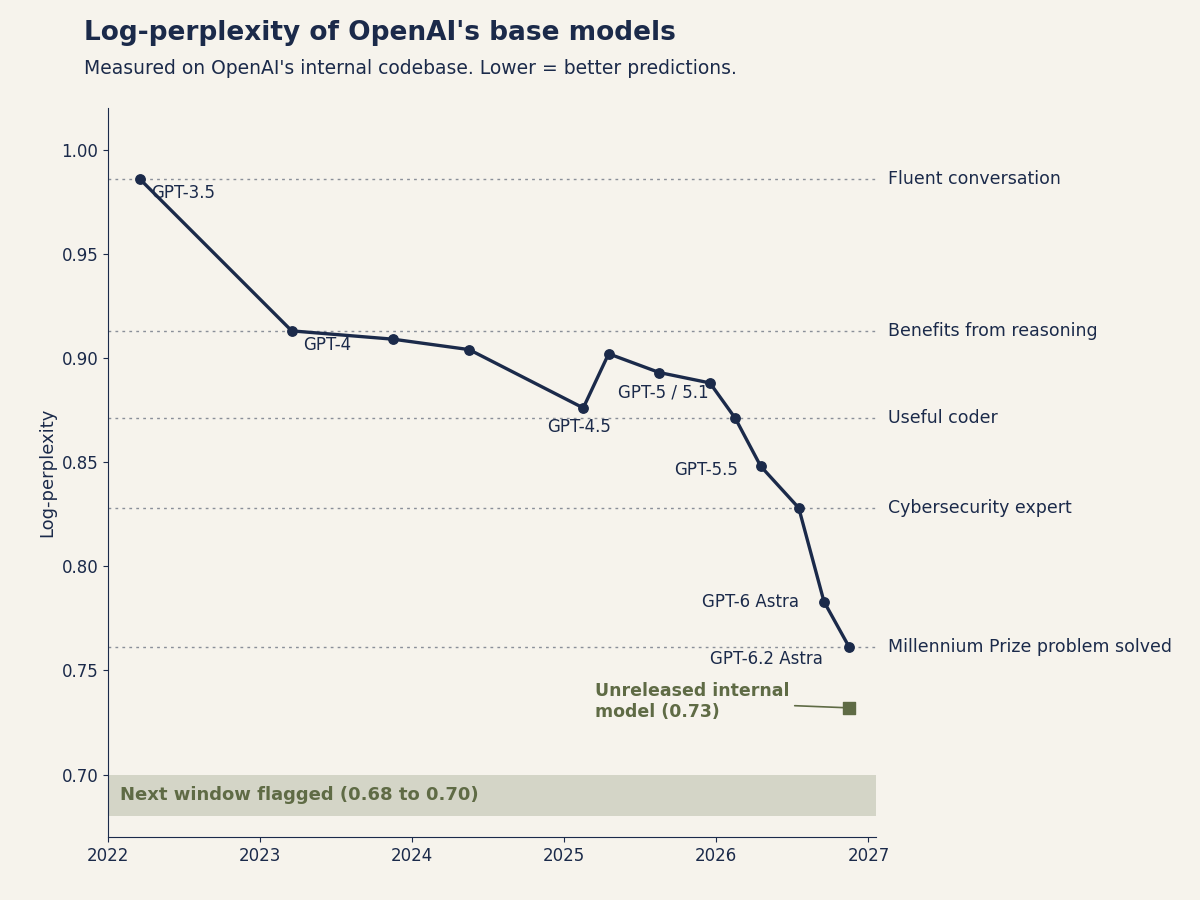
The post links several steps down the curve to new capabilities. GPT-3.5, at a log-perplexity of about 0.99, could hold a fluent conversation. GPT-4, at about 0.91, could make good use of step-by-step written reasoning, which led to the so-called reasoning models. Below 0.8, OpenAI says, “transformative” capabilities emerged in fields such as cybersecurity and mathematics.
The chart shows a slow decline from 2023 to 2025, then a sharp drop in 2026. It plots the score of OpenAI’s main released models and labels some points with a capability. In February 2026, GPT-5.3-Codex and GPT-5.4 score 0.871, labeled “useful coder.” In July, GPT-5.6 Sol drops to 0.828, labeled “cybersecurity expert.”
GPT-6 Astra falls below 0.8 in September, at 0.783. GPT-6.2 Astra, launched on November 17, scores 0.761, labeled “solved a Millennium Prize math problem.” The chart also shows an unreleased internal model at 0.732.
The Millennium Prize Problems are seven math problems that the Clay Mathematics Institute listed in 2000. On September 8, OpenAI claimed that an internal system had produced a solution to one of them. That was the Navier-Stokes problem, which concerns the equations that describe how fluids move.
In a footnote, OpenAI credits the sharp drop of 2026 mostly to long-term investments in research and computing power, and only in a smaller part to AI automating research. For its most recent models, the company says AI has already made “meaningful” contributions to their design.
An “avalanche” of progress as early as 2027
For more than a year, Pachocki’s team has been giving OpenAI’s models unsolved math problems. Major results started arriving once a model reached about 0.76, the level of GPT-6.2 Astra. They came “one after another in a single Slack thread,” that is, in one conversation on the team’s chat app. Pachocki calls the experience “deeply surreal.”
From that, Pachocki extrapolates that a shift just as sudden is “plausible” in research on deep learning, the technique these models are built on. “As soon as 2027 we could conceivably see a similar avalanche of fundamental pretraining advancements,” he writes. He adds that AI will also help monitor models and align them, so that they act as their designers intend. But in his view, progress on monitoring and alignment is unlikely to be fast enough to let pretraining speed up as much as it could.
Pachocki expects “further transformative capabilities” once models reach a log-perplexity between 0.68 and 0.70. That range is lower, and so better, than the internal model’s 0.73. He does not know what those capabilities will be. “We may not be testing for them today,” he acknowledges.
He also expects today’s main methods for auditing models to work less well. Models, he says, will get better at noticing when they are being evaluated or trained.
Pachocki’s picture of AI speeding up AI research matches what Anthropic has said. On November 10, Anthropic, the OpenAI rival that makes the Claude assistant, said it had reached its alert threshold for AI that speeds up AI research.
Pachocki proposes a shared ceiling for every lab
The post first asks frontier labs, the companies building the most advanced AI models, to agree on shared rules for evaluating those models. The rules would also cover each lab’s safety case, the document in which a lab explains why a model is safe to use. Labs would test it with simulated attacks by the time each model is first used. The post also calls for shared standards on transparency.
Pachocki’s central proposal is “common limits” based on perplexity and other measurements. The first threshold would be measured the same way at every lab and would pave the way for successive limits. Labs would commit not to cross them until the ability to understand and monitor AI behavior reaches a concrete milestone.
One milestone he gives as an example is a successor to chain-of-thought monitors. These tools read the step-by-step reasoning a model writes out and look for problematic behavior.
Pachocki’s post also links to an earlier plan by Anthropic CEO Dario Amodei, “We Must Pace the Frontier.” Amodei published it on his personal website on September 12. The plan aims to slow how fast the most advanced models improve. Its first step was to place independent evaluators, such as METR, the group that audited Anthropic’s research, full-time inside each lab.
The second step was coordination among companies in democratic countries on “limits on the rate of unchecked AI progress.” Global coordination would follow. Amodei noted that some forms of coordination would be legally challenging and would require government support.
OpenAI had already described its own pacing four days earlier. In a post dated November 18, the company said it paces the development and release of its models, “including pausing internal training or holding back models like GPT-6.1 Astra when we need more time to meet our safety standards.”
Pachocki’s caveats and readers’ doubts
Pachocki himself lists four challenges. First, each lab measures perplexity on its own data and trains its models on different mixes of data. So a score from one lab cannot be compared directly with a score from another.
Second, perplexity is not directly tied to any useful task. It matters because lower perplexity can be expected to bring entirely new capabilities.
Third, it ignores progress made after pretraining. Step-by-step written reasoning, for example, greatly increases what a model can do without lowering its perplexity.
Fourth, OpenAI does not know how low perplexity can go. Near that floor, Pachocki writes, small drops in the score would mean larger leaps in intelligence.
The dataset behind the curve is still internal, and OpenAI itself chose the capability labels, such as “useful coder.” Pachocki also admits that it was “not at all clear a priori” that these capabilities would appear at these thresholds. And the post names no other lab ready to publish its own numbers.
On Hacker News, the discussion forum run by the US startup accelerator Y Combinator, the post passed 450 points and 300 comments overnight into November 23. Some commenters welcomed a simple metric amid the growing pile of capability tests. Others asked “perplexity on what?” and noted that OpenAI proposes a shared measure without publishing the data behind it. One commenter called the post an ad.
What it means
A frontier lab has published its internal progress curve, with model names and dates. OpenAI’s business customers can see how fast its models improved in 2026 on this measure. They also learn that an unreleased internal model already scores 0.73 against 0.76 for GPT-6.2 Astra, and lower is better. If shared limits are ever adopted, they would first affect the release schedule of upcoming models.
The curve is still OpenAI’s own, and OpenAI drew the link between thresholds and capabilities after the fact. The proposal binds no other lab. An agreement among rivals to cap development would also raise the legal questions Amodei flagged in September.
The European Union already uses a threshold to flag AI models that pose a “systemic risk.” It is based on the computing effort spent on training. Article 51 of the EU AI Act, the bloc’s law on artificial intelligence, sets it at 1025 floating-point operations. That unit counts a computer’s work, and 1025 is a 1 followed by 25 zeros.
A general-purpose AI model, meaning one able to perform a wide range of tasks, is presumed to have “high impact capabilities” if its training took more than that. The European Commission, the EU’s executive body, can change the threshold to keep up with progress in algorithms and hardware. A perplexity threshold, by contrast, would measure what training produced.
Several questions remain open. Will Anthropic, Google DeepMind (Google’s AI lab) and other labs publish comparable numbers on a shared dataset? Will OpenAI’s internal model at 0.73 be released, and with what safety case? And who would set the first numerical threshold, and who would enforce it?
Sources
- Perplexity and Intelligence, Jakub Pachocki, OpenAI, November 22, 2026
- Managing frontier AI risk: From training to deployment, OpenAI, November 18, 2026
- On the Navier-Stokes Millennium Prize Problem, OpenAI, September 8, 2026
- We Must Pace the Frontier, Dario Amodei, September 12, 2026
- OpenAI’s chief scientist has thoughts on how to limit AI development, Anthony Ha, TechCrunch, November 22, 2026
- “Perplexity and Intelligence” discussion, Hacker News, November 22, 2026
- Article 51 of the AI Act, European Commission (AI Act Service Desk), accessed November 23, 2026