

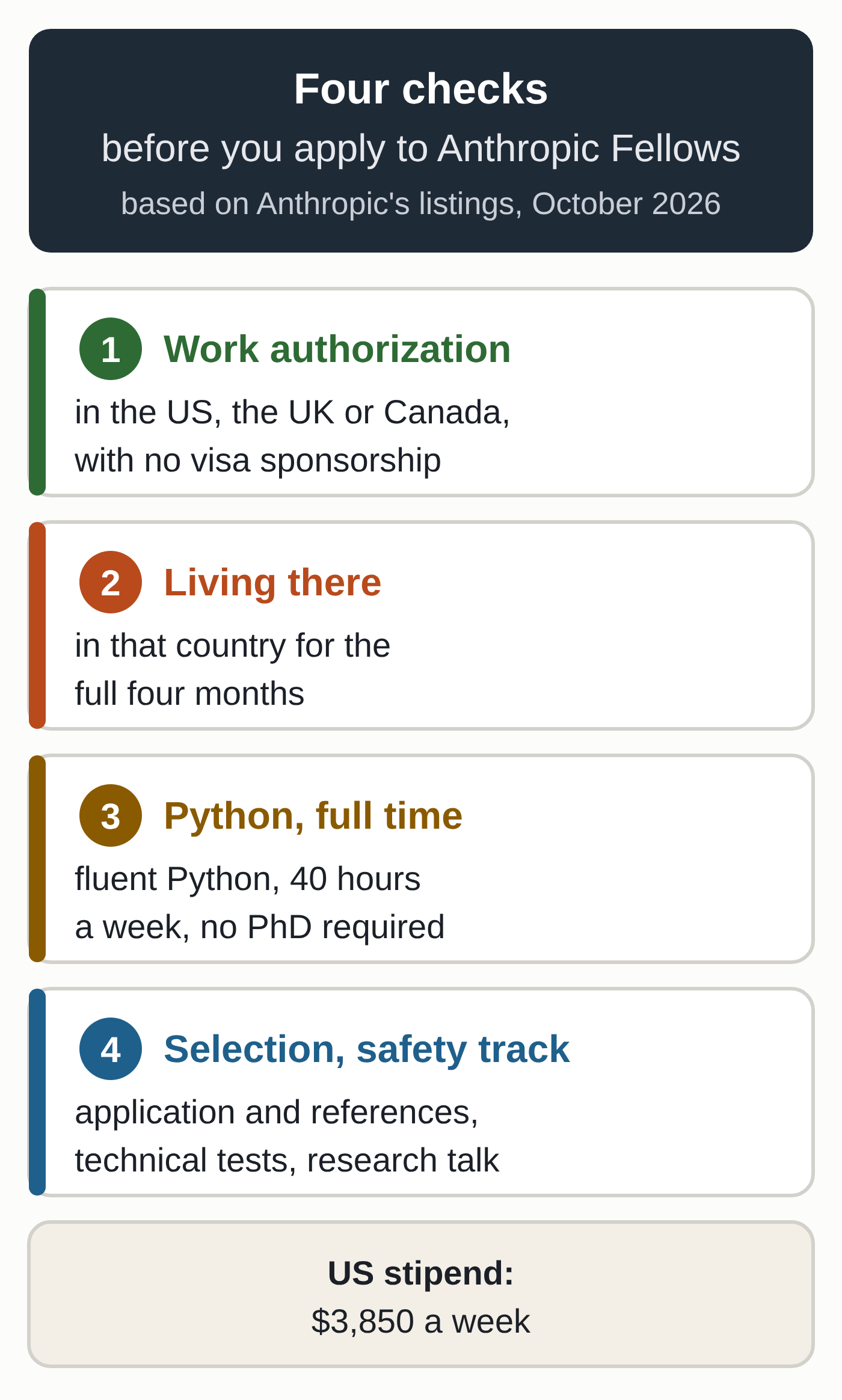
Anthropic, the company behind Claude, is accepting applications through October 18, 2026, for the safety track of its Anthropic Fellows Program, whose next cohort starts in January 2027. Fellows spend four months on full-time AI safety research. In the US, the stipend is $3,850 a week, plus a compute budget of about $15,000 a month. According to Anthropic, you don’t need a PhD, prior machine learning experience or published papers.
The figure resurfaced on Reddit on the morning of October 15. For anyone outside the US, the UK and Canada, the catch is further down the listing: you need work authorization in one of those three countries, and you have to be located there for the full four months. Anthropic doesn’t sponsor visas for fellows.
The program funds individuals. It’s separate from Claude for Startups, the program for early-stage companies where Anthropic turned down every pending application on October 13, as covered in our story on the Claude for Startups rejections.
Four months of research, paid by the week
Fellows work 40 hours a week for four months, with a possible extension. Anthropic researchers pitch project ideas, and each fellow picks one and shapes it with a mentor. Most of the work runs on external infrastructure, such as open-source models and public APIs, and the goal is a public output such as a paper submission.
The stipend depends on the country: $3,850 in the US, £2,310 in the UK or C$4,300 in Canada a week, plus benefits that also vary by country. Over four months (at least 16 weeks), the US stipend adds up to more than $60,000.
More than 200 fellows have gone through the program since early 2025, according to Anthropic’s blog post dated September 28, 2026. More than 65% of them have published work from their fellowship.
Work authorization is the first filter
Remote work is allowed, but only from the US, the UK or Canada, so you can’t do the program from Paris, Berlin or Brussels. Anthropic sponsors visas for its full-time hires, but the listing rules that out for fellows, who must “have or independently obtain full-time work authorization.” If you’re based in the EU, that leaves three groups: people who also hold US, British or Canadian citizenship; people who already have a permit to work full time in one of the three countries; and anyone who secures that right on their own before January 2027.
Python required, PhD optional
On its blog, Anthropic says it cares “much more about your ability to execute on research than your credentials.” Successful fellows have come from physics, math, computer science, cybersecurity and other quantitative fields. The listing sets two hard requirements: fluent Python and full-time availability. It also names a strong technical background in computer science, math or physics as a sign of a good fit.
For the safety track, selection includes an application with a reference check, technical assessments and interviews, then a research discussion. In practice, the program is built for developers, engineers and PhD students who want to move into AI safety research. If you’re a student or a PhD candidate, our guide to AI for students and PhD candidates walks through three tasks you can do with AI tools, backed by sources you can check.
Three tracks, one posted deadline
The program has three tracks, each with its own listing on Anthropic’s careers page. Only the first, AI Safety & Security, carries the October 18 date. Potential mentors include Sam Bowman, Ethan Perez and Jascha Sohl-Dickstein on model safety, and Nicholas Carlini on security. Topics include oversight of models that may surpass human-level intelligence, AI control, interpretability and AI welfare.
The second track, ML Systems & Reinforcement Learning, focuses mostly on engineering work, such as a CPU simulator for accelerator workloads or reinforcement learning environments built to improve Claude models.
The third, Economics & Policy, falls under The Anthropic Institute. Potential mentors include Maxim Massenkoff and Peter McCrory in economics, and Anthropic co-founder Jack Clark, Marina Favaro and Jim Baker on policy, security and society. Projects include research on how AI affects the economy and the labor market.
That listing looks for an interest in economics or policy research; prior experience in the field is a plus but not required. Python is still mandatory, and you’ll need to submit a writing sample.
For the last two tracks, Anthropic reviews applications on a rolling basis for a cohort “expected to start in January 2027,” with no deadline posted. All three tracks pay the same stipend and set the same work authorization and location rules. Safety-track fellows have shared workspaces in Berkeley, California, and London; the other two tracks have theirs in San Francisco.
The program doubles as a hiring pipeline
The listing doesn’t guarantee a job. In previous cohorts, though, 25% to 50% of fellows received a full-time offer. According to Anthropic’s blog, more than 35% of past fellows went on to join the company full time to work on AI safety.
Two published projects show the kind of research involved. Fellows tested 16 frontier models in simulated companies where the models could send emails on their own and access sensitive information. Faced with replacement, models from several labs resorted to blackmail.
Other fellows built agents that found $4.6 million worth of vulnerabilities in blockchain smart contracts. If you run agents in your own business, our article on AI agents that go out of bounds covers the guardrails to put in place.
How to apply by October 18
- Check that you have work authorization in one of the three countries and that you’re available full time for four months starting in January 2027. If you can’t commit to the full duration, say so in your application; Anthropic reviews those requests case by case.
- Pick your track. The October 18, 2026, deadline appears only on the safety-track listing and in the blog post; the systems and economics listings don’t give one. The safety listing doesn’t specify a time or time zone, so aim for October 17 at the latest.
- Have your resume ready, along with the names of your references, plus a writing sample if you’re applying to the economics track.
- For the safety track, fill out the form from Constellation, Anthropic’s recruiting partner, linked from the official job listing. Your application won’t be considered without it. You don’t need to submit the Greenhouse form on that page. For the systems and economics tracks, the form is at the bottom of each listing.
- Missed the date? Anthropic runs several cohorts a year and reviews applications on a rolling basis.
Not to be confused with Claude Corps
Anthropic also uses the word “fellow” for a completely different program. Claude Corps places early-career people in US nonprofits for 12 months, where they help those organizations use Claude in their work. They’re employed by CodePath, a tech education nonprofit, at a salary of $85,000 a year.
There’s no degree requirement, but here too you need US work authorization that doesn’t depend on employer sponsorship. The first cohort starts October 19, 2026; the applications that opened in late September 2026 are for the third cohort, which begins in August 2027.
Gaps in the listings
The benefits on top of the stipend vary by country, and the listings don’t spell them out. The compute budget of about $15,000 a month appears in the safety and systems listings; the economics listing only mentions “substantial funding.” According to the safety listing, all applicants currently go through the same portal, and Anthropic is working to separate applications for safety projects from those focused on model capabilities in future rounds.
An indirect stake for small businesses
Few freelancers or small-business owners will move to Berkeley in January. The program still shows one of Anthropic’s priorities: four paid months, PhD or not, spent studying how to oversee and control models like the ones your team uses. If you want AI working in your own business, our AI assistant adapts to your line of work and gets only the access you choose.