
A federal judge in San Francisco ruled on November 6, 2026, that the core claims of a class action against Anthropic can move forward. Two subscribers to Claude, Anthropic’s AI assistant, brought the case on behalf of other affected customers. They say Anthropic sold its top-tier Claude Max plans on the promise of “5x or 20x more usage” than Pro, its basic paid plan. In their view, that multiple applied only within each five-hour session.
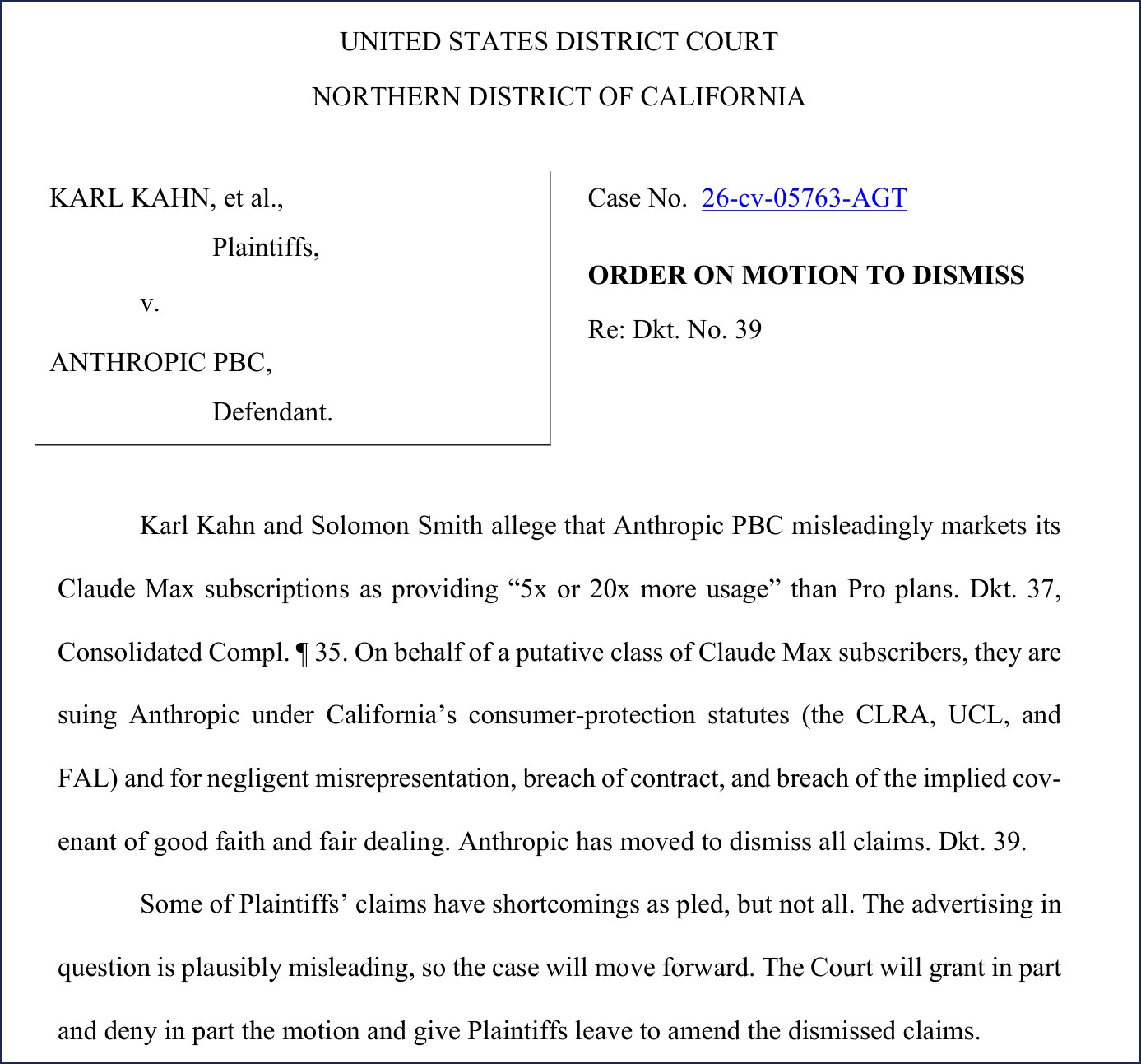
Anthropic had asked Judge Alex G. Tse, of the U.S. District Court for the Northern District of California, to dismiss the case. A motion to dismiss asks a court to end a lawsuit before trial. At this stage, the judge takes the plaintiffs’ account as true and only checks whether their claims hold up legally. In his 19-page order, Tse wrote that “the advertising in question is plausibly misleading, so the case will move forward.”
Three claims go forward: breach of contract, negligent misrepresentation (a false statement made carelessly) and a consumer protection claim. That one falls under California’s Consumers Legal Remedies Act (CLRA) and survives for only one of the two plaintiffs. The other claims were dismissed for now, and the plaintiffs can refile them by December 2, 2026.
The ruling came a week after Anthropic renamed both plans. On October 30, Max 5x became Max and Max 20x became Ultra (our story on Claude Ultra). The case covers the old Max 5x plan, at 100 dollars a month, and Max 20x, at 200 dollars, or about 90 and 180 euros at the European Central Bank rate of November 6.
A weekly cap far below the advertised multiple, plaintiffs say
Karl Kahn, a subscriber from Washington, D.C., filed the suit on June 14, 2026. Solomon Smith, a computer science student, filed his own complaint on July 27, and the two cases were combined in September. According to The Verge, their lawyers include Monica Vaca and Kati Daffan, who both previously worked at the Federal Trade Commission, the U.S. consumer protection agency.
The Max plans capped usage in two ways: per five-hour window, called a session, and per week. The complaint, which the order summarizes and takes as true at this stage, says Max subscribers did get 5 or 20 times Pro’s usage per session. Their weekly cap, it says, was not 5 or 20 times higher. Our guide to hitting the limit on Claude Pro explains how the two limits work.
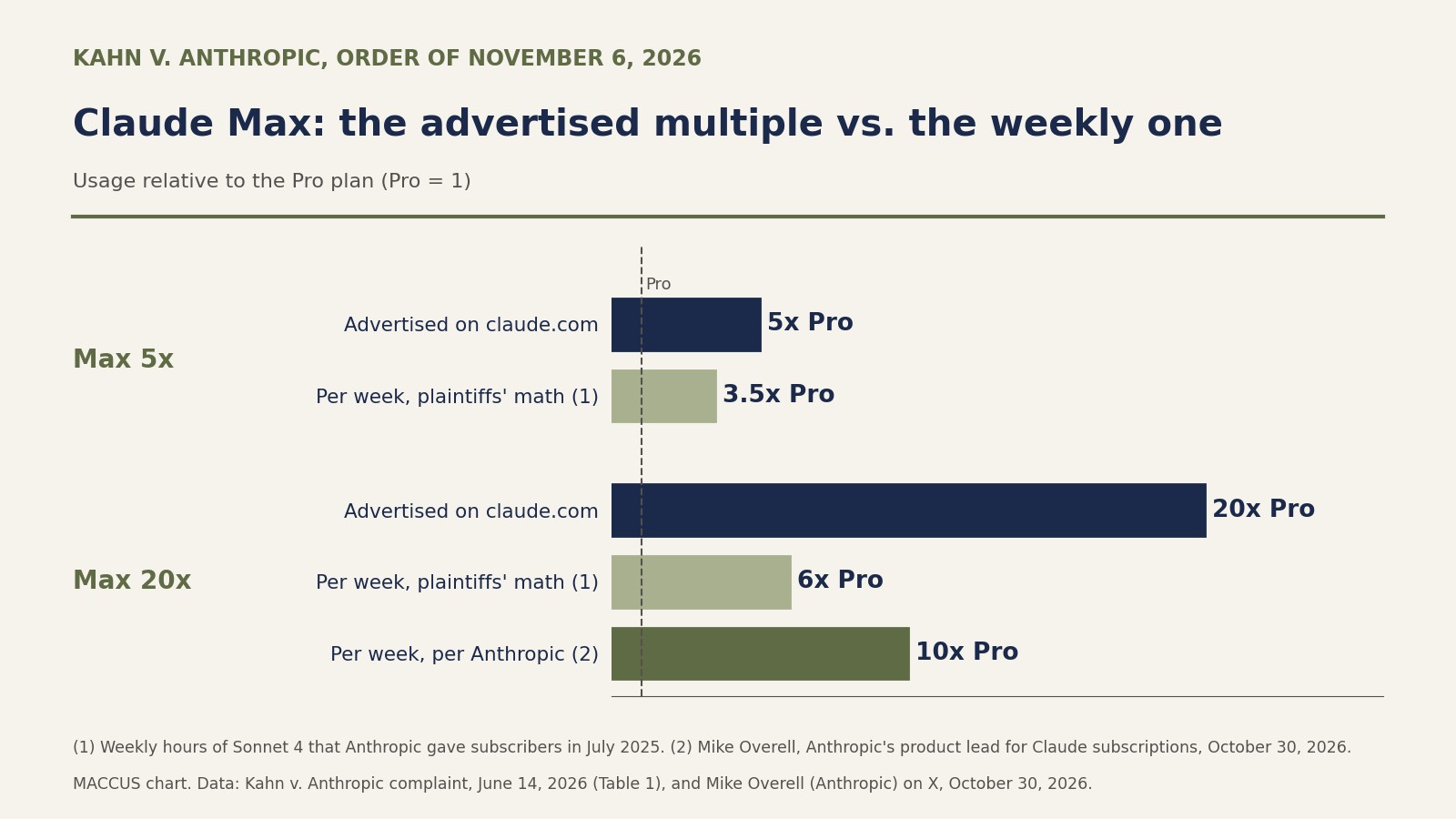
The plaintiffs measure the gap with the emails Anthropic sent around July 28, 2025, to announce the weekly limits. The emails gave figures for Sonnet 4, one of the AI models behind Claude. Anthropic said “most” users could expect 40 to 80 hours a week on Pro, 140 to 280 on Max 5x and 240 to 480 on Max 20x. By their math, Max 5x gave 3.5 times Pro’s weekly usage, and Max 20x gave 6 times for twice the price of Max 5x.
The order cites several surprised subscribers quoted in the complaint. “I am only on my third day of the week, and I have already used 50% of my weekly allowance on the 20x Max plan,” one wrote. Kahn says maxing out a single session could use up 15% of his weekly allowance.
A clarification two clicks from the sales page
Anthropic argues that customers should have understood the multiple to apply per session. On one of the main sales pages, as reproduced in the complaint, the words “more usage” were followed by an asterisk and the note “Usage limits apply.” That note linked to a tips page, where a second link led to the help page that finally spelled out “per session.”
The judge rejected that argument. “Anthropic’s per session disclosure is located two hyperlinks away from the primary sales pages on claude.com,” he wrote. According to the complaint, which the judge cites, that help page is outside the checkout process, so a customer can subscribe without ever opening it. The judge added that the asterisk note says nothing about sessions.
The judge adopted the plaintiffs’ comparison: the help page works like the label on the back of a shampoo bottle. At this stage, a court only looks at that back label if the front label, here the sales page, can’t be understood without it. Because the plan is billed monthly, he found, a reasonable customer could read “20x more usage” as 20 times more per month.
The claims that survived and those the plaintiffs can refile
The breach of contract and negligent misrepresentation claims both survive. Anthropic’s terms of service point to “the order process” to describe what a subscription includes. The judge therefore found that the sales pages customers click through to subscribe are plausibly part of the contract. The help page that explains sessions sits outside that process and plausibly is not.
The CLRA claim comes out differently for each plaintiff, because the law only protects purchases for personal use. The judge found that Claude Code, the coding tool included in the paid plans, can count as a “service” under that law. Smith keeps his claim: he uses Claude for coursework and for an IBM-sponsored hackathon, a coding competition. “Educational use is plainly not commercial use,” the judge agreed, quoting the plaintiffs’ written argument.
Kahn loses his CLRA claim for now. He says only that he uses Claude Code “to accomplish computer programming tasks,” without saying which ones. “He could be an entrepreneur who uses Claude Code to develop software for sale,” the judge wrote.
Claims under two other California laws, on unfair competition and false advertising, were dismissed. Those laws only allow restitution, meaning the return of money paid, or an injunction, a court order to stop the practice at issue. Because the plaintiffs are still subscribers who know how the limits work, the judge found they can’t seek an injunction for now. To get restitution, they had to explain why damages, meaning compensation for their losses, would not be enough, and they didn’t.
The judge also dismissed, for now, the claim that Anthropic tightened its limits in the middle of billing periods, since its terms allow that. Based on the plaintiffs’ own account, the company was trying to keep up with demand that outstripped its capacity. “Anthropic didn’t tighten usage limits as a bait-and-switch,” the judge wrote.
Anthropic’s defense and the October 30 rename
In its September 22 motion to dismiss, Anthropic said it “never promised a fixed total amount of usage or capacity.” The company argued that it promised 5 or 20 times Pro’s usage per session, while reserving the right to change total usage. It also noted that the plaintiffs did not claim to have received less than those multiples per session.
On October 30, Mike Overell, Anthropic’s product lead for Claude subscriptions, explained the rename on X without mentioning the lawsuit. When weekly limits were added, he said, Max 20x’s weekly limit was set at 10 times Pro’s and its five-hour limit stayed at 20 times. “I get that some new users assumed 20x applied to both limits. We could have done better here, and I’m sorry,” he wrote.
As of November 8, Claude’s pricing page describes Max as “5x Pro usage every 5 hours and every week” and Ultra as “10x Pro usage every week.” Courthouse News, which reported the ruling on November 6, said Anthropic and the plaintiffs didn’t immediately respond to its request for comment.
The limits of the ruling
Whether Anthropic actually misled its customers is still an open question. The order leaves it to the fact-finder, the judge or jury that weighs the evidence, if the case gets that far. The judge wrote that Anthropic’s help-page argument “may persuade the fact-finder” that the advertising is not misleading, “but it is not a basis for dismissal.”
The weekly multiples of 3.5 and 6 are the plaintiffs’ own math, and the court has not checked them. Overell’s “10 times Pro” figure is Anthropic’s own benchmark. He gave it in October 2026 without any number of hours or messages.
The original complaint seeks to represent individuals in the United States who have bought a Max 5x or Max 20x plan since April 9, 2025. The court has not yet certified that class, the step that lets a case proceed on behalf of the whole group.
What it means
The case concerns how every AI subscription presents its usage allowances. The judge gave more weight to the sales page, the one customers see before paying, than to the help pages that spell out the rules. He also accepted that sales pages can be part of the contract.
AI subscriptions have no common unit for the usage they sell: hours of Sonnet, multiples of Pro, five-hour windows. OpenAI, which makes ChatGPT and the coding assistant Codex, will soon count usage in tokens, the word fragments AI models process. The company is preparing a shared usage limit for ChatGPT and Codex that starts in December.
Claude’s pricing page now says “every 5 hours and every week” for Max, which makes the offer clearer for new subscribers. It says nothing about the subscriptions sold since April 2025.
The line between personal and business use also matters: for now, it has cost Kahn his CLRA claim. Under the order, the contract and misrepresentation claims do not depend on that distinction.
The plaintiffs have until December 2, 2026, to file a revised complaint. If they don’t, Anthropic must formally respond to the current complaint by December 16. The next question is whether Anthropic will defend its old sales pages or seek a settlement.
Sources
- Order on Motion to Dismiss, Kahn v. Anthropic PBC, 26-cv-05763-AGT, U.S. District Court for the Northern District of California, November 6, 2026
- Kahn v. Anthropic PBC, 3:26-cv-05763, docket, CourtListener, accessed November 8, 2026
- Class Action Complaint, Kahn v. Anthropic PBC, U.S. District Court for the Northern District of California, June 14, 2026
- Defendant Anthropic PBC’s Motion to Dismiss Plaintiffs’ Consolidated Complaint, Anthropic, September 22, 2026
- Anthropic must face claims its Claude Max pitch misled users, Courthouse News, November 6, 2026
- Mike Overell’s post on the Max plan rename, X, October 30, 2026
- Plans & pricing, Anthropic, accessed November 8, 2026
- AI power users claim Anthropic duped them with subscriptions, and they’re taking it to court, The Verge, September 8, 2026
Header image: MACCUS chart, data from the Kahn v. Anthropic complaint (June 14, 2026) and Mike Overell (Anthropic), October 30, 2026