French creators enrolled in YouTube Shopping, the platform’s affiliate program, can now feature products from Amazon, Cdiscount, Leroy Merlin and SharkNinja France in their videos. They earn a commission when a sale starts from one of their videos. The change took effect on Wednesday, November 4, 2026, YouTube said in a press release reported by the French trade publications e-marketing.fr and Influencia.
The program has been open in France since October 13. As of November 8, though, its overview page in YouTube Help does not list France among the countries where it is available. Another help page, about Amazon products, does. The overview page also promises creators 100% of merchant commissions “as we launch in your market,” without naming any country.
Amazon, Cdiscount, Leroy Merlin and SharkNinja join the catalog
YouTube has a worldwide partnership with Amazon, now extended to France. It announced on its blog on August 27, 2026, that Amazon was officially joining the program in the US. Eligible French creators can tag several thousand Amazon products, Influencia reports. Tagging a product means linking it to a video.
The other three merchants target the French market, each in its own category, according to e-marketing.fr. Cdiscount, a large French online retailer, brings consumer electronics and general merchandise. Leroy Merlin, a home improvement chain, covers home fittings, renovation and decor. SharkNinja France covers household appliances and personal care devices.
With Amazon, the four catalogs add up to millions of products, e-marketing.fr writes. Creators can tag them in all three of YouTube’s formats: long videos, Shorts (its short videos) and livestreams.
YouTube was presenting the rollout to industry professionals at Paris Creator Week on November 4 and 5, according to e-marketing.fr. The lineup included a panel with Travis Katz, YouTube’s general manager and vice president for shopping.
A product card in the video, checkout at the retailer
Once a product is tagged, a product card appears on screen. A viewer who taps it completes the order on the merchant’s website without stopping the video. If the sale is credited to the video, the creator earns a commission. YouTube’s press release, as reported by e-marketing.fr, says viewers used to hunt for affiliate links in the video description, which slowed purchases down.
This model differs from TikTok Shop, the store built into TikTok, where shoppers can complete a purchase without leaving the app, Influencia notes. In France, YouTube Shopping buyers pay on the seller’s site.
For merchants, the French rollout runs through Awin, an affiliate network that connects advertisers with creators and helps track sales, according to Influencia. None of the documents reviewed for this article describes a sign-up process for French online stores.
Google’s help pages for Merchant Center, the tool merchants use to list their products with Google, describe only one direct sign-up route. It runs through the Google & YouTube app for Shopify, a platform for building online stores. The route requires a Shopify Advanced or Plus plan and a Merchant Center account targeting the United States. Google says merchants pay only when a creator drives a purchase, and YouTube handles the rest: creator onboarding, affiliate links, sales tracking and billing.
Who can join and how creators get paid
To join YouTube Shopping, a channel must be in the YouTube Partner Program (YPP) and have reached that program’s subscriber threshold, according to YouTube Help. The YPP shares ad revenue with channels. On March 25, 2026, YouTube announced on its blog that it was opening affiliate access to YPP members with at least 500 subscribers who meet its eligibility guidelines. Music channels, Official Artist Channels (the official channels of music artists) and channels made for kids are excluded.
For each product, the brand or retailer sets the commission rate and the attribution window, the period during which a purchase is credited to the creator. Another help page explains that the rate in effect on the day of the purchase applies, even if it changed after the product was tagged.
The overview page says YouTube currently passes on 100% of the commissions from affiliate merchants to creators. Its stated reason: “To help you get started with your earnings as we launch in your market.” YouTube does not say which markets this covers. It calls the higher rate temporary, says it may be reduced, and promises to notify creators at least 30 days before the incentive ends.
Creators receive their commissions 60 to 120 days after the purchase, through AdSense for YouTube, the system YouTube uses to pay creators. Commissions are reversed if the customer returns the product. The overview page also bans sharing these affiliate links outside YouTube, for example on external websites or through automated redirects. Possible penalties include suspension of a channel’s affiliate features.
The overview page adds that YouTube’s branded content policies, which cover sponsored content, still apply. Influencia notes that paid promotion must be clearly disclosed, including promotion paid as a percentage of sales. Our guide to the legal framework for influencers in France and Belgium explains the disclosure labels required by France’s 2023 influencer law.
YouTube’s numbers and their limits
In an October 13 post on the Google France blog, YouTube said in-video product tags generate up to 110% more clicks than links in the description alone. It pointed to the US and the UK as evidence. It added that commissions paid to creators worldwide grew by more than 100% in a year. Yann Damongeot, director of YouTube Ads France, called the launch a great business opportunity for brands and creators.
YouTube also stresses that videos keep drawing views long after they go up. According to platform data cited by Influencia, 40% of a video’s views come more than a month after it is posted.
None of these figures comes with a method. YouTube gives no measurement dates, no number of channels and no commission total from before the 100% growth. The 110% figure is a ceiling, measured outside France. Influencia also notes that credited sales give an incomplete picture: a customer may have discovered the product elsewhere, or may come back later and buy without using the link.
Two help pages, two country lists
As of November 8, 2026, the overview page says the program is “currently available” in 18 countries. France is not on the list, in either the French or the English version of the page. To be eligible, creators must be based in one of these countries: Argentina, Brazil, Germany, India, Indonesia, Japan, Korea, Malaysia, Mexico, the Netherlands, the Philippines, Poland, Singapore, Taiwan, Thailand, the United Kingdom, the United States and Vietnam.
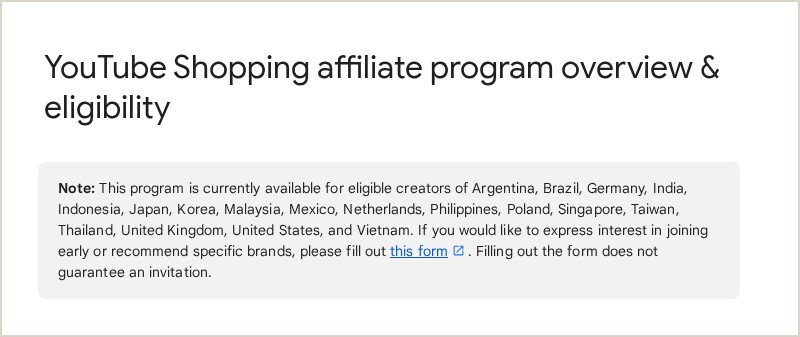
A second help page, on tagging Amazon products, does list France on the same day. It restricts Amazon products to creators enrolled in the affiliate program in nine countries, including France, Germany and the UK. French creators must also belong to the Amazon Influencer Program or Amazon Associates, two Amazon affiliate programs, and link their channel to that account. Reports show daily totals only: creators cannot see which video or product led to a purchase on Amazon.
Belgium does not appear in either help page, in the October 13 blog post, or in the e-marketing.fr and Influencia articles on the November 4 announcement. None of these sources says whether the program will open to Belgian creators.
None of the documents reviewed gives the four merchants’ commission rates. Enrolled creators see the rates product by product in YouTube Studio, YouTube’s channel management tool. The documents also give no number of French creators already enrolled.
What it means
The November 4 announcement adds four merchant catalogs to a program that had been open in France for three weeks. None of the documents reviewed reports any change to the program’s rules. The product categories, from electronics to home improvement, fit the videos YouTube highlights: unboxings, tutorials and product reviews.
French creators already in the affiliate program are affected first. For them, product cards in the video add to the links in the description. Their results show up in YouTube Studio next to watch time and click-through rate.
For channels run as a business with several revenue streams, affiliate income adds to ad revenue and brand deals. Platforms are competing for these creators. In late October, an Instagram representative quoted by Variety said the platform was funding some long-form creators directly.
For sellers, the setup favors large companies for now: the documents reviewed describe no sign-up process for small French online stores.
YouTube’s claimed results are still unproven. The 110% click figure comes from other markets and has no published method. The 100% commission incentive has no known end date, and the page that announces it does not say whether it covers France.
Still to watch: whether the two help pages come to agree on France, and whether more retailers join. Also open: whether the program reaches Belgian creators and smaller merchants. YouTube has promised at least 30 days’ notice before the 100% incentive ends.
Sources
- YouTube Shopping débarque en France : le shopping nouvelle génération porté par les créateurs, Google France Blog, October 13, 2026
- YouTube Shopping affiliate program overview & eligibility, YouTube Help, accessed November 8, 2026
- Tag Amazon products with YouTube Shopping, YouTube Help, accessed November 8, 2026
- Understand commission rates & earnings in the YouTube Shopping affiliate program, YouTube Help, accessed November 8, 2026
- Get started with the YouTube Shopping affiliate program (for Shopify merchants), Google Merchant Center Help, accessed November 8, 2026
- YouTube Shopping Creators can now tag Amazon products, YouTube Official Blog, August 27, 2026
- YouTube Shopping : YouTube s’associe à Amazon, e-marketing.fr, November 4, 2026
- YouTube Shopping : Amazon, Cdiscount et Leroy Merlin misent sur les créateurs pour vendre en France, Influencia, November 5, 2026
Header image: MACCUS chart, data from the YouTube blog, the Google France blog, e-marketing.fr and YouTube Help (accessed November 8, 2026)