Google Ads Editor, Google’s free desktop app for editing ad campaigns in bulk, now turns on AI Max by default. A new Search campaign built in Editor starts with ad text written by AI and landing pages picked by Google, unless the advertiser switches these features off. The change ships in Editor version 2.14, which the industry site Search Engine Roundtable reported on November 12, 2026.
AI Max is a set of automated features that Google adds on top of standard Search campaigns, whose ads appear in Google’s search results. It lets an ad show on a wider range of searches and rewrites ad text. It can also pick the landing page, the page a visitor reaches after clicking an ad, in place of the one the advertiser chose.
A second, separate change is about measuring AI Max. On November 11, the industry site PPC News Feed reported that Google’s help pages for advertisers now list a new tracking parameter, {search_term_matchtype}. Added to the address of the page a visitor lands on, it marks clicks from AI Max with the letter “a,” so an analytics tool can count them separately. PPC News Feed credits Hana Kobzová with spotting it.
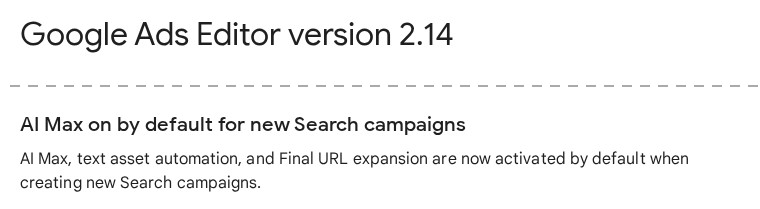
Editor 2.14 turns on three AI Max settings for new campaigns
The Editor 2.14 release notes sum up the change in one sentence: “AI Max, text asset automation, and Final URL expansion are now activated by default when creating new Search campaigns.” The notes are undated. They list 10 new features in this version.
Google Ads Help names the three settings search term matching, text customization and Final URL expansion. Search term matching lets an ad show on more searches. To find them, it uses broad match, the ad’s assets (the pieces an ad is built from, such as its headlines) and the content of the landing page. Broad match is the loosest way to match a keyword: it can show an ad on searches that are only related to the keyword.
Text customization, formerly called automatically created assets, uses generative AI to write headlines and descriptions based on the advertiser’s ads and website pages. Final URL expansion lets Google change the landing page. The final URL is the page address the advertiser sets for an ad. With this setting on, Google sends the click to whichever page on the site it judges most relevant to the search.
Final URL expansion also affects other settings. It requires text customization. When it sends a visitor to a different page, pinned assets are not used. Advertisers pin an asset to lock it in place, for example a headline in first position that carries a legal notice or a slogan.
Google also says these features need a Smart Bidding strategy based on conversions to work well. Smart Bidding means Google sets bids automatically. A conversion is the action the advertiser wants, such as a purchase or a submitted form.
By turning AI Max on by default, Editor catches up with the Google Ads web interface, the version advertisers use in a browser. For the web interface, Google’s AI Max help page states: “New Search campaigns have the AI Max feature turned on by default.” The same page says text customization and Final URL expansion are on by default there too.
Editor 2.14 also adds the channel prioritization and budget caps that Google launched in October.
The September migration did not turn on all three settings
On April 15, 2026, Google announced that AI Max was leaving beta, its test phase. It also said an automatic migration to AI Max would begin in September. The migration covered campaigns that used one of two older options: broad match applied to the whole campaign, or automatically created assets.
Dynamic Search Ads, which take their headline and landing page from the site’s content, were on the same schedule. According to the industry site PPC Land, their move to AI Max is now set for February 2027. The April announcement says they will get all three features, Final URL expansion included.
The migrated campaigns got settings that mirrored their old setup. Campaigns that used broad match got search term matching only. Campaigns that used automatically created assets also got text customization. PPC Land notes that Final URL expansion stayed off in both cases.
Google’s April announcement gives a figure for the full set. Campaigns that use all three features get on average 7% more conversions or conversion value than campaigns that use search term matching alone. Google says cost per acquisition (the ad cost of each conversion) or return on ad spend stays similar. The figure comes from Google’s internal 2026 data on advertisers outside retail.
A new tracking parameter isolates AI Max clicks
The new {search_term_matchtype} is one of Google’s ValueTrack parameters. These are placeholders that Google Ads fills in at the moment of the click and adds to the landing page address. They let an analytics tool or a customer relationship management (CRM) system see which keyword triggered the visit.
An existing parameter, {matchtype}, already reports the keyword’s match type. The match type is the setting that decides how closely a search must match the keyword. It uses four letters: “e” for exact, “p” for phrase, “b” for broad and “a” for an AI Max match with no keyword.
The new {search_term_matchtype} uses the same letters but describes the search itself, meaning what the person actually typed. In this parameter, “a” flags either an AI Max broad match expansion or a match with no keyword. A broad match expansion is a search that AI Max reached by widening a keyword.
Google’s help page explains how to read the two parameters together. If {matchtype} is e, p or b and {search_term_matchtype} is a, the click came from an AI Max expansion. If {matchtype} is e, p or b and {search_term_matchtype} is not a, the click is standard keyword traffic.
Google Ads already shows AI Max’s share in its own reports. The search terms report has an “AI Max” match type and a “Source” column. The landing pages report has a “Selected by” column. The new parameter carries that information with each click into tools outside Google Ads, where an advertiser connects visits to sales.
Google suggests this tracking template, the setting that adds these parameters to the page address:
{lpurl}?keyword={keyword}&matchtype={matchtype}&search_term_matchtype={search_term_matchtype}&targetid={targetid}
The {lpurl} parameter is replaced with the landing page address. As of November 16, 2026, the French version of Google’s ValueTrack help page does not yet mention the new parameter.
One Reddit user reports opposite AI Max results on two accounts
On November 15, a user on r/PPC, Reddit’s forum for pay-per-click advertising, asked whether others had seen AI Max performance change in November. The poster runs AI Max on two online store accounts. Both exclude brand searches.
The first account sells an expensive product. Its return on ad spend (ROAS) is 0.75, meaning sales come to 75% of ad spend. The poster says the ads are showing on some “really questionable search terms.” The account uses only 10 keywords, and just one of them is broad match.
The second account sells everyday products. On this account, 14 exact and phrase match keywords deliver a ROAS of 5.34, meaning sales are 5.34 times ad spend. That beats the account’s Search campaigns that run without AI Max. These figures come from one person’s accounts, and nobody else can check the data.
Open questions and a broken-page risk
The release notes do not explain why Editor turns on all three settings when the September migration left Final URL expansion off. PPC Land points out a second gap. Nothing in the notes says whether the default covers campaigns imported into Editor from a spreadsheet, a common way to build campaigns in bulk. These are only starting settings, and Google’s help explains how to switch off each feature in the web interface.
The 7% figure is an internal Google average for advertisers outside retail. Google has published no method and no breakdown by industry. The new parameter shows which clicks came from AI Max. Whether those clicks pay off is for each advertiser to measure with their own conversion data.
Google also flags a technical risk. Some tracking templates do not work with Final URL expansion and can lead to a 404 error, the “page not found” message. A template that points to a fixed address, with no {lpurl} parameter, may send visitors there instead of to the page AI Max chose. Before turning on AI Max, Google’s help recommends testing the tracking template with a dynamic landing page, meaning one picked by Google.
What it means
The Editor change is about a default, the setting that applies when an advertiser changes nothing. Google’s help says new campaigns in the web interface already start with AI Max on, text customization and Final URL expansion included. Editor, the tool agencies and in-house teams use to build campaigns in bulk, now follows the same rule. Campaigns moved to AI Max in September, by contrast, kept Final URL expansion off.
The tracking parameter comes at the same time and gives advertisers a way to measure AI Max clicks. With {search_term_matchtype}, an advertiser can follow those clicks in their own tools and compare what they earn with what keyword clicks earn. The r/PPC post illustrates why that comparison matters: AI Max makes money on one account and loses money on the other.
Google’s push toward more automation goes beyond AI Max. It has already removed language targeting from Search campaigns, AI Max included. Performance Max campaigns run ads across all of Google’s channels. According to PPC Land, new ones will have image extraction turned on by default starting December 4, 2026.
Three things are worth watching: how Editor handles imported campaigns, the French translation of Google’s help on the new parameter, and the move of Dynamic Search Ads to AI Max in February 2027.
Sources
- Google Ads Editor version 2.14, Google Ads Editor Help Center, accessed November 16, 2026
- Set up AI Max for Search campaigns, Google Ads Help, accessed November 16, 2026
- How AI Max for Search campaigns works, Google Ads Help, accessed November 16, 2026
- How you can use ValueTrack, Google Ads Help, accessed November 16, 2026
- Dynamic Search Ads are upgrading to AI Max, Google, April 15, 2026
- Google Ads Editor Version 2.14 Is Now Available, Search Engine Roundtable, November 12, 2026
- Google Ads Editor 2.14 turns on AI Max by default for new Search campaigns, PPC Land, November 12, 2026
- New {search_term_matchtype} ValueTrack Parameter Isolates AI Max Traffic, PPC News Feed, November 11, 2026
Header image: MACCUS diagram. Data: Google Ads Editor 2.14 release notes, Google’s announcement of April 15, 2026, and PPC Land (November 12, 2026)