Meta said Sunday that the No Kings coalition’s Instagram account went offline on Saturday, October 17, 2026, because “a Claude tool” was reading profiles, posts and hashtags on Instagram in bursts. Andy Stone, Meta’s vice president of communications, wrote on X that the activity jumped roughly fourfold and looked like bot traffic. Instagram’s automated protections then took the account down by mistake, Meta said.
Claude is Anthropic’s AI model. Meta did not say which Claude tool was involved or who was using it. It was the company’s second explanation in 24 hours; the first blamed how often the account was posting.
An outage in the middle of a day of action
October 17 was “No Kings: Vote Early,” a day organized by the anti-Trump coalition to encourage early voting ahead of the November 3 midterm elections. Millions of people took part in nearly 3,000 events across all 50 states and Washington, D.C., the coalition said, according to Bloomberg.
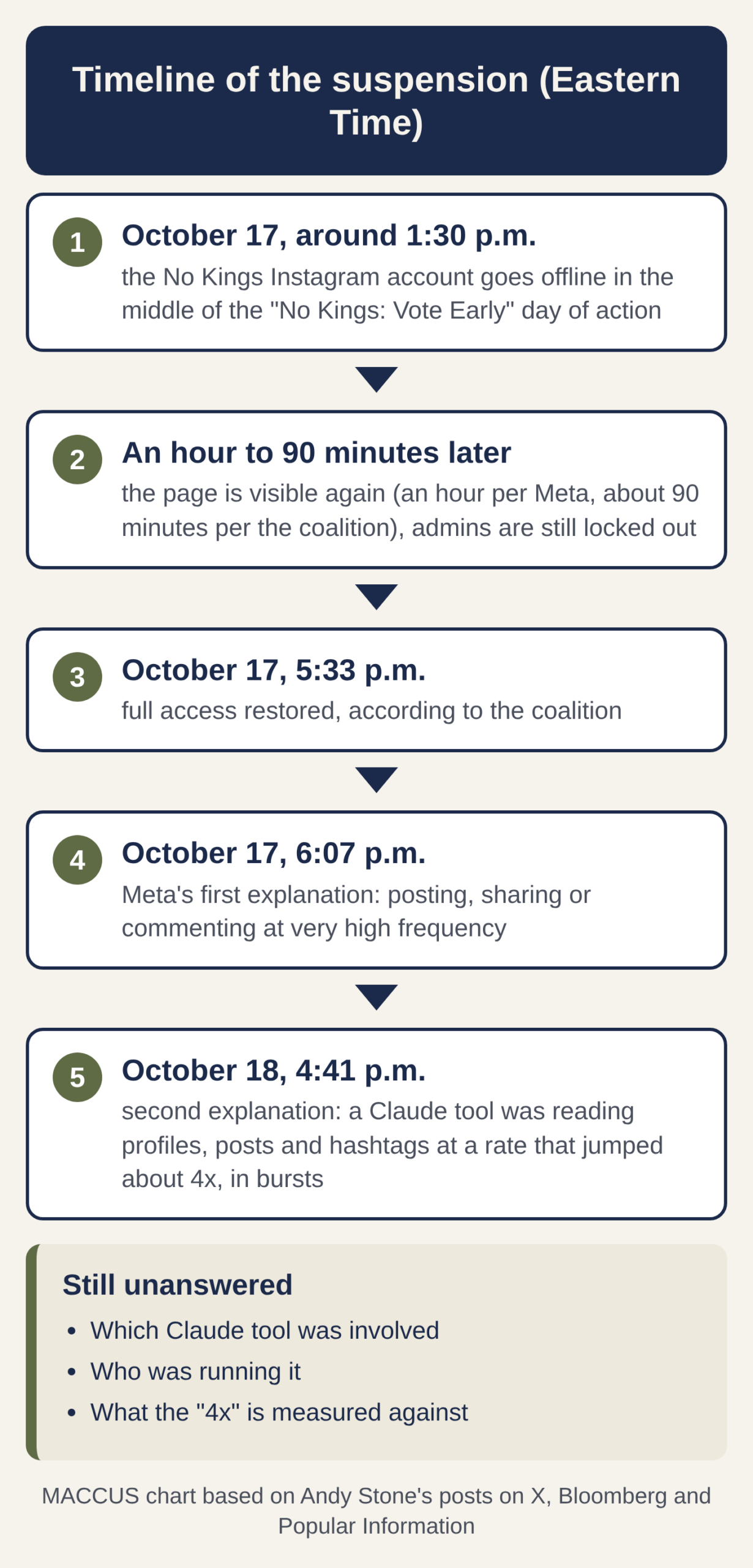
The account went dark around 1:30 p.m. ET, according to the newsletter Popular Information. By the coalition’s count, the page stayed down for about 90 minutes; Meta put the outage at an hour. The coalition said its administrators were still locked out after the page came back online and regained full access only at 5:33 p.m. ET.
Two explanations in 24 hours
At 6:07 p.m. ET on Saturday, Stone posted a first explanation on X: “When accounts post, share or comment at very high frequencies it can trigger automated systems.” He said that was what happened to the No Kings account in the lead-up to the day of action, wrote that the automated action was “clearly taken in error” and apologized.
At 4:41 p.m. ET on Sunday, October 18, Stone posted an update. Meta’s engineering team, he wrote, found that the spike that triggered the enforcement was “primarily in the account’s ‘reading’ behavior.” Meta’s network security systems, he added, detected “the use of a Claude tool reading profiles, posts, and hashtags, the rate of which sharply increased (~4x volume) in intense bursts on October 17.”
“These abrupt, high-volume, sequential requests in a short period resembled automated bot traffic rather than an ordinary human browsing our systems,” Stone wrote. He said an automated re-review recognized the mistake an hour later and restored the account, but that it “took additional time” to sort out admin access. Meta apologized again.
No Kings pushes back
The coalition challenged the first explanation on Saturday. “In the 24 hours before our account was shut down, we posted only a handful of times and livestreamed to thousands,” the coalition wrote, according to Popular Information. “Meta’s ‘high-frequency’ excuse doesn’t add up.”
After the second explanation, the coalition said on Bluesky that “Meta’s explanation still doesn’t add up.” It also said it had received reports that #NoKings and early-voting content was “inaccessible, restricted, or seemed suppressed across Meta platforms.”
Sen. Chris Murphy, a Connecticut Democrat, responded on X, The New Republic reported: “Let’s assume this is true. It’s still a total indictment of Meta’s outsized influence on our culture and politics.” He added that “an investigation is warranted, at the very least.” The magazine tied the episode to Meta’s closer relationship with the Trump administration.
Gaps in Meta’s explanation
Meta has published no data to back up its explanation. The “4x” figure has no stated baseline: Stone does not say what normal volume he is comparing it to. As Bloomberg noted, his post does not say which Claude tool was involved, who was operating it or what it was doing with the account.
Meta refers to the account’s own “reading” behavior, which suggests the activity came from a session logged into the No Kings account. Meta does not spell that out, and it has not said whether the tool was run by coalition staff or by someone else. None of the coverage we reviewed included a response from Anthropic, and we had found no public statement from the company as of late Monday, October 19, ET.
Anthropic sells several products that can browse the web on a user’s behalf. Its Claude in Chrome extension “allows Claude to read, click, and navigate websites alongside you,” according to its help center. It is available on every paid plan and can also be launched from Claude Code or Claude Cowork, Claude’s agent mode. Nothing indicates it was the tool Meta was referring to.
Instagram’s rules on automated access
Instagram’s Terms of Use say users “can’t attempt to create accounts or access or collect information in unauthorized ways.” That includes “accessing or collecting information in an automated way without our express permission, regardless of whether such automated access or collection is undertaken while logged-in to an Instagram account.”
Meta did not cite those terms against No Kings. Stone described “automated protections” that acted in error, mentioned no violation, and attributed the takedown to Meta’s “network security systems.” His post does not implicate the ranking systems that decide how posts are distributed, which we covered in our explainer on Instagram’s algorithm.
What it means
Meta has publicly named an AI tool as the trigger for an automated account takedown. In Meta’s telling, the signal was the rate at which the account was reading profiles, posts and hashtags. If that version holds, an AI agent browsing Instagram from a logged-in session can look like a bot to the platform’s defenses, and the account is the one that gets penalized. The line between human browsing and assisted browsing is drawn by traffic thresholds that Meta does not publish.
The episode matters to any organization whose social media accounts are partly run by browsing AI agents: nonprofits, retailers, agencies. Platforms are already dealing with this kind of traffic. In October, independent researchers who publish at swarmcha.se described a fleet of AI agents hosted on Tencent’s cloud that made more than 2,600 attempts between September 28 and October 8 to pull data from Amap, Alibaba’s mapping service, which is protected by anti-bot defenses. Meta itself relies on automated access: its rewritten commercial terms, which take effect October 30, authorize its crawlers to access sites linked to business accounts.
Meta’s version of events rests on its word alone: no published technical logs, no absolute figures, and a first explanation, about posting frequency, that the next day’s update does not repeat. The coalition disputes it, and Anthropic has not commented publicly. It is still unknown which tool was used, who ran it, what threshold applied and how the same mechanism treats accounts outside the U.S.
In the European Union, Article 17 of the Digital Services Act requires hosting providers, social networks included, to give a “clear and specific statement of reasons” when they suspend an account because content is illegal or incompatible with their terms and conditions, including “information on the use made of automated means in taking the decision.” The rule covers information the user provides. A takedown ordered by a security system over traffic volume does not clearly fall within it.
Before the November 3 elections, three things could shed light on the case: a response from Anthropic, a fuller explanation from Meta, and whatever comes of the investigation Murphy has called for.
Sources
- Andy Stone’s post on X (second explanation), Meta, October 18, 2026
- Andy Stone’s post on X (first explanation), Meta, October 17, 2026
- Meta Says Claude AI Tool Triggered No Kings Instagram Suspension, Bloomberg, October 18, 2026
- Meta shuts down “No Kings” account during major anti-Trump protest, Popular Information, October 19, 2026
- Meta Weakly Defends Blocking No Kings Instagram in the Middle of Event, The New Republic, October 19, 2026
- Terms of Use, Instagram, accessed October 20, 2026
- Get started with Claude in Chrome, Anthropic, August 26, 2026
- Regulation (EU) 2022/2065 (Digital Services Act), Official Journal of the European Union, October 19, 2022
Header image: MACCUS chart, data from Andy Stone’s posts on X (October 17 and 18, 2026), Bloomberg and Popular Information