

Between October 16 and 17, 2026, Meta rewrote the crawling clause of its Commercial Terms, which take effect October 30. The English version no longer contains the sentence that let Meta use content from sites tied to a business account to “train” its products. Its crawlers and test credentials are still authorized on those sites, but their use is now limited to advertising and business products, plus integrity and security. On the morning of October 18, the French version still showed the old text.
On October 16, we broke down the crawling clause added to Meta’s Commercial Terms and its reach for accounts that run a Facebook Page, an Instagram professional account or ads. The day before, Nieman Lab had published an analysis by legal experts, including James Grimmelmann, a law professor at Cornell. They read the clause as giving Meta a right to train AI on site content and an opening to override robots.txt. The Verge reported the rewrite on October 17, along with a new statement from Meta.
The sentence Meta removed
The Verge quotes the sentence that has disappeared from the English version of the Commercial Terms. It was still on that page when we read it on October 16:
“Meta may use any content from such domains, web pages, or URLs to provide, develop, improve, research, train, and maintain the integrity of, the Meta Company Products, services, and features provided under these Commercial Terms and any other applicable supplemental terms.”
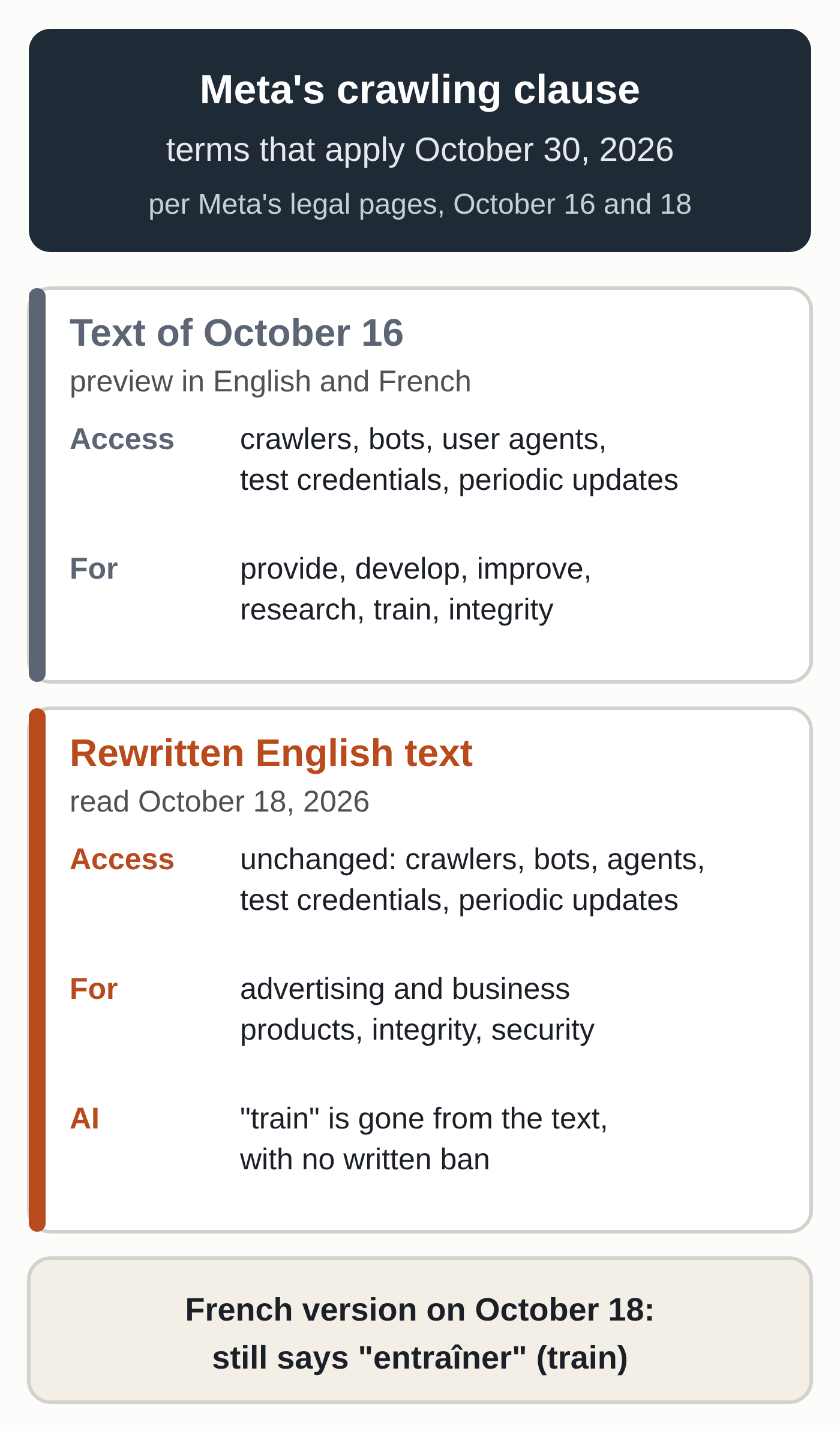
In the English text we read on October 18, the crawling paragraph ends with new purposes: “in order to provide, develop, improve, research, and maintain advertising and business products” and to “maintain the integrity and security of Meta Company Products.” A parenthetical lists examples: tools that help you create and deliver ads, give users information about your products and connect you with people who may be interested in them. The word “train” no longer appears anywhere on the page.
The Self-Serve Ad Terms, which also change on October 30, were rewritten the same way: neither “train” nor “training” appears in the English version. The current version, in force since August 22, 2025, already lets Meta access content on an advertiser’s sites for purposes that include “research and training.” Starting October 30, the English text will say less about training than it does today.
The crawling permission stays in the contract
The first part of the paragraph is unchanged. Starting October 30, a business that uses Facebook, Instagram or other Meta services for business purposes authorizes Meta, or anyone acting on its behalf, to use “web scrapers, bots, robots, spiders, crawlers, and user agents” on the domains, web pages or URLs “associated with your products or services.” Meta can also create test credentials to access them, then index, cache, analyze and collect that content and “periodically pull updates.”
The revised text no longer lists training among the permitted uses, and it does not forbid it either. It still says nothing about robots.txt. Acceptance remains automatic: continuing to use Meta’s products for business after notice of the update counts as agreement. Meta offers one way out: “you may stop all access or use of our Products for business or commercial purposes.”
Meta points to robots.txt again
According to The Verge, Andy Stone, Meta’s vice president of communications, and spokesperson Daniel Roberts first responded: “There is no change to how Meta uses web crawlers; any suggestion to the contrary is false.” On the morning of October 17, Roberts went further in a statement to The Verge:
“We’ve heard you and want to clarify: the crawling terms we consolidated only applied to our ads and business products, and we’ve clarified that in the terms themselves. It does not change how Meta uses web crawlers. As always, content owners can use robots.txt to signal their preferences. This is not about scraping news sites, and these updates don’t give us new rights that supersede those preferences.”
That robots.txt commitment lives only in the press statement. Meta’s documentation on its web crawlers, which we checked again on October 18, still says meta-externalagent crawls the web for use cases such as “training foundation AI models or improving products by indexing content directly.” Meta adds that meta-externalfetcher, which fetches links at a user’s request, “may bypass robots.txt rules,” and that facebookexternalhit may do the same during security or integrity checks. On October 18, the same Andy Stone blamed “a Claude tool” for the takedown of the No Kings coalition’s Instagram account, saying its reading bursts resembled bot traffic, as our article on the No Kings Instagram suspension explains.
The French text still says “entraîner”
Around 9:40 a.m. Brussels time on October 18, we reread both French previews. The French Commercial Terms still contain the deleted sentence, word for word as we read it on October 16, with “entraîner” (to train) in the list. The French Self-Serve Ad Terms still say Meta “peut utiliser tout contenu provenant de tels domaines, de telles pages Web ou de telles URL” (may use any content from such domains, web pages or URLs) to, among other things, “entraîner” its products.
The most likely explanation is a translation lag. The English version does not say which language governs if the versions differ, and neither The Verge nor Meta’s statement addresses the point. With 12 days to go, a business owner in France or Belgium who reads the terms in French still finds a sentence Meta has dropped from the English.
The News/Media Alliance is not convinced
On October 16, the News/Media Alliance, which represents U.S. news publishers, called Meta’s new terms “outrageous and probably illegal” in a statement from its president and CEO, Danielle Coffey. After the rewrite, an Alliance spokesperson told the Mercury News that the fix only limits what Meta can use the content for, The Next Web reported. Training was taken out of the listed uses but not expressly banned, the spokesperson said, and the terms still do not say Meta will respect robots.txt.
Open questions in the new text
The text still does not define the domains “associated with your products or services.” Is it only the site listed on your Page, or your other domains too? The phrase “advertising and business products” is broad as well, since the parenthetical that illustrates it starts with “including.” No governing language is named either.
Two days before the deadline, on October 28, product browsing turns on by default for Meta ads.
Terms that can still change
Meta rewrote its clause one or two days after the first public criticism, published on October 15. It can change the clause again, and each new version will apply to businesses that keep using its tools after being notified.