

Nikkei Inc., which publishes Japan’s leading business daily, the Nihon Keizai Shimbun, confirmed on November 27, 2026, that 5,399,986 records of its users’ personal data had leaked. The data leaked from KARTE, a marketing platform sold by PLAID, Inc., of Tokyo. Brands use it to track visitors on their sites and apps and send them targeted messages. Nikkei says the email addresses and phone numbers had been converted into other strings of characters, and that no card details or passwords were involved.
A third party broke into KARTE on November 13. The platform has been offline since, and PLAID is targeting a phased restart in mid-January 2027.
PLAID’s November 20 report covers data imported by 570 client companies, connection keys of 754 and former clients’ data that its terms required it to delete. As with the mail-printing platform in La Poste’s Maileva breach in France, one vendor held the files of many businesses.
Nikkei moves from a possible leak to a confirmed count
PLAID told Nikkei about the incident on November 15. Nikkei’s first notice, on November 17, said some personal data of its digital-edition users might have leaked. Its second notice, on November 27, confirmed the count after Nikkei analyzed data it received from PLAID.
Those affected hold a Nikkei ID, the reader account for the digital edition (paid or free), home delivery of the newspaper and Nikkei’s specialist publications. The leaked fields are email address, phone number, gender, and year and month of birth.
Nikkei says that because the email addresses and phone numbers had been converted, the real ones did not leak. Its first notice had said the data was processed so it could not be restored, but did not say which fields. In 71 records, the data also held ID codes that cannot identify anyone on their own, and may have included attribute codes and histories of visits to sites that present Nikkei services.
Nikkei says it never entrusted card details or passwords to PLAID, and that no misuse had been confirmed as of November 27. It will notify each affected person and, together with PLAID, report the case to the Personal Information Protection Commission, Japan’s data protection regulator.
How the intrusion unfolded on November 13
PLAID says a third party made repeated attempts through several routes in the early hours of November 13, Japan time. The intruder exploited a flaw in some of the internal processing behind a public route for retrieving data, and took some data. It then used the credentials it had obtained to enter the KARTE admin console, the platform’s web control panel.
PLAID detected the intrusion at 8:59 a.m., shut down its servers and finished containing the attack around 3:23 p.m. Every KARTE function stopped, from tracking on websites and apps to sending messages. PLAID said on November 16 that it was reporting the incident to the regulator and consulting the police.
Four kinds of client data, counted by company
PLAID’s November 20 release sorts the client data that leaked, or may have leaked, into four categories and counts the client companies in each. Some companies appear in more than one, so the figures do not add up.
The first category, covering 570 companies, is some of the data they had imported into KARTE from their own files, such as member lists. The second, covering 487, is some of their analytics data: logs of page views and button clicks, plus derived data such as a membership rank. Depending on the company, both can hold personal information.
The third, covering 409 companies at most by PLAID’s estimate, is cache data. This is temporary data, including visitor identifiers, that KARTE keeps briefly while it processes activity in real time. No log shows which cached items were read. PLAID therefore treats everything the cache may have held during the attack as possibly leaked.
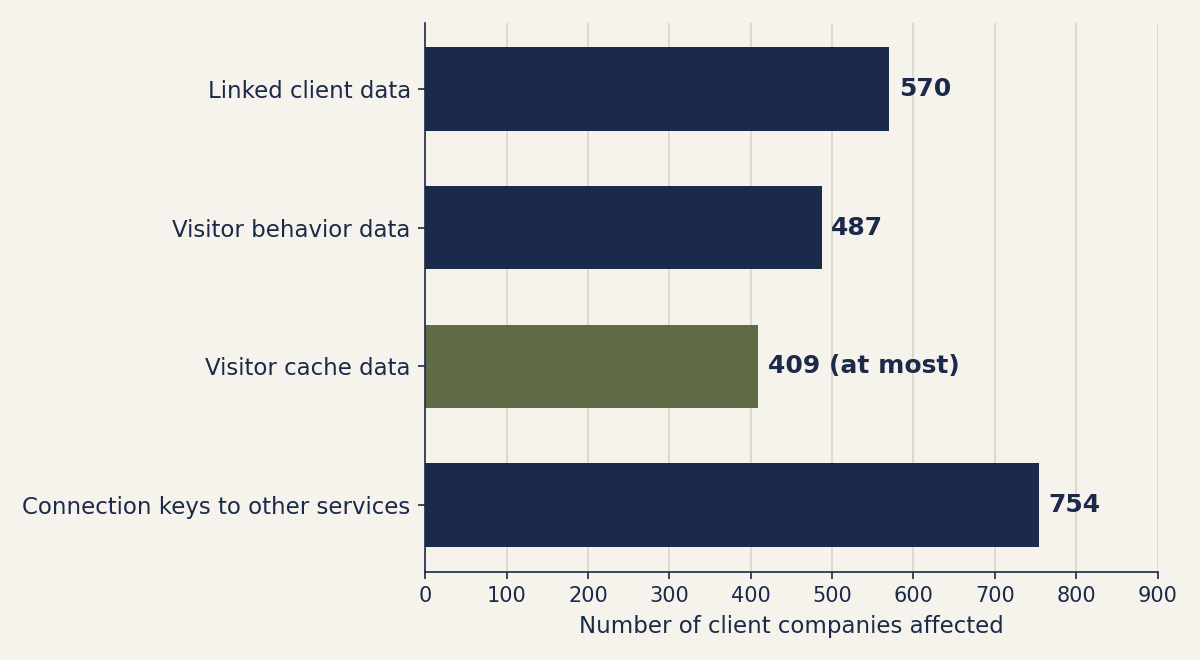
The fourth, covering 754 companies, is connection credentials: the keys and passwords that link KARTE to other services, such as an email-delivery tool. They hold no personal data, but they open the linked services, so PLAID asked clients on November 16 to revoke them. Keys left active, it warned, could let an intruder write or leak data there. In the UpdraftPlus breach, keys stolen from the maker of that WordPress backup plugin were used to plant backdoors in customer sites.
PLAID’s own files leaked too: 79,249 email addresses registered as KARTE accounts and 45,816 sales and support contact records with names and email addresses.
ZOZO and dozens of other brands
ZOZO, Inc., which runs the ZOZOTOWN online fashion store and the WEAR by ZOZO fashion app, used KARTE for messaging and marketing campaigns.
ZOZO’s November 20 notice covers about 15.18 million ZOZOTOWN customers, including former members, whose member ID, age, gender or postal code was exposed. About 47,000 of them also had a display name, email address or phone number exposed. It also lists about 13.93 million WEAR by ZOZO users. ZOZO said passwords were never stored in KARTE and that, as of November 20, no leak of card data and no follow-on harm had been confirmed.
TechnoEdge, a Japanese tech news site, counted 72 organizations that had posted notices about the incident as of 1 p.m. Japan time on November 20.
Data kept for clients who had already left
On November 20, PLAID corrected its earlier notice and apologized: companies whose contracts had fully or partly ended were affected too. It said data its terms required it to delete had been kept because of shortcomings in manual operations and in management. As of November 20, that data had not been deleted. PLAID said it had to keep it for checks before the restart and would delete it afterward.
TechnoEdge, citing PLAID, reported that Article 40(3) of KARTE’s terms of service sets a 90-day deadline to delete personal data after a contract ends. PLAID told TechnoEdge it had not published how many affected companies are former clients. TechnoEdge found at least four companies that say their data stayed at PLAID after they left, in the oldest case for about three years. Nothing in Nikkei’s notices says it had left KARTE.
A January restart target and a forecast loss
PLAID is aiming for a phased restart in mid-January 2027, after changes to the system, some of them structural. It says an outside organization will also check its work. Clients will not be charged for November or for the suspension period.
On November 20, PLAID also cut its forecast for a 15-month fiscal period ending December 31, 2026. It now expects revenue 2.3 billion yen (about $14.4 million) below its earlier forecast. It also forecasts a net loss attributable to owners of the parent of 2 billion yen (about $12.5 million), instead of a 600 million yen profit. Dollar figures are conversions at European Central Bank reference rates of November 27, 2026.
What the disclosures leave open
Nikkei says its processing cannot be undone but does not explain how the conversion works. For client data, PLAID’s figures count companies, so the total number of people affected is unknown. Nor has PLAID said how many are former clients. Nobody has named the attacker.
Nikkei had confirmed no misuse as of November 27, and neither had ZOZO in its November 20 notice. The mid-January restart is a target, and PLAID says it will announce any change.
What it means
For Nikkei ID holders in Japan, November 27 turned a possible leak into a confirmed count. KARTE is a Japanese platform, and the disclosures come from Japanese companies. Nothing in them points to sites in Europe or the United States using it. For marketers there, it is a case study.
A platform like KARTE holds three things at once: the member files brands upload, the behavior logs it produces and the keys to their other tools. One intrusion therefore reached hundreds of companies, from a business newspaper to a fashion retailer. If the January target holds, KARTE’s clients will have gone about two months without the tool.
If Nikkei’s claims hold, two steps limited what could leak in readable form: the email addresses and phone numbers were converted, and card details and passwords were never entrusted to PLAID. The leaked keys of 754 companies show that a breach of a marketing tool can open the services connected to it. In a separate case, note-taking software maker Notion confirmed on November 9, 2026, that some AI chats were exposed at Fireworks AI, one of its vendors.
The former clients’ data shows that ending a contract and deleting the data are separate steps. Under the GDPR, the European Union’s data protection law, a vendor handling personal data for a company is a processor, and their contract must cover deletion. Under Article 28(3)(g), the processor must delete or return the data when the service ends, whichever the company chooses. Recital 26, an explanatory passage of the law, adds that pseudonymized data is still personal data when extra information can link it back to a person.
The next milestones are the mid-January 2027 restart target, the joint report to the regulator, the promised deletion of former clients’ data and the counts other brands publish.
Sources
- 委託先外部サービスへの不正アクセスに伴う個人情報漏洩について(第2報), Nikkei Inc., November 27, 2026
- 委託先外部サービスへの不正アクセスに伴う個人情報漏洩の可能性について, Nikkei Inc., November 17, 2026
- 当社サービスへの不正アクセスに関するご報告, PLAID, November 13, 2026
- 不正アクセスによる個人情報を含む可能性のある情報等の漏えいに関するお詫びとお知らせ, PLAID, November 16, 2026
- 「KARTE」への不正アクセスに関する当社調査結果と、サービス再開の見通し等のお知らせ, PLAID, November 20, 2026
- 業績予想の修正に関するお知らせ, PLAID, November 20, 2026
- 当社利用の外部サービス「KARTE」への不正アクセスについて, ZOZO, November 20, 2026
- KARTE不正アクセス、プレイドが「解約後のデータ」漏えいを認める 取り込みデータは570社、連携用の認証情報は754社, TechnoEdge, November 20, 2026