

SAP is weighing a plan to cut at least 10,000 positions, roughly one job in 11 on its own staff count, as it reorganizes around AI, the financial news service Bloomberg reported on November 26, citing unnamed sources. SAP is Europe’s most valuable software company. Based in Walldorf, Germany, it makes software that handles accounting and payroll for many of the world’s largest companies. It has not confirmed a number, and Bloomberg says the total is not final.
A week earlier, SAP’s chief financial officer (CFO) had explained why he expects the company to shrink. On November 19, Dominik Asam told an investor conference in Barcelona that SAP’s productivity gains from AI now outpace the extra work that growth brings. “That is why I think headcount should actually trend down over time from here,” he said, according to a transcript. Earlier in the same answer, he said that in administrative functions SAP is “going to see some really nice use cases where you can just take people out and get more done by less people.”
Bloomberg and Reuters report a plan SAP won’t confirm
Bloomberg says the plan would affect at least 9% of SAP’s global workforce. Every department has been asked to identify areas for potential cuts, especially in product, engineering and sales, it reports. Its sources asked not to be named “because discussions are ongoing.” The total “hasn’t been finalized and might still change after labor negotiations,” Bloomberg wrote, citing them.
The Reuters news agency confirmed the broad outline on November 27 without giving a figure. Two people told Reuters that SAP is “preparing to cut a sizeable number of jobs.” One of them said SAP’s works council, the body that represents its staff, had not yet been informed. Reuters added that chief executive Christian Klein and Asam had signaled at investor events in recent weeks that a smaller workforce “was on the cards.”
SAP has neither confirmed nor denied a plan. In a statement to CNBC, the company said its business environment “is changing rapidly through AI” and that “roles and functions will naturally change over time.” It added: “Beyond this, no decisions have been made regarding any further measures. We do not comment on speculation.” Bloomberg notes that SAP has announced past major restructurings in late January, with its full-year results.
The CFO’s case and SAP’s numbers
Asam spoke at Morgan Stanley’s European technology conference, answering a question about SAP’s hiring plans for the next five years. He acknowledged that headcount “has increased a little bit over the course of the year,” through acquisitions and internal hiring, “and I think that kind of episode is over.”
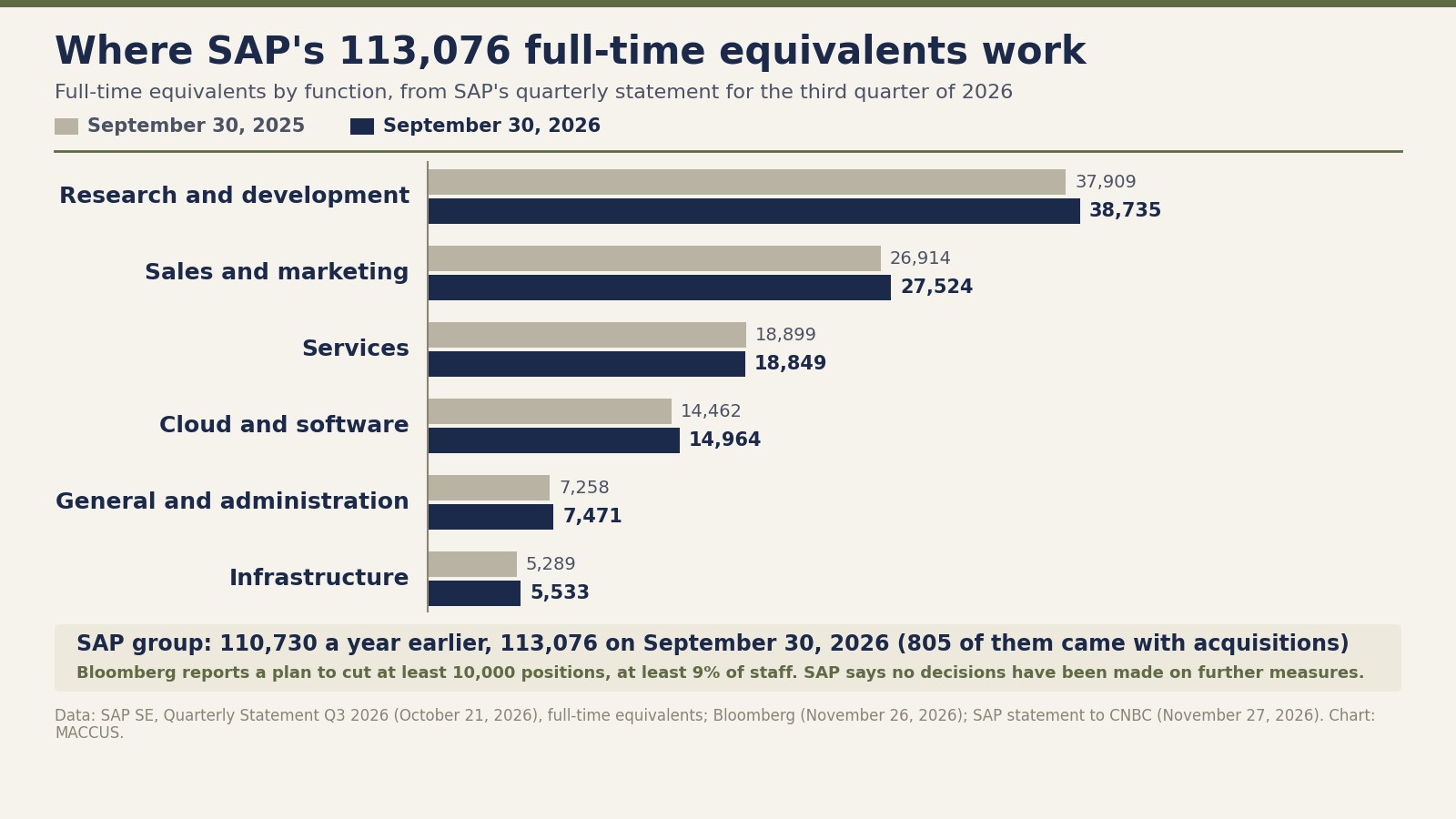
SAP’s latest quarterly report shows that growth. On September 30, 2026, the company employed the equivalent of 113,076 full-time staff, up from 110,730 a year earlier, according to its third-quarter statement. Companies SAP acquired in 2026 brought in 805 of them.
Asam described AI’s gains as “a multiplication of what historically we have been achieving in productivity,” with software development the “lowest hanging fruit.” Earlier in the same talk, he said finance and other admin teams already raise their productivity by a mid-single-digit percentage a year. SAP aims to lift that to “something around 20% over a one-and-a-half-year timeframe,” he said. He also reminded investors that SAP has committed “to take a couple billion EUR of cost plus out.”
His “take people out” remark was about administrative jobs, but administration alone is too small for the reported cut of at least 10,000 positions. SAP’s quarterly report lists the equivalent of 7,471 full-time staff in general and administration. Research and development plus sales and marketing account for 66,259, more than half the company. Bloomberg’s sources name product, engineering and sales as the focus of the cuts.
The 2024 cuts left headcount roughly flat
SAP’s last big restructuring, announced in early 2024, eliminated around 10,000 positions, cost about 3 billion euros and took more than a year, Bloomberg reports. It relied mostly on voluntary departures and retraining. Reuters notes that SAP said at the time it would review 8,000 jobs. Cuts in slow-growing units were later offset by hiring in faster-growing areas, Reuters adds. Bloomberg says total headcount stayed roughly flat.
This time, SAP’s CFO expects the workforce to shrink. In 2023, Klein told CNBC he did not necessarily expect a smaller workforce. Asam now says he “would be really surprised” if headcount did not “go the other way.”
In Germany, where SAP employs the most people, the company’s labor council negotiated an employment guarantee this year that runs through 2028, according to Bloomberg. SAP’s quarterly report lists the equivalent of 51,739 full-time staff across Europe, the Middle East and Africa, out of 113,076 worldwide.
Other companies and the wider job market
SAP would join other large software companies that are shrinking as they reorganize around AI, Bloomberg notes. Oracle has cut 21,000 jobs in 12 months and says AI eliminated some roles, according to Bloomberg. Microsoft has offered voluntary buyouts to about 60,000 employees.
In the United States, employers cited AI as a reason for 121,401 announced job cuts through October, about 20% of the total. The figures come from Challenger, Gray & Christmas, an outplacement firm that tracks layoffs, as cited by CNBC. Its monthly tally of AI-related cuts rose sharply in the spring and fell back by October.
The Burning Glass Institute, a US labor-market research group, released a report with RAISE US on November 23. It found that US occupations that AI could largely do on its own employed about 820,000 fewer people in 2025 than in 2023, mostly in clerical and customer service work. Jobs where AI mostly helps workers added 1.4 million over the same period, and the report found no wave of layoffs so far.
Workers in the euro area, the countries that share the euro, already use the tools Asam is counting on. In a European Central Bank survey published November 27, 44% of employed people there said they used AI at work at least weekly. About 18% used it daily, and around 56% of users said AI helps them get more work done, while 47% said it improves the quality of their work. Looking a year ahead, employed respondents as a whole were more likely to expect AI to raise their risk of losing a job than their household income or job opportunities.
Still unconfirmed
The 10,000 figure rests on unnamed sources, and Bloomberg itself says it is not final. Reuters confirms that cuts are being prepared but gives no number. SAP says no decisions have been made on further measures. Nobody has said how the cuts would split by country or function, whether they would be voluntary, as in 2024, or whether SAP plans to hire elsewhere again.
Asam’s productivity figures are targets he gave investors, and SAP has published no results that measure them. SAP is also under cost pressure. It trimmed its forecast in July as AI-focused deals weighed on earnings, according to Reuters. Bloomberg notes the company has lost more than a quarter of its market value since its peak, partly on investor fears that AI could let customers replace some business software.
What it means
The finance chief of one of Europe’s largest companies has said publicly that AI makes his staff productive enough for SAP to need fewer people. A week later, Bloomberg reported a plan to cut at least 10,000 positions. Asam put a target on it: admin productivity gains rising from mid-single digits a year to “something around 20%” within 18 months.
For SAP’s employees, the difference from 2024 is that this round could shrink the company. The 2024 program cut about as many positions, by Bloomberg’s count, but SAP kept hiring and stayed roughly the same size. Asam expects headcount to trend down. A cut of the reported size could not stop at administration, and Bloomberg’s sources point to the product, engineering and sales teams.
The next date to watch is SAP’s full-year results in late January, when it has announced past restructurings. Asam also told investors that SAP will introduce a new measure of AI’s financial impact in January, after its fourth-quarter results. Then there are SAP’s talks with employee representatives, starting with a works council that Reuters says has not yet been told. Bloomberg’s sources say the total may still change in those talks.
Sources
- SAP Weighs Cutting at Least 10,000 Positions in AI Restructuring, Bloomberg (via Yahoo Finance), November 26, 2026
- Software giant SAP weighs major job cuts as AI transforms sector, sources say, Reuters (via Euronext), November 27, 2026
- German software firm SAP is reportedly cutting at least 10,000 jobs in AI push, CNBC, November 27, 2026
- SAP at Morgan Stanley conference: AI push offsets margin pressure, Investing.com, November 19, 2026
- Quarterly Statement Q3 2026, SAP SE, October 21, 2026
- Sources say SAP mulling cuts of at least 10,000 roles, Bloomberg (via Taipei Times), November 28, 2026
- AI, jobs and prices: what euro area consumers expect, European Central Bank, November 27, 2026