

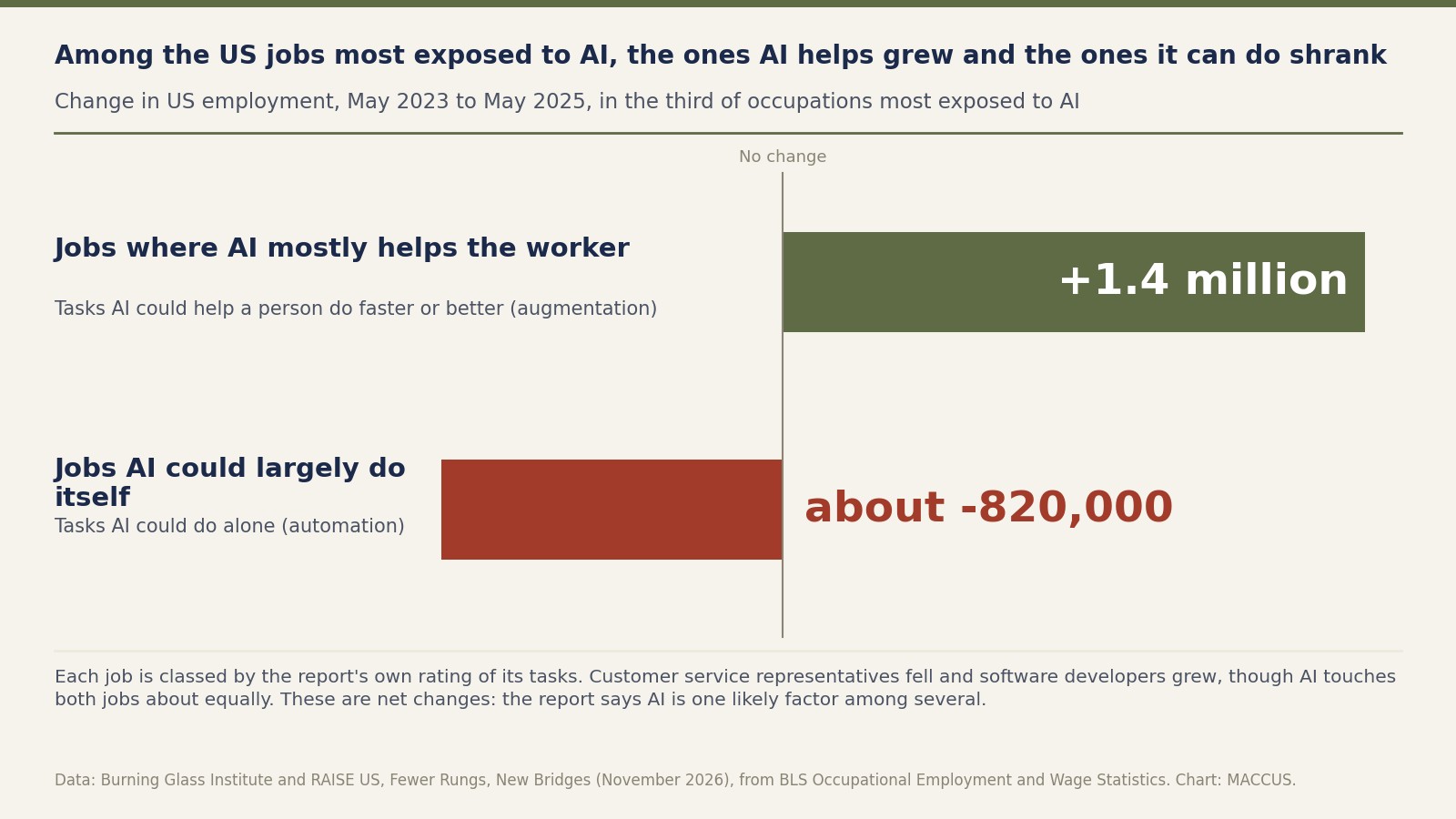
US jobs that AI could largely do by itself employed about 820,000 fewer people in May 2025 than in May 2023. Over the same two years, jobs where AI mostly helps the worker added 1.4 million positions. Both figures come from a report released on November 23, 2026, by the Burning Glass Institute, a nonprofit labor data lab, and RAISE US, a workforce group led by former Commerce Secretary Gina Raimondo. The figures cover the third of US occupations most exposed to AI, sorted by the report’s own rating of each task.
The shrinking jobs are mostly clerical and customer service work, which the report describes as a long-standing route into the middle class for people without a college degree. Nationwide, office and administrative support jobs fell by 780,000 between 2023 and 2025, while management, business and financial jobs grew by more than a million. Across the whole economy, workers without a bachelor’s degree hold 80% of the jobs where AI is more likely to do the work than to help with it, compared with 64% of all US jobs.
The report, Fewer Rungs, New Bridges, finds no wave of layoffs so far. In white-collar industries, layoff rates stayed close to normal while hiring fell well below its old pace. Those industries now employ about 1.5 million fewer people than their pre-pandemic trend would predict.
Two jobs almost equally exposed to AI went opposite ways
Burning Glass rates every task in an occupation on two questions: could AI do it alone, and could AI help a person do it faster or better? A job’s exposure is the share of its tasks that score high on either question. Its tilt is the balance between the two: whether AI mostly helps the people in the job or could do much of the work itself.
The report’s central claim is that tilt, more than exposure, separates the jobs that grew from those that shrank. Its example is two jobs AI touches about equally: customer service representatives, whose employment has fallen since 2023, and software developers, whose employment has grown. AI is likely to automate much of the first job but to make people in the second more productive while a human stays in the loop. “Exposure alone is a weak guide to which jobs are growing,” the authors write.
In call centers, the decline is older than ChatGPT. US call centers have lost about 235,000 jobs since their 2016 peak, and about half of that loss came before the chatbot launched. On the developer side, employment can grow while hiring slows: US employers hired about 113,000 software engineers in a year, less than half as many as in 2022.
The fifth of occupations that tilt most toward automation has started to lag. From 2015 to 2019, those jobs grew as fast as the average job in their industries. Since 2023, they have grown 2.3 percentage points a year more slowly than that average.
The same split shows up inside a single field. From May 2023 to May 2025, the number of computer programmers fell by 12.5% a year, while the number of data scientists rose by 16.7% a year.
White-collar employers are hiring less
The report groups finance, insurance, information, and professional and business services as white-collar industries. In August 2026, they employed 31.9 million people, according to its reading of federal payroll data. Had they kept growing at their 2005 to 2019 pace of 1.2% a year, they would employ about 1.5 million more people. Since April 2023, with no recession, they have lost about 700,000 jobs while the rest of the economy added 4.4 million.
Their output kept rising over roughly the same period. Value added, a measure of what an industry produces, grew 29% after inflation in information between the second quarters of 2023 and 2026. It rose 11% in finance and insurance and 6% in professional and business services. “The missing workers aren’t being laid off,” the authors write.
Beginners feel the hiring slowdown first. In the industries that use AI most, a smaller share of job postings is open to people with three years of experience or less. In the year to June 2026, that share was 3% to 8% below its 2021 to 2026 average, while across all postings it barely moved. The report also cites the AI company Anthropic, which said in October that juniors fell from 27% to 9% of its technical hires.
A Census Bureau working paper published in September finds the same pattern among new bachelor’s graduates. It compares the tenth of majors most exposed to AI, mostly computer science and related fields, with the least exposed majors. After ChatGPT appeared, graduates of the most exposed majors saw their chance of having a job soon after graduation fall by five percentage points relative to the least exposed majors. Their early earnings fell by 13% on the same comparison, a drop the paper’s authors compare to the losses of graduating into a large recession.
Matt Sigelman, president of the Burning Glass Institute and a co-author of the report, said on NPR’s Morning Edition that graduates “are essentially being asked to start their careers in the middle rather than at the beginning.”
Routes out of the jobs AI could largely do
The report studied 2,741 step-up moves, meaning common job changes into occupations that are short of workers and pay about the same or more. Across those moves, AI could help a newcomer close 31% of the skills gap. A bank teller moving into accounting could use AI to close nearly three-quarters of the skills gap. On another 46% of the gap, AI mainly makes people who already have the skill faster and better, which may widen the advantage of experience.
Some of these routes are drawing more people. Among workers leaving customer service jobs, the share moving into personal financial advising more than doubled from 2017-19 to 2023-25. The same held for moves from fast-food work into event planning.
Most of these routes lead to jobs that ask for a degree. Of the 1,431 step-up moves that start in a job requiring no bachelor’s degree, 1,202 lead to a job that typically asks for one.
What the data does not show
The report says its data cannot separate the effect of AI from higher interest rates, more remote work and the unwinding of pandemic-era hiring. “AI is one likely factor among several,” the authors write about the job shifts.
The 820,000 and the 1.4 million are net changes in the most exposed third of occupations, classified by Burning Glass’s own task ratings. They come from occupation estimates by the Bureau of Labor Statistics, the federal agency that tracks employment. The agency itself warns against using them to measure change over time.
The 1.5 million is a shortfall against a trend line. The report calls it “a net figure” that “reflects technology of all kinds, offshoring, and any jobs AI has created.” The 3% to 8% is a change in the share of advertised postings open to beginners, measured against each industry’s own 2021 to 2026 average.
The routes now drawing more people were already growing before ChatGPT. The share of workers taking these routes rose 15% from 2014-16 to 2017-19. The authors say it is too early to tell whether AI is speeding that up.
RAISE US has a stake in the remedies the report proposes. In the report’s foreword, Raimondo writes that the group already designs and supports programs of the kind the report recommends. Examples include apprenticeships and, in Maryland, paid service years that create full-time entry-level jobs for young people. Quoted by the news site Semafor, which had the report first, she said the report “should be a wakeup call to leaders from Washington to Silicon Valley.”
What it means
The data gives the optimists a real number. Among the jobs AI touches most, the gains where it helps people outweighed the losses where it could largely do the work. White-collar industries also produced more with fewer workers. That is what the optimistic case predicts: AI raising the output of the people who use it, and employers hiring more of them.
In the report’s reading, the cost falls on beginners and workers without degrees, who enter office work through the clerical and customer service jobs now shrinking. The cost arrives as hiring that never happens, which layoff counts do not record. “If companies stop developing beginners, eventually, they’re going to run out of experts,” Sigelman said on NPR.
The next federal occupation estimates will show whether the split keeps widening. Two other measures are worth watching. One is the share of job postings open to beginners in the industries that use AI most. The other is whether more customer service workers move into the jobs AI helps.
Sources
- Fewer Rungs, New Bridges, The Burning Glass Institute and RAISE US, November 2026
- Fewer Rungs, New Bridges: How AI is realigning the career ladder as we know it (full report, PDF), The Burning Glass Institute and RAISE US, November 2026
- Graduating into Disruption: Labor Market Outcomes for AI-Exposed College Majors, U.S. Census Bureau, Center for Economic Studies, September 2026
- AI is making it hard for young people to find work, report says, NPR, November 23, 2026
- AI is disrupting entry-level work, report finds, Semafor, November 23, 2026