

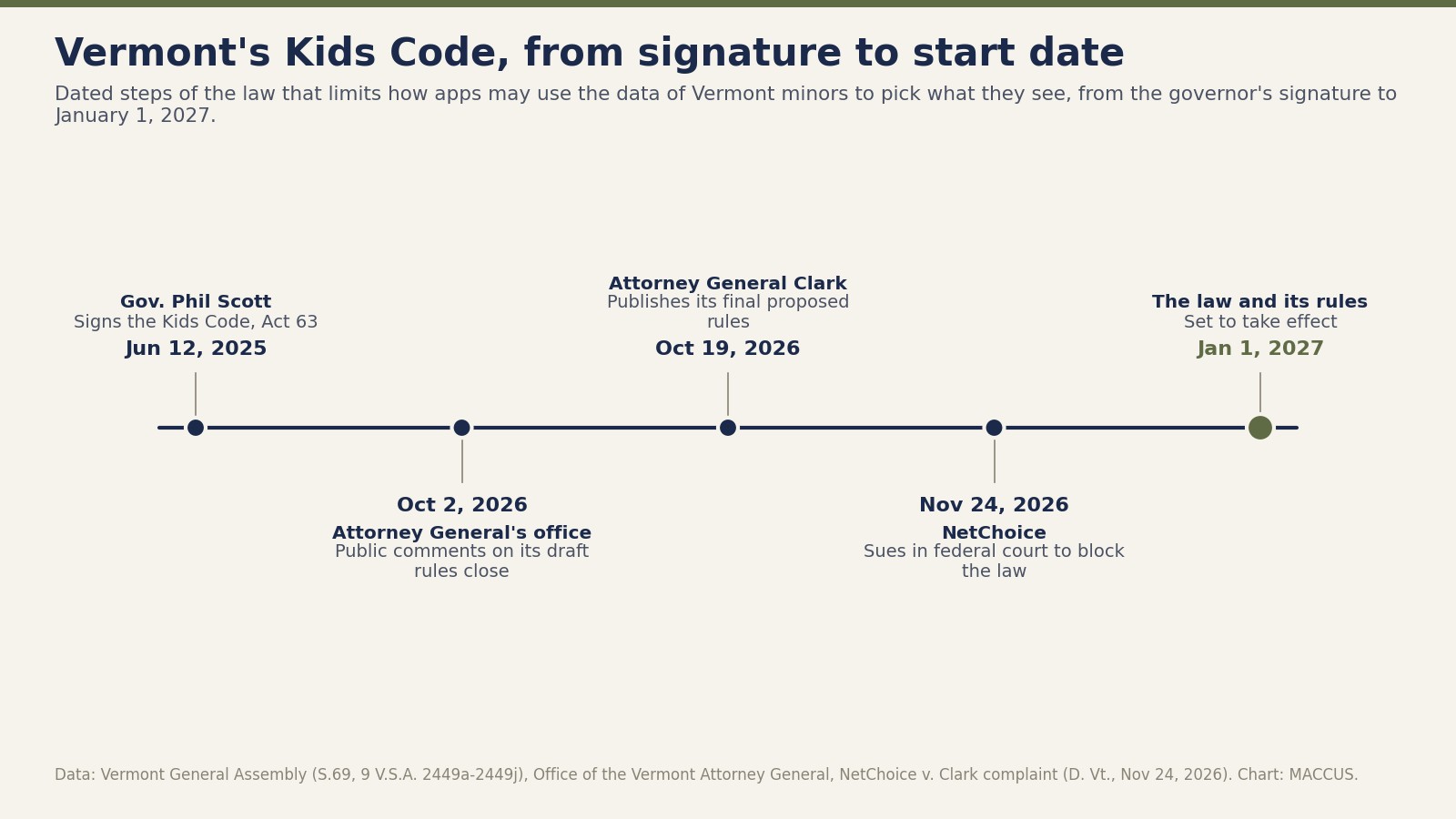
From January 1, 2027, covered apps and websites may no longer use a Vermont minor’s personal data to choose, recommend or rank the videos and posts that minor sees. The rule applies when a company knows the user is under 18. It is part of the Age-Appropriate Design Code, a state law known as the Kids Code, which Gov. Phil Scott signed on June 12, 2025. Teenagers keep their accounts.
Under section 2449f of the law, an app may act on a minor’s “express and unambiguous request.” The minor can ask to follow an account, to get a category such as “cat videos” or “breaking news,” or to see more or less of something. The app may also use the privacy or accessibility settings the minor picked, and it may use a search the minor typed for that search only.
On November 24, 2026, NetChoice, a trade group for online companies, sued in federal court to stop the state from enforcing the law. Its members include Google, Meta, Snap, TikTok and YouTube. No judge had ruled by November 26.
Other changes on January 1
Beyond the feed rule, companies must set a minor’s privacy settings to the highest level by default. On social media, a minor’s account and posts stay hidden from users the platform knows are adults. Those adults cannot comment or send direct messages unless the minor allows a specific person to.
The minor’s location stays hidden, and profiles stay out of search engines. No single switch may lower all the settings at once. Push notifications start switched off, and the law bans sending them to minors between midnight and 6 a.m.
Apps may collect only the data needed for the service the minor is actively using. They may not reuse it for another purpose. A request to delete or unpublish a social media account must be honored within 15 days. If a parent or anyone else monitors a minor’s activity or location through the service, the minor must get a clear signal that it is happening.
Companies must also explain publicly what each recommendation system is for and how it uses minors’ data. Data collected to check a user’s age must be deleted immediately after the check, except the age range.
The law also sets a “minimum duty of care.” The way a company uses a minor’s data and designs its service must not result in reasonably foreseeable emotional distress, compulsive use or discrimination. The law defines compulsive use as repeated use that “materially disrupts” major parts of a minor’s life, “including sleeping, eating, learning, reading, concentrating, communicating, or working.” The content a minor watches cannot establish a violation.
In a separate fight over app design, Bloomberg News reported on November 20 that YouTube is close to paying about $3 billion to school districts that accuse its design of hooking students.
Which apps and which kids
A company is covered only if it does business in Vermont, earns most of its annual revenue from online services and collects users’ personal data. Its service must also be “reasonably likely to be accessed” by minors.
A service meets that test if COPPA, the federal children’s privacy law, counts it as aimed at children. The test is also met if at least 2 percent of its audience is between 2 and 17 years old. The law excludes news organizations, government bodies and banks, along with health data covered by federal privacy rules.
Coverage does not depend on the type of app. A video platform, a game or an AI chat service is covered if it meets those tests. A Gallup survey in 16 countries found that half of the young people who use AI daily have used it as a friend.
The protections apply to Vermont residents under 18 who a company “actually knows” is a minor. They also cover users a company labels as minors with age-check methods set by the state attorney general. The law tells the attorney general to “prioritize user privacy and accessibility over the accuracy” of those methods.
The law firm Mayer Brown wrote in a client note on November 25 that the attorney general’s age-check rule requires age checks only where reasonably necessary. A company can skip collecting data for them if it treats every user as a minor, the firm added.
The attorney general’s rules
The feed rule is written in the statute that Vermont’s Legislature passed, and it covers any use of a minor’s personal data to pick media, whatever the feed is designed to do. Since July 1, 2025, the law has also required Attorney General Charity Clark to write rules by January 1, 2027. They cover age checks and design practices that lead to compulsive use.
Her office took public comments until October 2, 2026, and held three hearings. On October 19, it published revised rules, which its rulemaking page labels “final proposed rules.” Mayer Brown says they have been adopted and take effect with the law.
On feeds, the attorney general’s design rule goes further than the statute. According to Mayer Brown, it also bars the use of a minor’s “behavioral data” and “inferred preferences” to rank or order media. Behavioral data, the firm says, includes “clicks, scrolls, dwell time, viewing history, and navigation patterns.” The law’s three exceptions still apply: what the minor asks for, the privacy or accessibility settings they chose and their searches.
Other design features are judged case by case. Autoplay, endless feeds, streaks and notifications are not banned outright, Mayer Brown writes. They break the rules only when used in a way that leads to compulsive use or impairs a minor’s choices. Answering public comments, the attorney general’s office refused to exempt autoplay as a category.
The tech industry’s lawsuit
In its complaint, NetChoice names 16 members it says are directly subject to the law, among them Amazon, Netflix, Reddit and X. It asks the U.S. District Court for the District of Vermont to declare the law unlawful and to bar the attorney general from enforcing it against those members.
Its main argument is the First Amendment. The complaint says the law restricts “how websites curate, disseminate, and publish speech.” Citing a 2024 Supreme Court opinion, it argues that the First Amendment protects the “selection and ranking” of content “based on a user’s expressed interests and past activities.”
NetChoice also calls terms such as “compulsive use” and “emotional distress” too vague. It says age checks would push companies to collect sensitive data from all users, and that the law “seizes the role of parents.”
“Vermont’s confusing law may seek to protect minors, but it would actively prevent websites from using information to remove underage accounts and improve protections for minors,” Paul Taske, who directs the NetChoice Litigation Center, said in the group’s statement. NetChoice says courts have stopped “a nearly identical speech code in California” and similar laws in Texas, Arkansas, Utah and Louisiana.
The law began as S.69, a bill led by Sen. Wendy Harrison. Its backers expected the challenge. Seventeen Vermont lawmakers, among them Rep. Monique Priestley, wrote a June 2025 commentary on VTDigger, a Vermont news site. They said they had “removed any provision that regulated speech and focused only on product design and data processing.”
Limits of the law
The Kids Code is not in force yet, and a court could still pause it before January 1. As of November 26, NetChoice’s case page listed the complaint but no motion, hearing or ruling.
The law does not ban minors from any app or require companies to block any video or category. Only the attorney general can enforce the law, and families have no right to sue under it, Mayer Brown notes.
The protections apply only in Vermont, and only to minors a company knows are under 18 or identifies through age checks. New York took a different route: on the day NetChoice sued, Gov. Kathy Hochul signed a five-year ban on toys with built-in AI chatbots.
What it means
A covered app may still show a Vermont teenager videos and posts, but it may not use the teen’s personal data to choose them. Under the rules, that also goes for their clicks and viewing time. The exceptions are the teen’s own requests and searches, and the privacy or accessibility settings they picked.
A court ruling could still keep that from starting on time. NetChoice argues that ranking a feed is protected speech, and it points to the California rulings. The law’s backers say they wrote a law about data and design. The statute also says no company has to block any media.
The first thing to watch is whether NetChoice asks for a preliminary injunction, a court order that would pause the law while the case goes on. NetChoice’s case page did not list such a request by November 26. The other date is January 1, 2027, when the attorney general can begin enforcing the law. Mayer Brown wrote that her early enforcement will be important to watch.
Sources
- 9 V.S.A. chapter 62, subchapter 6: Vermont Age-Appropriate Design Code Act, Vermont General Assembly, read November 26, 2026
- S.69 (Act 63): An act relating to an age-appropriate design code, Vermont General Assembly, June 12, 2025
- Vermont Age-Appropriate Design Code Rulemaking, Office of the Vermont Attorney General, read November 26, 2026
- NetChoice v. Clark, Complaint for Declaratory and Injunctive Relief, U.S. District Court for the District of Vermont, November 24, 2026
- NetChoice Sues to Stop the Censorship Implemented in the Vermont Speech Code, NetChoice, November 24, 2026
- NetChoice v. Clark (Vermont), NetChoice, November 24, 2026
- Vermont’s Final AADC Rules: What Changes on January 1, 2027, Mayer Brown, November 25, 2026
- Vermont state legislators: Big Tech doesn’t want you to know what’s happening to your kids online. We do., VTDigger, June 1, 2025